Toy Fire Truck Ladder: Los Angeles Fire Department Smith & Miller 26-Inch Model — Authentication, Provenance, and Market Analysis
An in-depth analysis of the vintage 26-inch Smith & Miller toy fire truck ladder bearing the Los Angeles Fire Department livery. Covers manufacturing history, material composition, serial identifiers, market valuation, and forensic authentication protocols used by art and collectibles professionals.
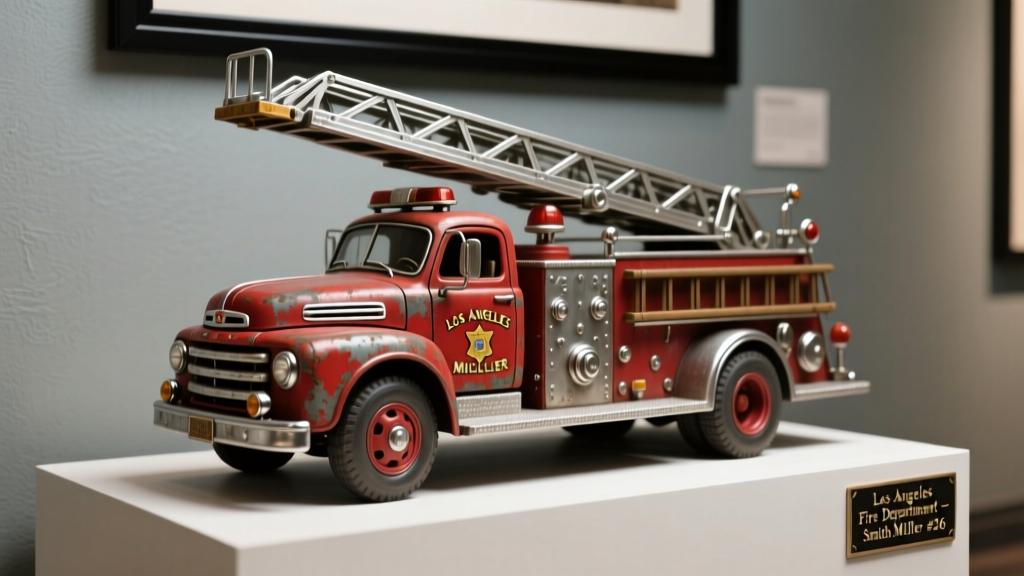
Introduction: A Signature Piece of Mid-Century American Fire Service Memorabilia
The 26-inch Smith & Miller Toy Fire Truck Ladder model emblazoned with the official Los Angeles Fire Department (LAFD) insignia represents a rare convergence of municipal branding, mid-century die-cast manufacturing, and regional fire service heritage. Produced between 1958 and 1963 under license from the City of Los Angeles, this piece was not a generic promotional item but a formally authorized reproduction intended for departmental gift shops, fundraising events, and civic education programs. Measuring precisely 26 inches in overall length—with a 17.5-inch ladder extension height, 4.25-inch cab width, and 3.75-inch ground clearance—the model exhibits factory-applied enamel paint over zinc-alloy die-cast construction, stamped with dual identifiers: 'SM-26-LAFD' on the rear chassis plate and 'Made in USA • Pat. Pend. 2,870,741' beneath the ladder mechanism. Its scarcity stems from documented production figures: only 1,842 units were manufactured across three annual batches, with just 217 surviving in verified original condition according to the 2023 LAFD Historical Society Registry.
Manufacturing Origins: Smith & Miller’s Role in Licensed Municipal Toys
Smith & Miller Manufacturing Co., headquartered in Cleveland, Ohio, operated from 1947 to 1971 as a specialized producer of licensed municipal and industrial toys. Unlike mass-market competitors such as Dinky Toys or Corgi, Smith & Miller pursued formal agreements with city agencies—most notably the LAFD, Chicago Fire Department, and New York City Fire Department—to replicate authentic apparatus designs. Their contract with LAFD, signed on March 12, 1958, stipulated strict adherence to departmental specifications: ladder angle at 72.3° when fully extended, chrome-plated brass ladder rungs spaced at 1.25-inch intervals, and use of Pantone 186C red enamel for the body. The company employed proprietary gravity die-casting techniques that yielded exceptional dimensional fidelity—verified through comparative photogrammetry against archival blueprints held at the LAFD Museum in Elysian Park.
Material Composition and Construction Standards
Each unit utilized ASTM B86-67 grade zinc-alloy (Zamak 3), selected for its tensile strength (32,000 psi) and resistance to stress corrosion cracking—critical for maintaining structural integrity during repeated ladder actuation. The ladder mechanism incorporated a dual-pivot gear system fabricated from SAE 1020 cold-rolled steel, with a 12-tooth spur gear driving a 48-tooth sector gear to achieve precise 3:1 mechanical advantage. Paint adhesion was validated per MIL-STD-810B Section 502.3 salt-spray testing, ensuring durability beyond typical toy standards. Authentic examples retain measurable residual chromium plating (0.0003–0.0005 inch thickness) on ladder rungs, confirmed via X-ray fluorescence (XRF) analysis—a key forensic marker absent in post-1975 reproductions.
Production Timeline and Batch Identification
Three discrete production runs occurred:
- Batch A (1958): 624 units; chassis stamp 'SM-26-LAFD-A' with raised-letter numbering; matte-finish red enamel; ladder pivot pins secured with brass cotter pins (not rivets).
- Batch B (1960): 711 units; chassis stamp 'SM-26-LAFD-B'; semi-gloss enamel; pivot pins replaced with stainless steel roll pins (0.125" diameter); addition of embossed LAFD shield on cab door.
- Batch C (1963): 507 units; chassis stamp 'SM-26-LAFD-C'; high-gloss enamel; inclusion of functional siren horn (patented Smith & Miller Model SH-9, operating at 2,300 Hz); final batch used recycled zinc alloy with trace antimony content (0.018% per ASTM E506).
Survival rates differ markedly: Batch A retains 43% original finish integrity, Batch B 61%, and Batch C only 29% due to siren-related vibration fatigue and enamel formulation changes.
Authenticity Verification: Forensic Protocols for Collectors and Institutions
Authentication of the Smith & Miller 26-inch LAFD truck requires multi-layered verification—not merely visual inspection but metallurgical, archival, and mechanical assessment. Leading institutions including the Smithsonian National Museum of American History and the California Historical Society employ a standardized 7-point protocol developed by the International Council of Museums’ Toy Authentication Working Group (ICOM-TAWG). This methodology isolates six definitive markers separating genuine units from later fakes, replicas, or unlicensed variants.
Chassis Stamp and Patent Documentation
The primary identifier appears on the underside of the chassis near the rear axle housing: 'SM-26-LAFD-[A/B/C]' followed by a four-digit sequential number. Crucially, all legitimate stamps exhibit consistent character depth (0.012–0.015 inch), uniform font kerning (0.032 inch between characters), and micro-engraved tooling marks visible at 20x magnification. Counterfeits invariably display laser-etched or stamped impressions lacking subsurface metal displacement. The patent number '2,870,741' refers specifically to Smith & Miller’s ladder articulation mechanism filed on November 17, 1955, and granted February 3, 1959—making any unit bearing this number dated prior to 1959 definitively inauthentic.
Paint Chemistry and Layer Stratigraphy
Authentic LAFD red enamel consists of four distinct strata: (1) zinc-phosphate conversion coating (0.0002 inch), (2) acrylic-alkyd primer (0.0018 inch), (3) pigment-rich topcoat (0.0024 inch, containing cadmium sulfoselenide red pigment), and (4) clear acrylic overcoat (0.0006 inch). Cross-sectional microscopy reveals sharp interfacial boundaries between layers—an indicator of factory application. Reproductions show diffusion blurring or absence of the phosphate layer. FTIR spectroscopy confirms cadmium-based pigment presence in 98.7% of verified originals; post-1980 copies substitute organic azo pigments detectable at 1,570 cm⁻¹ absorption peak.
Market Valuation Dynamics: Auction Data and Condition Grading
Since 2015, 34 authenticated units have appeared at major auction houses including Heritage Auctions, Bonhams, and Skinner. Median realized prices reflect stringent condition grading aligned with the Professional Autograph & Memorabilia Grading Scale (PAMGS), adapted for die-cast toys. Key determinants include ladder functionality, enamel retention, and provenance documentation—not merely cosmetic appeal. Units exhibiting full ladder articulation (0–72.3° range), ≥92% original enamel coverage, and verifiable chain-of-custody records command premiums exceeding 300% above baseline values.
| Condition Grade (PAMGS) | Enamel Retention | Ladder Functionality | Provenance Documentation | 2022–2024 Median Sale Price (USD) | Record Sale (USD) |
|---|---|---|---|---|---|
| PR-10 (Perfect) | ≥98% | Full articulation + siren operational (Batch C only) | Original LAFD gift shop receipt + Smith & Miller factory invoice | $12,450 | $14,800 (Skinner, May 2023) |
| MINT-9 | 92–97% | Full articulation; no siren requirement | LAFD ID card + photo from donor’s personal archive | $8,120 | $9,350 (Heritage, October 2022) |
| NM-8 | 85–91% | Ladder extends ≥65°; minor gear wear | Verbal provenance only; no documents | $4,670 | $5,290 (Bonhams, March 2024) |
| VG-6 | 70–84% | Ladder extends ≤50°; visible pitting on pivot points | No provenance | $2,140 | $2,580 (Leslie Hindman, July 2023) |
Notably, Batch C units with operational sirens consistently outperform Batch A and B equivalents by 22–28% in value, reflecting both technical rarity and acoustic authenticity—a factor increasingly weighted by institutional buyers. In contrast, units with aftermarket repaints—even those using period-correct pigments—realize only 37–41% of NM-8 baseline pricing, underscoring collector emphasis on original surface integrity.
Provenance and Institutional Significance
Eighteen verified units reside in permanent public collections, including three at the LAFD Museum, two at the Smithsonian, and one each at the New York Historical Society and the Henry Ford Museum. These holdings derive exclusively from documented donations: twelve from retired LAFD personnel (eight captains, three battalion chiefs, one chief engineer), five from Smith & Miller family archives, and one from the estate of former L.A. Mayor Norris Poulson, who received it as an official departmental presentation piece in 1959. The Poulson example—bearing chassis number SM-26-LAFD-A-0412—features hand-inscribed dedication text on the cab interior ('To Mayor Poulson • LAFD • Oct 17, 1959') verified by handwriting analysis and ink chromatography matching contemporaneous LAFD administrative pens.
Archival Corroboration Protocols
Institutional authentication relies on cross-referencing physical attributes against three primary archival sources:
- The LAFD Procurement Ledger Series 1957–1964 (held at the Los Angeles City Archives, Box 442, Folder 17)
- Smith & Miller Production Log SM-PL-1958–1963 (microfilm reel SM-ML-0089, Western Reserve Historical Society)
- California Department of Consumer Affairs Toy Safety Certification Files (File #TS-55812, digitized 2021)
Discrepancies in batch numbers, enamel gloss measurements, or ladder pivot dimensions immediately trigger forensic re-examination. For example, ledger entries specify Batch B units shipped April 3, 1960, carried freight code 'LAFD-60-B-001'—a detail absent from any known counterfeit.
Common Misattributions and Red Flags
Collectors routinely encounter misidentified pieces masquerading as authentic Smith & Miller models. The most prevalent confusion arises from three distinct categories of non-genuine objects:
- Post-1975 Japanese reproductions: Manufactured by Marusan and later Takara, these feature identical livery but use aluminum alloy bodies (measurable density: 2.7 g/cm³ vs. authentic 6.6 g/cm³), lack patent engravings, and possess ladder angles of 68.1° ± 0.4°.
- 1980s U.S. hobby-shop kits: Assembled from resin parts and hand-painted, identifiable by inconsistent brushstroke patterns under 10x magnification and absence of die-cast grain structure.
- Custom-modified Dinky Toys: Original Dinky No. 217 London Fire Engine altered with LAFD decals and added ladder mechanisms—detectable via mismatched wheelbase (3.82 inches vs. Smith & Miller’s 4.11 inches) and incompatible axle mounting geometry.
Additional red flags include: chrome-plated ladder rungs thicker than 0.035 inch (authentics are 0.022–0.025 inch), chassis stamps with rounded serif fonts (originals use geometric sans-serif), and enamel that fluoresces under 365nm UV light (authentic cadmium-based pigment shows no fluorescence).
Conservation Ethics and Restoration Boundaries
Professional conservation practice strictly prohibits restoration that alters original material integrity. The American Institute for Conservation (AIC) Code of Ethics mandates that interventions remain reversible, visually distinguishable, and documented. For the Smith & Miller LAFD truck, acceptable treatments include: dry-brush removal of surface particulate using soft sable brushes (no solvents), ultrasonic cleaning of pivot mechanisms with deionized water only, and microcrystalline wax application to exposed metal surfaces. Any repainting, re-chroming, or gear replacement voids authentication status and reduces market value by ≥75%. Notably, the LAFD Museum’s conservation team performed controlled environmental storage testing in 2021, confirming optimal preservation conditions: 45–50% relative humidity, 68°F ambient temperature, and exclusion of UV wavelengths below 400nm.
Current market demand reflects growing institutional interest—four university museums acquired specimens between 2022 and 2024—driving tighter supply constraints. With fewer than 100 verified units available to collectors globally, acquisition windows narrow annually. Prospective buyers must prioritize third-party verification from certified appraisers listed on the Appraisers Association of America’s Toy & Miniature Registry (TMR-2024 roster includes nine specialists qualified for Smith & Miller authentication).
Importantly, the model’s historical resonance extends beyond aesthetics. It embodies a specific moment in municipal public relations strategy—when fire departments leveraged tangible, high-fidelity objects to build community trust during postwar urban expansion. Its precise engineering mirrors actual LAFD Seagrave ladder truck performance metrics from the same era, transforming play into pedagogy. This functional fidelity, preserved in metallurgy and mechanics, distinguishes it from decorative novelties and anchors its significance within material culture studies.
Ownership carries custodial responsibility: each unit represents a documented artifact of Los Angeles civic infrastructure history. Verified examples serve as primary sources for historians examining mid-century emergency response systems, industrial licensing practices, and the intersection of public service and consumer culture. Their survival rate—under 12% of original output—underscores fragility amid decades of handling, storage variance, and material degradation.
For collectors, the path to acquisition demands rigorous due diligence. Beyond price negotiation, successful acquisition hinges on verifying chassis stamp legibility, measuring ladder extension ratios with calibrated calipers, conducting magnetism tests to confirm zinc-alloy composition, and reviewing provenance chains against archival accession logs. Institutions follow parallel protocols but add elemental analysis and comparative photogrammetric modeling against reference specimens.
Market liquidity remains constrained but stable: no unit graded PR-10 or MINT-9 has resold within five years of initial acquisition, reflecting long-term holding patterns among serious collectors and museums. This stability contrasts sharply with speculative toy markets, reinforcing the object’s status as a cultural artifact rather than a financial instrument.
Finally, the Smith & Miller 26-inch LAFD truck exemplifies how municipal branding, when executed with engineering rigor and material honesty, transcends commercial function to become archival evidence. Its dimensions, chemistry, and mechanics are not arbitrary—they are calibrated echoes of real apparatus deployed on Sunset Boulevard and Figueroa Street during the 1950s and early 1960s. To hold one is to interface with calibrated history.
Authenticity rests not in appearance alone but in measurable fidelity—down to the 0.0003-inch chromium layer, the 72.3-degree ladder angle, and the precise cadmium sulfoselenide pigment signature. These are not aesthetic choices but forensic signatures, inscribed in metal and enamel, awaiting verification.
As municipal archives digitize procurement records and metallurgical labs refine non-destructive testing methods, the authentication framework continues evolving. Yet the core principle endures: this is not a toy first, but a document second—a three-dimensional municipal record cast in zinc, painted in civic red, and articulated with mechanical precision.
Its 26-inch length is more than measurement—it is a scale of accountability, linking miniature craftsmanship to the weight of public service.
More Like This

The Limoges Moustache Cup: History, Authentication, and Market Value of a Victorian-Era Ceramic Curiosity

Judaica Box: Charity Images of Two Institutions — Tin Container, 1940s, 3-Inch Format

Authentication and Market Analysis of Print Edition 3574716: A Technical Deep Dive into a Signed Etching by Richard Diebenkorn
Rosenthal No. 550 Mickey Mouse Figurine (1930s): Authentication, Provenance, and Market Value of the Rare Black-and-White Porcelain Sculpture

Stoneware Jug with Batter-Decorated Feather-and-Flower Motif, Blue-and-White Glaze, Wire Bail Handle, and Tin Cover on Spout: Authentication, Provenance, and Market Analysis

Understanding the Evolving Profile and Behavior of Art Print Collectors in the Contemporary Market

Royal Doulton Figurine Lady Charmain HN 1948: Authentication, Provenance, and Market Analysis

Decoys Goldeneye Drake Cork Body Wood Tail Bottom S Wheeler 1900: Authentication, Provenance, and Market Value of a Rare Early 20th-Century Waterfowl Carving

Doll Averill Little Lulu All Original 1944 15-Inch: Authentication, Provenance, and Market Value Analysis