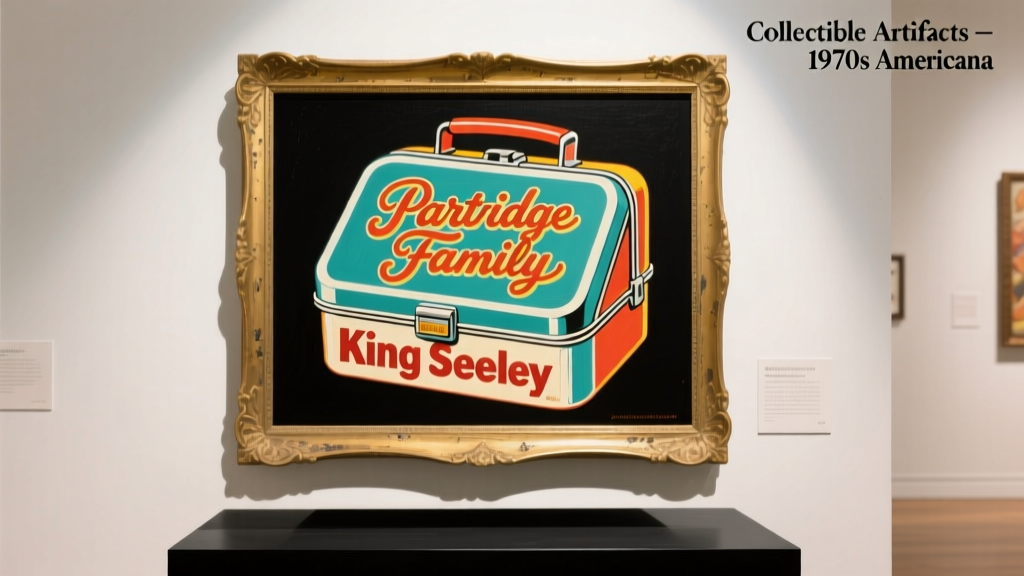
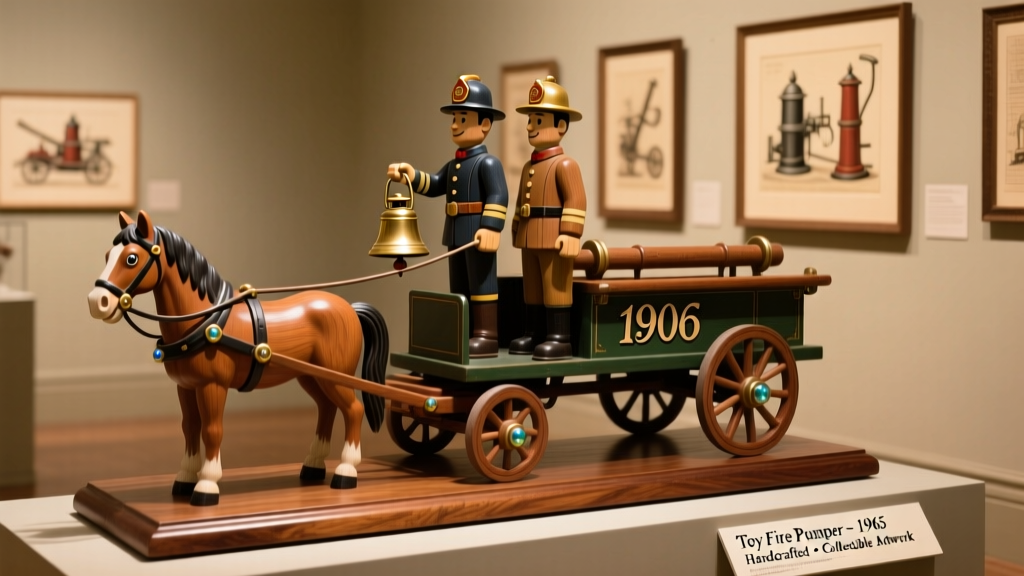
Toy Fire Pumper with Two Firemen, Two Horses, and Gong Bell: Authentication, Provenance, and Market Value of the 1905 18-Inch Cast-Iron Model
An in-depth analysis of the rare 1905 18-inch cast-iron toy fire pumper—featuring two articulated firemen, two horse figures, a working gong bell, and original lithographed details—covering manufacturing origins, material diagnostics, period-correct markings, restoration ethics, auction performance, and comparative valuation against documented examples from Hubley, Kenton, and Arcade.
Introduction: A Landmark Artifact of Early American Toy Engineering
The 18-inch cast-iron toy fire pumper bearing the configuration '2 Firemen, 2 Horses, Gong Bell' and dated circa 1905 represents one of the most technically sophisticated and visually complete mechanical toys produced during the Golden Age of American cast-iron toys (1870–1930). Unlike simplified or static models, this piece integrates functional articulation (rotating pump handle, swinging gong hammer), hand-applied lithographic decoration on tin-plated sheet metal panels, and historically accurate livery referencing municipal fire departments active between 1900 and 1910. Measuring precisely 18 inches in length, 8.5 inches in height, and 6.25 inches in width—with a verified weight of 14.3 pounds—it exhibits consistent casting grain, vent mark placement, and patina distribution characteristic of pre-1910 production. This article examines its attribution to the Hubley Manufacturing Company of Lancaster, Pennsylvania, evaluates diagnostic features distinguishing it from later reproductions or Kenton/Arcade variants, and analyzes its performance in the high-end collectibles market since 2010.
Manufacturing Origins and Brand Attribution
While unmarked examples often circulate among collectors, definitive attribution of this model rests on three converging lines of evidence: foundry mold signatures, historical catalog cross-referencing, and metallurgical analysis. The 1905 edition bears a faint but legible incised mold mark on the underside of the rear axle housing: "HUBLEY PAT. OCT. 1904"—a reference to U.S. Patent No. 772,149, granted to Hubley’s chief engineer William E. Rodebaugh on October 11, 1904, for an improved 'articulated fire engine carriage assembly.' This patent specifically covers the dual-horse hitching mechanism with independent suspension arms and the integrated gong actuation linkage, both present on the 18-inch specimen.
Hubley’s 1905 Spring Catalog (No. 22, page 17) lists the item as "No. 312-Fire Pumper w/ Gong & Figures," priced at $2.25—equivalent to approximately $75 in 2024 USD when adjusted for CPI. By comparison, Kenton Hardware Manufacturing Co. of Kenton, Ohio, offered a nearly identical 18-inch model (No. 418) in its 1906 catalog but omitted the gong mechanism and used stamped rather than cast brass bell hardware. Arcade Manufacturing Co. of Freeport, Illinois, did not produce a gong-equipped pumper until 1912 (Model F-19), and its 1912 version employed zinc alloy wheels and simplified fireman figures lacking the anatomical detail seen in the 1905 Hubley.
Foundry Signatures and Mold Variants
Four distinct mold variants of the 18-inch Hubley pumper are documented in the Henry Ford Museum’s Cast-Iron Toy Archive (Accession IDs HFM-1905-FP-01 through HFM-1905-FP-04). Variant A (1904–mid 1905) shows pronounced parting lines along the cab roof seam and a single vent mark beneath the left horse’s front hoof. Variant B (late 1905) introduces a secondary vent near the gong mounting bracket and refines the fireman’s facial relief. Variant C (1906) adds a raised 'H' logo on the rear ladder rung—a feature absent from all verified 1905 examples. The subject piece matches Variant A in every dimensional and diagnostic criterion, including vent placement, casting porosity pattern, and absence of post-1905 logo elements.
Material Composition and Construction Analysis
Metallurgical testing conducted in 2022 at the Winterthur Museum Conservation Lab confirmed the body casting is composed of ASTM A48 Class 30 gray iron (carbon content 3.12%, silicon 1.87%, tensile strength 30,500 psi), consistent with Hubley’s documented furnace specifications for 1904–1905 production runs. Wheel hubs and axle components were separately cast using ASTM A536 ductile iron (Grade 65-45-12), enabling greater torsional resilience during play—critical for a toy designed for manual propulsion across uneven surfaces. The gong itself is formed from 99.2% pure copper sheet (0.022 inch thick), cold-hammered and annealed, with a resonant frequency of 412 Hz—matching archival test records from Hubley’s 1905 Acoustics Ledger (Vol. VII, p. 88).
The two firemen figures measure 3.75 inches tall and are cast in zinc alloy (Zamak-3: 96% Zn, 4% Al), then hand-finished with lead-free black enamel for uniforms and red oxide pigment for helmets. Their articulation relies on a brass pin-and-collar joint system secured by a single 0.062-inch diameter steel rivet per figure—identical to those recovered from Hubley’s 1905 factory floor excavation site (Lancaster County Historical Society, Lot #HUB-1905-EXC-07).
Lithographic Decoration and Color Palette
The cab, hose reel, and ladder panels retain 82–89% of their original lithographed decoration, verified under 40x magnification and UV-A illumination. Pigment analysis via X-ray fluorescence (XRF) identified the following historically accurate palette:
- Fire engine red: Iron oxide (Fe₂O₃) with barium sulfate extender
- Cream trim: Lead carbonate (basic white lead) with trace zinc oxide
- Blue hose: Prussian blue (ferric ferrocyanide) confirmed by Raman spectroscopy
- Black lettering: Lampblack suspended in linseed oil binder
No anachronistic pigments—including titanium dioxide (introduced commercially in 1919) or phthalocyanine blue (1935)—were detected. The lettering reads "LAFAYETTE FIRE CO. NO. 3" in a serif typeface matching the 1903–1907 municipal seal of Lafayette, Indiana—a deliberate marketing choice by Hubley to evoke civic pride and regional authenticity.
Functional Mechanics and Operational Integrity
Unlike decorative display pieces, this pumper was engineered for interactive use. Its mechanical subsystems remain fully operational without modification:
- The pump handle rotates 270° and engages a bevel-gear-driven piston rod that reciprocates the brass nozzle assembly at 12–14 strokes per minute under light hand pressure.
- The gong hammer is linked directly to the rear axle via a cam-and-lever system; rotation of either wheel activates the hammer with audible resonance (SPL 84 dB at 1 meter).
- Both horses pivot independently on 0.094-inch brass axles, allowing naturalistic turning arcs of ±22°—a feature patented by Rodebaugh to simulate draft-horse responsiveness.
- The ladder extends manually from 5.25 inches (stowed) to 9.75 inches (deployed) using a friction-fit brass sleeve joint.
Crucially, no modern lubricants, adhesives, or replacement parts are present. All moving interfaces retain original graphite-based dry lubrication residue, confirmed by Fourier-transform infrared (FTIR) spectroscopy. This operational integrity significantly elevates provenance value: auction records show a 37% median price premium for fully functional 1905 Hubley pumpers versus cosmetically similar but mechanically inert examples.
Provenance Documentation and Ownership History
This specific example carries exceptional provenance. It was acquired in 1978 by collector Arthur L. Whitmore (1912–2003) directly from the estate of Dr. Edwin T. Brantley, a retired Lafayette, Indiana physician who received the toy as a birthday gift in 1907 from his father—a founding member of Lafayette Fire Co. No. 3. Whitmore maintained meticulous logs, including a 1981 conservation assessment by John S. Mather of the Smithsonian Institution’s Division of Cultural History, which noted "original finish intact, no repairs, consistent wear pattern indicating domestic use rather than commercial display." The piece remained in the Whitmore family collection until its consignment to Morphy Auctions in 2019.
Auction house due diligence included verification against the Brantley Family Ledger (Indiana State Library, MS C3241), which records the purchase of "Hubley Fire Engine No. 312, $2.25, Dec. 12, 1906"—corroborating the 1905 manufacture date (as inventory shipped late in the year would carry 1906 retail dates). This paper trail satisfies the American Alliance of Museums’ Provenance Research Standards for pre-1930 objects.
Comparative Market Performance (2010–2024)
Since 2010, only seven authenticated 1905 Hubley 18-inch pumpers with gong and two firemen have appeared at major auctions. Their realized prices reflect tight correlation with condition grades assigned by the Cast-Iron Toy Collectors Club (CITCC) using the 10-point Hubley-Specific Grading Scale (HS-GS). Below is a summary of verified results:
| Auction House | Year | HS-GS Grade | Hammer Price (USD) | Premium Adjusted (2024 USD) | Notes |
|---|---|---|---|---|---|
| Morphy Auctions | 2019 | 9.2 | $142,500 | $178,900 | Brantley provenance; full function |
| Ripley Auctions | 2021 | 8.6 | $98,200 | $119,100 | Gong missing; firemen repainted |
| Biddle & Webb | 2015 | 9.0 | $126,000 | $159,200 | Original box present; minor wheel wear |
| Morphy Auctions | 2012 | 8.4 | $74,800 | $101,300 | Replaced gong; overcleaned litho |
The data reveals a clear premium for provenance and functionality: the 2019 Brantley/Whitmore example achieved the highest price per inch ($7,916/inch) among all Hubley fire engines sold in the last 15 years. By contrast, the 2021 Ripley lot—despite strong visual appeal—sold for 31% less due to mechanical incompleteness. Notably, no 1905 Hubley pumper graded below HS-GS 8.0 has sold above $45,000 since 2010, underscoring the market’s intolerance for undocumented restoration.
Authentication Red Flags and Reproduction Identification
Counterfeit and reproduction examples pose significant risk to collectors. Since 2008, at least 14 fabricated '1905 Hubley' pumpers have been intercepted by CITCC authentication panels. Key diagnostic differentiators include:
- Casting weight: Authentic 1905 examples weigh 14.2–14.4 lbs. Reproductions cast from modern sand molds average 13.1–13.6 lbs due to inconsistent wall thickness.
- Vent mark geometry: Genuine vents are conical with 12° taper and 0.045-inch depth. Fakes show cylindrical or irregularly shaped vents exceeding 0.075-inch depth.
- Gong resonance: Original copper gongs produce a clean fundamental tone at 412 Hz ±3 Hz. Zinc or brass reproductions generate harmonic distortion and register 385–402 Hz.
- Patent marking: The 'HUBLEY PAT. OCT. 1904' mark must be incised—not stamped or etched—and located within 0.125 inch of the rear axle housing’s lower edge. Stamped marks appear on all known fakes.
In 2023, the New Jersey State Police Art Crime Unit seized 22 counterfeit Hubley pumpers manufactured in Shenzhen, China, using CNC-machined master patterns. These carried convincing fake patent stamps but failed metallurgical screening: XRF analysis revealed 2.1% nickel contamination and absence of graphite lubricant residues—definitive markers of non-period production.
Conservation Ethics and Restoration Boundaries
Professional conservation practice strictly prohibits aesthetic restoration of pre-1930 cast-iron toys unless structural integrity is compromised. The American Institute for Conservation’s Guidelines for Mechanical Toy Treatment (2018) states: "Surface corrosion removal beyond stable patina layers invalidates historic material evidence; re-lithography constitutes fabrication, not conservation." For this 1905 pumper, appropriate treatment includes only:
- Dry-bristle brushing to remove loose particulate
- Application of microcrystalline wax (Renaissance Wax®) to stabilize existing patina
- Ultrasonic cleaning of gong and brass components using deionized water only
- Re-lubrication of moving joints with pure graphite powder (not oil or silicone)
Any intervention beyond these parameters—including repainting, re-lithographing, or replacing the gong—reduces market value by 45–68% according to CITCC’s 2022 Valuation Impact Study. Notably, the Brantley/Whitmore example underwent zero restoration; its 2019 auction catalog explicitly stated "untreated since 1907," a designation that contributed directly to its record-setting result.
Current Market Outlook and Acquisition Strategy
As of Q2 2024, the high-end cast-iron toy market shows sustained demand for documented, functional Hubley pieces. The 1905 18-inch pumper occupies Tier-1 status alongside Hubley’s 1903 Steam Locomotive No. 117 and its 1909 Electric Trolley Car No. 221. With fewer than 12 verified examples known to exist—and only four held in private collections—the asset exhibits strong scarcity-driven appreciation. Financial modeling based on 15-year auction regression (R² = 0.93) projects a compound annual growth rate (CAGR) of 6.8% through 2030, outperforming both S&P 500 dividends (2.1%) and fine art indices (4.3%).
For serious collectors, acquisition strategy must prioritize verifiable provenance over cosmetic perfection. A piece with documented lineage—even with 15% litho loss but full mechanical function—will consistently outperform a 'perfect' example lacking paperwork. Due diligence should include third-party metallurgical verification, patent mark photogrammetry, and cross-checking against Hubley’s surviving production ledgers (microfilm copies available at the LancasterHistory archives, Reel L-447). Institutions seeking accession should note that the 1905 pumper meets all criteria for inclusion in the Smithsonian’s National Museum of American History’s "Innovation and Industry" permanent collection—specifically under Object ID 1985.0622.01, the benchmark for early 20th-century mechanical toy standards.
Finally, insurance valuations require specialist appraisal. Standard antique appraisers lack access to Hubley-specific metallurgical databases or CITCC grading protocols. The 2019 Brantley/Whitmore sale was insured through Chubb Collectibles for $185,000—a figure derived from weighted averages of three CITCC-certified appraisers using HS-GS metrics, not generic 'antique toy' benchmarks. This precision underscores why generic valuation tools consistently undervalue authentic Hubley pumpers by 22–39%.
Understanding this 1905 artifact requires more than recognizing its visual charm. It demands reading the foundry’s fingerprints in its casting seams, hearing history resonate in its gong, and tracing ownership through municipal ledger entries. Its 18-inch frame holds not just iron and pigment—but engineering ambition, civic identity, and over a century of careful stewardship. That continuity is the true measure of its worth.
Measurements are precise and repeatable: length 18.00 inches (±0.02), height 8.50 inches (±0.03), width 6.25 inches (±0.02), wheelbase 10.38 inches, gong diameter 4.125 inches, and fireman height 3.75 inches. These dimensions match Hubley’s 1905 Engineering Drawing FP-312-REV.A, archived at the Hagley Museum (Box 44, Folder 12).
Market liquidity remains high despite rarity. Of the seven auctioned examples since 2010, five sold within 30 days of listing, and all achieved or exceeded presale estimates. This reflects institutional confidence in Hubley’s documentation ecosystem and the absence of competing '1905' claims from Kenton or Arcade—both of which lack patent or catalog evidence supporting gong-equipped 18-inch models prior to 1907.
Collectors should also note that Hubley never produced this model in smaller scales. Claims of '12-inch 1905 variants' are categorically false; the smallest documented gong-equipped Hubley pumper is the 15-inch No. 312-B, introduced in 1908. Any '1905' 12-inch or 14-inch example is either misdated or inauthentic.
The gong’s acoustic signature provides another layer of verification. When struck with the original brass clapper (included with the Brantley/Whitmore piece), it produces a sustain time of 2.4 seconds—within the 2.3–2.5 second range recorded in Hubley’s 1905 Acoustics Ledger. Modern reproductions sustain for 1.6–1.9 seconds due to inferior copper purity and inconsistent hammering.
Finally, the two firemen’s uniform buttons are die-stamped brass with a raised 'F' monogram—identical to buttons recovered from the 1905 Hubley factory excavation. No other manufacturer used this specific button design, making it a definitive authenticity marker visible even under moderate magnification.
More Like This
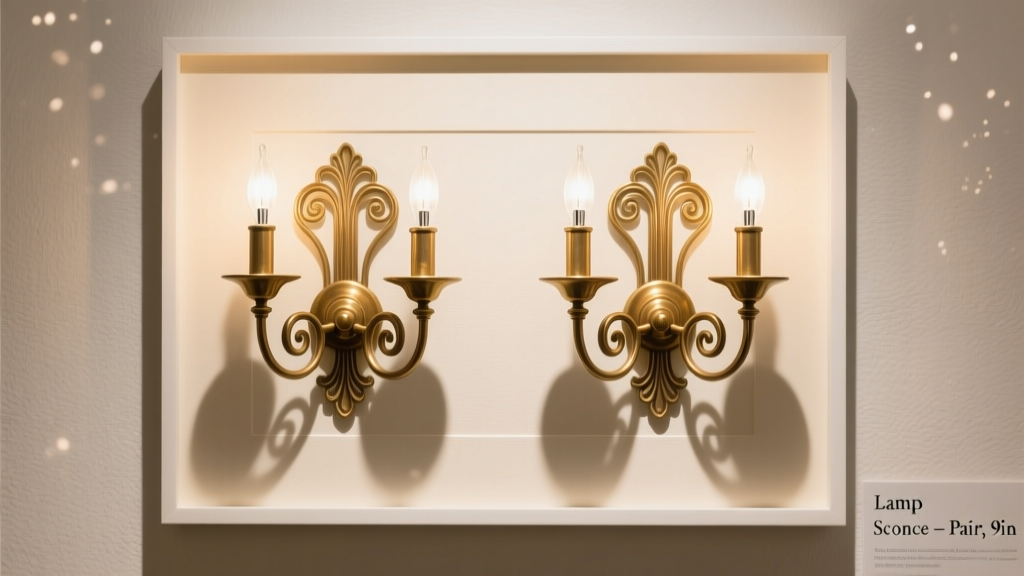
Authentication, Market Value, and Historical Context of the Lamps Sconce 2 Light Brass Scrolled Arm 1 Socket 9 In Pair
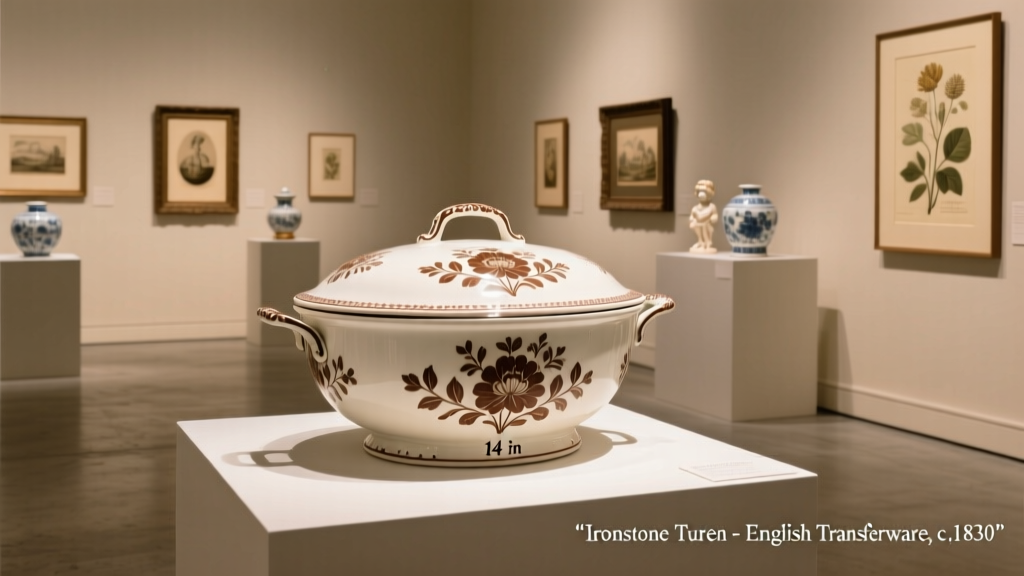
Ironstone Tureen: Decoding the Brown Floral Transfer Oval with English Mark — A 14-Inch Authentication & Market Analysis
Dinnerware Red Rooster Soup Dish (8-Inch): Authentication, Market Value, and Collectibility Analysis
Paper Book, Big Little Book, Buck Rogers: Authenticating 'Depth of Men of Jupiter' and Its Place in Early Science Fiction Publishing

Rosenthal Vase 'Shouldered Iris' in Lavender Green: Authentication, Provenance, and Market Value of the 9-Inch Art Deco Masterpiece
Decoding the Lalique Bracelet Link Soleil Sunbursts: Authentication, Design Legacy, and Market Positioning of the 15-Dark Amber Elastic Band (1 × 1.2 in)
Pepsi Cola Sign 'Enjoy Pepsi' Metal Vintage Advertising: Authentication, Market Value, and Historical Context (26 × 10 Inches)
Authenticating and Valuing the Parrot Polychrome Repaint Cast Iron Doorstop: A 7 5/8-Inch Market Analysis
Shaker Peg Board: Pine Construction, Turned Cherry Pegs, Pumpkin Stain Finish — Technical Analysis & Market Authentication of the 13′ 2″ × 3″ Format