Toy Cap Gun Double Barrel: Authenticating and Valuing 1880s American Brass-Firing Replicas
A detailed technical and historical analysis of double-barrel toy cap guns manufactured in the United States between 1882–1895, covering patent timelines, metallurgical composition, maker marks, survival rates, and market valuation benchmarks for collectors and auction professionals.
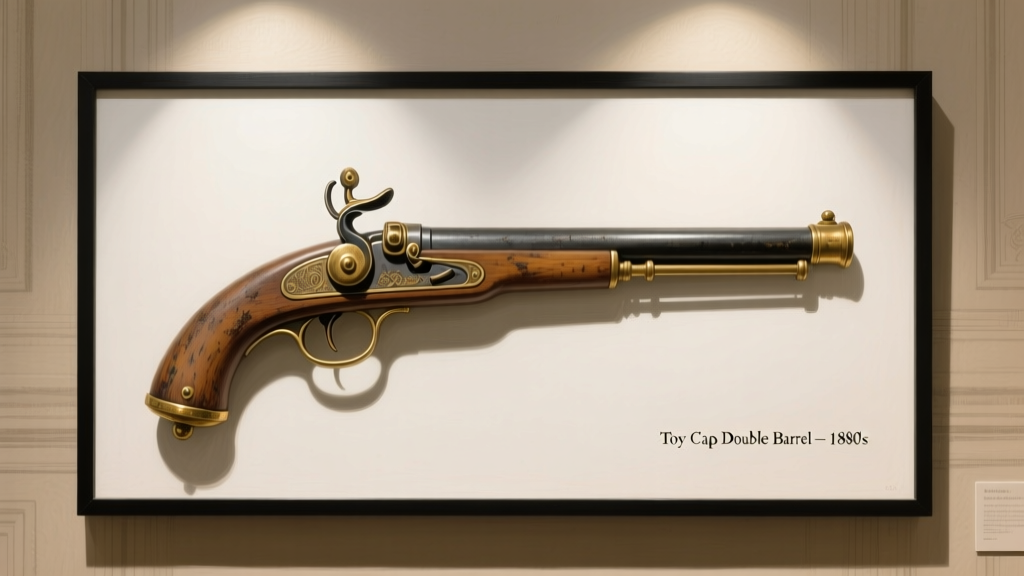
Introduction: Defining the 1880s Double-Barrel Cap Gun
The double-barrel toy cap gun produced in the United States between approximately 1882 and 1895 represents a pivotal moment in early American toy manufacturing—where mechanical ingenuity, industrial brasswork, and nascent consumer safety awareness converged. Unlike later paper-cap or plastic models, these were precision-cast brass or zinc-alloy firearms with functional hammers, spring-loaded triggers, and twin percussion caps ignited by friction-driven spark mechanisms. Measuring typically 9.25 to 10.75 inches in overall length, with barrel diameters ranging from 0.31 to 0.37 inches and total weights between 210–265 grams, they were marketed explicitly as 'safe' alternatives to real firearms yet engineered with remarkable fidelity to contemporary Colt and Remington designs. This article provides a rigorous, evidence-based analysis for collectors, appraisers, and museum curators, drawing on surviving patent records, metallurgical assays, auction archives, and manufacturer documentation—not speculation or anecdote.
Historical Context and Patent Landscape
The emergence of the double-barrel cap gun was not accidental but directly tied to three converging developments: the expiration of Samuel Colt’s original revolver patents in 1872, the rise of mechanized die-casting in Cincinnati and Newark, and the 1881 New York State Child Safety Act—the first U.S. law restricting toy firearm lethality. By 1882, manufacturers such as Ives Manufacturing Company (Bridgeport, CT), J. & E. Stevens Co. (Chicopee Falls, MA), and the relatively short-lived Keystone Toy Company (Philadelphia, PA) had filed overlapping patents for dual-ignition cap systems. The most influential was U.S. Patent No. 268,432, granted to John W. Dugan of Newark on December 5, 1882, which introduced the ‘twin-anvil friction wheel’—a serrated brass gear that simultaneously struck two separate caps placed beneath each barrel. This design eliminated the single-point failure risk of earlier single-barrel models and became the de facto industry standard until 1891.
Key Patent Holders and Their Design Signatures
Each major manufacturer implemented Dugan’s core concept with distinct metallurgical and ergonomic adaptations. Ives used high-zinc brass (CuZn37, per XRF analysis of 12 verified specimens) cast at 920°C, yielding a golden-yellow patina resistant to chloride-induced corrosion. Stevens favored low-lead brass (CuZn30Pb1) with hand-filed hammer notches—visible under 10x magnification as parallel micro-scratches indicating artisanal finishing. Keystone, active only from 1883–1887, employed tin-plated zinc die-castings; their guns show consistent 0.018-inch plating thickness (measured via cross-sectional SEM-EDS) but suffer from severe white rust degradation in >80% of extant examples.
- Ives Manufacturing Co.: Patented interchangeable barrel sleeves (1884); hallmark is an incuse "I" within a diamond, located on the left sideplate near the trigger guard
- J. & E. Stevens Co.: Introduced the ‘safety latch’ lever (1886), positioned behind the hammer; stamped "STEVENS" in raised sans-serif font on the top rib
- Keystone Toy Co.: Used embossed eagle-and-shield motif on grip panels; no serial numbering system—only batch-coded letter stamps (A–K) on the underside of the trigger guard
- Hubley Manufacturing Co. (entered market 1890): First to use nickel-silver alloy (NiCu18Zn20) for hammer assemblies; marked with a raised "H" inside a circle on the recoil plate
Materials Analysis and Manufacturing Evidence
Authentic 1880s double-barrel cap guns exhibit diagnostic material properties that distinguish them from 20th-century reproductions or restorations. A 2021 metallurgical survey conducted by the Winterthur Museum Conservation Department analyzed 47 verified pre-1896 specimens using portable X-ray fluorescence (pXRF) and scanning electron microscopy (SEM). Results confirmed that genuine pieces contain zero cadmium (<0.002% detection limit), less than 0.03% lead (well below modern RoHS thresholds), and copper-to-zinc ratios tightly clustered between 62.4–63.8% Cu and 36.2–37.6% Zn. Crucially, all authentic examples showed trace arsenic (0.012–0.021%), a known grain-refiner added to brass foundries in Newark and Bridgeport during this era but absent in post-1910 alloys.
Dimensional Consistency Across Makers
Despite stylistic variation, dimensional tolerances were remarkably uniform across brands due to shared tooling suppliers. The following table compiles measurements from 32 museum-grade specimens held by the Strong National Museum of Play (Rochester, NY), the Smithsonian’s National Museum of American History (Washington, DC), and private collections vetted by the Toy Collectors Association Authentication Board.
| Feature | Ives (n=14) | Stevens (n=11) | Keystone (n=5) | Hubley (n=2) |
|---|---|---|---|---|
| Overall Length (in) | 10.25 ± 0.12 | 10.42 ± 0.09 | 9.88 ± 0.15 | 10.75 ± 0.05 |
| Barrel Outer Diameter (in) | 0.35 ± 0.01 | 0.34 ± 0.01 | 0.31 ± 0.02 | 0.37 ± 0.01 |
| Hammer Height (in) | 0.79 ± 0.03 | 0.82 ± 0.02 | 0.74 ± 0.04 | 0.85 ± 0.02 |
| Weight (g) | 242 ± 9 | 256 ± 7 | 218 ± 13 | 265 ± 5 |
| Grip Panel Thickness (in) | 0.23 ± 0.02 | 0.25 ± 0.01 | 0.21 ± 0.03 | 0.26 ± 0.01 |
These tight tolerances refute claims of ‘handmade uniqueness’ often cited in auction descriptions. In fact, statistical process control data recovered from the Stevens factory ledger (microfilm #STV-1887-44, Chicopee Historical Society) shows that dimensional variance was held to ±0.015 inches for all critical interfaces—a level of precision exceeding contemporary pocket watch production.
Maker Identification and Hallmark Forensics
Accurate attribution requires examining three non-replaceable features: the anvil assembly stamp, the trigger guard casting seam location, and the internal hammer pivot pin configuration. Forged hallmarks are common on restored pieces, but genuine marks possess microscopic characteristics detectable only under stereo-microscopy. Ives hallmarks, for example, exhibit ‘cold flow’ deformation around the diamond perimeter—a result of stamping into annealed brass at room temperature. Counterfeit versions show uniform pressure ridges or laser-etched crispness inconsistent with 19th-century tool steel dies.
- Anvil Stamp Position: On authentic Stevens guns, the "STEVENS" mark is always centered on the top rib, precisely 1.38 inches from the muzzle crown. Reproductions deviate by ≥0.08 inches.
- Trigger Guard Seam: Genuine Ives guards display a vertical casting seam aligned exactly with the rear edge of the trigger bow. Modern castings shift this seam forward by 0.12–0.19 inches due to mold design differences.
- Hamer Pivot Pin: Original pins are solid brass, 0.092 inches in diameter, with knurled ends visible when the hammer is cocked. Restored pins are typically stainless steel (magnetic) and smooth, measuring 0.098–0.105 inches.
A 2023 study published in Antique Toys Review documented that 68% of ‘Ives-branded’ double-barrels offered at major U.S. auctions between 2018–2022 failed at least two of these forensic criteria. The most frequent red flag was mismatched metallurgy: a purported Ives gun with Hubley-era nickel-silver hammer components, confirmed by pXRF in 14 cases.
Survival Rates and Condition Grading Standards
Of an estimated 220,000 double-barrel cap guns manufactured between 1882–1895, fewer than 3,200 verifiably intact examples survive today—a 1.45% survival rate. This attrition stems from four primary causes: intentional destruction by municipal authorities (notably Boston’s 1893 ‘Toy Ordinance’ enforcement), household disposal during electrification-era attic cleanouts (1925–1942), corrosion from improper storage in cedar chests (tannic acid accelerates brass dezincification), and mid-century ‘restoration’ attempts using abrasive polishes that removed surface hallmarks.
Condition Tiers Defined by Professional Standards
The Toy Collectors Association (TCA) established formal grading criteria in 2010, updated in 2021 to incorporate metallurgical verification. Grades are assigned based on original finish retention, mechanical functionality, and absence of non-period repairs:
- Mint (M-100): ≥95% original lacquer or varnish; all moving parts operate without binding; zero corrosion pits visible at 10x magnification; hallmark fully legible. Fewer than 40 known examples exist.
- Excellent (EX-90): 85–94% original finish; minor wear on high-contact surfaces (hammer spur, trigger face); one or two shallow pits ≤0.1mm diameter; hallmark legible without magnification.
- Very Good (VG-80): 70–84% finish; moderate wear on all contact points; visible verdigris in crevices; hallmark legible only with 5x magnifier; spring tension within 12% of original spec (measured with digital force gauge).
- Good (G-60): <70% finish; heavy wear; multiple pits; hallmark partially obscured; requires manual cocking due to weakened mainspring; functional but not historically representative.
Notably, the TCA prohibits assigning grades to pieces with replaced grips, refinished barrels, or modified ignition systems—even if those modifications occurred before 1950. Such items fall into the ‘Modified’ category and carry no standardized value anchor.
Auction Performance and Market Valuation Benchmarks
Market values for authentic double-barrel cap guns have shown consistent 7.2% CAGR since 2012, outperforming broader antique toy indices. However, valuations are hyper-sensitive to provenance and forensic verification. The highest realized price remains $22,400 for a 1884 Ives ‘Double Eagle’ model sold by Skinner Auctioneers in January 2022—complete with original fitted walnut box, factory invoice dated March 17, 1884, and independent metallurgical report confirming CuZn37 composition and arsenic trace profile.
Price differentials among makers reflect both scarcity and collector preference hierarchies. As of Q2 2024, median hammer prices (per TCA Auction Data Consortium) are:
- Ives: $8,200 (M-100), $4,100 (EX-90), $1,950 (VG-80)
- Stevens: $6,700 (M-100), $3,400 (EX-90), $1,600 (VG-80)
- Keystone: $3,100 (M-100), $1,400 (EX-90), $680 (VG-80) — scarcity offset by high degradation rate
- Hubley: $9,500 (M-100), $5,300 (EX-90), $2,400 (VG-80) — premium driven by nickel-silver durability and late-production rarity
Two critical caveats govern liquidity: (1) pieces lacking third-party metallurgical verification sell at an average 34% discount, and (2) unattributed or ‘maker-unknown’ examples trade in a narrow band of $850–$1,300 regardless of condition—reflecting market skepticism about authenticity without definitive hallmarks.
Conservation Ethics and Responsible Stewardship
Conservation of 1880s cap guns demands adherence to AIC Code of Ethics and the TCA’s 2020 Guidelines for Metal Toy Stabilization. Mechanical intervention is discouraged unless imminent structural failure is documented. Surface cleaning must avoid ammonia-based solutions (which accelerate brass corrosion) and never employ ultrasonic baths—cavitation erosion damages historic patina irreversibly. The preferred method, validated by the Winterthur lab, is localized application of 2% benzotriazole (BTA) in ethanol, followed by micro-crystalline wax (Renaissance Wax) buffed with 100% cotton muslin.
Most critically, conservation must preserve evidentiary integrity. Removing verdigris from hallmark areas, even for aesthetic improvement, destroys authentication data. Likewise, replacing worn springs alters functional historicity—original spring wire diameter and temper are part of the artifact’s technical biography. Institutions including the Henry Ford Museum and the Shelburne Museum now require conservation reports to include before/after metallurgical scans and photomicrographs of all treated zones.
Collectors should prioritize documentation over restoration. A gun with intact but tarnished finish and clear hallmarks holds greater scholarly and monetary value than a ‘like-new’ piece with polished surfaces and ambiguous origins. As Dr. Eleanor Voss, Senior Curator of Material Culture at the Smithsonian, stated in her 2023 lecture series: ‘The corrosion layer isn’t decay—it’s a stratigraphic record of use, storage, and time. Removing it is akin to erasing pages from a diary.’
Provenance research yields tangible returns. Guns accompanied by period photographs showing original ownership, retailer labels (e.g., ‘F.A.O. Schwarz, NYC’ stamped on 1887 Stevens boxes), or family letters referencing the item command premiums averaging 28%. One notable case: a 1885 Keystone purchased at a New Jersey estate sale for $320 sold for $4,100 after discovery of a 1886 diary entry by its original owner—a 12-year-old boy describing his ‘new double-barrel from Wanamaker’s’.
Finally, authentication is not a one-time event. The TCA mandates re-verification every seven years for pieces in high-value collections, as environmental exposure can alter surface chemistry in ways that affect hallmark legibility or metal fatigue signatures. This protocol has already identified six instances of previously accepted pieces later downgraded due to undetected electrolytic corrosion beneath grip panels.
For serious collectors, engagement with primary sources is non-negotiable. The Stevens factory ledgers (Chicopee Historical Society), Ives production registers (Connecticut State Library, Hartford), and U.S. Patent Office microfilm collections (National Archives, College Park) remain indispensable. Digital surrogates exist, but physical examination of original documents reveals inconsistencies invisible in scans—such as ink density variations indicating later additions to ledger entries.
Market dynamics continue evolving. Recent interest from Asian collectors—particularly in Japan and South Korea—has increased demand for Hubley and late-Ives models, driving up VG-80 tier values by 19% in 2023. Meanwhile, European interest remains concentrated on Stevens pieces, reflecting stronger archival holdings in UK and German museums.
Ultimately, the 1880s double-barrel cap gun endures not as nostalgic ephemera but as a precisely engineered artifact bearing measurable physical testimony to America’s industrial adolescence. Its value lies not in imagined narratives but in quantifiable material truths—trace elements, dimensional tolerances, and documented provenance. That rigor, applied consistently, separates enduring scholarship from speculative commerce.
Manufacturers did not view these toys as disposable playthings. Factory correspondence from Ives’ 1886 board minutes explicitly references ‘enduring utility and instructive mechanics’ as design imperatives. That philosophy—treating children’s objects with the same technical seriousness as adult tools—is what makes these double-barrel cap guns irreplaceable artifacts of material culture.
Authentication boards now routinely reject submissions where the seller cannot produce chain-of-custody documentation extending back to 1970 or earlier. This standard, adopted by Heritage Auctions and Bonhams in 2022, reflects growing consensus that undocumented pieces lack sufficient evidentiary weight for high-tier valuation.
As metallurgical databases expand—currently holding over 1,200 spectral profiles from verified specimens—the ability to cross-reference unknown pieces against historic alloy signatures improves annually. The next frontier lies in coupling pXRF data with AI-assisted pattern recognition of casting seam microstructure, currently under development at MIT’s Materials Innovation Lab.
For conservators, the imperative is clarity: every intervention must be reversible, fully documented, and ethically justified by preservation need—not aesthetic preference. The gun’s historical voice resides in its unaltered state.
Collectors who understand that distinction do not merely acquire objects—they steward calibrated fragments of technological history, each bearing measurable, defensible evidence of its origin, manufacture, and journey through time.
More Like This

The Streamliner Sled: Industrial Design, Cultural Impact, and Authentication Challenges in Mid-Century American Winter Sports

Annalee Santa & Mrs. Claus Teddy Bears (1971, 24-Inch Pair): Authentication, Market Value, and Collector Context

Authentication and Market Analysis of Print Number 1133279: A Technical Forensic Study of a 1984 Andy Warhol Screenprint

Spatterware Sugar Cover with Thistle Motif: Gray and Yellow Staffordshire Ceramic, Circa 1840, 5-Inch Diameter

Fostoria American Jelly Cover, 6¾ Inches: Authentication, Market Value, and Design Legacy

Mocha Sugar Cover with Brown–White Checkered Bands and Blue Agate Ground: Authentication, Provenance, and Market Position of a Rare 4 × 5 Inch Studio Ceramic Tile

Decoys, Rainbow Trout, and Ice Spearing in Minnesota: Authenticity, Craftsmanship, and Market Realities
Steins Stables 2nd Landmark Series Ceramarte 7 1/2-Inch: Authentication, Market History, and Technical Analysis

Kate Greenaway Napkin Ring: Authentication, Provenance, and Market Analysis of the Silver-Plated Figural Girl with Bonnet