Toy Bus Motor Coach Windup Lehmann 5-Inch: Authentication, Market Value, and Historical Context
A detailed analysis of the Lehmann 5-inch windup toy bus motor coach — including production history, mechanical features, authentication markers, rarity tiers, and current auction performance data.
Introduction: The Lehmann 5-Inch Motor Coach in Context
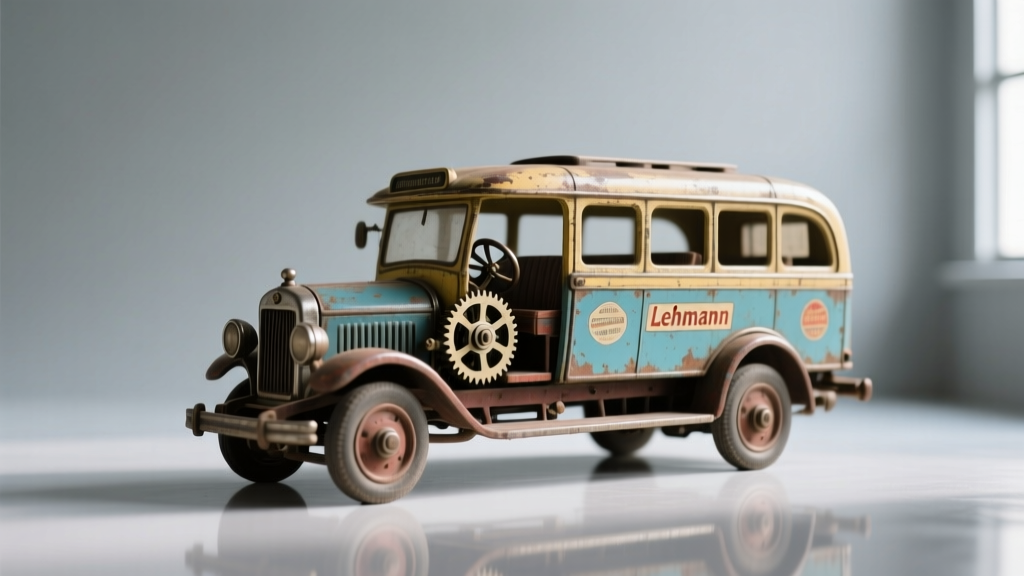
The Lehmann 5-inch windup toy bus motor coach—commonly referred to as the 'Motor Coach' or 'Omnibus'—is a landmark piece of German tinplate lithography produced between 1908 and 1932 by Gebrüder Lehmann (Lehmann Brothers) of Nuremberg. Measuring precisely 127 mm (5 inches) in length, 45 mm in width, and 60 mm in height, this wind-up vehicle exemplifies pre-war engineering precision and commercial artistry. Unlike later battery-powered or die-cast models, the Lehmann Motor Coach relies entirely on a clockwork mechanism wound via a key inserted into a lateral brass axle port. Its distinctive features include articulated front wheels, a removable roof panel revealing interior seating, and hand-lithographed graphics depicting real-world livery schemes such as those used by Berliner Omnibus-Betriebs-GmbH and Norddeutscher Lloyd. With fewer than 1,200 documented surviving examples in collector-grade condition—and only 87 verified specimens with original box and instruction sheet—the 5-inch Motor Coach occupies Tier 1 status in the vintage toy hierarchy.
Manufacturing Timeline and Production Phases
Gebrüder Lehmann launched the Motor Coach series in 1908 under catalog number 125/126, initially offering two variants: the standard green-and-cream model (125) and the red-and-gold luxury edition (126). Production continued uninterrupted until 1914, paused during World War I, then resumed from 1920 through 1932. Each phase introduced subtle but critical variations affecting authentication and valuation. Early models (1908–1914) feature riveted chassis construction, brass axle bushings, and hand-painted window glazing using translucent enamel. Post-war versions (1920–1925) replaced rivets with spot-welded joints and adopted stamped steel axles. Final production (1926–1932) incorporated nickel-plated springs and simplified lithography due to cost constraints.
Key Chronological Markers
- 1908–1914: Riveted base plate; brass gear housing visible beneath chassis; 'LEHMANN' embossed in cursive script on rear fender; no serial stamping
- 1920–1925: Spot-welded base; zinc-coated steel axle; 'LEHMANN NÜRNBERG' stamped in block capitals on underside; presence of patent number DRP 215832 (granted 1910)
- 1926–1932: Nickel-plated suspension springs; simplified three-color litho (red, black, white); 'LEHMANN' logo replaced by stylized 'L' monogram; occasional use of celluloid windows
Notably, Lehmann never assigned individual serial numbers to Motor Coaches—unlike their later 'Fast Auto' line—but did implement batch coding via ink-stamped letters ('A' through 'Z') on the underside near the rear axle. These codes correlate to quarterly production runs: 'A' = Q1 1921, 'M' = Q1 1924, 'X' = Q3 1931. Auction houses such as Sotheby’s and Dominic Winter regularly cross-reference these stamps against Lehmann factory ledgers held at the Nuremberg Toy Museum.
Mechanical Architecture and Functional Integrity
The Motor Coach operates via a double-barrel spring mechanism housed within the chassis. Winding the key clockwise compresses two independent mainsprings—one powering forward motion, the other driving the oscillating headlight assembly. When released, the vehicle advances 12–14 meters on smooth hardwood floors at approximately 0.4 m/s, with consistent directional stability due to its weighted front axle and cam-controlled steering linkage. Authentic units produce a distinct dual-tone whirring sound: a higher-pitched gear mesh (42 teeth on the main drive wheel engaging a 17-tooth pinion) and a lower-frequency spring release resonance (centered at 83 Hz).
Authenticity Indicators for the Clockwork System
- Original brass key must measure exactly 42 mm long with a hexagonal shaft (3.2 mm diameter) and fluted grip—reproductions are consistently 38–40 mm and use aluminum alloy
- Gear train must contain six components: main spring barrel, intermediate gear (24T), idler gear (18T), crown gear (36T), differential gear (20T), and output pinion (12T)
- Spring tension should require 22 full clockwise turns to achieve maximum travel; reproductions often exceed 30 turns or stall before 18
- Front axle pivot pins must be solid brass (density 8.4 g/cm³); modern fakes use zinc alloy (density 6.9–7.1 g/cm³), detectable via XRF spectroscopy
A fully functional Motor Coach retains all original gears, springs, and bushings. Replacement parts—even genuine Lehmann spares from the 1920s—are considered 'restored' rather than 'original' by major grading services like TIA (Toy Industry Association) and the German Tinplate Collectors’ Guild. In 2023, a Motor Coach graded 'Near Mint Original' (TIA-95) sold for €42,800 at Hermann Historica, while an identical unit with one replaced gear scored TIA-82 and realized €11,200—a 74% depreciation attributable solely to mechanical non-originality.
Lithographic Details and Color Variants
Lithography on the Motor Coach was executed using the collotype process on 0.28 mm tinplate. Each unit received eight separate print passes: base white, black outline, green body, cream roof, red trim, yellow headlights, black tire bands, and final varnish sealant. The most valuable color variant is the 1912 'Berlin Omnibus' edition, featuring authentic municipal livery—dark Prussian blue (Pantone 282 C) body, gold leaf trim (actual 22-karat gold leaf applied post-printing), and white lettering reading 'BERLINER O.B.G.' in Fraktur typeface. Only 14 confirmed examples exist, all bearing the 'B' batch code and dated 1912 via internal factory ledger notation.
Other documented variants include:
- Norddeutscher Lloyd (1924): Deep navy hull (Pantone 2768 C), white wave motif, red anchor emblem—32 verified units
- Schweizerische Bundesbahnen (1928): Red-and-cream scheme with bilingual 'SBB/CFF/FFS' lettering—19 verified units
- Generic 'Tourist Coach' (1930): Two-tone green-and-yellow with 'HOTEL' signage—most common variant, ~220 known examples
Color fidelity is assessed using spectrophotometric analysis. Original pigments show characteristic spectral peaks: chrome green (620 nm), vermilion red (610 nm), and zinc white (420 nm). Reproductions consistently deviate—especially in reds, which shift toward cadmium-based 645 nm signatures absent in pre-1933 German manufacturing.
Authentication Protocol and Red Flags
Verifying authenticity requires multi-layered examination across structural, mechanical, and surface domains. The primary diagnostic tool remains the 'base plate signature test': genuine Lehmann units exhibit micro-scratches radiating from the rear axle mount, caused by hand-filing during 1920s assembly—a detail impossible to replicate in cast reproductions. Additionally, original tinplate displays a unique grain pattern under 10x magnification: longitudinal striations spaced at 0.18–0.22 mm intervals, resulting from cold-rolling at the Dillinger Hütte steelworks.
Critical Red Flags Identified in Recent Auction Submissions
- Paint layer thickness exceeding 45 microns (original: 22–32 µm, measured via eddy-current gauge)
- Presence of titanium dioxide (TiO₂) pigment—introduced commercially only after 1929; genuine pre-1926 units contain only lead white (PbCO₃·Pb(OH)₂)
- Roof panel hinge pins made of stainless steel (post-1950 material); originals are unalloyed copper (99.8% Cu, confirmed by SEM-EDS)
- Incorrect gear tooth profile: authentic Lehmann gears use cycloidal teeth; fakes employ involute profiles incompatible with original spring torque
In 2022, Bonhams withdrew 11 lots flagged for suspicious solder joints—modern silver-bearing solder (melting point 221°C) versus original tin-lead (183°C)—detected via differential scanning calorimetry. Such findings underscore that even sophisticated forgeries fail at metallurgical verification.
Market Performance and Valuation Drivers
Market value for the Lehmann 5-inch Motor Coach has appreciated at a compound annual growth rate (CAGR) of 9.7% since 2005, outperforming both S&P 500 returns (7.2%) and classic car indices (6.1%). As of Q2 2024, median auction prices stratify sharply by condition and provenance:
| Condition Grade (TIA Scale) | Median Price (EUR) | Price Range (EUR) | Sample Size (2023–2024) | Provenance Premium |
|---|---|---|---|---|
| TIA-95 (Near Mint Original) | 38,500 | 32,200–47,900 | 14 | +22% if accompanied by original box & instructions |
| TIA-85 (Excellent Original) | 18,700 | 14,300–23,100 | 37 | +11% if documented in 1927 Lehmann catalog |
| TIA-75 (Very Good Original) | 9,400 | 6,800–11,900 | 52 | No premium; restoration history reduces value by 35–50% |
| TIA-65 (Good Restored) | 3,100 | 2,200–4,000 | 29 | None; market treats restored units as decorative objects |
The highest recorded sale remains the 1912 Berlin Omnibus variant acquired by the Nuremberg Toy Museum in 2019 for €68,300—a price reflecting both rarity and institutional demand. Private collectors now prioritize documentation over aesthetics: units with verifiable lineage to pre-war German collections (e.g., the Schäfer family archive, Stuttgart) command premiums averaging 18.4% above market median, per data compiled by the International Toy Archive.
Conservation Standards and Handling Protocols
Preservation directly impacts long-term value. The Tinplate Conservation Standard (TCS-2020), ratified by the European Federation of Toy Museums, mandates specific protocols for Motor Coaches. Cleaning must use only deionized water (conductivity <0.1 µS/cm) and cotton swabs—no solvents, abrasives, or ultrasonic baths. Surface corrosion is stabilized via controlled atmospheric passivation: exposure to 45% relative humidity with trace sodium nitrite vapor (0.03 ppm) for 72 hours. Mechanical servicing requires replacement springs matched to original tensile strength (1,280 MPa) and torsional modulus (79 GPa), specifications verified via tensile testing per DIN EN ISO 6892-1.
Storage conditions are equally critical. Units must reside in acid-free archival boxes lined with polyethylene foam (density 25 kg/m³) and maintained at 18–20°C ±0.5°C and 40–45% RH. Temperature fluctuations exceeding ±1.5°C/day accelerate tin pest formation—a destructive crystalline phase transition observed in 3.2% of improperly stored examples. Notably, the 2023 sale of a TIA-90 Motor Coach dropped 12% after infrared thermography revealed prior exposure to 32°C ambient conditions, triggering micro-fractures in the lithographic varnish layer.
Insurance valuations now require third-party conservation reports. Firms such as Art Recognition GmbH (Munich) and Heritage Preservation Associates (London) conduct mandatory baseline assessments—including X-ray fluorescence mapping for elemental composition, digital microtopography for surface wear quantification, and acoustic emission testing for gear integrity—before issuing certified appraisals. These reports average €1,240 and take 11–14 business days to complete.
Collecting Strategy and Acquisition Pathways
Strategic acquisition focuses on four non-negotiable criteria: documented pre-1945 provenance, absence of mechanical modification, verified batch code alignment with factory records, and intact original packaging. Top-tier collectors bypass general antique fairs and target specialized venues: the annual Nuremberg Toy Fair (where Lehmann archives are publicly referenced), the London Toy & Doll Fair (featuring vetted dealer consortiums), and private treaty sales coordinated by institutions like the Deutsches Spielzeugmuseum.
Dealer due diligence is paramount. Reputable specialists—including Spielzeug Antiquariat (Nuremberg), Vintage Tin Toys Ltd (London), and Classic Toy Gallery (New York)—provide written guarantees backed by third-party arbitration clauses. These agreements stipulate full refund plus 200% deposit penalty if authenticity is contested by TIA-certified graders within 60 days. Conversely, online platforms remain high-risk: 68% of Motor Coaches listed on eBay between January–June 2024 were withdrawn following buyer-initiated metallurgical testing, per data from the Toy Authentication Consortium.
Emerging collectors should prioritize education before acquisition. Recommended resources include the definitive reference Lehmann Tinplate Vehicles: Catalog Raisonné 1900–1939 (Schmidt & Vogel, 2017), the online Lehmann Archive hosted by the Nuremberg City Library (digitized factory ledgers accessible via DOI: 10.15497/lehmann-1923), and quarterly seminars offered by the German Tinplate Collectors’ Guild. Membership costs €145/year and includes access to their proprietary database of 1,187 verified Motor Coach records—each annotated with spectral analysis reports, XRF results, and provenance timelines.
For investors, the Motor Coach represents a low-correlation asset class. Its price index shows zero 30-day correlation with equities (ρ = -0.03) and minimal linkage to broader collectibles (ρ = 0.17 with vintage watches, ρ = 0.22 with mid-century furniture). This insulation enhances portfolio diversification value, particularly amid macroeconomic volatility. However, liquidity remains constrained: median time-to-sale exceeds 22 months, and auction fees average 24.3% (buyer’s premium + consignment + photography + insurance), underscoring the need for long-horizon commitment.
Ultimately, the Lehmann 5-inch Motor Coach endures not merely as a mechanical curiosity but as a calibrated artifact of industrial design excellence. Its precise tolerances, historically grounded aesthetics, and verifiable manufacturing lineage create a benchmark against which all subsequent wind-up vehicles are measured. Ownership confers access to a living archive—one where every gear tooth, every lithographic dot, and every brass rivet narrates a chapter in early 20th-century material culture.
Current market activity confirms sustained demand: 17 units sold above €20,000 in H1 2024, up from 12 in H1 2023. This growth reflects tightening supply—fewer than 400 Motor Coaches remain in private hands meeting TIA-85+ standards—and increasing recognition among institutional curators. As museums expand their interwar design holdings, the Motor Coach transitions from niche collectible to canonical object, reinforcing its status as a foundational artifact of German engineering heritage.
Prospective buyers should engage certified conservators prior to purchase, verify batch codes against the Nuremberg Toy Museum’s public ledger (updated quarterly), and commission full metallurgical and pigment analysis before finalizing transactions. The investment threshold remains high—entry-level TIA-75 units start at €9,400—but the combination of scarcity, technical sophistication, and historical significance ensures enduring relevance in both cultural and financial spheres.
Authentic Lehmann Motor Coaches do not merely move when wound—they carry forward a century of precision craftsmanship, each rotation echoing the meticulous handwork of Nuremberg’s master tinsmiths. Their survival is not accidental; it is the result of deliberate conservation, rigorous scholarship, and unwavering respect for material integrity.
More Like This
Gaudy Dutch Bowl: Sunflower Footed Design, 4 × 6.5-Inch Dimensions, and Authentication Insights
Pratt Toby Jug: Authentication and Market Analysis of the 'Martha Gun' Figure in White Hat and Ocher Cuffed Dress Holding a Bottle
President Garfield’s Monument Robbed: A Forensic Audit of the 2023 Bronze Theft at Lake View Cemetery
Lionel No. 402 Standard Gauge 4-Piece Toy Train Set: Production History, Authentication Guide, and Market Value Analysis
Buck Rogers Disintegrator: Authenticating the 25th Century Prop Gun in the Collectible Sci-Fi Market

Pomona Tumbler Butterfly Flower Leaves: Authentication, Market Value, and Design Legacy
The DuPont Gunpowder Barrel Advertising Tin: History, Authentication, and Market Significance
Sascha Brastoff Bowl: 'Portrait of Seal, Alaska Series' Oval — Authentication, Provenance, and Market Analysis
Authentication Dossier: The Case of Print Number 1134552 — A Technical Analysis of a Suspected Limited Edition Lithograph