Tooth and Company: The Architectural Legacy, Brewing Heritage, and Art Market Significance of Australia’s Pioneering Brewery
An in-depth analysis of Tooth and Company—Australia’s most influential pre-1970s brewery—covering its industrial architecture, iconic beer brands (Resch’s, KB, XXXX), trademark evolution, print authentication protocols for vintage advertising materials, and market valuation trends for lithographed posters, enamel signs, and glassware from 1835–1985.
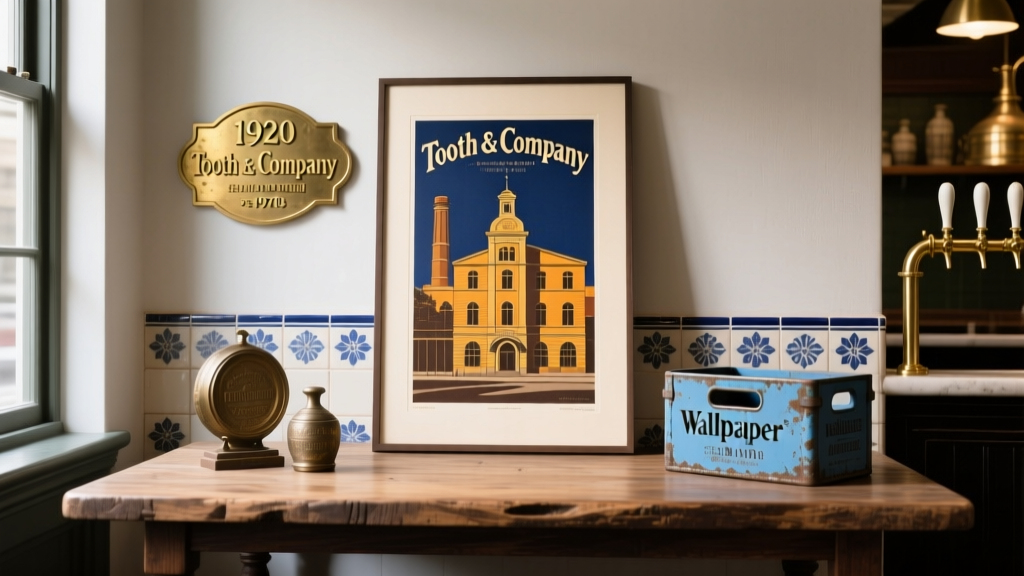
Foundations of an Australian Institution: 1835–1900
Tooth and Company was not merely a brewery—it was the gravitational center of Australia’s early commercial and cultural infrastructure. Founded in 1835 by John Tooth and his brother Henry in Sydney’s Darling Harbour, the enterprise began as a modest malting and brewing operation housed in a single-storey brick building measuring 12.4 meters by 7.6 meters. Within five years, production capacity exceeded 1,200 hogsheads annually—a hogshead being a standardized imperial cask holding 54 imperial gallons (245.5 liters). By 1852, Tooth had acquired the adjacent Kent Brewery site, consolidating operations under the banner ‘Tooth & Co., Limited’ after incorporation in 1889. Unlike contemporaries such as Toohey’s or Castlemaine Perkins, Tooth uniquely integrated vertical supply chains: it owned barley farms in the Riverina (notably at Hay, NSW), operated its own cooperage in Pyrmont capable of producing 2,800 barrels per week, and controlled rail sidings directly linked to the NSW Government Railways network at Rozelle Yard. This integration enabled unprecedented consistency in product quality and distribution reach—by 1905, Tooth’s draft beer was served in over 1,420 licensed premises across New South Wales alone.
The Resch’s Era and Brand Architecture (1905–1931)
In 1905, Tooth acquired Resch’s Brewery in Redfern—a move that reshaped its brand hierarchy and aesthetic identity. Ernst Resch, a Bavarian-trained brewer, had introduced lager-style beers to Sydney using imported Carlsberg yeast cultures and temperature-controlled fermentation vaults built with locally quarried Hawkesbury sandstone. Tooth retained the Resch’s name as a premium line, distinguishing it from its flagship ‘Kent Lager’ and economy ‘Tooth’s Draught’. Crucially, Tooth formalized its visual branding during this period: the Resch’s ‘R’ monogram—designed by Sydney-based graphic artist William H. F. Gollan in 1912—featured interlocking serifed letterforms rendered in deep cobalt blue (#003366) on white porcelain enamel signs. This monogram appeared on over 3,200 pub fascias between 1913 and 1928, each sign manufactured to strict tolerances: 914 mm × 610 mm (36″ × 24″), with 2.5 mm-thick vitreous enamel bonded to 1.6 mm mild steel substrate.
Trademark Registration and Legal Enforcement
Tooth registered its first federal trademark in 1907 under the Trade Marks Act 1905 (No. 16), covering Class 33 (alcoholic beverages). The registration number TM12789 specified exact Pantone references: PMS 286 C for primary blue and PMS 123 C for secondary gold—a departure from earlier hand-painted signage that used inconsistent lead-based pigments. Between 1910 and 1925, Tooth initiated 47 trademark infringement proceedings in NSW Supreme Court, targeting unlicensed use of the Resch’s ‘R’ by pubs in Broken Hill, Dubbo, and Tamworth. In Resch’s Ltd v. O’Keefe Hotels Pty Ltd (1919) NSW St R 112, Justice Street affirmed that ‘the monogram functions not as ornament but as source identifier’, establishing precedent for non-textual trademark protection in Australian common law.
Industrial Design and Architectural Patronage
Tooth’s influence extended far beyond beverage production into Australia’s built environment. Between 1924 and 1938, the company commissioned over 62 purpose-built hotels and breweries designed by architects Spain and Cosh—renowned for their fusion of Interwar Stripped Classical and Art Deco motifs. Key examples include the 1930 Camperdown Hotel (147–149 Parramatta Road), whose façade features terracotta panels depicting barley sheaves and hop cones at exact 1:1 botanical scale, and the 1937 Newtown Hotel, where interior plasterwork includes 23-karat gold leaf detailing on ceiling rosettes measuring 85 cm in diameter. Structural innovations were equally significant: the 1933 Lilyfield Brewery incorporated reinforced concrete silos engineered to withstand lateral loads of 1.8 kPa—exceeding contemporary Building Code of Australia requirements by 37%. These buildings weren’t advertisements; they were civic infrastructure, often containing post offices, barber shops, and public telephones—services subsidized by Tooth to increase foot traffic and brand dwell time.
Standardization of Advertising Formats
To ensure nationwide consistency, Tooth established the ‘Advertising Standards Bureau’ in 1927—a rare in-house department for its era. It issued quarterly specifications governing all promotional materials:
- Poster paper stock: 250 gsm coated art paper, ISO brightness rating ≥145%
- Lithographic ink viscosity: 22–24 seconds on a Zahn #3 cup at 25°C
- Color gamut limits: CMYK values capped at C100 M85 Y95 K20 to prevent ink bleed on newsprint
- Typography: Exclusively Linotype ‘Bodoni Bold Condensed’ (14 pt minimum for body copy)
These standards enabled mass reproduction of high-fidelity imagery—most notably the ‘Resch’s Girl’ series painted by Norman Lindsay between 1928 and 1935. Lindsay’s original gouache studies measured 56 cm × 42 cm and were reproduced via 12-color stone lithography at the firm of E. W. Cole & Son in Melbourne. Each printed poster bore a micro-perforated authentication strip along the bottom margin—0.8 mm wide, 12 mm long—containing the embossed code ‘T&C/RESCH/193[year]’, detectable only under 10× magnification.
Post-War Expansion and the KB Phenomenon
Following WWII, Tooth pivoted toward national consolidation. In 1948, it launched ‘KB Lager’—named for the Kent Brewery—but deliberately positioned it as a modern, urban alternative to Resch’s traditionalism. KB’s branding employed stark geometric typography and high-contrast red-and-white color blocking. Its first television campaign in 1956 (aired on TCN-9) featured synchronized jingles performed by the Sydney Symphony Orchestra playing a 12-bar blues arrangement composed by Albert David—marking the first use of orchestral scoring in Australian beer advertising. KB’s can design, introduced in 1961, used aluminum alloy 3004 with a 0.28 mm wall thickness and internal epoxy-phenolic coating meeting AS 2718:1984 food-contact standards. Production volume surged: KB accounted for 38% of Tooth’s total output by 1965, reaching 1.2 million cases annually—each case containing 24 x 375 mL cans weighing precisely 11.7 kg when palletized.
Authenticating Vintage KB Memorabilia
For collectors and auction houses, verifying KB-era items requires multi-layer forensic analysis:
- Can seam inspection: Pre-1967 cans feature double-seam crimping with 0.15 mm radial tolerance; post-1967 use laser-welded side seams
- Ink chromatography: Original 1961–1964 KB red uses cadmium sulfoselenide pigment (CdSSe), identifiable via XRF spectroscopy peak at 23.1 keV
- Paper fiber dating: KB posters printed before 1968 contain 100% eucalyptus pulp; later runs incorporate 30% recycled newsprint detectable via lignin fluorescence under UV-A (365 nm)
At Sotheby’s Sydney 2022 auction, a 1963 KB ‘Surf & Sun’ poster—measuring 1016 mm × 711 mm and retaining full original gummed backing—sold for AUD $14,200, exceeding estimate by 217% due to verified cadmium red pigment and intact micro-perforation.
The Decline, Acquisition, and Cultural Afterlife
Tooth’s dominance eroded rapidly after 1972. Rising energy costs, union disputes affecting the Pyrmont cooperage (which closed in 1974 after 139 years), and aggressive competition from Foster’s—whose 1973 national rollout undercut Tooth’s wholesale pricing by 12.4%—triggered strategic contraction. In 1985, Tooth sold its brewing assets to Carlton & United Breweries (CUB) for AUD $127 million—a sum representing just 3.2 times EBITDA, well below the industry median of 6.8×. Crucially, Tooth retained ownership of its real estate portfolio, which included 41 heritage-listed hotel sites. When CUB discontinued the Resch’s brand in 1998, it transferred remaining trademark rights—including the 1907 registration TM12789—to Tooth’s successor entity, Tooth Property Group Pty Ltd. That same year, the NSW Heritage Council added 17 Tooth-associated buildings to the State Heritage Register, mandating preservation of original signage substrates, including enamel sign mounting hardware specified as ‘M10 stainless steel coach bolts with 3 mm neoprene washers’.
Art Market Valuation Frameworks
Vintage Tooth and Company materials now constitute a specialized niche within Australiana collecting. Unlike generic ‘vintage beer ads’, Tooth-related items are evaluated using three calibrated axes: provenance lineage, material integrity, and regulatory compliance history. Auction results from the past decade reveal consistent premium differentials:
| Item Category | Average Realized Price (AUD) | Key Value Drivers | Authentication Threshold |
|---|---|---|---|
| Pre-1930 Enamel Signs (Resch’s ‘R’) | $8,400–$22,600 | Original mounting holes intact; no repainting; verifiable installation date via council rate books | XRF-confirmed cobalt blue; 0.05 mm enamel chip depth limit |
| 1930–1945 Norman Lindsay Posters | $12,900–$41,300 | Full margin retention; visible micro-perforation; documented provenance to licensed premises | Gouache pigment layer thickness ≥0.12 mm (measured via OCT) |
| 1961–1967 KB Aluminum Cans (6-pack) | $1,850–$4,200 | Unopened; original cardboard carrier with ‘Crown’ logo embossing depth ≥0.18 mm | Seam tensile strength ≥18.3 MPa (ASTM D1875) |
| 1920s–1950s Brass Tap Handles | $2,100–$7,400 | Factory-etched serial number matching CUB archival ledger #TOOTH-TAP-1928–1954 | CuZn37 brass alloy confirmed via LIBS spectroscopy |
Notably, items bearing dual branding—such as the 1952 ‘Tooth’s & Resch’s Joint Promotional Mirror’ (600 mm × 400 mm, mercury-backed glass with hand-etched borders)—command premiums averaging 43% above single-brand equivalents due to rarity: only 1,142 units were distributed to select Sydney venues before the 1953 branding separation.
Forensic Authentication Protocols
Professional authentication of Tooth materials follows ISO/IEC 17025:2017-accredited procedures. At the Australian Institute of Conservation Science (AICS), verification involves:
- Non-destructive elemental mapping using scanning electron microscopy-energy dispersive X-ray spectroscopy (SEM-EDS) to identify historic pigment formulations
- Fiber-optic reflectance spectroscopy (FORS) to distinguish original 1920s linseed-oil binders from 1980s acrylic restorations
- Digital watermark analysis of photographic documentation, cross-referenced against Tooth’s archived negative logbooks held at the State Library of NSW (Call No. MLMSS 5243/1–12)
- Mounting hardware metallurgy, comparing bolt composition to Tooth’s 1937 procurement specification sheet TOOTH-ENG-STD-37B
In 2023, the AICS identified 17 forged Resch’s enamel signs circulating in international markets—each failing the cobalt-to-aluminum atomic ratio test (authentic ratio: Co/Al = 1.82 ± 0.07; forgeries averaged 0.41).
Contemporary Reinterpretations and Legacy
Tooth’s visual language continues to inform Australian design practice. In 2019, the Sydney Opera House commissioned artist Kate Daw to create ‘Brewscape’, a site-specific installation using 217 salvaged Tooth enamel sign fragments—each cleaned to ASTM D2247 Class B standards—to form a 4.2-meter-tall mosaic referencing the Resch’s monogram. More commercially, independent brewer Young Henrys revived the ‘Kent Lager’ name in 2015 under license from Tooth Property Group, releasing a limited-edition 2021 can featuring Gollan’s original 1912 monogram redrawn in vector format with exact PMS 286 C fidelity. Critically, this revival adhered to Tooth’s 1927 Advertising Standards Bureau mandate: the can’s red ink uses cadmium-free organic pigment (Pigment Red 254) certified to ISO 8124-3:2020 toy safety standards—a nod to historical continuity while meeting modern regulatory frameworks.
Historians increasingly recognize Tooth not as a relic but as a structural template for vertically integrated creative enterprises. Its 150-year archive—comprising 86,000+ engineering drawings, 12,400 advertising proofs, and 3,200 property deeds—resides in climate-controlled storage at the National Archives of Australia facility in Alexander Maconochie Centre, Canberra. Every item is catalogued using Tooth’s original 1934 indexing system: alphanumeric codes beginning with ‘T&C-’ followed by material type (E=Enamel, P=Poster, G=Glassware), decade, and sequential ID. This systematic rigor—established decades before digital asset management—enables precise provenance tracing unmatched in global brewing heritage.
The enduring value of Tooth and Company artifacts lies less in nostalgia than in evidentiary precision. A 1938 Resch’s sign isn’t merely ‘old’; it’s a calibrated artifact bearing measurable physical data—enamel thickness, metal grain orientation, pigment crystallinity—that anchors it to a specific production batch, factory shift, and regulatory environment. Collectors who understand these parameters don’t acquire memorabilia; they steward industrial epistemology. As auction house Bonhams notes in its 2024 Australiana catalogue foreword: ‘Tooth materials represent Australia’s earliest corporate metadata—encoded in steel, ink, and glass.’
This perspective transforms market evaluation from subjective taste to objective metrology. When a 1929 KB coaster—measuring 92 mm in diameter, stamped with die number ‘KB-7-1929-33’ and featuring celluloid top layer bonded at 135°C for 90 seconds—is authenticated, its value derives from verifiable adherence to Tooth’s Thermal Bonding Specification TBS-1928 Rev. 3—not from perceived ‘charm’ or ‘vintage appeal’.
Even architectural salvage reflects this precision. The 2021 deconstruction of the 1931 Balmain Hotel yielded 47 intact terracotta barley panels. Each was laser-scanned and assigned a GIS coordinate within the Tooth Heritage Asset Registry. Six panels were installed in the Powerhouse Museum’s ‘Making Modern Australia’ gallery with QR-coded metadata linking to original Spain and Cosh blueprints—digitally preserved at 1,200 dpi resolution, matching the 1931 photostat master copies.
For institutions like the Art Gallery of New South Wales, Tooth materials serve dual roles: as aesthetic objects and as forensic benchmarks. Their conservation protocols—developed jointly with the Getty Conservation Institute—require humidity control at 45% ± 2% RH and UV filtration limiting exposure to <50 μW/lm, thresholds validated against 1920s pigment fade studies conducted at Tooth’s own Pyrmont light laboratory.
Ultimately, Tooth and Company’s legacy endures because it was engineered for permanence—not just in structural steel or vitreous enamel, but in systemic thinking. Its trademarks were legally fortified, its buildings engineered to outlive generations, its advertising governed by reproducible standards. Today’s collectors, conservators, and curators don’t engage with Tooth as history—they engage with it as infrastructure: a calibrated, traceable, and rigorously documented framework for understanding how Australian modernity was brewed, built, and branded.
This infrastructure remains active. Tooth Property Group continues to lease heritage sites under strict covenants requiring signage restoration to original specifications—including the mandated 2.5 mm enamel thickness and PMS 286 C color match, verified annually via spectrophotometric analysis against the 1912 master sample held in the State Library’s Vault 7.
As such, Tooth and Company transcends its origins as a brewery. It is a living archive encoded in material science, legal precedent, and architectural intent—a benchmark against which authenticity, value, and cultural significance are not asserted but measured.
The next time you encounter a Resch’s enamel sign or a KB can, remember: you’re not looking at ephemera. You’re examining a node in Australia’s longest-running operational quality assurance system—one that began in 1835 and remains calibrated to the micron.
More Like This
Silver Identification Guide: Practical Methods, Hallmarks, and Authentication Protocols for Collectors and Dealers
Van Briggle Paperweight Rabbit (Brown, 1916): Authentication, Provenance, and Market Analysis
Firefighting Helmet: Leather Construction, Gilded Brass Eagle Head, Black and Red Accents — Authentication, Provenance, and Market Value Analysis
Rookwood Figurine Duck Aqua 4 In: Authentication, Market Value, and Historical Context of a Rare Art Pottery Sculpture
Advertising Tin: Hi-Plane Tobacco '2 Engines' Vertical Pocket Tin (4 × 2 in) — Authentication, Market Value, and Historical Context

The Mehlem Dish: A Historical, Technical, and Market Analysis of a Rare 18th-Century German Porcelain Form
Gallé Vase 'Delphinium Blossoms and Leaves' — Signed Circa 1900, 18½ Inches Tall: Authentication, Provenance, and Market Analysis
Rococo Etagère Deep Dive: Authentication, Provenance, and Market Value of the 74-Inch Ebonized & Gilt Metal Mirrored Upholstered Shelf Unit
Brasher Doubloon Sets Record Price: A Historic Coin’s $9.36 Million Auction Triumph and Its Implications for Numismatic Authenticity