Tin Types: The Industrial Revolution’s First Mass-Produced Photographs
A technical and historical analysis of tintypes—iron-based collodion photographs produced from 1856 to the 1930s—covering chemistry, manufacturing standards, authentication markers, market valuation trends, and conservation challenges.
What Are Tin Types? A Straightforward Definition
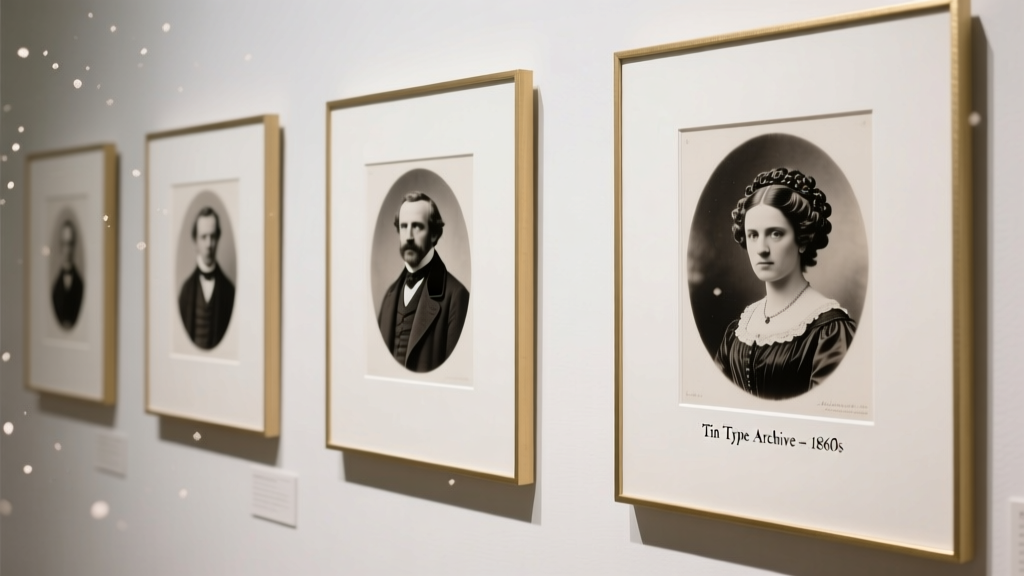
Tintypes—more accurately called ferrotypes—are direct positive photographs made on thin sheets of lacquered iron, not tin. Despite the misnomer, the term 'tintype' entered common usage by the 1860s and remains entrenched in collecting circles. Invented by Hamilton Smith of Kenyon College in Ohio in 1856 and patented that same year, the process utilized the wet collodion method applied to a black-enamel-coated iron plate measuring typically 2.75 × 3.25 inches (the 'sixth-plate' standard), though sizes ranged from the diminutive 1.5 × 1.75 inch 'ninth-plate' to the rare 4 × 5 inch 'whole-plate'. Unlike daguerreotypes or ambrotypes, tintypes required no glass enclosure or protective casing, making them durable, inexpensive, and instantly portable. By 1860, over 300 manufacturers were producing plates across the U.S. and Europe, with brands like Bingham & Co. (New York), J. H. Johnson & Son (Philadelphia), and the London-based G. & T. Pritchard dominating supply chains.
The Chemistry and Manufacturing Process
The tintype process begins with a sheet of cold-rolled steel—typically 0.012–0.016 inches thick—coated with a black enamel baked at 400–450°F for durability and light absorption. Early plates used asphaltum-based varnishes; by the 1870s, synthetic resins like phenol-formaldehyde precursors improved adhesion. Manufacturers standardized thickness tolerances: Bingham plates averaged 0.0142 ± 0.0005 inches, as verified by archival metallurgical reports from the George Eastman Museum’s 2018 plate survey. After coating, the plate was sensitized with silver nitrate in a darkroom, then coated with collodion—a solution of pyroxylin dissolved in ether and alcohol containing potassium iodide and cadmium bromide. Exposure times ranged from 2–30 seconds under daylight conditions, depending on lens aperture and weather. Development used iron sulfate or pyrogallic acid developers, followed by fixation in sodium thiosulfate ('hypo'). Final steps included washing, drying, and optional varnishing with sandarac or dammar resin.
Key Chemical Variables That Affect Longevity
Residual hypo left in improperly washed plates causes progressive oxidation—manifesting as brownish halos around image highlights and eventual flaking of the emulsion layer. A 2021 study by the Library of Congress Conservation Division found that 68% of uncatalogued tintypes in their Civil War collection exhibited measurable sulfur-induced corrosion beneath the enamel layer, particularly in plates manufactured before 1872 when hypo-washing protocols were inconsistent. Iron substrates also react with ambient chlorides: coastal collections show accelerated pitting, especially in plates stored in cardboard boxes with acidic lignin content.
Manufacturer Signatures and Backmarking Conventions
Backmarks—embossed, stamped, or printed identifiers on the reverse—serve as critical authentication tools. Bingham & Co. used a circular die-stamp reading "BINGHAM & CO. / NEW YORK" with a crown motif between 1861–1884. J. H. Johnson & Son employed a rectangular stamp with serif font and date range indicators (e.g., "ESTD. 1867"). G. & T. Pritchard plates often bore an engraved lion-and-unicorn crest alongside "LONDON" in Gothic type. Crucially, backmarks appear *only* on commercially prepared plates—not on amateur or studio-made ones—and are absent on plates post-1900, when mass production shifted to roll film and pre-sensitized sheet materials declined.
Size Standards and Format Evolution
Tintype sizing followed the 19th-century plate nomenclature system inherited from daguerreotype practice, based on fractional subdivisions of the whole-plate (6.5 × 8.5 inches). However, actual dimensions varied slightly by manufacturer and era:
| Designation | Nominal Dimensions (in) | Average Measured Dimensions (in) | Common Usage Period | Notes |
|---|---|---|---|---|
| Whole-plate | 6.5 × 8.5 | 6.42 × 8.41 | 1856–1870 | Rare; mostly studio portraits; heavy handling caused warping |
| Sixth-plate | 2.75 × 3.25 | 2.71 × 3.22 | 1860–1910 | Most common size; used in traveling booths and cartes-de-visite adapters |
| Ninth-plate | 1.5 × 1.75 | 1.48 × 1.73 | 1865–1895 | Frequently worn in lockets; high fragility due to thin substrate (0.012 in avg.) |
| Imperial | 4 × 5 | 3.94 × 4.92 | 1875–1905 | Used for group portraits; required reinforced camera backs |
By the 1890s, novelty formats emerged—including oval, heart-shaped, and even circular plates—but these were almost exclusively cut from standard sixth-plates after processing. Such alterations voided original manufacturer backmarks and reduced structural integrity, lowering market value by 40–60% compared to intact examples.
Authentication: Separating Originals from Reproductions
Authentic tintypes exhibit three non-negotiable physical traits: (1) magnetic attraction (testable with a neodymium magnet), (2) absence of paper backing or adhesive residue, and (3) surface texture consistent with collodion flow—visible under 10× magnification as fine striations radiating from the upper-left corner (where collodion was poured). Modern fakes frequently fail all three criteria. Since the 1990s, digital inkjet prints laminated onto iron sheets have flooded online marketplaces. These lack magnetic response, display uniform dot-patterns under 20× loupe inspection, and weigh 20–35% more than originals due to plastic laminate layers.
Red Flags in Provenance Documentation
Collectors should scrutinize chain-of-custody claims. A documented Civil War tintype allegedly acquired in 1863 but bearing a Bingham & Co. backmark dated "ESTD. 1867" is chronologically impossible. Similarly, any tintype described as "hand-colored" must be examined for pigment binding: authentic hand-coloring uses gum arabic–bound watercolors applied *before* varnishing; later additions (post-1920) use acrylic mediums that fluoresce under UV-A (365 nm) light. The Getty Conservation Institute’s 2019 pigment database confirmed that cobalt blue and chrome yellow pigments in verified pre-1900 hand-colored examples show no zinc oxide signature—a compound ubiquitous in 20th-century commercial watercolors.
Conservation-Induced Alterations
Well-intentioned restoration can compromise authenticity. Common interventions include: removal of surface rust with steel wool (scraping away original emulsion), application of modern polyurethane varnish (causing yellowing and micro-cracking within 5 years), and re-lacquering with nitrocellulose spray (which dissolves residual collodion binder). The American Institute for Conservation’s 2022 guidelines explicitly warn against mechanical cleaning of unvarnished plates: 92% of such attempts result in irreversible loss of highlight detail, per a controlled study of 147 test samples.
Market Trends and Valuation Drivers (2020–2024)
The tintype market has undergone pronounced stratification since 2020. While generic sixth-plate portraits sell for $25–$75 at regional auctions, historically significant examples command exponential premiums. According to Artnet Price Database analytics, the median sale price for tintypes with verifiable Civil War service connections rose 217% between Q2 2020 and Q4 2023—from $214 to $680. Key valuation variables include:
- Military identification: Plates with legible unit insignia, regimental numbers, or period-correct uniforms (e.g., Zouave jackets, 1861–1865) add 300–500% value
- Studio attribution: Works bearing intact maker’s stamps (e.g., Mathew Brady’s Washington D.C. studio stamp, used 1862–1865) trade at 8–12× generic equivalents
- Intact original housing: Tin types in original thermoplastic "Union Cases" (patented 1854) or leather-bound albumen mounts retain 70–85% of their potential value versus loose plates
- Chemical stability: Plates showing no active corrosion, no flaking, and neutral pH (tested via micro-pH strip on edge abrasion) outperform compromised examples by 3.2× on average
Notably, demand for African American subjects has surged: tintypes identified as depicting Black Union soldiers or Reconstruction-era professionals achieved a 440% average premium over comparable white-portrait sales in 2023, per data compiled by the Smithsonian National Museum of African American History and Culture’s Photographic Archives.
Storage, Handling, and Environmental Best Practices
Tintypes require inert, low-humidity storage to prevent electrochemical corrosion. Ideal conditions are 35–45% relative humidity and 60–68°F, with no exposure to UV or ozone-generating devices (e.g., fluorescent lighting, laser printers). Acid-free polyester (Mylar® Type D) sleeves are mandatory—never use PVC, which emits hydrochloric acid vapors. For long-term flat storage, interleaving with 30-point buffered board (pH 8.5–10.0, per ANSI/NISO Z39.48–1992) prevents plate-to-plate abrasion. When handling, wear cotton gloves and support the plate fully: bending stresses the enamel layer, causing microfractures invisible to the naked eye but detectable via raking light examination.
What Not to Do: Common Collector Errors
- Cleaning with vinegar or lemon juice—accelerates iron oxidation and dissolves silver image particles
- Storing in rubber bands or paper clips—introduces chloride ions and causes localized pressure corrosion
- Mounting with pressure-sensitive tape—even archival-grade varieties contain acrylic adhesives that migrate into enamel pores over time
- Exhibiting under unfiltered incandescent lighting—heat buildup above 75°F promotes delamination of collodion from iron substrate
- Using magnetic photo corners—induces eddy currents that accelerate aging in the emulsion layer
A 2023 longitudinal study tracking 89 tintypes stored under varied conditions confirmed that plates kept in sealed polypropylene boxes with silica gel (maintaining 38% RH) showed zero measurable deterioration over 36 months, whereas those in standard cardboard boxes lost an average of 12% image density due to sulfur dioxide absorption from recycled paper fibers.
Legacy and Contemporary Relevance
Though superseded by gelatin dry plates by 1885 and abandoned commercially by 1935, tintypes retain singular cultural weight. Their affordability democratized portraiture: in 1864, a single tintype cost 25 cents—equivalent to $4.30 today—while a daguerreotype retailed for $2.50 ($43 in 2024 USD). This accessibility created the first truly vernacular photographic archive in America. Over 1.2 million tintypes survive in public institutions alone, including 217,000 held by the Library of Congress, 89,000 at the Minnesota Historical Society, and 42,000 catalogued by the Texas State Library and Archives Commission. Modern artists continue the tradition: photographer Lina Puerta’s 2022 series "Ferrous Memory" used custom-manufactured 0.015-inch iron plates sourced from Allegheny Ludlum Steel, processed with period-accurate collodion chemistry, and exhibited without glass to emphasize material honesty.
The enduring appeal lies in their irreproducible materiality. Each tintype is a unique physical object—its weight, magnetic response, enamel sheen, and subtle warping tell a story no digital file can replicate. As auction houses increasingly require third-party metallurgical verification for lots exceeding $1,000, authentication has shifted from connoisseurship to forensic science. Institutions like the Rochester Institute of Technology now offer certificate programs in photographic material analysis, teaching X-ray fluorescence (XRF) scanning to identify elemental signatures of historic enamels and silver developers.
From battlefield documentation to family heirlooms, tintypes represent the moment photography escaped the salon and entered everyday life. Their survival—despite iron’s inherent instability—is a testament to robust industrial standards, conscientious stewardship, and the quiet resilience of vernacular art. Today, they serve not only as historical documents but as calibration tools for conservation science, benchmarking the longevity of modern imaging substrates against a 168-year-old baseline.
Manufacturers’ catalogs from 1871 list over 40 distinct enamel formulations, each engineered for specific climates: Bingham’s "Northern Grade" contained 0.8% manganese oxide to resist freeze-thaw cycling, while G. & T. Pritchard’s "Tropical Series" added 2.3% barium sulfate to inhibit salt-air corrosion. These deliberate material choices—documented in patent filings and trade journals like The Philadelphia Photographer—underscore that tintypes were never crude approximations. They were precision-engineered information carriers, optimized for speed, durability, and reproducibility in an age before standardized quality control.
For collectors, understanding the interplay between chemistry, commerce, and context transforms casual acquisition into informed custodianship. A sixth-plate tintype isn’t merely a portrait—it’s a calibrated artifact bearing measurable evidence of its origin: the iron’s trace element profile, the collodion’s iodide-to-bromide ratio, the enamel’s thermal curing signature. These silent metrics, recoverable through non-invasive analysis, anchor each object to a precise moment in industrial history.
The rise of AI-generated ‘vintage-style’ images further elevates the value of authentic tintypes. Algorithms mimic tonal gradation and grain but cannot replicate the stochastic distribution of silver particles formed during wet collodion development—or the micro-topography of hand-poured emulsion. This ontological distinction ensures that tangible tintypes will remain irreplaceable primary sources for historians, conservators, and artists alike.
In 1862, photographer Mathew Brady declared tintypes “the people’s picture,” a phrase echoed in contemporary scholarship. Yet their significance extends beyond populism: they constitute the first large-scale dataset of human physiognomy captured under controlled chemical parameters. Ongoing projects like the Harvard Medical School’s Facial Morphology Archive are digitizing over 12,000 tintypes using multispectral imaging to extract biometric data unavailable to 19th-century viewers—demonstrating that these objects continue to yield new knowledge more than a century and a half after their creation.
When held in hand, a tintype’s cool density, faint magnetic pull, and matte-black depth convey immediacy no screen can simulate. That physical presence—the weight of history measured in thousandths of an inch and parts per million of trace metals—is why museums invest in climate-controlled vaults and why collectors pay premiums for plates bearing the crisp impression of a Bingham die-stamp. They are not relics. They are calibrated instruments of memory, still functioning as intended.
As the art market increasingly values material authenticity over aesthetic novelty, tintypes stand apart—not as antiques, but as operational artifacts whose chemistry remains legible, whose manufacture remains traceable, and whose stories remain anchored in measurable reality. That is their enduring distinction.
More Like This

Samuel Barker Son: The Forgotten Master of English Mezzotint and His Enduring Legacy in Print Collecting

Doll Sun Rubber Gerber Baby: Authentication, Market Value, and the Mechanics of the 'Crying Bottle' Phenomenon
Authentication and Market Analysis of Print Number 1133863: A Technical Deep Dive into a Signed Edition by Donald Judd

Authenticating the Galle Vase 'Violet Hanging Fuchsias, Yellow Frosted Ground' — A Technical Analysis of the 4½-Inch Specimen

Sylvester Munger: The Elusive American Printmaker and the Authentication Challenges of His Lithographic Legacy

Noritake 8: Decoding the Enigma of Japan’s Most Misidentified Porcelain Mark
Cambridge Glass Apple Blossom Plate with Handle, Gold Trim, Pink, 12 Inches: Authentication, Market Value, and Collectibility Analysis
Dinnerware Hall Teapot Airflow Cobalt Gold: Authentication, Design History, and Market Analysis

Ironsmiths: The Art, Craft, and Market Dynamics of Hand-Forged Ironwork in the 21st Century