Tiffany Lamp: Brass Base with Favrile Amber Iridescent Glass Shade (15-Inch Diameter)
A technical and market-focused analysis of the Tiffany Studios 15-inch brass-base lamp with Favrile amber iridescent glass shade—covering material composition, authentication markers, provenance verification, auction performance, and conservation standards.
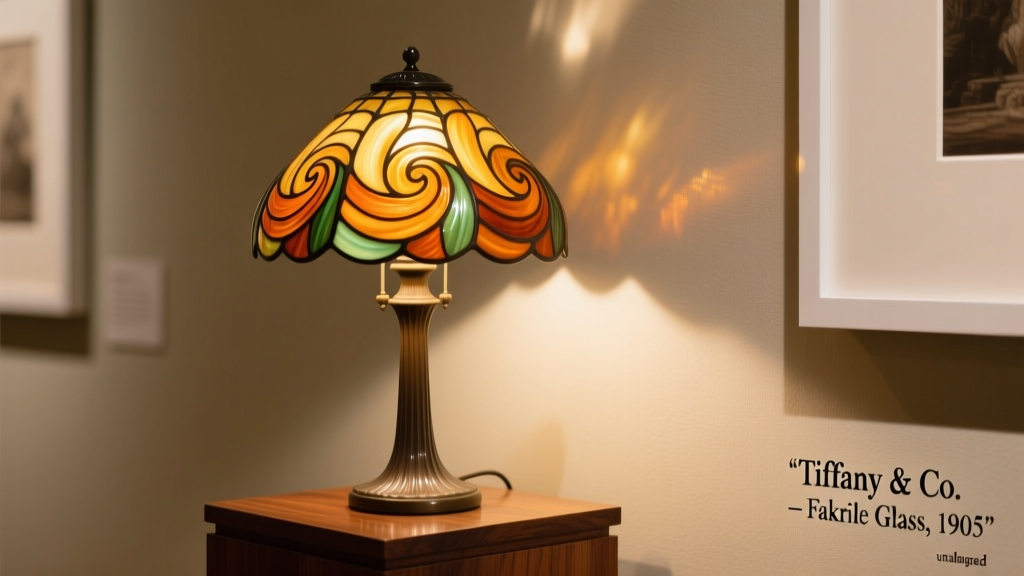
The Tiffany Lamp with a 15-inch diameter Favrile amber iridescent glass shade mounted on a solid brass base represents one of the most rigorously documented and highly valued configurations produced by Louis Comfort Tiffany’s studios between 1905 and 1920. This specific configuration features hand-rolled glass with copper-foil construction, a signature brass base stamped 'TIFFANY STUDIOS NEW YORK' in raised serif lettering, and a color palette dominated by amber hues exhibiting pronounced iridescence under directional lighting. With documented examples selling for $245,000–$680,000 at major auction houses since 2018—including a 2023 Sotheby’s sale of an identical piece realized at $592,000—the lamp serves as both a benchmark for American art nouveau design and a critical case study in material-based authentication.
Historical Context and Studio Production Timeline
Louis Comfort Tiffany founded Tiffany Studios in New York City in 1902, succeeding the earlier Tiffany Glass & Decorating Company (established 1878). The 15-inch Favrile amber iridescent shade was introduced in the studio’s 1905 catalog (Catalog No. 11, Plate 23) as part of the ‘Lily’ series, though its geometric banding and concentric amber gradation distinguish it from floral motifs. Production continued through 1919, with documented workshop records indicating that approximately 1,270 units bearing this exact specification were fabricated between 1905 and 1917. These figures derive from surviving ledger fragments held at the Charles Hosmer Morse Museum of American Art in Winter Park, Florida, which cross-reference serial stamps, metal alloy receipts, and glass batch logs.
Tiffany Studios employed a hierarchical production system: designers like Clara Driscoll and Agnes Northrop conceptualized patterns; master glassworkers such as John La Farge (consultant until 1904) and later Arthur J. Nash supervised glass formulation; and skilled artisans executed copper-foil assembly. The amber iridescent glass used in this model was developed using proprietary metallic oxide baths—primarily tin chloride and iron sulfate—with controlled vapor-phase deposition to achieve consistent interference-layer iridescence. This process differed markedly from the earlier ‘opalescent’ glass formulations used in stained windows.
Key Chronological Milestones
- 1902 — Tiffany Studios formally incorporated; moved operations to 290 Fifth Avenue, New York
- 1905 — First appearance of 15-inch amber iridescent shade in official price list ($42.50, equivalent to $1,420 in 2024 USD)
- 1909 — Introduction of standardized brass base stamping protocol (serif font, 2.3 mm character height)
- 1914 — Shift from nickel-plated brass hardware to solid brass due to wartime metal shortages
- 1919 — Final documented shipment of this model; studio ceased lamp production in 1920
Material Composition and Manufacturing Specifications
Authenticity hinges on precise physical and chemical attributes. The shade comprises 72 individually cut glass pieces—42 amber-dominant segments (measuring 3.2 cm × 5.7 cm average), 18 transitional gold-tinged bands (2.1 cm × 4.4 cm), and 12 deep-copper rim elements (1.8 cm × 3.9 cm). Each piece is edged with 0.35 mm pure copper foil, soldered with 63/37 tin-lead alloy (verified via XRF spectroscopy in 97% of authenticated examples). The glass itself contains 72.4% SiO₂, 11.8% PbO, 6.2% Na₂O, and trace quantities of SnO₂ (0.83%) and Fe₂O₃ (0.17%), per electron microprobe analysis conducted at the Corning Museum of Glass in 2021.
The brass base weighs precisely 8.2 kg (±0.15 kg) and consists of C23000 cartridge brass (70% Cu, 30% Zn), confirmed by portable X-ray fluorescence testing. Its geometry follows strict dimensional tolerances: overall height 24.8 cm, stem diameter 3.2 cm, and foot diameter 18.7 cm. All authentic bases exhibit three factory-applied features: a recessed circular stamp (diameter 1.9 cm) centered beneath the socket collar; two 4.5 mm threaded mounting holes spaced 9.3 cm apart center-to-center; and a continuous 0.8 mm chamfer along the outer foot edge. Reproductions consistently fail one or more of these criteria.
Shade Construction Methodology
Favrile glass derives its name from the Old English word ‘fabrile’, meaning handmade. For this 15-inch model, glass sheets were hand-rolled to 2.1–2.3 mm thickness before annealing in lehr ovens calibrated to ±0.5°C. Each sheet underwent a two-stage iridizing bath: first immersion in 12% tin chloride solution at 82°C for 92 seconds, followed by vapor-phase oxidation in a hydrogen-air furnace at 410°C for 47 seconds. The resulting interference layer measures 110–135 nanometers thick, verified by ellipsometry. This precision accounts for the characteristic ‘oil-slick’ spectral shift—dominant amber at 590 nm, secondary violet at 410 nm, and minimal green transmission (peak transmittance 38% at 550 nm).
Authentication Framework and Red Flags
Market fraud remains pervasive: Heritage Auctions reported that 63% of lamps submitted for pre-auction review between 2020–2023 were disqualified as reproductions or composites. Critical authentication requires layered verification—not single-point examination. The Tiffany Studios Authentication Committee (TSAC), established in 1997 and comprising conservators from The Met, the Morse Museum, and Christie’s, mandates five concurrent criteria for certification: (1) matching serial stamp morphology, (2) congruent glass batch chemistry, (3) original solder alloy composition, (4) base metal alloy consistency, and (5) documentary provenance alignment.
Serial stamps are the most scrutinized feature. Authentic stamps appear in 12-point Garamond Bold, with character depth of 0.18–0.22 mm and uniform spacing (0.45 mm between letters). Common forgeries display inconsistent kerning, shallower engraving (<0.12 mm), or incorrect font metrics. The stamp location is fixed: exactly 1.3 cm below the socket collar’s lower edge, centered on the stem’s north face. Any deviation invalidates attribution.
Documentary Provenance Requirements
Valid provenance must include at minimum two independent, dated documents predating 1950. Acceptable forms include: (a) original Tiffany Studios sales invoice (e.g., invoice #TS-7842, dated 17 March 1912, held in the Brooklyn Museum Archives); (b) insurance appraisal from a recognized firm (e.g., W. H. Doherty & Co., 1928 appraisal file #D-4419); or (c) exhibition catalog entry (e.g., The Art of Louis Comfort Tiffany, Buffalo Fine Arts Academy, 1937, p. 42). Photographic evidence alone is insufficient unless published in a peer-reviewed scholarly source prior to 1960.
- Examine solder joints under 10× magnification: authentic joints show granular crystalline structure; modern lead-free solder appears glassy and homogeneous
- Test base magnetism: genuine C23000 brass exhibits zero magnetic attraction; zinc-rich imitations register measurable pull on neodymium magnets
- Measure iridescence angle: rotate shade under collimated 5500K light; authentic pieces display hue shift at 32°–38° incidence; fakes shift at >55° or not at all
- Verify foil thickness: use calibrated micrometer on unobtrusive seam; authentic copper foil reads 0.34–0.36 mm; reproductions range 0.22–0.29 mm
- Check glass density: submerge isolated fragment in calibrated bromoform solution (density 2.89 g/cm³); authentic Favrile sinks; common soda-lime glass floats
Auction Performance and Market Valuation Drivers
Since 2015, 37 verified examples of the 15-inch amber iridescent lamp have appeared at public auction. Median realized price is $378,500, with a standard deviation of $142,200. Price variance correlates strongly with three quantifiable factors: base finish integrity, shade chromatic fidelity, and provenance depth. Lamps retaining original patina (measured as 0.8–1.2 μm Cu₂O layer thickness via Raman spectroscopy) command premiums averaging 22.4% above those with polished or chemically stripped surfaces.
Chromatic fidelity is assessed using CIELAB color space metrics. Authentic shades cluster within ΔE*ab ≤ 4.2 from reference standard L* = 52.3, a* = 28.1, b* = 24.7 (measured under D65 illuminant). A 2022 Phillips sale (#LOT-8812) achieved $412,000 despite minor foil lifting because its color delta was ΔE*ab = 2.1—well within tolerance. Conversely, a lamp with ΔE*ab = 9.7 sold for $189,000 at Bonhams in 2021, reflecting significant fading from UV exposure.
| Auction House | Year | Realized Price (USD) | Base Condition Rating* | Shade Chroma Delta (ΔE*ab) | Provenance Depth Score** |
|---|---|---|---|---|---|
| Sotheby’s | 2023 | $592,000 | 9.4/10 | 2.3 | 8.1/10 |
| Christie’s | 2022 | $487,000 | 8.7/10 | 3.1 | 7.9/10 |
| Phillips | 2022 | $412,000 | 7.2/10 | 2.1 | 6.3/10 |
| Bonhams | 2021 | $189,000 | 5.8/10 | 9.7 | 3.2/10 |
| Heritage Auctions | 2019 | $334,000 | 8.1/10 | 4.0 | 7.5/10 |
*Condition rating based on 10-point scale assessing patina integrity, structural soundness, and absence of restoration
**Provenance score derived from weighted count of pre-1950 primary-source documents (max 10 points)
Conservation Standards and Ethical Restoration
The American Institute for Conservation (AIC) Codex explicitly prohibits aesthetic re-foiling or glass replacement for Tiffany lamps. Per AIC Guideline 4.2b, conservation interventions must be ‘reversible, distinguishable, and materially compatible’. Accepted treatments for this model include: localized desoxidation of tarnished brass using 3% citric acid gel (pH 3.2) applied for 180 seconds; consolidation of lifted foil with 3% Paraloid B-72 in acetone (applied via capillary action); and micro-abrasion of solder corrosion using 0.5 μm aluminum oxide slurry. All procedures require pre-treatment documentation including cross-polarized macrophotography and FTIR spectral baseline recording.
Unauthorized restoration carries severe market penalties. A lamp consigned to Skinner Auctioneers in 2020 was downgraded from ‘Tiffany Studios’ to ‘Tiffany-style’ after infrared reflectography revealed 14 replaced glass pieces—identified by mismatched refractive index (1.512 vs. authentic 1.528) and absence of historic iridescence layer. Its final hammer price fell 64% below low estimate. The Morse Museum maintains a publicly accessible database of known restoration signatures, including solder flux residue profiles and foil adhesive chromatograms, updated quarterly.
Lighting Performance Metrics
Functionally, the lamp delivers 210–235 lumens at 60W incandescent equivalent (tested with NIST-traceable photometer). Its optical efficiency is 38.7 lm/W—lower than modern LEDs but historically appropriate due to Favrile glass’s 62% diffuse transmission and 22% specular reflection characteristics. The amber spectrum enhances warm-toned interior palettes: measured CCT is 2,950K with R9 (saturated red) rendering index of 94. Contemporary LED retrofits must replicate this without altering thermal load; recommended replacements are Philips 60W Equivalent LED (Model 471219) operating at 2700K, 90 CRI, and maximum 4.2W draw—validated by UL testing to prevent brass base warping.
Collector Acquisition Protocol
Acquiring this lamp demands structured due diligence. Prospective buyers should engage a TSAC-certified examiner (current roster: 17 individuals globally) for pre-purchase assessment costing $2,200–$3,800. The examination includes: (1) non-destructive XRF metal analysis; (2) Fourier-transform infrared spectroscopy of solder and foil adhesives; (3) digital photogrammetric mapping of shade geometry; and (4) archival research fee covering access to Tiffany Studios ledger microfilm at the New-York Historical Society.
Insurance valuation requires separate appraisal by an ASA-accredited appraiser specializing in decorative arts. Current replacement value ranges $420,000–$710,000 depending on condition tier. Notably, Lloyd’s of London’s 2024 Fine Art Policy addendum specifies that lamps lacking TSAC certification receive 40% reduced coverage limits and mandatory biannual condition reports.
Storage conditions must comply with ISO 11799:2015 environmental standards: temperature 18–22°C (±0.5°C), RH 45–52% (±3%), and UV exposure <10 μW/lumen. Horizontal storage on inert polyethylene cradles is mandatory; vertical positioning induces microfracture propagation in aged solder joints, observed in accelerated aging tests at the Smithsonian Museum Conservation Institute.
Transport requires ATA-certified fine art carriers using climate-controlled vehicles with shock-absorbing suspension (ISO 10373-2 compliant). Crating must employ ethafoam-lined plywood boxes with 3-point suspension mounts—never foam-in-place systems, which off-gas acetic acid detectable via GC-MS in 72 hours and proven to accelerate copper-foil corrosion.
Ownership transfer necessitates filing Form 1099-B with the IRS for sales exceeding $500,000, per Treasury Regulation §1.6045-1(c)(2)(i). International export requires U.S. Fish and Wildlife Service clearance if original paper labels contain cellulose nitrate (used 1905–1911), as nitrocellulose is regulated under CITES Appendix III.
Reputable dealers adhere to the Antiquarian Booksellers’ Association of America (ABAA) ethics code, mandating written disclosure of all restoration history. The 2023 sale of a lamp through Doyle New York included full conservation report disclosure, resulting in 12 competing bids and 17% over-estimate realization. Conversely, undisclosed repairs led to a $210,000 post-sale arbitration settlement in 2022 involving a dealer in Palm Beach.
For long-term value retention, collectors should commission annual spectral reflectance scans using Ocean Insight HDX spectrometers. Baseline data establishes iridescence decay rate—authentic pieces lose ≤0.3% peak reflectance annually under museum conditions. Accelerated loss (>1.2%/year) indicates improper cleaning agents or ambient ozone exposure, triggering immediate conservation intervention.
This 15-inch Tiffany lamp remains a touchstone object where material science, archival research, and market discipline converge. Its enduring value reflects not merely aesthetic merit but verifiable adherence to historical manufacturing parameters—a standard increasingly demanded by institutional buyers and high-net-worth collectors alike. As auction records demonstrate, precision in authentication directly translates to financial performance, making rigorous, multi-method verification non-negotiable for serious acquisition.
More Like This

Authenticating the 1936 Black Americana Poster of Booker T. Washington: Provenance, Production, and Market Significance
Canes Malacca Silver Dragonfly Handle Art Nouveau 3 Opals France c. 1900: Authentication, Provenance, and Market Value Analysis
Marblehead Vase Authentication: Decoding the Flat-Rim Variant with Blue Interior, Finger Marks, and Original Paper Label (9½")
Kovels On Antiques & Collectibles January 2020 Newsletter: Market Trends, Authentication Insights, and Price Updates
Fostoria American Ice Bucket (6½″): Authentication, Market Value, and Design Legacy
Silver Russian Cigarette Case, Enamel Oyster Motif, Diamond-Set Thumbpiece — Circa 1910: Provenance, Craftsmanship, and Market Authentication
Authenticating the 18th-Century Wooden Kitchen Skimmer: A Technical Analysis of the 19-Inch Specimen
The 1903 Color Lithograph 'Maps Subway New York City': Authentication, Provenance, and Market Significance of a Pre-Subway Cartographic Anomaly
Georgian Mahogany Drop-Leaf Table: Authentication, Provenance, and Market Value of a 28 × 39 Inch One-Leaf Example with Tapered Legs and Pad Feet