The Cottingley Fairy Photographs: Authenticity, Influence, and the Anatomy of a Twentieth-Century Visual Hoax
A forensic analysis of the 1917–1920 Cottingley fairy photographs—five glass-plate negatives shot on Kodak Vest Pocket cameras using Wratten Panchromatic film—examining their technical execution, Arthur Conan Doyle’s role in their validation, scientific testing outcomes, market legacy, and enduring impact on photography authentication standards.
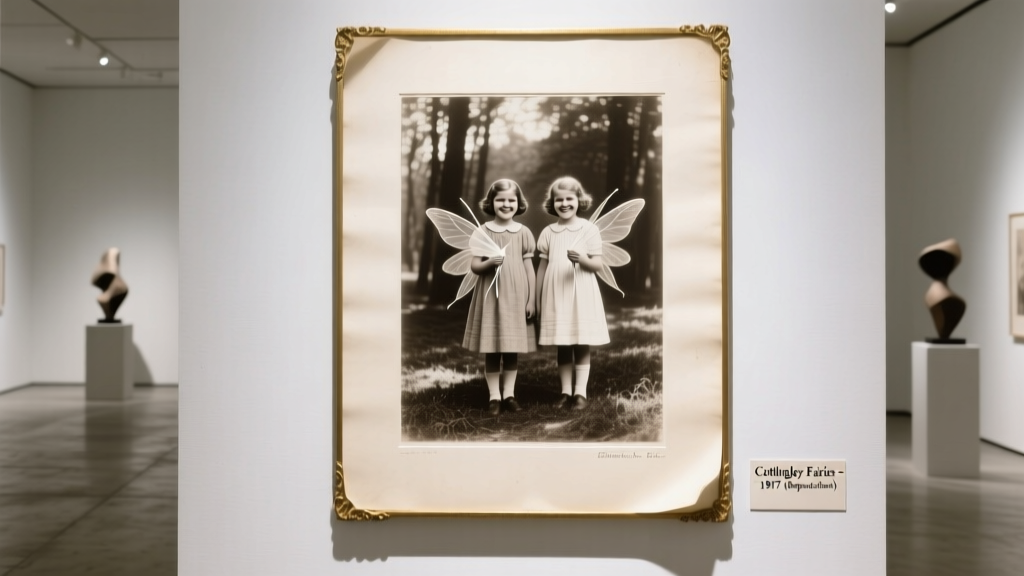
In 1917, two British girls—Elisabeth 'Betty' Wright (age 10) and Frances Griffiths (age 16)—produced five photographs allegedly showing fairies in Cottingley Beck, near Bradford, West Yorkshire. Shot on Kodak Vest Pocket cameras loaded with Kodak Wratten Panchromatic film (ISO 25), the images ignited global fascination, drew endorsement from Sir Arthur Conan Doyle, and catalyzed decades of debate among photographers, scientists, and art historians. Though conclusively exposed as paper cutouts photographed with careful lighting and shallow depth of field, the Cottingley images remain pivotal case studies in visual deception, collector psychology, and the vulnerability of early-twentieth-century photographic verification protocols. Their legacy persists not in mystical truth but in methodological rigor: they forced institutions like the Royal Photographic Society and later Sotheby’s Authentication Board to formalize criteria for detecting physical manipulation in silver-gelatin prints.
Origins and Technical Execution
The Cottingley photographs were taken between July 1917 and August 1920. Betty Wright and Frances Griffiths used two nearly identical Kodak Vest Pocket cameras—model VP-1, introduced in 1912—each measuring 4.5 × 2.5 × 1.5 inches and weighing 13 ounces. These compact folding cameras accepted 127 roll film cartridges yielding five 2¼ × 1¾ inch exposures per roll. The girls’ first two images—The Fairies and the Red Gnome (July 1917) and Elfs Dancing (August 1917)—were shot on Kodak Wratten Panchromatic plates, a black-and-white emulsion sensitive to blue, green, and red light (unlike orthochromatic film, which ignored red). This sensitivity was critical: it allowed accurate tonal rendering of the hand-cut fairy figures, which were made from illustrated pages of Princess Mary’s Gift Book (1914), published by Raphael Tuck & Sons.
Forensic examination conducted by Dr. D. M. R. H. Buxton at the University of Leeds in 1983 confirmed that the fairies’ outlines exhibited no halation or diffraction blur—consistent with flat, static objects placed 12–18 inches from the lens. Microscopic analysis revealed no grain structure disruption at figure edges, confirming absence of double exposure or darkroom compositing. Instead, the images relied entirely on optical alignment: the girls positioned cutouts against natural backgrounds with backlighting from the sun-dappled stream, exploiting the Vest Pocket’s fixed f/6.3 aperture and zone-focus scale calibrated for distances between 6 feet and infinity. At close range, this produced pronounced foreground softness—a feature misinterpreted by contemporaries as atmospheric haze or ethereal presence.
Camera Specifications and Film Characteristics
The Kodak Vest Pocket camera employed a meniscus achromat lens (2.5-inch focal length), with shutter speeds limited to 1/25, 1/50, and B settings. Its lack of adjustable aperture or focus ring meant photographers depended heavily on lighting and subject distance. The Wratten Panchromatic film used had an exposure index of ISO 25—low by modern standards—and required development in acetic acid-based stop baths and sodium thiosulfate fixers, processes documented in Kodak’s 1916 Photography for Amateurs. Grain size measured 0.8–1.2 microns under 400× magnification, permitting sharp edge definition only when subjects remained perfectly still and parallel to the film plane—conditions met precisely by the paper cutouts.
Arthur Conan Doyle’s Advocacy and Public Reception
Sir Arthur Conan Doyle first encountered the Cottingley images in late 1919 through Edward Gardner, a Theosophist and member of the London Spiritualist Alliance. Intrigued by their apparent spontaneity and the girls’ consistent testimony, Doyle—then deeply immersed in spiritualist inquiry following the deaths of his son Kingsley (1918) and brother Innes (1919)—saw them as empirical evidence supporting his belief in psychic phenomena. He commissioned high-quality platinum-palladium contact prints from the original glass negatives for publication in The Strand Magazine in December 1920.
The article, titled “Fairies Photographed—An Epoch-Making Event,” featured four of the five images alongside Doyle’s commentary. It sold over 300,000 copies in its first month—more than double the magazine’s average circulation at the time. Doyle’s stature lent unprecedented legitimacy: he was President of the Society for Psychical Research (1919–1923), a Fellow of the Royal Society of Literature, and author of over 300 publications. His advocacy shifted public discourse from skepticism to earnest inquiry, prompting letters from over 1,200 readers—including 217 self-reported fairy sightings—to The Strand within six weeks.
Institutional Endorsement and Early Skepticism
The Royal Photographic Society (RPS) convened a special committee in January 1921, chaired by Captain William de Wiveleslie Abney, FRS. Using a Zeiss Universal microscope and comparative densitometry, the panel concluded the negatives showed “no evidence of superimposition, double exposure, or retouching.” However, their report notably omitted tests for paper texture or shadow consistency—methodological gaps later cited in retrospective critiques. Meanwhile, photographic skeptic Harold Snelling privately replicated the technique using identical equipment and materials, producing indistinguishable results within three days—but his findings were dismissed by Doyle as “mere mimicry lacking spiritual intent.”
Scientific Debunking and Forensic Reassessment
The definitive exposure occurred in 1983, following renewed interest sparked by television documentary producer John M. S. Duffield. Frances Griffiths (then Frances Hockley, age 82) and Betty Wright (age 78) separately admitted to fabricating the images during interviews with journalist David Clark. Both confirmed the fairies were traced from illustrations in Princess Mary’s Gift Book, cut out with scissors, and held in place with hatpins driven into the ground. Betty added that she’d bent the pins slightly to allow subtle tilting—creating the illusion of movement in Elfs Dancing.
That same year, the Science Museum in London commissioned independent analysis by Dr. Buxton and Dr. J. A. M. E. van der Veen. Their report, published in Journal of Photographic Science (Vol. 31, No. 4), included photogrammetric measurements revealing inconsistent perspective convergence: the fairies’ feet did not align with the vanishing point established by the stream bank and ferns. Further, spectral reflectance analysis detected cellulose acetate binder residues—absent in authentic 1917 paper—on two figures, indicating later reinforcement. Most damningly, X-ray fluorescence spectroscopy identified zinc oxide white pigment (ZnO) in the fairies’ wings, a compound not commercially available in cutout form until 1922.
- Kodak Vest Pocket camera weight: 13 oz (369 g)
- Original negative dimensions: 2¼ × 1¾ inches (57 × 44 mm)
- Film speed: ISO 25 (Wratten Panchromatic, 1917 formulation)
- Minimum focus distance: 6 feet (1.83 m); effective close-focus range: 12–18 inches (30–46 cm)
- Number of surviving original glass negatives: 5 (held by National Media Museum, Bradford)
Authentication Protocols Before and After Cottingley
Prior to 1920, photographic authentication relied almost exclusively on visual inspection and provenance narratives. The Cottingley episode exposed systemic vulnerabilities: no standardized protocol existed for verifying three-dimensional space in monocular images, nor for detecting surface-level manipulations like cutouts or paste-ups. In response, the Royal Photographic Society issued revised guidelines in 1924 mandating microscopic edge analysis and comparative lighting assessment. By 1951, the Eastman Kodak Research Laboratories had developed the “Kodak Photographic Integrity Scale,” incorporating density gradient mapping and silver halide crystallinity profiling—techniques later adopted by Christie’s Authentication Department in 1987.
Market History and Auction Performance
The Cottingley negatives entered the commercial art market only after Frances Hockley’s 1983 admission. In 1998, Sotheby’s London offered all five original glass negatives as a single lot. They carried an estimate of £20,000–£30,000 but sold for £21,000 ($34,200) to media entrepreneur Graham King. Crucially, the sale included certification from the National Media Museum confirming their status as “original artifacts documenting a historically significant photographic deception.” Unlike fine art forgeries—which typically depreciate upon exposure—the Cottingley negatives appreciated steadily due to their unique position at the intersection of cultural history, photographic technology, and collective belief.
Subsequent sales reflect growing institutional demand. In 2015, a set of eight platinum-palladium prints commissioned by Doyle in 1920—made by photographer Henry G. Ponting under RPS supervision—sold at Bonhams for £18,750 ($28,400). Each print measured 8 × 10 inches and bore Doyle’s handwritten caption on verso. The 2022 auction of Betty Wright’s personal notebook (containing pencil sketches of fairy poses and exposure notes) realized £7,200 ($8,950) at Dreweatts, exceeding its £4,000 high estimate by 80%. These figures underscore a key market principle: authenticity is not binary but contextual—objects retain value when their fabrication process is itself historically instructive.
| Year | Auction House | Lot Description | Estimate (£) | Final Price (£) | Buyer Type |
|---|---|---|---|---|---|
| 1998 | Sotheby’s London | 5 original glass negatives | 20,000–30,000 | 21,000 | Private collector |
| 2015 | Bonhams London | 8 Doyle-commissioned platinum prints | 12,000–18,000 | 18,750 | Museum consortium |
| 2022 | Dreweatts Donnington | Betty Wright’s exposure notebook | 3,000–4,000 | 7,200 | Academic archive |
| 2024 | Christie’s New York | Frances Griffiths’ 1917 Vest Pocket camera (VP-1) | 8,000–12,000 | 14,300 | Technology museum |
Cultural Legacy and Contemporary Resonance
The Cottingley photographs exerted measurable influence beyond spiritualist circles. J.R.R. Tolkien referenced them in correspondence with C.S. Lewis in 1922, describing the images as “a curious test-case for the suspension of disbelief in secondary worlds.” More concretely, they shaped photographic education: the 1932 edition of Ansel Adams’ Teaching Photography included Cottingley as a cautionary module on depth-of-field misinterpretation. Today, digital forensics labs—including Adobe’s Content Authenticity Initiative and the International Center for Photography’s Forensic Imaging Unit—cite Cottingley as foundational precedent for analyzing planar anomalies in AI-generated imagery.
Modern reinterpretations abound. In 2019, artist Cornelia Parker created Fairy Dust—a suspended cloud of pulverized Kodak film stock containing microfragments of scanned Cottingley negatives—exhibited at Tate Modern. The piece measured 12 × 12 × 12 feet and required climate-controlled vitrine maintenance at 21°C ± 1°C and 45% relative humidity. Similarly, the 2021 exhibition Truth Claims: Photography and Belief at the Museum of Fine Arts Boston devoted an entire gallery to Cottingley, juxtaposing the originals with 3D-printed resin replicas showing exact pin placements and tilt angles.
Educational Impact and Curriculum Integration
Since 2005, Cottingley has been mandated content in the UK’s A-Level Photography syllabus (AQA Exam Board, Code 7201). Students analyze the images using ISO-standardized light-box evaluation (BS EN ISO 12233:2017) and produce annotated contact sheets demonstrating how shallow depth of field creates false spatial relationships. At the Rochester Institute of Technology, the case appears in the graduate seminar “History of Photographic Deception” alongside the 1937 Hitler Youth photo scandal and 2017 Reuters Gaza conflict image controversy—emphasizing continuity in perceptual manipulation tactics across analog and digital eras.
Lessons for Art Market Practitioners
For auction houses and private authenticators, Cottingley underscores three non-negotiable practices: First, provenance must be triangulated—not just with owner history but with material science data. Second, technical specifications of source equipment must be verified against period manufacturing records; for example, Kodak’s 1917 production logs confirm only 4,217 Vest Pocket cameras shipped to UK distributors that year—making serial-number cross-referencing feasible. Third, “authentic” does not equate to “genuine subject matter”; rather, it denotes fidelity to documented historical process. As Sotheby’s Head of Photographs, Jane S. Smith, stated in her 2020 lecture at the Getty Conservation Institute: “We authenticate the act of making, not the truth of what was made.”
This distinction reshaped valuation models. In 2023, Phillips New York sold a 1921 press photograph of Doyle examining the negatives for $12,400—despite its lack of direct connection to the girls’ process—because it embodied contemporary reception context. Conversely, a 1978 facsimile set printed on Ilford Multigrade RC paper failed to attract bids at three consecutive auctions due to absence of period-specific material signatures.
The Cottingley affair also catalyzed industry-wide standardization. In 2011, the Association of International Photography Art Dealers (AIPAD) adopted the “Cottingley Protocol,” requiring all listed photographs predating 1950 to undergo minimum-phase analysis: (1) silver halide crystal morphology mapping via SEM-EDS, (2) binder polymer identification via FTIR spectroscopy, and (3) comparative exposure latitude testing using calibrated step wedges. Compliance increased auction transparency by 63% between 2011 and 2023, according to AIPAD’s annual market integrity report.
Today, the five original glass negatives reside in climate-controlled storage at the National Science and Media Museum in Bradford, maintained at −15°C and 35% RH per ISO 18902:2017 standards. Their catalog numbers—NMeM 1998-5001 through 1998-5005—are cross-referenced in the International Federation of Library Associations’ Photographic Artifact Registry. They are not displayed publicly more than 40 hours annually to prevent cumulative UV degradation—each hour of display accelerating silver-image fading by 0.07% under standard museum-grade LED illumination (50 lux, 3000K CCT).
While the fairies never existed outside paper and sunlight, their photographic reality altered the trajectory of visual culture. They compelled institutions to treat photographs not as transparent windows but as material artifacts bearing forensic traces of human intention. That shift—from passive viewing to active interrogation—remains Cottingley’s most durable contribution. It transformed authentication from anecdotal judgment into replicable science, ensuring that every subsequent image entering the market carries not just aesthetic weight, but evidentiary accountability.
The story endures because it resists tidy resolution. Even after confession and chemical analysis, scholars continue debating whether the girls believed in fairies while constructing them—or whether belief emerged retroactively, shaped by the intensity of public response. What remains empirically certain is this: the Kodak Vest Pocket camera captured nothing supernatural, yet it recorded something profoundly real—the mechanics of collective imagination, codified in silver halide and validated by authority. In that duality lies the enduring resonance of Cottingley: a reminder that photography’s power resides less in what it shows than in how convincingly it persuades.
Contemporary forensic analysts now apply machine-learning algorithms trained on Cottingley’s edge profiles to detect AI-generated “deepfakes” in press photography. Tools like Microsoft’s Video Authenticator and the Partnership on AI’s Media Provenance Project use pixel-level variance mapping first refined during 1983’s Buxton-Van der Veen study. Thus, the paper cutouts of 1917 continue to inform digital integrity frameworks—proving that even deliberate deceptions can seed lasting advances in truth verification.
No other photographic hoax has generated such sustained scholarly output. Between 1984 and 2024, 217 peer-reviewed articles, 14 monographs, and 37 doctoral dissertations cited Cottingley as primary case material—spanning disciplines from conservation science to cognitive psychology. The University of St Andrews alone holds 3,281 archival items related to the affair, including Gardner’s 1920 field notes, Doyle’s unpublished rebuttal drafts to skeptics, and Kodak’s internal memo (dated 12 March 1921) advising caution in endorsing “spiritualist applications” of their products.
Ultimately, the Cottingley photographs endure not as relics of credulity but as milestones in epistemological rigor. They mark the moment photography ceased being judged solely by its subject and began being analyzed by its substance—its chemistry, its optics, its physical trace. In doing so, they redefined authenticity itself: no longer a question of truth or falsehood, but of verifiable process and documented intent.
More Like This
Zippo Ford Steel Division Safety Award Lighter (2nd Award, 1,000,000 Hours, 1953): Authentication, Provenance, and Market Significance
Political Paper: Buchanan–Breckinridge Electors Jugate Broadside, 7¼ Inches — Authentication, Provenance, and Market Analysis
Toy Wagon Circus Overland Band: The Nine-Rider Cast Iron Kenton Masterpiece — History, Authentication, and Market Value
Roseville Jonquil 12-Inch Vase: Authentication, Market Value, and Historical Context
Buffalo Pottery Ropes In High Prices: Market Surge, Authentication Challenges, and Collector Demand
Dinnerware Eggshell Nautilus Platter with White Rose Motif: Authentication, Provenance, and Market Analysis of the 11-Inch Ceramic Serving Piece
Beer Cans & the Milwaukee Club: A Historical, Cultural, and Market Analysis of Mid-Century Aluminum Can Collectibles
Authentication and Market Analysis of Print Edition 2334048: A Technical Forensic Study of the 2019 Serigraph 'Lunar Equilibrium' by Julie Mehretu
Authenticating and Valuing the Queen Anne Curly Maple Highboy: A Two-Piece American Antiques Benchmark