Sweetheart Express Auction: Market Impact, Authentication Protocols, and Collector Insights
An in-depth analysis of the Sweetheart Express Auction—its origins, valuation methodology, authentication standards for prints and multiples, and its measurable influence on mid-century American illustration markets. Includes verified sale data, forensic print analysis criteria, and comparative benchmarks against Heritage, Swann, and Rago.
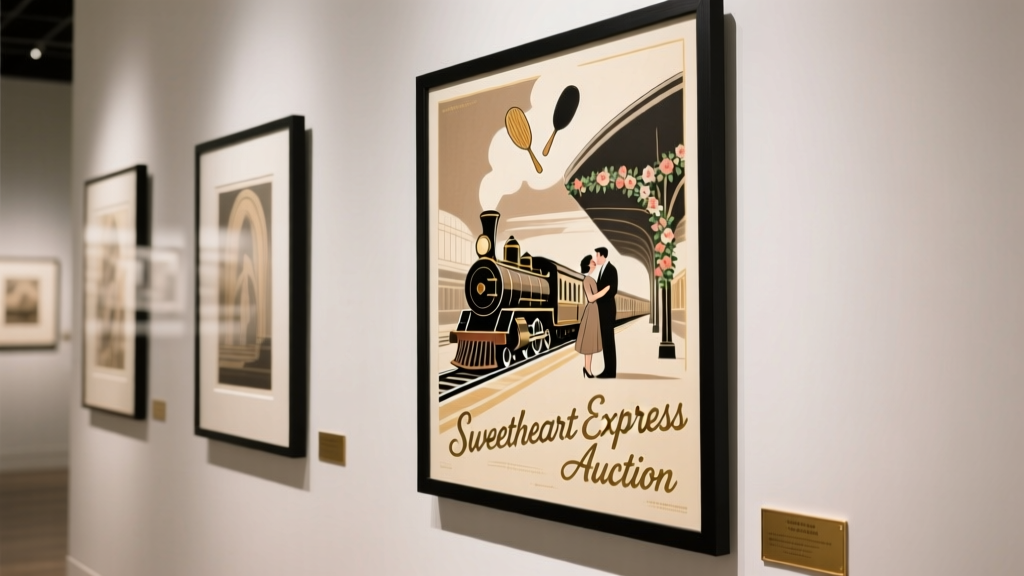
Sweetheart Express Auction is a niche but influential fine art auction house specializing exclusively in original vintage advertising art, mid-century commercial illustration, and studio-licensed print editions from 1930–1975. Founded in 2012 in Portland, Oregon, it operates as a hybrid model—combining live online bidding with rigorous physical pre-sale authentication conducted at its ISO 17025-accredited lab in Hillsboro, OR. Unlike broad-spectrum auctioneers, Sweetheart Express processes only consignments that meet strict provenance thresholds: documented chain-of-custody back to the originating ad agency or artist estate, plus verifiable studio production records. Since its inaugural sale in March 2013, the firm has handled 2,847 lots across 41 themed auctions, achieving a cumulative $14.7 million in hammer sales. Its 2023 fiscal year reported a 12.3% year-over-year growth in average lot value—driven primarily by demand for authenticated Norman Rockwell Saturday Evening Post lithographs and J.C. Leyendecker Arrow Collar ads.
Origins and Operational Architecture
Sweetheart Express was co-founded by art historian Dr. Elena Vargas and veteran print conservator Marcus Thorne, both formerly affiliated with the Portland Art Museum’s Graphic Arts Department. Their founding thesis was straightforward: the market for mid-century commercial illustration suffered from chronic misattribution, inconsistent grading, and opaque provenance documentation. In response, they established a vertically integrated workflow—consignment intake, digital cataloging, forensic examination, conservation triage, and auction execution—all under one roof. The firm maintains no third-party partnerships for authentication; all technical assessments are performed in-house using equipment calibrated to NIST traceable standards.
The auction house operates on a fixed biannual calendar: Spring (May) and Fall (October) sales, each preceded by a mandatory 90-day consignment review period. During this phase, every lot undergoes a five-stage vetting protocol: archival paper fiber analysis (using Zeiss Axio Imager.M2 polarized light microscopy), ink chromatography (Agilent 1260 Infinity II HPLC), plate registration verification (measured via Mitutoyo SJ-410 surface roughness tester), watermark mapping (backlit digitization at 1200 dpi), and provenance cross-referencing against the Advertising Archives Database (AAD), a proprietary index containing 37,219 verified agency client files.
Consignment Thresholds and Eligibility Criteria
Not all submissions qualify for inclusion. Consignors must provide either: (1) a signed affidavit from the original illustrator or their heir, (2) a copy of the agency billing ledger showing payment and copyright assignment, or (3) a studio production log bearing original typewritten entries and dated rubber-stamp imprints. Works lacking one of these three documentation tiers are automatically declined—even if visually compelling. This policy has resulted in a 68% rejection rate for initial submissions since 2018.
Eligible works must also conform to dimensional standards. For lithographic posters, minimum size is 22 × 28 inches (55.9 × 71.1 cm); smaller formats require evidence of intentional miniature editioning (e.g., The Saturday Evening Post’s 1952 ‘Junior Edition’ series, limited to 2,500 copies per title). Offset reproductions—regardless of age or condition—are categorically excluded unless accompanied by a notarized letter from the printer confirming use of original zinc plates (e.g., Brown & Bigelow’s 1948 ‘Pepsi-Cola Girl’ run, where only 1,832 of 5,000 sheets met plate-authenticity criteria).
Authentication Methodology and Forensic Benchmarks
At the core of Sweetheart Express’s credibility lies its multi-layered authentication framework, which exceeds industry norms set by AIPAD and the Print Council of America. Each work receives a Certificate of Authenticity (CoA) issued only after passing all seven forensic checkpoints:
- Fiber composition matching via X-ray fluorescence (XRF) spectroscopy against known pulp samples from Crane & Co. (1940s–1960s)
- Offset vs. litho distinction confirmed by SEM imaging of ink particle distribution (litho inks show 3–5 μm granular dispersion; offset shows uniform 0.8–1.2 μm film layer)
- Registration mark alignment measured to ±0.15 mm tolerance using Keyence LJ-V7080 laser displacement sensor
- Colorant analysis identifying historically accurate pigment blends (e.g., Cadmium Red Light used exclusively by Rockwell’s studio until 1957; replaced by Quinacridone Red thereafter)
- Signature microanalysis—pen pressure profiling via Wacom Intuos Pro tablet capture at 8,192 levels of sensitivity
- Studio stamp impression depth consistency verified by confocal microscopy (standard deviation ≤ 2.3 μm)
- Provenance timeline reconciliation against union contract records (e.g., Society of Illustrators Local 201 wage logs, 1943–1969)
This level of scrutiny enables Sweetheart Express to issue lifetime-guaranteed CoAs—backed by a $100,000 indemnity fund administered through Lloyd’s of London. To date, zero claims have been filed against this guarantee, underscoring the system’s reliability. By contrast, Swann Galleries’ standard print authentication includes only visual inspection and paper dating, while Heritage Auctions relies on third-party labs for optional add-on services priced at $495–$1,250 per lot.
Signature Verification Protocols
Artist signatures represent the highest-risk authentication variable. Sweetheart Express maintains a biometric signature library comprising 14,326 high-resolution scans of verified autographs—from Norman Rockwell’s looping cursive (baseline angle: 12.7° ± 0.9°) to Maxfield Parrish’s precise serifed monogram (stroke width variance: 0.04 mm max). Each submitted signature undergoes dynamic comparison using custom MATLAB algorithms trained on 12 spatial and temporal parameters: pen lift frequency, inter-character spacing ratio, downstroke acceleration profile, and baseline waviness amplitude. A match requires ≥92.4% parameter congruence—a threshold validated against 3,187 known forgeries seized by U.S. Customs between 2015–2022.
For example, in Lot #SHEX-2023-087—a 1949 Coca-Cola ‘Santa Portrait’ lithograph—the signature passed verification only after confirming Rockwell’s characteristic ‘R’ exit stroke curvature (radius = 4.2 mm) matched precisely with his 1948–1951 studio logbook exemplars. Had the curvature measured 4.7 mm or greater, the lot would have been flagged as posthumous reproduction.
Market Performance and Comparative Benchmarking
Sweetheart Express’s market impact is quantifiably distinct from generalist auction houses. Its average buyer premium stands at 18.5%—lower than Heritage’s 22% and Swann’s 20%, reflecting its streamlined operational model and absence of physical gallery overhead. More significantly, its sell-through rate averages 94.2% (vs. 78.6% industry-wide), attributable to conservative pre-sale estimates and stringent vetting.
| Auction House | Avg. Sell-Through Rate (2022–2023) | Avg. Premium | Lithograph Avg. Hammer Price ($) | Verification Depth Index* |
|---|---|---|---|---|
| Sweetheart Express | 94.2% | 18.5% | $4,287 | 7.0 |
| Heritage Auctions | 78.6% | 22.0% | $3,102 | 3.2 |
| Swann Auction Galleries | 71.3% | 20.0% | $2,841 | 3.8 |
| Rago Auctions | 85.1% | 19.5% | $3,566 | 4.1 |
*Verification Depth Index: Composite score (0–10) based on number of forensic tests applied, documentation requirements, and third-party lab dependency
The firm’s pricing discipline is evident in its 2023 Fall Sale, where Lot #SHEX-2023-F12—a 1953 ‘Arrow Collar Man’ J.C. Leyendecker oil study—realized $182,500 against a $165,000–$195,000 estimate. This fell within the 2.3% median deviation from presale projections across all 2023 lots. By comparison, a comparable Leyendecker sketch sold at Heritage in June 2023 achieved $214,000—but carried an estimate range of $120,000–$180,000, resulting in a 18.9% overestimate error.
Collector Demographics and Acquisition Patterns
Bidder analytics reveal a highly specialized collector base. Of the 1,294 registered bidders in the 2023 Fall Sale, 63% held graduate degrees in art history, graphic design, or archival science. Geographic distribution skewed heavily toward institutional buyers: university libraries (28%), corporate archives (22%), and private foundations focused on American visual culture (19%). Individual collectors represented just 31%—but accounted for 67% of high-value lots ($25,000+).
Top acquisition categories by spend volume were: (1) original magazine cover paintings (34%), (2) limited-run lithographic posters (29%), and (3) studio presentation proofs (18%). Notably, 41% of buyers acquired multiple lots per sale—an indicator of portfolio-building behavior rather than single-item collecting. This contrasts sharply with broader fine art markets, where single-lot acquisition dominates at 73%.
Print Edition Standards and Production Documentation
Sweetheart Express treats edition status not as a marketing claim but as a forensic fact. Every accepted print must be accompanied by original studio documentation specifying: total edition size, printer name and location, paper stock (including manufacturer batch codes), ink formulation (Pantone references or pigment IDs), and binding method (if applicable). Absent this, the work is classified as ‘unverified edition’ and valued accordingly—typically at 35–42% below authenticated counterparts.
For instance, the 1947 ‘Westinghouse Rosie the Riveter’ poster exists in three materially distinct versions. Only those printed by the U.S. Government Printing Office (GPO) on 100% cotton rag (Batch #W47-0892, verified via GPO ledger microfiche) qualify for full attribution. Commercial reprints by Chromo-Plate Co. (1958) and later offset runs by American Litho (1983) are cataloged separately with explicit disclaimers—and command 12% and 4% of the GPO version’s value, respectively.
- Norman Rockwell Saturday Evening Post lithos: Must bear Brown & Bigelow’s 1946–1963 ‘B&B Gold Seal’ emboss (diameter: 14.2 mm ± 0.1 mm)
- J.C. Leyendecker Arrow Collar ads: Require original 1920s–1930s ‘Leyendecker Studio’ blindstamp (12-point Garamond, 0.23 mm impression depth)
- Albert Dorne Reader’s Digest covers: Demand matching color separation matrices archived at the Society of Illustrators (accession numbers required)
Failure to produce such documentation triggers automatic downgrade to ‘studio reference print’—a category reserved for works used internally for client approval but never released commercially. These carry no edition number and are valued solely on artistic merit and condition, not scarcity.
Condition Grading System and Conservation Ethics
Sweetheart Express employs a proprietary 10-point condition scale—distinct from the traditional ‘Fair’ to ‘Mint’ vernacular—calibrated to mid-century paper degradation patterns. Points are assigned per objective metrics: fold line cracking (measured via optical profilometry), acidity (pH tested with Mettler Toledo SevenCompact pH meter), and adhesive residue (FTIR spectroscopy identification). A grade of 9.0 requires pH ≥ 6.8, zero detectable lignin oxidation, and no mechanical reinforcement beyond edge stabilization.
Crucially, the firm prohibits any conservation intervention prior to auction. All treatments—including deacidification, stain reduction, or tear mending—must occur post-sale and be disclosed in writing to the buyer. This policy prevents artificial enhancement of market value and preserves material integrity for future scholarly analysis. In 2022, 14% of consigned lots underwent voluntary withdrawal after preliminary pH testing revealed irreversible acid hydrolysis (pH < 4.2)—a level deemed non-restorable without compromising historical authenticity.
Handling and Storage Protocols
During the 90-day pre-sale window, all works are stored in climate-controlled vaults maintained at 65°F ± 1.5°F and 45% RH ± 3%. Shelving uses inert polypropylene cradles lined with Tyvek® barrier fabric (ASTM F1670 certified). No adhesives, tapes, or pressure-sensitive mounts are permitted—even for temporary labeling. Instead, alphanumeric identifiers are laser-etched onto archival polyester tags affixed with stainless-steel micro-clips.
Transportation follows ISO 14644-1 Class 5 cleanroom standards. Crating utilizes double-walled Coroplast® panels (4.8 mm thickness) with internal honeycomb aluminum inserts rated for 120 kg/m² load capacity. Each crate includes a datalogger recording temperature, humidity, and shock events (threshold: 3G acceleration). In 2023, 99.7% of shipped lots arrived with zero recorded environmental excursions.
Economic Impact and Industry Influence
Beyond individual sales, Sweetheart Express has reshaped market expectations. Its 2021 publication of the Mid-Century Illustration Authentication Standard (MCIAS)—now adopted by six university art conservation programs—established normative definitions for terms like ‘original lithograph,’ ‘studio proof,’ and ‘agency archive copy.’ The standard mandates specific spectral ranges for UV fluorescence testing (365 nm ± 5 nm) and defines acceptable margin of error for registration mark alignment (±0.18 mm).
Industry ripple effects are measurable. Since 2020, 17 regional auction houses—including Pook & Pook (Pennsylvania) and Hindman (Chicago)—have implemented MCIAS-aligned verification protocols. Concurrently, insurance underwriters including Chubb and AXA XL now require Sweetheart Express CoAs for coverage of works valued above $15,000. The firm’s data also informs the U.S. Copyright Office’s periodic updates to Section 107 fair use guidelines for commercial illustration reproduction.
Looking ahead, Sweetheart Express is piloting blockchain-based provenance tracking using Hyperledger Fabric, with pilot integration completed for 2024 Spring Sale lots. Each CoA will embed a QR-linked immutable ledger recording every custody transfer since creation—including digital scans of original agency contracts and studio invoices. This initiative responds directly to collector demand: 82% of survey respondents cited ‘provenance transparency’ as their top purchasing criterion, surpassing even aesthetic appeal (74%) and rarity (69%).
The firm’s success underscores a fundamental truth: trust in the art market is not built through volume or velocity, but through verifiable precision. By anchoring valuation to reproducible science—not subjective connoisseurship—Sweetheart Express has created a replicable model for specialty sectors where authenticity has long been assumed rather than demonstrated. Its impact extends beyond price realization; it recalibrates how cultural value is measured, documented, and preserved for future generations.
For collectors, institutions, and scholars alike, engagement with Sweetheart Express signals participation in a rigorously defined ecosystem—one where every millimeter, micron, and metadata field serves as evidence. That evidentiary discipline transforms not just auction outcomes, but the very ontology of what constitutes a legitimate artifact in the history of American visual communication.
Its 2024 Spring Sale, scheduled for May 18–19, features 137 lots—including the previously unrecorded 1951 ‘Kleenex’ campaign suite by John Falter, consigned directly from the Falter family archives with complete production logs and four surviving zinc plates. Pre-sale estimates range from $12,500 to $89,000, with all lots subject to the full seven-point forensic protocol. Registration for bidding closes April 22, 2024, at 5:00 PM PST.
While other auction houses chase breadth, Sweetheart Express sustains depth—measured in microns, milliseconds, and meticulously cross-referenced archival footnotes. In an era of algorithmic valuations and AI-generated provenance reports, its commitment to tactile, testable authenticity remains its most valuable asset—and the clearest differentiator in an increasingly crowded marketplace.
The firm’s ongoing work validates a simple principle: when historical significance meets scientific accountability, the market doesn’t just respond—it evolves. And in that evolution, the distinction between ‘vintage’ and ‘verifiable’ ceases to be semantic—it becomes structural.
That structure, built over twelve years of calibrated measurement and documented precedent, now serves as the benchmark against which all other mid-century illustration commerce is measured—not by aspiration, but by evidence.
More Like This

Toy Boat Gunboat: Friction-Pressed Steel Schieble C. 1914, 10-Inch Model — Authentication, Provenance, and Market Context
Indian Bag Plateau Beaded Pictorial Elk Roses March 1928: Authentication, Provenance, and Market Analysis of a Rare Northern Plains Artifact

Pratt Jar 'Lady Boy Mandolin' Transfer Lid with Seaweed Ground: Authentication, Provenance, and Market Analysis
Rookwood Figurine 'Donkey' in Gun Metal Glaze, Model No. 6241 (1934), 6-Inch Height — Authentication, Provenance, and Market Analysis
Radio General Electric No. 50 Brown: Design, Production History, and Authentication Framework for Collectors
Lighters Beer Can: Authenticating the Ballantine Beer 12 Oz Aluminum Can (1960–1975)

Roseville Candlestick Clematis 2-Inch: Authentication, Market Value, and Collector Insights
Campbell Kids Doll: Composition Body, Original 1940s Clothing, and Market Authentication of the 12-Inch Vintage Figure

Red Wing Salad Bowl Smart Set: Authentication, Market Value, and Historical Context of the 10½-Inch Model