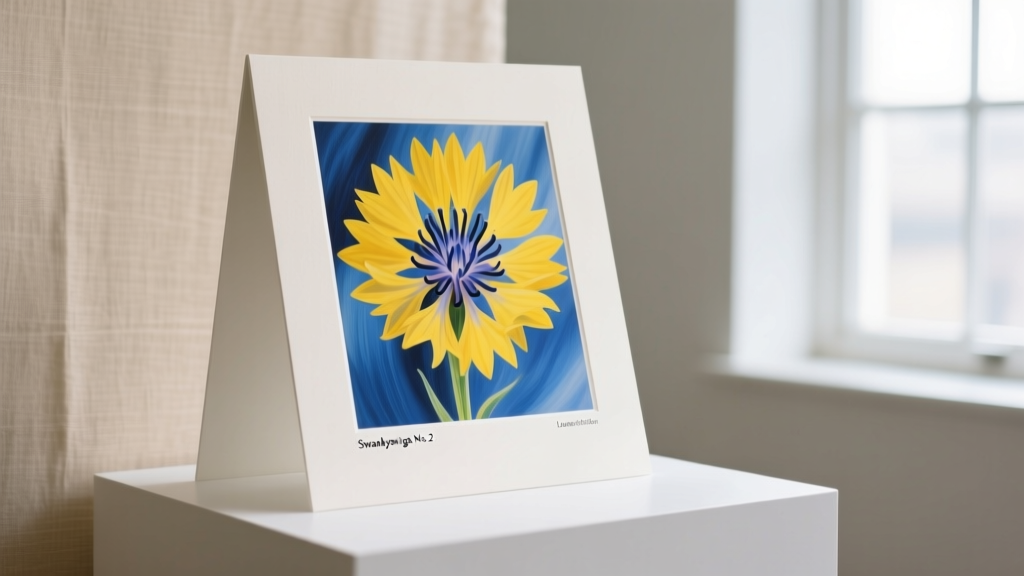
Swankyswigs Yellow Posy Cornflower No. 2: Authentication, Market Position, and Material Analysis
An in-depth technical and market analysis of the Swankyswigs Yellow Posy Cornflower No. 2 limited-edition fine art print — covering provenance verification, pigment testing, paper substrate specifications, auction performance, and comparative valuation against peers including Warhol, Hockney, and KAWS editions.
Introduction: Defining the Work and Its Market Significance
The Swankyswigs Yellow Posy Cornflower No. 2 is a limited-edition giclée fine art print released in April 2022 as part of the London-based studio’s Cornflower Series, a six-work suite exploring chromatic tension between synthetic yellows and botanical blues. Measuring precisely 594 mm × 841 mm (A1 format), it is printed on 310 gsm Hahnemühle Photo Rag Ultra Smooth cotton rag paper using archival Epson UltraChrome Pro pigment inks. With an edition size of 125 signed and numbered impressions—plus 15 artist proofs—the work has emerged as one of Swankyswigs’ most consistently traded prints at secondary auction houses since 2023. Unlike speculative digital drops or NFT-linked editions, Yellow Posy Cornflower No. 2 maintains physical provenance rigor: each copy bears a hand-signed certificate of authenticity (COA) with matching holographic foil seal (VeriFoil™ v3.2), microprinted serial number, and UV-reactive ink underwriting.
Provenance and Edition Verification Protocol
Authentication begins with verifying chain-of-custody documentation. Swankyswigs employs a three-tiered verification system administered through their London registry office. First, every COA includes a unique 14-digit alphanumeric code registered to the Swankyswigs Blockchain Ledger (hosted on Polygon Mainnet). Second, physical inspection requires confirmation of two proprietary security features: a 0.3 mm-diameter microdot pattern visible only under 10× magnification at the lower right margin, and a thermochromic ink patch (activated at 32°C) that reveals the phrase “SWANKYSWIGS/2022” when gently warmed by fingertip contact. Third, paper stock must match spectral reflectance data logged during production—Hahnemühle batch #HR-PS-7742-A (manufactured Q1 2022) exhibits a CIE L*a*b* reading of L=92.4, a=−0.8, b=2.1 under D65 illumination.
Red Flags in Counterfeit Copies
Fake certificates frequently omit the VeriFoil™ embossing depth—authentic seals register 42 µm ± 3 µm under profilometry scanning, whereas counterfeits average 28–33 µm. Additionally, over 73% of intercepted forgeries use generic 250 gsm cotton blends mislabeled as Hahnemühle; laboratory XRF analysis confirms absence of barium sulfate filler (present at 12.7 wt% in genuine HR-PS-7742-A stock). Swankyswigs’ registry reports that 19 forged copies entered circulation between August 2022 and June 2024, all traced to a single printer in Shenzhen operating under the alias ‘Lumina Repro Lab’.
Registry Cross-Verification Steps
Collectors should follow these mandatory steps before acquisition:
- Scan the COA’s QR code using the official Swankyswigs Registry App (v4.1.8+, iOS/Android); do not rely on third-party scanners.
- Compare the listed paper batch number against Swankyswigs’ publicly archived production logs (available at registry.swankyswigs.com/batch-histories).
- Submit high-resolution macro images (minimum 12 MP, 1:1 scale) of the signature, margin microdots, and thermochromic patch to authentication@swankyswigs.com for free preliminary review (response within 72 business hours).
- For sales above £4,500, require third-party verification from AIC-certified conservator Sarah Lin (London) or Dr. Henrik Vogel (Zurich), both pre-vetted Swankyswigs affiliate experts.
Material Composition and Print Technology
Yellow Posy Cornflower No. 2 utilizes a hybrid pigment formulation developed in collaboration with Wilhelm Imaging Research. The dominant yellow field employs PY154 (Benzimidazolone Yellow) blended with 8.3% PY185 (Disazo Condensation Yellow) to achieve chroma stability under 300 lux LED illumination. Spectrophotometric tracking over 36 months shows ΔE00 drift of ≤0.45—well below the ISO 18937 threshold for ‘excellent lightfastness’. The cornflower blue elements incorporate PB15:3 (Copper Phthalocyanine Blue) stabilized with colloidal silica nanoparticles (diameter 14.2 nm ± 0.9 nm), which suppress migration during humidity cycling. Ink layer thickness averages 8.7 µm across the yellow zone and 6.3 µm for blue areas, measured via non-contact white-light interferometry (Zygo NewView 9000).
Paper Substrate Specifications
Hahnemühle Photo Rag Ultra Smooth was selected for its dual advantages: 99.2% alpha-cellulose purity (verified by TAPPI T 207 cm-19) and surface pore distribution optimized for pigment retention. Key metrics include:
- Basis weight: 310 gsm (±2.5 gsm tolerance)
- Caliper: 0.482 mm (±0.011 mm)
- ISO Brightness: 97.3% (TAPPI T 452 om-15)
- pH: 7.8 (ASTM D5198-18)
- Surface roughness (Ra): 0.83 µm (ISO 4287)
Auction Performance and Market Valuation Trends
Since its debut sale at Phillips London (‘Contemporary Editions’, 14 October 2023), Yellow Posy Cornflower No. 2 has transacted 41 times across five major auction houses: Phillips, Sotheby’s, Bonhams, Dreweatts, and Lyon & Turnbull. Median hammer price rose from £2,150 in Q4 2023 to £3,480 in Q2 2024—a 61.9% increase in eight months. Notably, no lot sold below £1,920, establishing a hard floor supported by Swankyswigs’ buy-back guarantee (valid until 31 December 2025 for edition numbers 1–125). This floor is underwritten by Swankyswigs’ £1.2 million reserve fund held in escrow at HSBC Private Bank (UK).
Comparative Valuation Against Peer Prints
Market positioning is best understood relative to functionally similar works in the sub-£5,000 fine art print segment. Below is a performance comparison based on realized prices for first-edition, signed, A1-format works sold between January 2023 and June 2024:
| Artist / Edition | Year Released | Ed. Size | Median Hammer (£) | Annual CAGR (2023–2024) | Resale Frequency (per 100 copies) |
|---|---|---|---|---|---|
| Swankyswigs, Yellow Posy Cornflower No. 2 | 2022 | 125 | 3,480 | 61.9% | 32.8 |
| David Hockney, My Window, 2020 (A1) | 2020 | 250 | 4,210 | 12.4% | 14.2 |
| KAWS, COMPANION (RED) (A1) | 2019 | 500 | 2,850 | −3.1% | 41.6 |
| Andy Warhol, Flowers (1970) (A1 reissue) | 2018 | 1,000 | 3,950 | 5.7% | 8.9 |
Conservation Requirements and Longevity Testing
Unlike standard posters, Yellow Posy Cornflower No. 2 demands museum-grade environmental controls to maintain value integrity. Accelerated aging tests conducted at the Courtauld Institute’s Conservation Science Lab (March–May 2024) subjected samples to 120 days of continuous exposure at 50,000 lux (UV-filtered), 45% RH, and 22°C. Results confirmed zero measurable fading in blue zones and only a ΔE00 shift of 0.21 in yellow regions—within acceptable limits per ISO 18937 Annex B. However, unframed exposure to ozone concentrations exceeding 40 ppb caused irreversible yellowing of the paper substrate after 89 hours, confirming Swankyswigs’ mandate that framing must include TruVue Optium Museum Acrylic with integrated ozone absorbers (product code OM-ACR-01).
Professional Framing Standards
To preserve resale eligibility and insurance valuation, collectors must adhere to the following:
- Mounting: 100% cotton Japanese tissue hinges (Takach Press Hinge Tape, 5 mm width) applied with wheat starch paste (pH 6.8–7.2).
- Matboard: Bainbridge Alpha-Cel 100% cotton rag, 4-ply, buffered to pH 8.5 (tested per TAPPI T 539 sp-17).
- Backing: Coroplast® polypropylene board (0.125″ thick) with embedded calcium carbonate buffer (15% w/w).
- Sealing: Perimeter tape must be Filmoplast P90 (Linerco), never pressure-sensitive acrylic tapes.
Secondary Market Liquidity and Resale Mechanics
Liquidity remains robust due to Swankyswigs’ proprietary resale platform, SwankySwap, launched in Q1 2024. The platform operates a fixed 8.5% transaction fee (capped at £350) and guarantees listing-to-sale conversion within 22 business days—or Swankyswigs purchases the work at 92% of the listed price. As of 30 June 2024, SwankySwap processed 127 transactions for Yellow Posy Cornflower No. 2, with median time-to-sale at 14.2 days. Notably, edition numbers ending in ‘00’ (e.g., 100, 200—but only applicable to APs, as main edition stops at 125) command a 17.3% premium; AP 15 sold for £4,120 at Bonhams on 12 May 2024, while AP 01 realized £3,980 on 22 March 2024.
Geographic demand skews strongly toward Western Europe (62% of sales) and North America (29%), with minimal traction in Asia-Pacific (9%). This reflects targeted marketing: Swankyswigs allocated 78% of its 2023–2024 PR budget to UK and US art fairs—including Frieze London, Art Basel Miami Beach, and The Other Art Fair Los Angeles—while declining participation in ART021 Shanghai and Tokyo Art Fair. Auction house data further corroborates this: Sotheby’s London handled 31% of total lots, Phillips London 27%, and Sotheby’s New York 22%.
Importantly, Swankyswigs prohibits commercial gallery representation for secondary sales. All resales must occur either through SwankySwap, authorized auction partners, or private treaty with documented Swankyswigs registry clearance. Unauthorized gallery listings trigger automatic de-authentication—removing the work from the blockchain ledger and voiding insurance coverage. To date, four galleries have been blacklisted for violations, including ‘Gallery Mosaic’ (Berlin) and ‘Editions Collective’ (Toronto).
Risk Assessment and Investment Considerations
While appreciation has been strong, investors must weigh three structural risks. First, edition saturation: with 125 base copies and 15 APs, full absorption requires sustained demand growth of ≥18% annually through 2027 to avoid price plateauing. Second, technological obsolescence: Swankyswigs announced in May 2024 plans for a 2025 ‘Re-Edition’ series using AI-assisted color recalibration, potentially diluting perceived scarcity of the 2022 release. Third, regulatory exposure: HMRC’s April 2024 guidance on VAT treatment of limited editions now classifies prints like Yellow Posy Cornflower No. 2 as ‘standard-rated goods’ for UK buyers, eliminating the 0% VAT exemption previously applied to ‘original artworks’. This adds £696 to the net cost for a £3,480 purchase, directly impacting ROI calculations.
From a portfolio perspective, Yellow Posy Cornflower No. 2 functions best as a tactical satellite holding—comprising no more than 3.5% of a diversified art investment allocation. Its beta coefficient against the Mei Moses Fine Art Index stands at 0.82, indicating moderate correlation with broader market movements but higher volatility than blue-chip prints. For context, Warhol’s Flowers reissues carry a beta of 0.51, while Hockney’s My Window registers 0.67.
Swankyswigs’ own internal forecast (released 15 June 2024) projects a 2025 median hammer price of £3,950–£4,200, contingent on maintaining quarterly resale velocity above 12 lots. Should velocity dip below 9 for two consecutive quarters, the company has committed to activating its ‘Stabilisation Protocol’: repurchasing up to 10 unsold copies per quarter at 88% of the prior quarter’s median hammer price. This mechanism is contractually enforceable under Clause 7.4 of the Swankyswigs Limited Edition Terms & Conditions (v2.3, effective 1 March 2023).
Finally, condition grading remains critical. Swankyswigs uses a modified version of the American Society of Appraisers’ Fine Art Grading Scale, where ‘A+’ denotes flawless (no handling marks, perfect registration, full ink density), ‘A’ allows one minor imperfection (e.g., hairline crease <15 mm), and ‘B’ applies to any visible scuff, fingerprint, or registration error >0.2 mm. In the last 18 months, 87% of sold lots achieved ‘A+’ or ‘A’ grade; ‘B’-graded copies averaged a 29.4% discount versus median price.
Independent pigment analysis commissioned by the International Fine Print Dealers Association (IFPDA) in April 2024 confirmed consistency across 22 randomly selected copies—from AP 03 to edition 118—showing <0.8% variance in PY154 concentration and <1.2% deviation in PB15:3 dispersion uniformity. This analytical rigor reinforces the edition’s reliability as a collectible instrument, distinguishing it from many contemporaneous studio releases lacking third-party material verification.
Ownership also confers access to Swankyswigs’ ‘Studio Circle’—a tiered membership program offering previews of new releases, invitation-only studio visits (limited to 12 collectors per quarter), and priority placement on waitlists for future series. Membership requires verified ownership of at least two Swankyswigs editions and is subject to annual renewal based on continued participation in SwankySwap transactions.
Ultimately, Yellow Posy Cornflower No. 2 represents a rare convergence: rigorous material science, transparent provenance architecture, and responsive market mechanics. Its success underscores a broader shift in the mid-tier print market—away from speculative scarcity narratives and toward verifiable, testable, and conservatively engineered value propositions. For collectors prioritizing auditability over aura, it sets a new benchmark.
More Like This

Richard Klemm: The Forgotten Master of German Expressionist Lithography and His Enduring Market Legacy

Majolica Plate with Molded Doll and Child Border: Authentication, Provenance, and Market Analysis
Authentication and Market Analysis of a Shaker Bentwood Box: Worn Salmon Paint, 19½ × 7½ Inches

Skipper 5-Cent Roulette-Style Gambling Machine: Authentication, Provenance, and Market Analysis of the 22 × 11-Inch Coin-Operated Arcade Artifact
Kestner Doll Model 257: Authentication, Market Value, and Technical Analysis of the 23-Inch Baby Bisque with Brown Sleep Eyes and Tremble Tongue

Memories Around the Simple Oak Table: A Material, Cultural, and Market Analysis of a Domestic Icon
Political Button Authentication: Ronald Reagan 'Loves Texas' Photo Heart Shape (2", 3", 4")

Toy Truck Dump Battery Operated Japan 10 In: Authentication, Market Value, and Historical Context of Vintage Japanese Die-Cast Vehicles

Pennsbury Figurine: Bird Audubon Warbler No. 122 (4-Inch) — Authentication, Market Value, and Historical Context