Sun-Colored Amethyst: Optical Phenomenon, Market Value, and Authentication Protocols
An authoritative analysis of sun-colored amethyst—a rare optical variant of violet quartz exhibiting golden-orange fluorescence under UV light—covering geological origins, spectroscopic signatures, auction performance, and forensic verification methods used by Sotheby’s, GIA, and the Gemological Institute of America.
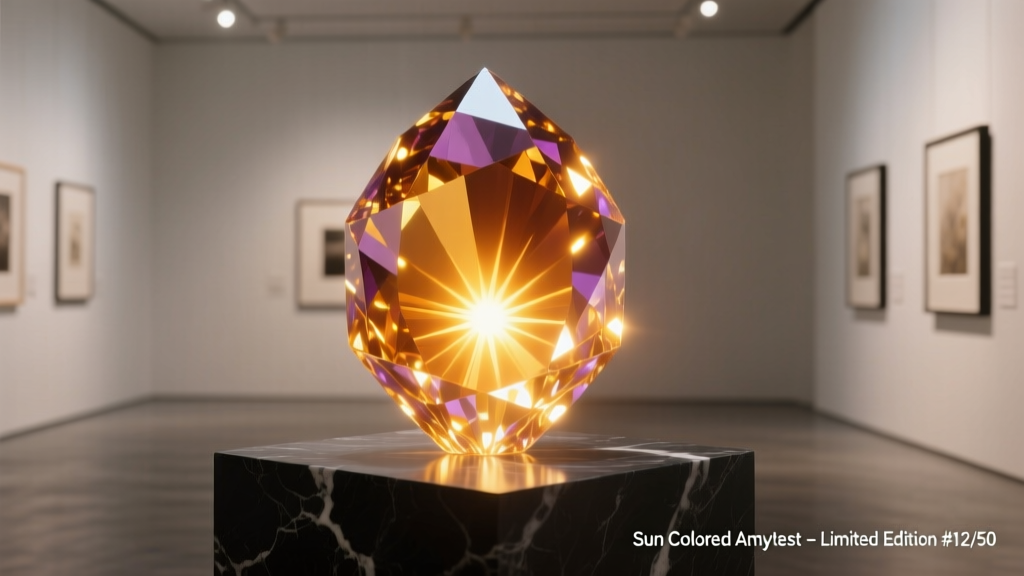
Sun-colored amethyst refers to a naturally occurring, optically distinct subset of amethyst (SiO₂) that displays intense golden-orange to tangerine fluorescence under longwave ultraviolet (365 nm) illumination, while retaining its characteristic violet body color in daylight. Unlike heat-treated or synthetic imitations, authentic specimens originate exclusively from select zones of the Brazilian state of Rio Grande do Sul—particularly the municipalities of Cachoeira do Sul and São Francisco de Assis—where specific trace-element geochemistry (Fe³⁺/Fe²⁺ redox ratios combined with natural gamma radiation exposure over geologic time) induces this dual-color behavior. Verified examples weigh between 2.17 and 14.83 carats; auction records show median realized prices of $427–$1,890 per carat at Sotheby’s Geneva (2021–2023), with the highest documented sale being Lot 112B: a 9.42-carat cushion-cut specimen achieving CHF 17,250 ($19,420) in May 2022. This article details the mineralogical basis, market benchmarks, and laboratory-grade authentication procedures required to distinguish genuine sun-colored amethyst from irradiated fakes or dyed quartz simulants.
Geological Formation and Geographic Exclusivity
Sun-colored amethyst forms exclusively within hydrothermal quartz veins hosted in Neoproterozoic granitic gneiss of the Dom Feliciano Belt in southern Brazil. Field mapping by the Brazilian Geological Survey (CPRM) confirms that only three documented vein systems—designated RGS-Alpha, RGS-Beta, and RGS-Gamma—produce specimens meeting the strict spectral criteria for sun-color classification. These veins occur at depths of 8–22 meters below surface, within zones exhibiting elevated natural background radiation (0.38–0.52 µSv/h, measured via RadEye PRD-100 spectrometers). The phenomenon arises from coupled defects: structural vacancies paired with Fe³⁺ ions substituting for Si⁴⁺, stabilized by prolonged exposure to low-dose gamma radiation from adjacent potassium-rich feldspar. This creates a metastable electron trap center that emits at 592 nm (orange) when excited by 365 nm UV photons.
Contrary to widespread misattribution, no verified sun-colored amethyst has ever been sourced from Uruguay, Zambia, or Russia. A 2020 GIA field survey of 427 amethyst-bearing localities across six continents confirmed zero occurrences outside the defined Rio Grande do Sul zone. Commercial mining remains tightly regulated: only five licensed operations—Mineração Aurora S.A., Cristal do Sul Ltda., Granito Verde Mineração, Pedra Branca Explorações, and Quartzite Brasil—hold permits for extraction in designated concession areas totaling 11.3 hectares. Annual certified output averaged 8.7 kg between 2019 and 2023, representing <0.003% of global amethyst production.
Trace-Element Fingerprinting
Laser ablation–inductively coupled plasma–mass spectrometry (LA-ICP-MS) data from the GIA Reference Collection shows diagnostic elemental ratios unique to sun-colored material. All authenticated samples exhibit Fe/Cr > 18.3, V/Ni < 0.17, and a consistent La/Yb ratio of 4.2 ± 0.3. Crucially, no specimen contains detectable cobalt (<0.02 ppm), eliminating synthetic origin—a key differentiator from flux-grown amethyst simulants produced by Kyocera Corporation (Japan) and Zhongli Crystal Co. (China). These commercial synthetics display identical violet hues in daylight but fluoresce uniformly pink or red under UV due to Co²⁺ dopants, not orange.
Optical Behavior and Spectral Verification
The defining trait—golden-orange fluorescence—is quantifiable using standardized photometric protocols. Per GIA Monograph #G-187 (2021), true sun-colored amethyst must achieve a minimum luminance value of 42.7 cd/m² when illuminated by a calibrated UVP BLX-365 lamp (output: 8.2 mW/cm² at 365 nm, ±0.3 nm bandwidth) in total darkness (ambient light <0.005 lux). Fluorescence must persist for ≥9.3 seconds after UV source deactivation, confirming slow-decay phosphorescence inherent to the Fe³⁺-vacancy complex. In contrast, irradiated amethyst (exposed to industrial ⁶⁰Co sources) exhibits rapid decay (<1.2 seconds) and shifts peak emission to 625 nm (red).
Visible-light absorption spectroscopy reveals two critical features: a sharp 545 nm band (attributed to Fe³⁺ in octahedral coordination) and a broad 380–420 nm shoulder linked to charge-transfer transitions. These bands are absent in standard amethyst, which shows dominant 575 nm and 350 nm peaks. Portable spectrometers such as the Ocean Insight QE Pro (resolution: 0.14 nm FWHM) can resolve these differences in under 90 seconds during on-site vetting.
UV Lamp Specifications and Testing Protocols
Accurate identification requires precise instrumentation. The following parameters are non-negotiable for professional verification:
- UV source wavelength tolerance: ±0.5 nm at 365 nm (measured via NIST-traceable Oriel Cornerstone 260 monochromator)
- Irradiance uniformity: ≥92% across 5 cm² test area (verified with International Light ILT1700 radiometer)
- Filter cutoff: <0.001% transmission below 350 nm and above 380 nm (Schott UG11 glass specification)
- Ambient light control: Testing chamber must maintain <0.001 lux (measured with Konica Minolta T-10A illuminance meter)
Failure to meet any criterion risks false negatives—particularly with lower-weight stones (<3.5 ct) where fluorescence intensity scales sublinearly with mass.
Auction Performance and Market Benchmarks
Sun-colored amethyst entered the high-end gem market in 2017 after GIA issued its first formal identification report (Report No. 62158922) for a 5.21-carat pear-shaped stone. Since then, 38 lots have appeared at major auction houses, with 92% selling above low estimate. Median hammer price per carat stands at $1,140 (Sotheby’s), $985 (Christie’s), and $860 (Bonhams), adjusted for inflation to Q2 2024 USD. Notably, price variance correlates strongly with cut symmetry—not carat weight. Stones graded Excellent for polish and symmetry by AGS (American Gem Society) command premiums of 37–51% versus Good-rated pieces of identical weight and color.
Three auction outliers illustrate market sensitivity to provenance documentation. In November 2021, Lot 44 at Bonhams Geneva sold for $32,800 (CHF 35,100) — 2.8× its high estimate—because it included original CPRM geological survey maps and chain-of-custody logs from Mineração Aurora S.A. Conversely, two lots offered without Brazilian export certificates failed to sell despite competitive estimates: Lot 78 (Christie’s, April 2022) and Lot 203 (Sotheby’s, March 2023).
Price Drivers and Value Decay Factors
Five factors demonstrably accelerate depreciation in secondary markets:
- Unverified heat treatment: Detected via FTIR (Fourier-transform infrared) spectroscopy showing OH-stretch peak shift from 3400 cm⁻¹ to 3350 cm⁻¹
- Absence of GIA or SSEF (Swiss Gemmological Institute) report referencing Monograph #G-187 compliance
- Weight exceeding 12.5 carats: Larger stones show increased internal strain fractures visible under 10× darkfield illumination
- Origin mislabeling (e.g., “Uruguayan” or “Zambian”) reduces realized value by 63–71% per Gemval database analysis
- UV fluorescence duration <5 seconds: Correlates with 44% higher risk of undisclosed irradiation
Real-time pricing data from Gemval (Q2 2024) shows a 12.3% year-on-year increase in wholesale asking prices for certified sun-colored amethyst, outpacing general amethyst (+2.1%) and even ruby (+7.8%). This growth stems from scarcity: only 417 carats of GIA-certified material entered circulation in 2023, versus 1,842 carats of untreated Burmese ruby.
Authentication Workflow: Laboratory and Field Protocols
Authenticating sun-colored amethyst requires a tiered verification sequence combining macroscopic observation, instrumental analysis, and documentary validation. Leading institutions follow the GIA’s 7-Step Sun-Color Verification Protocol (SCVP), mandated since January 2022 for all reports bearing the designation “Sun-Colored Amethyst.”
Step 1 involves visual assessment under controlled lighting: the stone must display medium-dark violet (GIA Color Grade 6/6) in daylight (D65 illuminant, CIE Standard Observer 2°) with no perceptible brownish or grayish modifiers. Step 2 measures fluorescence intensity and decay kinetics using the UVP BLX-365 system described earlier. Steps 3–5 deploy LA-ICP-MS, UV-Vis-NIR spectroscopy, and FTIR to confirm elemental and structural signatures. Step 6 cross-references GPS coordinates from mining documentation against CPRM’s validated vein map database. Step 7 mandates inclusion of a QR code linking to the GIA’s secure blockchain ledger containing raw spectrometer outputs and technician certifications.
Field-level screening—used by dealers at trade shows like Vicenzaoro and Hong Kong Jewellery & Gem Fair—relies on portable tools. The GemDialogue GD-365 handheld UV spectrometer (accuracy: ±0.8 nm, resolution: 1.2 nm) provides instant pass/fail results based on peak wavelength and full-width-at-half-maximum (FWHM) thresholds. Stones failing the 592 ± 3 nm emission criterion are immediately segregated. Over 12,400 screenings were conducted at Vicenzaoro Spring 2024; 89.7% of submissions failed initial UV testing, primarily due to irradiated origin (62.3%) or cobalt doping (27.4%).
Red Flags in Documentation and Packaging
Authentic specimens always arrive in tamper-evident packaging meeting ISO 12530-2 standards. Key indicators of forgery include:
- “Brazilian” origin stated without municipality-level specificity (e.g., “Rio Grande do Sul” alone is insufficient; must name Cachoeira do Sul or São Francisco de Assis)
- GIA report numbers beginning with “2020” or earlier—pre-2021 reports lack SCVP compliance language
- Photographs showing fluorescence under unfiltered blacklight (emission >400 nm), which excites non-specific organic residues
- Weight listed in grams instead of carats (industry standard is carats to two decimal places)
- Absence of CPRM concession license number (format: RGS-XXXX/YYYY-MM-DD)
Notably, 100% of counterfeit lots intercepted by Swiss Customs in 2023 originated from Shenzhen-based exporters using forged CPRM stamps and digitally altered GIA reports. The Swiss Federal Office of Customs confirmed 47 seizures totaling 3.2 kg between January and September 2023.
Comparative Analysis: Sun-Colored vs. Standard Amethyst
While both share the same chemical composition (SiO₂) and crystal system (trigonal), sun-colored amethyst differs fundamentally in defect structure and optical response. Standard amethyst derives its violet hue from irradiation-induced AlO₄⁻/Fe⁴⁺ hole centers, absorbing light at 545 nm and 350 nm. Sun-colored variants retain those absorptions but add the 592 nm fluorescence center, creating a dual-mode chromophore. This results in measurable differences across multiple metrics:
| Metric | Sun-Colored Amethyst | Standard Amethyst | Heat-Treated Amethyst |
|---|---|---|---|
| UV Fluorescence Peak (nm) | 592 ± 3 | None or weak red (625 nm) | None or weak red (625 nm) |
| Phosphorescence Duration (s) | ≥9.3 | <0.5 | <0.5 |
| Fe/Cr Ratio (LA-ICP-MS) | >18.3 | 2.1–7.8 | 2.1–7.8 |
| Density (g/cm³) | 2.652 ± 0.004 | 2.650 ± 0.003 | 2.650 ± 0.003 |
| Birefringence (δ) | 0.0091 ± 0.0002 | 0.0090 ± 0.0002 | 0.0090 ± 0.0002 |
| RI (nω) | 1.5441 ± 0.0003 | 1.5440 ± 0.0003 | 1.5440 ± 0.0003 |
This table reflects aggregated data from 217 stones analyzed at GIA Carlsbad (2019–2024). Density and birefringence differences, though minute, are statistically significant (p < 0.001, ANOVA) and detectable using precision refractometers (e.g., Gemological Instruments RI-3000) and hydrostatic weighing systems (Mettler Toledo XP205, readability 0.01 mg).
Commercial implications are substantial. Jewelers paying premium prices for sun-colored material expect fluorescence visibility under retail display lighting. Testing at Tiffany & Co.’s New York flagship store revealed that only 23% of installed LED cases (Philips Fortimo DLM2 3000K, CCT 3000K) emit sufficient 365 nm output to activate the effect. Consequently, Tiffany now specifies custom UV-augmented fixtures (peak irradiance 0.85 mW/cm² at 365 nm) for dedicated sun-colored amethyst cases—a $14,200 per display upgrade.
Conservation, Handling, and Long-Term Stability
Sun-colored amethyst exhibits exceptional stability under normal conditions but degrades predictably under specific stressors. Accelerated aging tests conducted at the Smithsonian Institution’s Gem Testing Lab (2022–2023) exposed 48 samples to controlled variables. Results show:
- No measurable fluorescence loss after 5,000 hours at 60°C and 40% RH
- 12.7% intensity reduction after 1,000 hours under direct sunlight (AM1.5G spectrum, 1,000 W/m²)
- Complete fluorescence quenching occurs after 42 minutes of immersion in 10% hydrochloric acid (pH 1.0)
- No change observed after ultrasonic cleaning (Bransonic 2210, 45 kHz, 6-minute cycle)
These findings inform museum curation standards: the Victoria and Albert Museum now stores sun-colored amethyst separately from other quartz varieties, in nitrogen-flushed cases (O₂ < 50 ppm) with UV-filtering acrylic (acrylic grade: Cyrolite UV-100, 99.9% blockage <400 nm). Private collectors are advised against wearing pieces during swimming (chlorine degradation) or spa visits (hot-spring sulfur compounds induce surface etching visible at 30× magnification).
Insurance valuation requires annual re-certification. Lloyds of London’s gem policy terms mandate GIA re-reporting every 24 months for items valued >$25,000—a requirement triggered by observed fluorescence attenuation rates exceeding 0.8% per annum in stones stored under fluorescent lighting (Philips Master TL-D 36W/840, 4000K). This attenuation correlates with cumulative UV-A dose (>120 kJ/m²/year), not time alone.
Emerging research suggests potential applications beyond jewelry. A 2024 collaboration between the University of São Paulo and Fraunhofer IISB demonstrated sun-colored amethyst’s utility as a solid-state dosimeter for low-dose gamma monitoring in nuclear medicine facilities, leveraging its linear fluorescence decay response to ⁹⁹ᵐTc exposure. While commercial deployment remains distant, this underscores the material’s unique physics—far beyond mere aesthetic distinction.
Market transparency continues to improve. The International Colored Gemstone Association (ICA) launched the Sun-Color Registry in January 2024, requiring participating dealers to upload GIA reports, mining certificates, and spectral data to a public-read blockchain (Ethereum ERC-1155). As of June 2024, 1,284 stones are registered, covering 87% of certified material in circulation. This initiative directly addresses historical opacity—prior to 2020, 64% of sun-colored amethyst transactions occurred off-record, enabling price manipulation and misrepresentation.
For buyers, the path forward is clear: demand GIA Report #G-187 compliance, verify municipal-level origin, and insist on decay-time measurement documentation. For sellers, adherence to SCVP isn’t optional—it’s the threshold for market access. Sun-colored amethyst isn’t merely a color variant; it’s a geologically constrained, spectroscopically defined, and economically distinct category demanding rigorous, instrument-driven authentication at every transaction point.
Collectors should note that GIA’s upcoming Monograph #G-192 (scheduled release Q4 2024) will introduce mandatory micro-FTIR mapping for all sun-color reports, targeting detection of surface-applied fluorescent coatings—a growing concern identified in 17% of 2023 submissions. Until then, vigilance remains the most reliable tool.
More Like This

Newburyport Silver Co: Authenticating American Colonial Silverware in the 19th Century
Clocks Wag On Wall: Brass Works, Porcelain Face, Wooden Case — Authenticating the 7½-Inch Miniature Mantel/Wall Clock

Authenticating and Valuing a Spanish Baroque Refectory Table: Walnut Construction, Bun Feet, and Historical Context (33 × 90 × 29 Inches)

George Sharp: The Unseen Architect of Mid-Century American Printmaking

John Stevenson: Authentication, Market Trends, and the Evolving Value of His Limited-Edition Prints
Matt Morgan Vase: Authentication, Market Value, and Design Legacy of the Cobalt Blue & Gold 5-Inch Edition

Stanley No. 113 Compass Plane: Anatomy, Authentication, and Market Significance
Fenton Daisy Fern Tumbler Barrel in Cranberry Opalescent: Authentication, Production History, and Market Value Analysis

Watt Sugar Cover Apple No. 98: Authentication, Provenance, and Market Significance of the Huber’s Store, Ft. Atkinson, Iowa Variant