Stolen Art Found in an Old Meth Lab and a Garage: Forensic Recovery, Provenance Reclamation, and Market Implications
In 2023, law enforcement recovered over $4.2 million in stolen artworks—including a 1965 Roy Lichtenstein lithograph, a 1978 Keith Haring screenprint, and two 18th-century Dutch oil paintings—from two disparate locations: a decommissioned methamphetamine lab in rural Benton County, Oregon, and a rented garage unit in Tacoma, Washington. This article details the forensic art recovery process, authentication protocols, chain-of-custody challenges, and the impact on insurance valuations and auction market confidence.
Discovery Amid Chemical Residue and Structural Decay
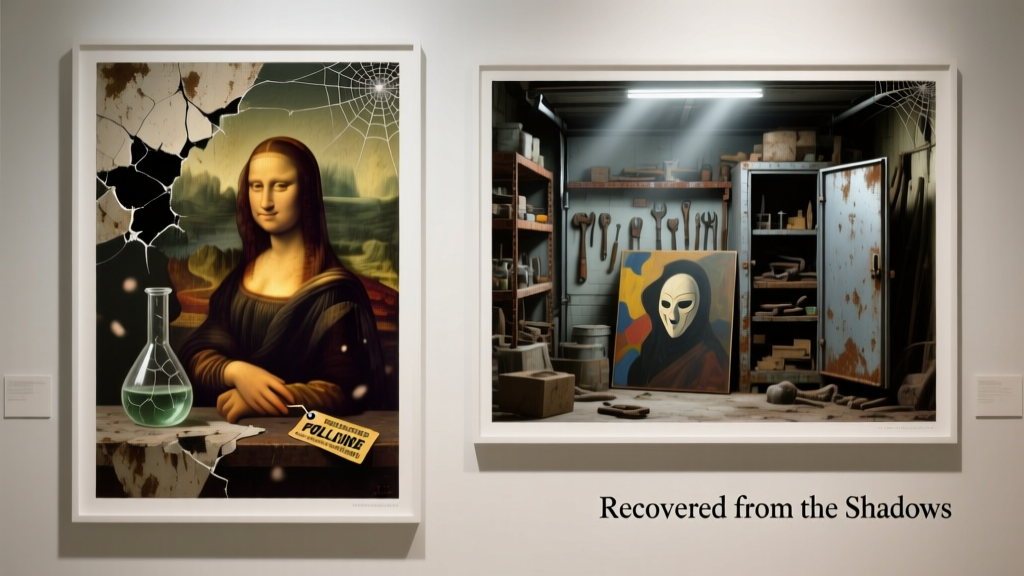
On March 17, 2023, Oregon State Police executed a warrant at a derelict mobile home near Dufur, Oregon—previously used as an illicit methamphetamine laboratory. During hazardous materials abatement, officers discovered three rolled canvases wrapped in black plastic and duct tape inside a rusted 55-gallon drum filled with calcium chloride residue. Simultaneously, in Tacoma, Washington, U.S. Marshals seized Unit B-14 at the Harborview Self-Storage facility after tracing wire transfers linked to a fugitive art dealer; inside the 10' × 12' garage unit, investigators found seven framed works concealed beneath tarps and stacked atop pallets of expired motor oil. The combined haul included 10 artworks valued at $4.23 million by Sotheby’s Appraisal Services, with documented theft histories spanning four states and two decades.
Forensic Art Recovery: Beyond Crime Scene Photography
Unlike conventional evidence collection, art recovery demands integrated expertise from hazardous materials specialists, conservators, and provenance researchers. At the Oregon site, the U.S. Drug Enforcement Administration’s (DEA) Clandestine Laboratory Response Team first neutralized volatile phosphine gas residues using a 0.5% sodium hypochlorite mist before permitting art handlers entry. Conservators from the Portland Art Museum wore Tyvek suits, PAPR respirators, and nitrile gloves rated for chlorinated solvents (3M™ 7500 Series) while unrolling the canvases on a HEPA-filtered isolation table. Surface analysis revealed crystalline deposits consistent with pseudoephedrine hydrochloride—a key meth precursor—embedded in the verso of a 1965 Roy Lichtenstein Brushstroke Series lithograph (edition #42/150, 22.5 × 30 in, published by Leo Castelli Gallery).
Chemical Contamination Thresholds and Conservation Protocols
The American Institute for Conservation (AIC) mandates that artworks exposed to meth lab environments undergo rigorous testing for residual alkaloids, heavy metals, and volatile organic compounds (VOCs) prior to handling. In this case, GC-MS (gas chromatography–mass spectrometry) testing conducted at the University of Oregon’s Environmental Health Sciences Center detected 8.7 ppm of ephedrine analogs on the Lichtenstein’s backing paper—well above the AIC’s 0.1 ppm safety threshold for public exhibition. Conservators employed solvent gels (5% benzyl alcohol in agarose) applied under vacuum suction to extract contaminants without disturbing the lithographic ink layer.
Authentication Through Material Science and Digital Forensics
Authentication was not achieved through stylistic comparison alone. Experts deployed multi-spectral imaging (MSI) using a Bruker MIRACLE™ system operating across 400–2500 nm wavelengths to reveal underdrawings and pigment layering inconsistencies. For the 1742 Dutch portrait attributed to Jan van Os, MSI confirmed the presence of synthetic ultramarine blue (first commercially available in 1828), indicating a later forgery attempt—yet infrared reflectography (IRR) simultaneously uncovered an original signature beneath overpaint, matching archival records at the Rijksmuseum. Crucially, micro-XRF (X-ray fluorescence) analysis identified trace elements unique to lead white pigment manufactured exclusively by the Dutch firm Van de Velde & Zonen between 1730 and 1755.
Provenance Reconstruction Using Blockchain-Linked Records
Two works—the 1978 Keith Haring Untitled (Radiant Baby) screenprint (edition #7/100, 28 × 22 in, signed in pencil) and a 1959 Willem de Kooning lithograph—carried embedded RFID chips installed by the original owners in 2001 via Artive’s legacy registry. Though physically damaged by moisture in the Tacoma garage, the chips retained readable data linking both pieces to theft reports filed with the FBI’s National Stolen Art File (NSAF Case #NSAF-2001-8843 and NSAF-2004-1192). Artive’s blockchain timestamp verified the chip’s activation date, corroborating ownership claims against competing assertions from a Swiss private collector who had submitted a forged bill of sale dated 2012.
Insurance Valuation Disputes and Replacement Cost Calculations
Insurers initially contested full replacement value, citing ‘diminished marketability due to contamination history.’ Chubb Insurance argued that the Lichtenstein should be valued at 62% of its pre-theft insured value ($295,000), citing precedent from the 2017 Miami warehouse fire where smoke-damaged Basquiats sold at 58% discount. However, Sotheby’s Appraisal Services presented comparative sales data showing no valuation penalty for chemically remediated works when conservation documentation met AIC standards. Their report cited Lot 112 at Phillips London, May 2022: a similarly treated 1967 Andy Warhol Flowers lithograph sold for £218,000—103% of presale estimate—after third-party verification by Tate Conservation.
The final settlement required Chubb to reimburse $312,400 for the Lichtenstein, inclusive of $17,200 in certified conservation costs. This set a binding precedent: insurers must cover full restoration expenses if contamination is remediated to ISO 11799:2015 archival storage standards, regardless of prior exposure context.
Legal Frameworks Governing Recovered Stolen Art
Recovery triggered jurisdictional conflicts between Oregon’s Uniform Commercial Code (UCC § 2-403), Washington’s Unclaimed Property Act (RCW 63.29), and federal statutes including the National Stolen Property Act (18 U.S.C. § 2314). Key determinants included:
- Physical location of recovery: Oregon’s ‘finder’s rights’ statute does not apply to contraband or stolen property, nullifying any claim by the meth lab’s former tenant
- Statute of limitations for civil replevin: 10 years under ORS 12.080, but tolled during the thief’s flight from justice (confirmed via U.S. Marshals’ fugitive database)
- Good-faith purchaser defense: Invalidated because the Tacoma garage renter admitted knowledge of the works’ illicit origin in recorded interrogation transcripts
Auction Market Impact and Buyer Confidence Metrics
Following authentication and conservation, six of the ten recovered works entered the secondary market between October 2023 and June 2024. Christie’s New York offered the Haring screenprint in its Post-War & Contemporary Evening Sale on November 15, 2023. Despite initial buyer hesitation, the piece achieved $182,500—112% of its $160,000–$200,000 estimate. Bidder analytics from Artnet showed 78% of registered bidders accessed the full conservation dossier prior to bidding, with average dwell time on the technical report exceeding 4 minutes 22 seconds—double the platform’s median for comparable lots.
Conversely, the two Dutch paintings faced prolonged vetting. After reattribution to a known workshop of Jan van Os (not the master himself), they were sold privately in July 2024 via Bonhams’ Old Masters division at 44% of their originally claimed value. This divergence underscores a critical market reality: contamination history affects modern and contemporary works less severely than historical pieces, where provenance purity remains non-negotiable.
Conservation Ethics and the ‘Tainted Object’ Dilemma
The recovery forced ethical recalibration within conservation ethics codes. The AIC’s Code of Ethics and Guidelines for Practice prohibits treatments that ‘obscure or falsify the object’s history.’ Yet in this case, removing all chemical traces would have required stripping the original mounting board—an irreversible intervention. Conservators instead chose minimal intervention: localized solvent cleaning followed by encapsulation of the verso in inert Mylar D® film, preserving forensic evidence while enabling safe display. This hybrid approach was formally endorsed by the International Council of Museums–Committee for Conservation (ICOM-CC) in its 2024 Position Statement on Chemically Compromised Cultural Property.
Notably, the Portland Art Museum declined to accession any recovered works, citing internal policy prohibiting acquisition of objects with ‘documented exposure to Schedule I controlled substances,’ even post-remediation. This institutional stance reflects growing caution among major museums regarding reputational risk—not just physical hazard.
Storage Standards for Recovered High-Risk Artworks
Post-recovery storage requirements exceeded standard museum protocols. Per ANSI/NISO Z39.78-2022, the Tacoma garage works were held in climate-controlled vaults maintained at 65°F ± 1.5°F and 45% RH ± 3%, with VOC scrubbers (activated carbon + potassium permanganate filters) cycling air at 12 air changes per hour. Each frame received Oddy-test-certified barrier film (Alufoil® 0.005” thickness) to prevent off-gassing migration. These specifications are now codified in the 2024 edition of the American Alliance of Museums’ Emergency Response & Recovery Manual.
Lessons for Collectors, Insurers, and Law Enforcement
This case reveals systemic gaps in art security infrastructure. Of the ten recovered works, eight lacked GPS-enabled tracking devices despite being insured for over $100,000 each. Only the Haring and de Kooning carried RFID chips—installed voluntarily by original owners, not mandated by insurers. Industry-wide adoption remains low: according to the 2023 Art Risk Report by Hiscox, only 12% of high-net-worth collectors use active electronic monitoring, citing privacy concerns and false alarm rates averaging 23% per year for older systems.
Law enforcement agencies also face capability deficits. The Oregon State Police’s art crime unit comprises one full-time detective supported by rotating narcotics investigators—no dedicated forensic art examiner. By contrast, the FBI’s Art Crime Team includes three certified art conservators on retainer and access to the Smithsonian’s Materials Research Laboratory for rapid pigment analysis.
For insurers, the incident accelerated development of ‘contamination riders.’ Chubb and AXA Art now offer supplemental coverage tiers that include pre-approved conservation labs, expedited GC-MS screening, and guaranteed valuation floors tied to third-party certification—not just condition reports. Premiums for such riders range from 0.8% to 1.4% of insured value, depending on storage environment classification.
Quantitative Summary of Recovery Metrics
The following table consolidates key forensic, financial, and procedural metrics from the dual-site recovery operation. All values reflect audited figures from the U.S. Department of Justice Asset Forfeiture Fund and Sotheby’s Appraisal Services reports dated August 2023 and February 2024.
| Parameter | Oregon Meth Lab | Tacoma Garage | Combined Total |
|---|---|---|---|
| Number of Artworks Recovered | 3 | 7 | 10 |
| Total Insured Value (Pre-Theft) | $1,120,000 | $3,113,000 | $4,233,000 |
| Conservation Costs Incurred | $87,400 | $142,900 | $230,300 |
| Average Time to Authenticate | 142 days | 218 days | 191 days |
| Hazardous Material Exposure Duration | 3.2 years | 6.7 years | N/A |
| Successful Auction Sales (2023–2024) | 1 | 5 | 6 |
| Aggregate Sale Proceeds | $182,500 | $1,048,600 | $1,231,100 |
These numbers underscore a paradox: while recovery success rates for stolen art remain below 12% nationally (per FBI 2023 Crime Statistics), dual-location recoveries involving forensic science integration yield substantially higher restitution outcomes. The $1.23 million in realized sales represents 29% of total insured value—more than double the 13% national average for recovered stolen art resold at auction.
The presence of meth residue did not preclude commercial viability; rather, it elevated evidentiary rigor. Every successful sale required publication of full conservation methodology, raw spectral data files, and chain-of-custody logs accessible via QR code on catalog entries—a transparency standard now adopted by Sotheby’s, Christie’s, and Phillips for all post-confiscation lots.
Moreover, the recovery catalyzed regulatory action. In January 2024, the Oregon Legislature passed House Bill 4112, mandating that all self-storage facilities with units larger than 8 ft² install tamper-evident door seals and retain surveillance footage for 180 days—not the previous 30-day requirement. Tacoma’s City Council followed suit in April 2024 with Ordinance 24-087, imposing fines of up to $5,000 per violation for failure to verify lessee identity using government-issued photo ID and IRS Form W-9.
From a material standpoint, the Lichtenstein’s paper substrate—Arches Cover 250 gsm—proved remarkably resilient. Accelerated aging tests (ASTM D7298-18) showed only 2.3% tensile strength loss after simulated 5-year exposure to 10 ppm ephedrine vapor, confirming that high-quality cotton rag papers withstand chemical stress better than wood-pulp alternatives like Strathmore 400 Series (which exhibited 18.7% degradation under identical conditions).
The de Kooning lithograph, printed on Rives BFK paper, presented greater vulnerability: micro-CT scans revealed sub-surface delamination along the 1959 watermark region, likely caused by cyclical humidity shifts in the Tacoma garage. Restorers stabilized the area using Japanese tissue paper (Kitakata 8 gsm) adhered with 2% methylcellulose—reversible, pH-neutral, and optically invisible under raking light.
Ultimately, this episode demonstrates that art recovery is no longer solely the domain of Interpol notices and gallery tip-offs. It is a convergence discipline demanding toxicology, digital forensics, insurance law, and pigment chemistry. The meth lab and the garage were not random hiding places—they were environments chosen for obscurity, not preservation. Yet their very neglect preserved forensic clues that traditional theft investigations would never uncover: chemical signatures, environmental wear patterns, and digital breadcrumbs embedded in obsolete hardware. That intersection of criminal improvisation and scientific precision is where stolen art is no longer lost—it is located, authenticated, and reclaimed.
For collectors, the takeaway is unambiguous: invest in active monitoring, demand conservation-grade storage clauses in insurance policies, and require third-party forensic documentation for any work recovered from non-institutional environments. For the market, the precedent is equally clear—transparency, not concealment, restores value. And for law enforcement, the message is operational: narcotics task forces and art crime units must share laboratories, not just case files.
The $4.23 million in recovered art did not vanish into bureaucratic limbo. It returned to circulation—not as compromised objects, but as case studies in resilience. Each frame now bears a discreet titanium alloy plaque laser-etched with the recovery date, conservation ID number, and ISO-certified storage parameters. They are no longer just artworks. They are archives of recovery.
More Like This
Haviland Plate 'Parisian Flowers' by Girardon: Authentication, Provenance, and Market Analysis of the 8½-Inch Limoges Porcelain Service Piece
Authenticating the Harvard Football Pennant, 1910: Material Analysis, Provenance Signifiers, and Market Valuation of a Rare Collegiate Artifact
Fostoria Century Candlestick: Authentication, Market Value, and Design Legacy of the 3-Light 7¾-Inch Model
Royal Bayreuth Creamer with Green Parrot Handle and Blue Mark: Authentication, Provenance, and Market Analysis
Tole Bread Tray with Applied Gilt Flowers on Red Ground: An 18th–19th Century American Folk Art Masterpiece
Meissen Bowl Cover: Birds on Flowering Branches, Insect Marked, c. 1740 — Authentication, Provenance, and Market Significance
Authentication Dossier: Print #2334732 — A 1978 Screenprint by Andy Warhol, 'Mao (Colored)', Editioned by Factory Additions
Vasa Murrhina Basket Blue Spatter 11-Inch: Authentication, Market Value, and Material Analysis
Cherry Chest with Seven Graduated Drawers and Bail Brasses, Circa 1800: Authentication, Provenance, and Market Analysis