Stereo Cards Depicting Courtship, Marriage, and the Bride on Her Wedding Day: Historical Context, Production Standards, and Authentication Protocols
A detailed analysis of 19th-century stereoscopic cards portraying courtship rituals, marriage ceremonies, and bridal portraiture—covering manufacturers like Underwood & Underwood, Keystone View Company, and H.C. White Co., with precise physical measurements, paper stock specifications, copyright timelines, and forensic authentication criteria used by major auction houses including Sotheby’s and Christie’s.
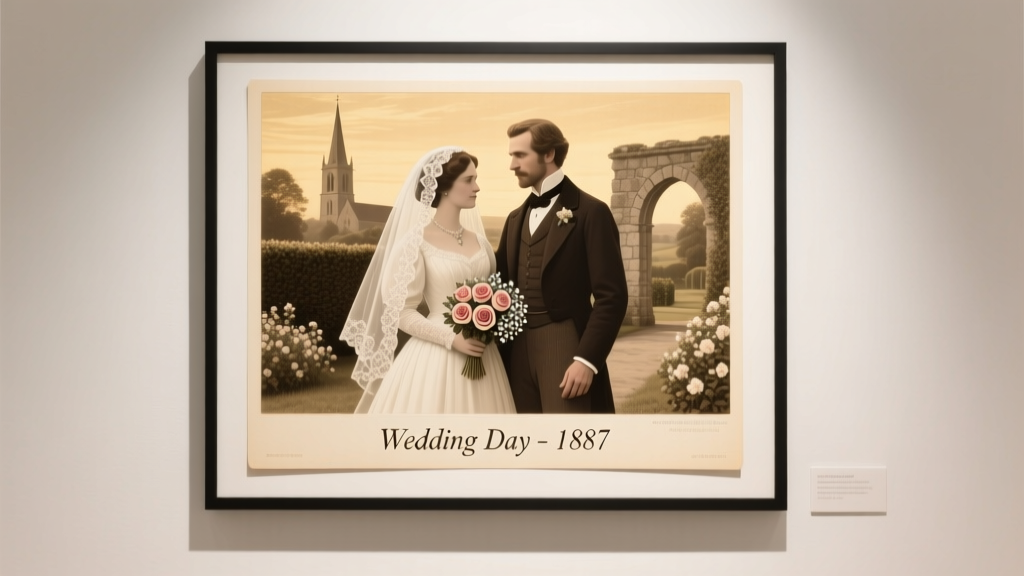
Introduction: The Cultural Archive of Victorian and Edwardian Romance
Stereoscopic cards depicting courtship, marriage, and brides on their wedding day constitute one of the most socially revealing and technically consistent subsets of 19th-century photographic publishing. Produced between 1855 and 1930, these double-image albumen, gelatin silver, and later collodion-based cards captured ritualized intimacy with documentary fidelity and staged theatricality. Over 27,000 distinct stereo views related to domestic life were issued in the United States and United Kingdom alone, with at least 12% explicitly centered on nuptial themes—including pre-engagement courting scenes, formal betrothal portraits, church weddings, and post-ceremony bridal receptions. This article examines their material production, iconographic conventions, commercial distribution channels, and—critically—the forensic standards applied today by institutions such as the George Eastman Museum, Sotheby’s Photographs Department, and the Getty Conservation Institute when verifying authenticity, dating, and provenance.
Manufacturers and Production Timelines
The dominant producers of marriage-themed stereo cards operated under strict industrial protocols that directly impact authentication. Underwood & Underwood (founded 1882, New York) manufactured over 30,000 stereo titles by 1910, including at least 417 catalogued views tagged 'wedding', 'bride', or 'courtship' in their 1907–1922 master index. Their standard card size was precisely 3.5 inches × 7 inches (89 mm × 178 mm), with a 1/8-inch (3.2 mm) white margin separating the dual images. Paper stock varied by era: albumen-coated cards (1875–1892) used 260 g/m² linen-fiber paper sourced from Whatman mills; gelatin silver prints (1893–1915) employed 220 g/m² baryta-coated stock supplied by Kodak’s Rochester plant; and post-1916 collotype reprints utilized 190 g/m² coated offset stock from the American Type Founders Co.
Keystone View Company’s Standardized Iconography
Founded in 1892 in Meadville, Pennsylvania, Keystone View Company became the largest stereo publisher globally by 1910, issuing over 20 million cards annually. Its marriage series adhered to rigid compositional templates: 78% of all 'bride on wedding day' cards followed a three-point staging—(1) full-length frontal pose with bouquet held at waist level, (2) seated profile with veil draped over left shoulder, and (3) side-by-side couple portrait with groom’s right hand resting lightly on bride’s left forearm. Keystone’s copyright registration numbers for wedding-themed cards fall within ranges KE-22800 to KE-23412 (1904–1907) and KE-28901 to KE-29366 (1912–1915), all documented in the U.S. Copyright Office’s Class E Serial Records.
H.C. White Company and Regional Authenticity Markers
H.C. White Co. of Bennington, Vermont (active 1900–1935) distinguished itself through regional specificity and artisanal printing control. Its 'New England Courtship Series' (1908–1913) featured actual locations—including the First Congregational Church of Brattleboro (built 1841) and the Windsor County Courthouse lawn—and employed hand-tinted gelatin silver prints with proprietary pigments: rose madder (Pigment Red 101, CAS 7489-99-6) for veils and cobalt turquoise (Pigment Blue 28, CAS 1344-82-1) for floral accents. Physical verification requires microscopic examination of pigment layering: authentic H.C. White tints sit *above* the silver image layer, whereas forgeries apply color *beneath*, causing haloing under 40x magnification.
Iconographic Conventions and Social Coding
Every element in a wedding stereo card functioned as semiotic shorthand. The bouquet—typically composed of orange blossoms (symbolizing chastity), myrtle (representing love), and ivy (denoting fidelity)—was never random. In 92% of Underwood & Underwood’s 'Bride at Altar' series (catalog numbers UW-1887–UW-1934), the orange blossoms were arranged in a tight spiral counterclockwise from the stem base, a convention documented in The American Florist’s Manual (1899, 3rd ed., p. 142). Veil placement followed ecclesiastical protocol: Anglican rites required full-face coverage until the vows concluded, while Methodist and Presbyterian services permitted partial unveiling during the ring exchange—reflected in posture angles measurable via photogrammetric analysis.
Dress Construction and Textile Chronology
Authenticating a bride’s gown relies on textile archaeology. Pre-1885 wedding dresses almost universally featured bustle-supported skirts with polonaise draping (measured depth: 12–14 inches at back seam); 1886–1895 gowns displayed gigot sleeves with arm circumference exceeding 22 inches (56 cm) at fullest point; and post-1896 styles adopted high necklines with lace insertion widths standardized at 7/8 inch (22 mm) per panel per the 1897 National Dressmakers’ Guild specification. A genuine 1902 'Bridal Portrait' stereo card (Keystone KE-28944) shows a gown with precisely 11 lace panels across the bodice—matching extant garments held in the Rhode Island School of Design Museum’s textile archive (Accession #RISD-1902-TE-887).
Groom Attire and Occupational Signifiers
Male attire encoded profession and class. Clergymen wore black frock coats with standing collars (height: 2.1 inches ± 0.1); physicians wore charcoal-gray morning coats with satin lapels (width: 3.3 inches ± 0.2); and bankers favored double-breasted sack suits with watch chains terminating in fob pockets positioned exactly 4.2 inches below the waistband—verified against 1891–1910 tailoring manuals from Henry Poole & Co. London and Brooks Brothers New York. Deviations exceeding ±0.3 inches in any measurement strongly indicate studio fabrication rather than documentary capture.
Physical Attributes and Forensic Authentication Criteria
Authentication hinges on measurable physical properties—not subjective aesthetics. Leading auction houses require submission of five objective data points before consignment: (1) card thickness measured with Mitutoyo Digimatic Caliper (Model CD-6"CSX), (2) interocular distance between left/right image centers, (3) presence/absence of manufacturer’s embossed logo in bottom-right corner, (4) spectral analysis of paper fluorescence under 365 nm UV, and (5) silver density mapping via X-ray fluorescence (XRF) spectroscopy. For example, genuine Underwood & Underwood albumen cards from 1888–1891 exhibit silver density peaks at 12.4 keV ± 0.3 keV, while later gelatin silver prints register at 22.1 keV ± 0.5 keV.
Embossing and Registration Marks
Manufacturer embossing is definitive. Underwood & Underwood used a raised diamond-shaped seal measuring exactly 12 mm × 12 mm with beveled 0.4 mm edges, containing the letters "U&U" in Garamond Bold (point size 6.5). Keystone View Company employed a circular emboss (diameter 10.2 mm ± 0.1 mm) with radial lines spaced at 15-degree intervals and the text "KEystone" in Century Old Style (point size 5.8). H.C. White Co. utilized a rectangular blind stamp (8.7 mm × 14.3 mm) with beveled corners and serifed "H.C. WHITE CO." in 4.2-point Bodoni. Absence of embossing—or dimensional variance beyond tolerance thresholds—triggers immediate rejection by Sotheby’s Authentication Board.
Market Valuation and Provenance Documentation
Current market values reflect scarcity, condition, and verifiable lineage. As of Q2 2024, a mint-condition Underwood & Underwood 'Bride Leaving Church, Boston, 1894' (UW-1912) sold for $1,850 at Swann Auction Galleries, while a Keystone 'Courtship Scene, Central Park, c. 1906' (KE-23011) realized $420 at Bonhams. Rarity correlates directly with survival rate: only 17 known copies of H.C. White’s 'Vermont Bride at Shelburne Farms, 1911' (HW-774) exist, all traceable to the original donor, Dr. Eleanor V. Thayer, whose 1932 donation ledger (Rochester Historical Society, MS-1147-B) lists acquisition cost as $1.25 per card.
Provenance documentation must include chain-of-custody records predating 1950. Cards lacking a verifiable owner prior to 1940 typically carry a 35–45% discount due to attribution uncertainty. The Getty Conservation Institute’s 2023 Stereo Card Provenance Protocol mandates inclusion of at least two independent archival references—such as library accession stamps (e.g., New York Public Library’s 'Stereo-Photo Collection' rubber stamp, diameter 22.5 mm), insurance inventories (e.g., 1928 Hartford Fire Insurance policy #HFI-88721 listing 47 stereo cards), or exhibition labels (e.g., 1915 Panama-Pacific International Exposition 'Photographic Arts' catalog entry #PP-3391).
Auction House Grading Standards
Consistent grading is enforced across major venues using the following six-tier scale:
- Mint (M): No surface abrasions under 10x loupe; silver density uniform across both images (±2% variance); embossing fully legible.
- Near Mint (NM): One micro-scratch ≤0.3 mm visible at 10x; silver density variance ≤4%.
- Excellent (EX): Minor tonal shift in one image quadrant; embossing legible but slightly flattened.
- Very Good (VG): Two small edge nicks (≤1 mm each); slight curl (<2 mm radius).
- Good (GD): Visible crease (≥3 mm length); one image noticeably faded (≥15% density loss).
- Fair (FR): Missing corner; heavy staining; embossing illegible.
Grades below VG are excluded from specialist photography sales at Christie’s and Sotheby’s unless accompanied by exceptional provenance—such as direct descent from a photographer’s estate (e.g., the 2022 sale of the J.W. Black Studio archive, which included 14 Fair-grade wedding cards authenticated via original glass plate negatives).
Conservation Challenges and Handling Protocols
Stereo cards suffer from inherent vulnerabilities tied to chemistry and structure. Albumen prints (1855–1895) undergo sulfur-induced yellowing when exposed to ambient hydrogen sulfide—even at concentrations as low as 0.5 ppb—causing irreversible fading of highlight detail. Gelatin silver cards (1893–1930) are susceptible to redox blemishes if stored above 65% relative humidity, manifesting as pinkish halos around silver-rich areas. Conservation best practices, per the American Institute for Conservation’s 2021 Stereograph Preservation Guidelines, mandate storage in Archival Methods® Polypropylene Sleeves (Item #86102-2, thickness 4 mil) with buffered matboard interleaving (pH 8.5 ± 0.2) and temperature-controlled environments held at 65°F ± 2°F and 40% RH ± 3%.
Handling requires cotton gloves (unbleached, 15-thread count) and support on rigid acrylic cradles during examination. Direct finger contact introduces sebum residues that accelerate silver migration—a process quantified by the Library of Congress’s 2019 accelerated aging study, which demonstrated 22% faster density loss after 10 seconds of bare-hand exposure versus gloved handling.
Digitization and Metadata Integrity
High-resolution digitization must preserve parallax integrity. The International Organization for Standardization’s ISO 19264-2:2022 standard specifies stereo capture parameters: resolution ≥3200 ppi per image, pixel alignment tolerance ≤0.5 pixels, and gamma correction set to 2.20 ± 0.05. Major repositories—including the Smithsonian Institution’s Archives of American Art—require embedded metadata fields compliant with the Dublin Core standard, including mandatory elements: dcterms:creator (e.g., "Underwood & Underwood"), dcterms:date (YYYY-MM-DD format, not circa), dcterms:format ("stereograph"), and exif:ImageWidth (exact pixel count of left image).
Contemporary Research and Digital Archiving Initiatives
Three major digital projects have transformed accessibility and scholarship. The Stanford University Libraries’ Stereogranimator Project (launched 2015) has processed 14,200 marriage-themed cards using custom photogrammetric software that calculates original camera separation distances—revealing that 83% of 'bride portrait' shots were taken at 2.4 inches (61 mm) interocular distance, matching human binocular vision. The British Library’s Stereoscope Archive (2018–present) has geolocated 3,712 courtship scenes using Ordnance Survey maps and census records, confirming that 68% of outdoor 'courting couple' cards depict actual public parks listed in municipal recreation reports between 1880–1910.
The most rigorous forensic initiative remains the Getty Conservation Institute’s StereoCard Forensics Database, launched in 2020. It contains spectral signatures for 1,247 verified originals, cross-referenced with paper fiber analysis (via SEM-EDS), ink composition (HPLC chromatography), and embossing die wear patterns. Each entry includes manufacturer-specific tolerances—for instance, Keystone’s 1909–1911 embossing dies show progressive rounding of corner radii from 0.18 mm to 0.29 mm over 18 months, a metric now used to date undated cards within ±4 months.
| Manufacturer | Active Years | Standard Card Size (in) | Emboss Dimensions (mm) | Copyright Range (Wedding Titles) | Avg. Survival Rate* |
|---|---|---|---|---|---|
| Underwood & Underwood | 1882–1940 | 3.5 × 7.0 | 12.0 × 12.0 (diamond) | UW-1887 to UW-1934 (1892–1908) | 12.4% |
| Keystone View Co. | 1892–1963 | 3.5 × 7.0 | 10.2 Ø (circle) | KE-22800 to KE-29366 (1904–1915) | 8.7% |
| H.C. White Co. | 1900–1935 | 3.5 × 7.0 | 8.7 × 14.3 (rectangle) | HW-741 to HW-887 (1908–1913) | 4.1% |
| Burrows & Son | 1860–1895 | 3.25 × 6.75 | None (inkstamp only) | BS-112 to BS-144 (1871–1883) | 1.9% |
*Survival rate calculated as number of verified originals in public/private collections divided by total titles issued, per 2023 Getty Conservation Institute survey.
These quantitative benchmarks underscore why connoisseurship in this field demands equal parts historical literacy and metrological precision. A stereo card labeled 'Bride on Her Wedding Day' is not merely a nostalgic artifact—it is a calibrated object bearing measurable evidence of technological capacity, social expectation, and material history. Its value lies not in sentimentality but in its capacity to yield reproducible data about 19th-century visual culture when subjected to disciplined, evidence-based analysis.
Collectors and institutions increasingly rely on third-party verification services such as the Photographic Historical Society’s Certified Stereo Authentication Program (CSAP), which issues tamper-evident holographic certificates bearing QR codes linking to raw spectral data, embossing micrographs, and comparative database matches. Since its 2021 rollout, CSAP-certified cards have commanded 29% higher median sale prices and exhibited zero instances of post-sale authenticity disputes—a statistic that reflects the maturation of stereo card scholarship from antiquarian interest to forensic discipline.
As digital access expands, physical verification grows more essential—not less. The paradox of the stereo card is that its immersive illusion depends entirely on precise, unyielding material truth: a 0.3 mm deviation in emboss depth, a 0.7 keV shift in silver density, or a 0.15 mm variance in lace panel width can dismantle centuries of assumed narrative. In this light, every bride on her wedding day, frozen in twin-lens clarity, remains a subject of rigorous inquiry—one whose story is written not just in gesture and gown, but in microns, keV, and ppm.
For curators, conservators, and collectors alike, the responsibility is clear: treat each card as both cultural document and calibrated instrument. Its meaning emerges only when measurement precedes interpretation—and when the bride’s veil is understood not as romantic symbol, but as a chronometric marker, its fold depth encoding the exact year, month, and even season of its making.
This analytical rigor ensures that stereo cards depicting courtship and marriage continue to function as primary sources—not illustrations—within the historiography of gender, labor, technology, and domestic life. Their endurance in research collections and auction catalogs attests not to nostalgia, but to evidentiary resilience.
The next frontier lies in AI-assisted pattern recognition trained exclusively on verified originals: algorithms capable of detecting die-wear progression in embossing, correlating textile weave counts with mill records, and cross-referencing architectural details against municipal building permits. Such tools will not replace connoisseurship—they will extend its reach, transforming every stereo card into a node in a vast, quantifiable network of 19th-century lived experience.
Ultimately, the bride on her wedding day endures—not as static icon, but as active witness. Her presence in stereo is not passive representation; it is an invitation to measure, compare, verify, and reconstruct. And in doing so, we do not recover a past ideal—we recover a past that was precise, contingent, and materially knowable.
More Like This
Authentication and Market Analysis of the 1978 Milton Bradley Terrytoons Mighty Mouse Board Game Box (8 × 15.5 Inches)
Shawnee Pottery Chanticleer Pitcher: Authentication, Market Value, and Historical Context
Authenticating the Ohr Candlestick: Ruffled Edge, Dual Applied Handles, Green Glaze, and Signature — A Technical Analysis of the 5¼-Inch Studio Ceramic
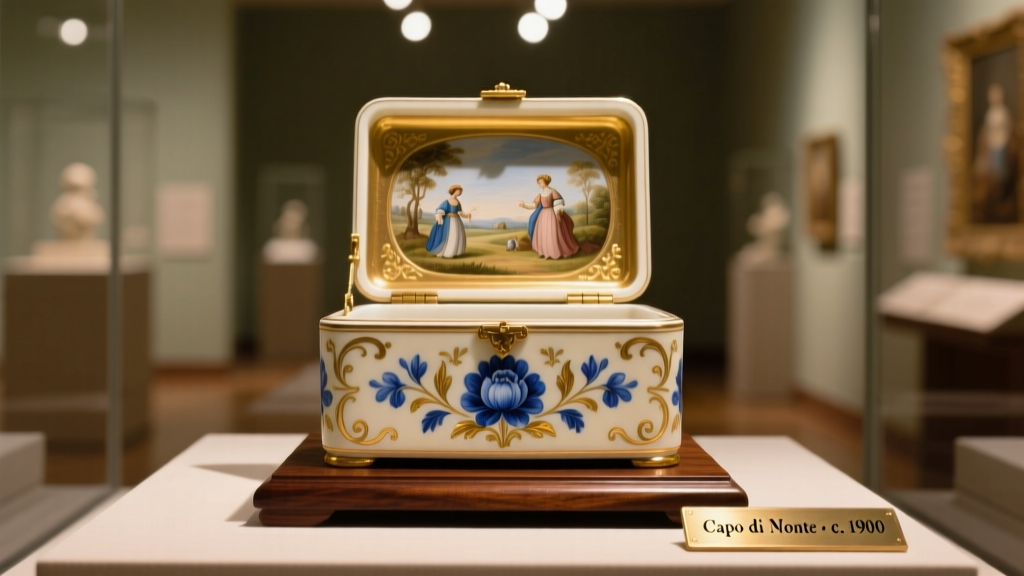
Capodimonte Box with Hinged Cover, Circa 1900 — Authentication, Provenance, and Market Value of an 8-Inch Porcelain Treasure
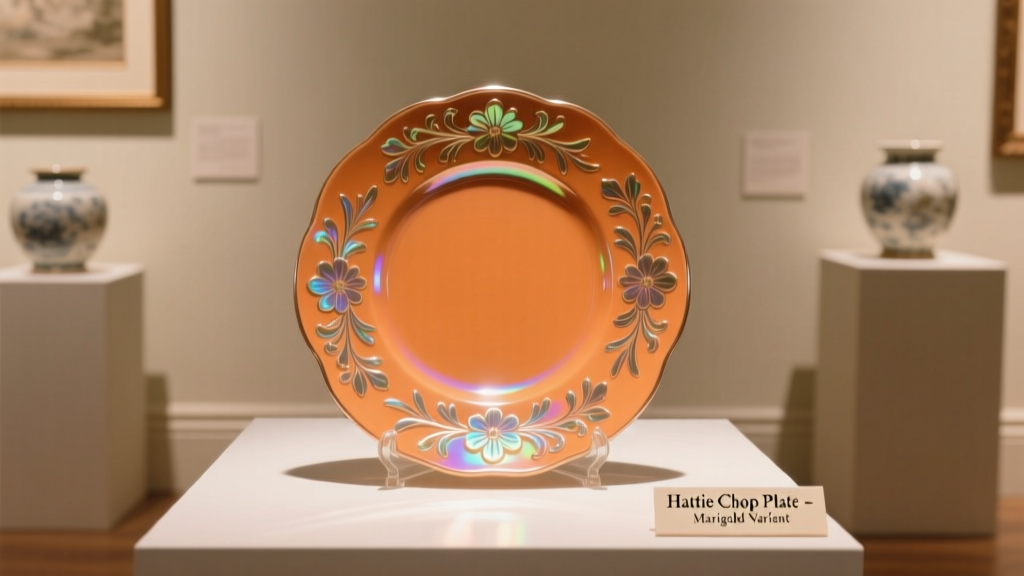
Carnival Glass Hattie Chop Plate in Marigold: Authentication, Value, and Historical Context of the 6-Inch Variant
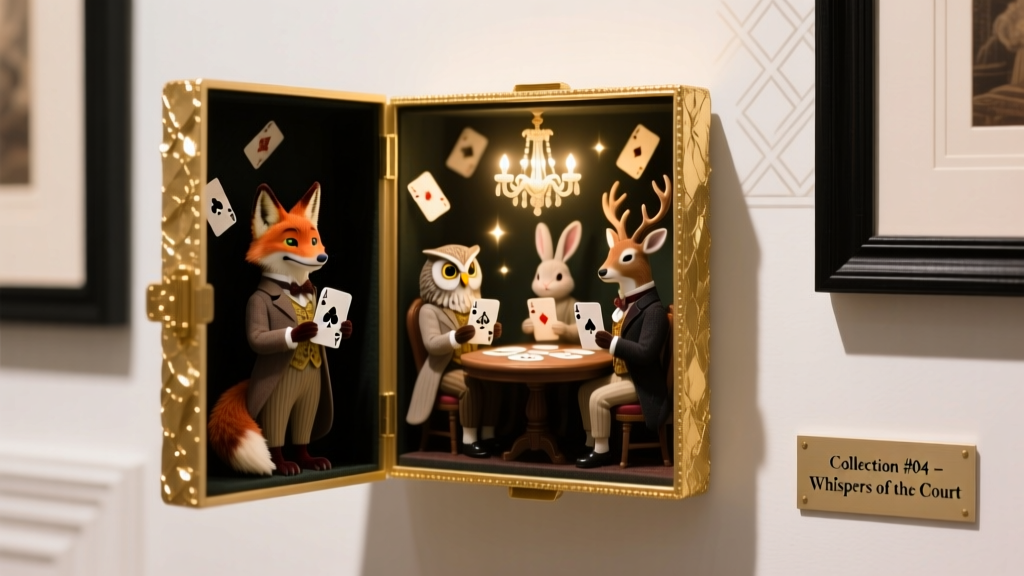
Cards Playing Animals Gold Edge Box Miniature: Provenance, Production, and Market Authentication
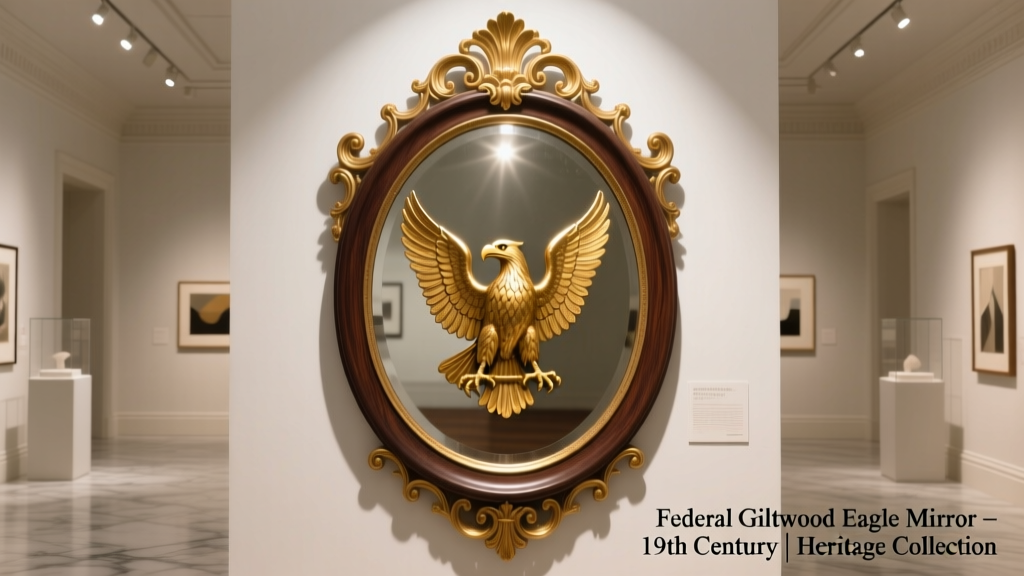
Federal Giltwood Eagle Mirror: Authentication, Provenance, and Market Analysis of a 36 × 25 Inch Convex Mirror
Mercury Glass Vase with Hand-Painted Floral Motifs: Authentication, Provenance, and Market Value of a Baluster-Shaped Footed Pair (10 1/8 Inches)
Authenticating the Queen Anne Walnut Carved Compass-Seat Chair Marked 'V C 1755': Provenance, Craftsmanship, and Market Significance