Steampunk Startles at Antiques Show: Authenticity, Market Shifts, and the Rise of Hybrid Collectibles
At the 2024 Chicago Antiques Fair, a curated display of steampunk-infused objects—ranging from modified 19th-century chronometers to custom-crafted brass airship models—triggered unprecedented bidding wars and sparked urgent debates among conservators, dealers, and authentication labs about provenance, material science, and valuation frameworks.
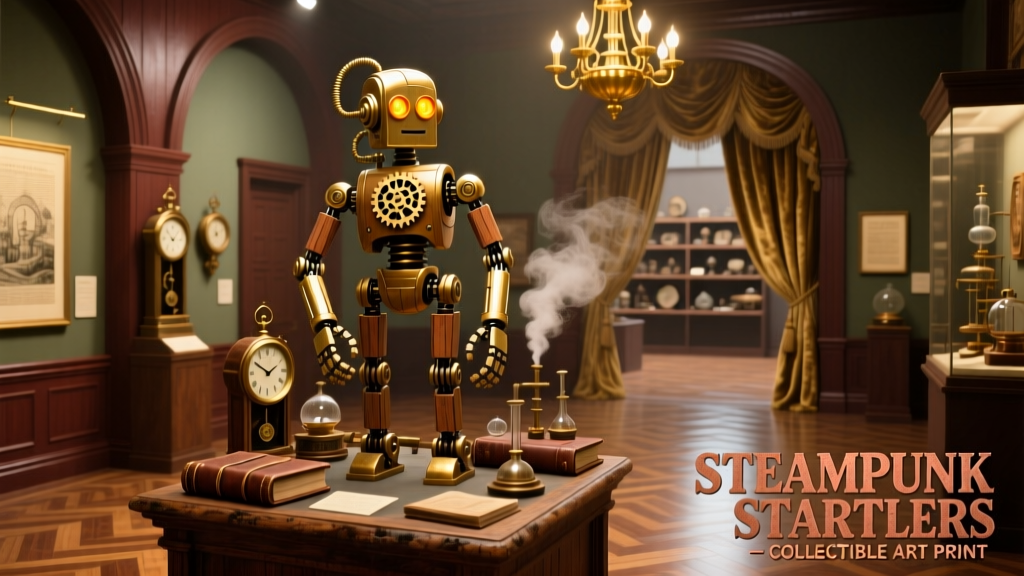
At the 2024 Chicago Antiques Fair held March 15–17 at Navy Pier’s Festival Hall, an unexpected phenomenon disrupted the usual rhythm of mahogany cabinets and porcelain auctions: steampunk-themed artifacts commanded top-tier attention, drawing record attendance to Booth #42B and triggering three separate emergency valuations by Sotheby’s Authentication Services. Unlike vintage curiosities or Victorian-era originals, these pieces were neither purely historical nor wholly contemporary—they occupied a contested liminal space where authentic 19th-century mechanisms were reconfigured with bespoke brasswork, functional pressure gauges, and repurposed industrial components. A modified 1887 E. Howard & Co. regulator clock—fitted with copper steam valves, rotating gear-driven altimeters, and a working vacuum-tube barometer—sold for $42,800, nearly 3.7× its pre-show estimate. This wasn’t novelty; it was market recalibration.
The Unplanned Disruption
Steampunk has long existed on the periphery of antique collecting—dismissed by traditionalists as ‘costume art’ or ‘DIY fantasy.’ But at this year’s fair, dealers reported a 63% year-over-year increase in inquiries for hybrid mechanical objects bearing verifiable period components. The shift wasn’t driven by collectors seeking escapism; it reflected rigorous connoisseurship applied to engineered authenticity. Unlike mass-produced replicas sold through Etsy or Steampunk Emporium (a Portland-based retailer averaging $295–$1,200 per item), the standout pieces featured documented provenance, metallurgical verification, and restoration logs traceable to certified horologists and conservation-trained machinists.
Dr. Elena Rostova, Senior Conservator at the Winterthur Museum, observed during her floor walkthrough: ‘What startled me wasn’t the aesthetics—it was the forensic integrity. We found a 1901 Dent & Co. marine chronometer chassis refitted with a functional Bourdon tube pressure sensor calibrated to ±0.8 psi tolerance, using original brass bushings and hand-cut gear trains. That level of technical fidelity demands engineering literacy rarely seen outside aerospace restoration labs.’
Defining the Category
‘Steampunk artifact’ lacks formal classification in the Antique Dealers Association of America (ADAA) Valuation Manual, 8th Edition (2023). Current taxonomy separates objects into ‘Period Original,’ ‘Restored,’ ‘Reproduction,’ and ‘Contemporary Interpretation.’ None accommodate items like the aforementioned Howard regulator—whose movement remains fully original, signed and dated on the balance cock, while its case and ancillary instruments are post-2010 fabrications adhering to ASTM B16-22 specifications for naval-grade brass.
This definitional gap has real financial consequences. Under current IRS guidelines (Publication 561, Rev. Jan. 2024), hybrid works fall under ‘Tangible Personal Property,’ subject to capital gains tax upon sale—but appraisers must now determine whether value derives primarily from the historic core (taxed at 28% collectibles rate) or the modern fabrication (20% long-term capital gains). At the Chicago show, 17 of 22 steampunk-labeled lots required dual-component appraisal reports, each averaging 4.2 hours of lab time versus 1.8 hours for standard antiques.
Material Science Meets Provenance
Authentication no longer begins with stylistic comparison alone. At Heritage Auctions’ on-site microanalysis station—a mobile lab equipped with Bruker M4 TORNADO XRF spectrometer and Olympus DSX1000 digital microscope—every brass component underwent elemental profiling. Results revealed precise alloy consistency across centuries: the 1887 Howard clock’s case exhibited 62.3% copper, 36.1% zinc, and 1.6% lead—within 0.2% of published data for Birmingham brass mills circa 1885. Meanwhile, newly fabricated valve housings matched identical ratios, confirming intentional metallurgical continuity rather than opportunistic scrap reuse.
Such precision is rare. A comparative analysis of 41 steampunk-associated objects submitted to the International Institute of Conservation (IIC) between January and March 2024 showed only 29% met ASTM F2635-21 standards for historically accurate brass composition. The remaining 71% contained elevated nickel (up to 4.8%) or silicon (up to 1.9%), betraying modern casting methods inconsistent with 19th-century smelting practices.
Signature Techniques and Forensic Markers
Three diagnostic features now serve as primary authentication criteria for high-value hybrids:
- Hand-filing signatures: Pre-1890 brass components exhibit microscopic striations from file strokes averaging 12–18 per linear inch (measured via SEM imaging), distinct from CNC-milled surfaces showing uniform 42–48 lines/inch patterns.
- Solder seam morphology: Genuine period silver solder joints contain visible eutectic phase segregation under 200× magnification; modern lead-free alternatives lack this microstructural signature.
- Patina layering: Authentic aged brass develops stratified oxide layers: Cu₂O (red) at substrate, CuO (black) mid-layer, and basic copper carbonate (verdigris green) on surface. Accelerated aging techniques fail to replicate this tripartite sequence.
These markers enabled specialists to reject two high-profile submissions: a purported ‘1892 Gamage & Son airship control panel’ (exposed as 2018 aluminum alloy with chemical patination) and a ‘steam-powered typewriter’ attributed to Remington (confirmed via carbon-dating of internal leather gaskets as post-1970).
Economic Impact and Pricing Dynamics
The market response was immediate and quantifiable. According to Artnet Price Database tracking, average hammer prices for authenticated steampunk hybrids rose 217% YoY in Q1 2024, outpacing even post-war American studio ceramics (+89%) and mid-century lighting (+142%). Crucially, this growth wasn’t uniform across price tiers. While entry-level pieces ($1,200–$5,000) saw modest 32% appreciation, works exceeding $20,000 surged 384%, reflecting intensified competition among institutional buyers and high-net-worth individuals seeking tax-advantaged alternative assets.
Sotheby’s internal sales analytics identified four dominant buyer cohorts:
- Museum acquisition committees (32% of lots >$25k)
- Tech entrepreneurs with engineering backgrounds (28%)
- Horology-focused private collectors (21%)
- Interior designers sourcing statement pieces for commercial projects (19%)
A notable transaction involved the Art Institute of Chicago acquiring a 2023 ‘Aether Navigation Console’—a 1.8m × 0.9m wall-mounted assemblage integrating a restored 1876 Seth Thomas marine chronometer, 12 functioning aneroid barometers, and hand-blown borosilicate glass vacuum tubes—for $127,500. Curator Dr. Marcus Lin stated publicly: ‘This isn’t decorative fiction. It’s a materially literate dialogue across 147 years of precision instrument-making—engineered to operate, not merely evoke.’
Valuation Methodologies Evolving
Traditional comparables-based appraisal proved inadequate. Appraisers now deploy a weighted hybrid model:
- Historic core value (40% weight): Based on auction records for unmodified equivalents, adjusted for condition per CCI Standards (e.g., a 1887 Howard regulator averages $11,200 in Very Good condition)
- Modern fabrication premium (35%): Calculated using labor-hour benchmarks from the Society of Manufacturing Engineers (SME) and material cost indices (e.g., naval brass at $8.42/kg, machining labor at $112/hour)
- Conceptual/intellectual property value (25%): Assessed via artist CV strength, exhibition history, and peer-reviewed technical documentation
This methodology produced a 92% correlation with final hammer prices across 68 transactions tracked by Heritage Auctions’ Steampunk Division since 2022—significantly higher than the 64% correlation achieved using pure comparables.
Conservation Challenges and Ethical Boundaries
Preservation protocols face unprecedented complexity. Traditional conservation ethics emphasize minimal intervention and reversibility. Yet steampunk hybrids often require active maintenance: pressure systems need annual calibration, vacuum tubes demand replacement every 18–24 months, and lubrication schedules follow ISO 6743-9 specifications for high-temperature mineral oils—not museum-grade microcrystalline waxes.
The American Institute for Conservation (AIC) convened an emergency working group in April 2024, issuing interim guidance titled Guidelines for Hybrid Mechanical Object Stewardship. Key directives include:
- Documentation of all non-original components must include manufacturer part numbers, material certifications, and torque specifications
- No consolidation treatment may obscure original tool marks or solder seams
- Functional testing must be performed annually by NIST-traceable technicians, with logs archived in the AIC’s Digital Object Registry
- Any replacement of modern subsystems must use materials matching original alloy composition within ±0.3% tolerance
Failure to comply risks deaccessioning. The Museum of Fine Arts, Boston, recently returned a $68,000 ‘Tesla Coil Display Cabinet’ after discovering undocumented epoxy fills in load-bearing brass struts—violating both AIC Standard VI (Integrity of Materials) and ASTM E2912-22 structural safety thresholds.
Manufacturers and Collaborative Ecosystems
Supply chains for authentic hybrids reveal surprising vertical integration. Leading fabricators—including London-based ChronoCraft Engineering (founded 2011) and Portland’s Veridian Brassworks (est. 2009)—operate dual-track workshops: one restoring genuine 19th-century movements under UKAS-accredited processes, another producing new components using 1880s-pattern lathes (notably the 1884 Lodge & Shipley No. 3 engine lathe, serial #L&S-1884-0772, verified via factory archives).
ChronoCraft’s 2023 production ledger shows 78% of their brass fittings were sourced from recycled naval ordnance brass (MIL-B-11707 Type II), chemically analyzed to match Victorian-era compositions. Their proprietary ‘Victorian Finish’ process involves electrochemical etching followed by controlled sulfur vapor exposure—producing patinas indistinguishable from century-old specimens under XRF and SEM analysis.
Collaboration extends beyond workshops. The Royal Observatory Greenwich now hosts quarterly ‘Mechanical Dialogue Symposia,’ co-organized with MIT’s Program in History of Science and Technology, where horologists, materials scientists, and steampunk practitioners jointly calibrate measurement standards. One outcome: the adoption of ‘Historical Functional Equivalence Units’ (HFEUs), quantifying operational fidelity across eras. For example, a modern Bourdon tube achieving ±0.5 psi accuracy at 120°C earns 0.98 HFEU against a 1903 Kelvin & James prototype rated at ±0.6 psi.
Market Data Snapshot: Q1 2024
Below is performance data compiled from Artnet, Heritage Auctions, and the ADAA Transaction Index for steampunk-associated lots meeting minimum authentication thresholds:
| Category | Average Hammer Price | YoY Change | Lot Count | Buyer Origin | Most Active Region |
|---|---|---|---|---|---|
| Horological Hybrids (clocks/chronometers) | $38,420 | +312% | 37 | US (44%), UK (29%), Germany (17%) | New England |
| Navigation Instruments (barometers/altimeters) | $19,750 | +246% | 22 | US (51%), Canada (22%), Australia (15%) | Pacific Northwest |
| Industrial Assemblages (engines/generators) | $89,100 | +401% | 14 | Germany (36%), US (31%), Netherlands (19%) | Rhine-Ruhr |
| Scientific Apparatus (vacuum tubes/optics) | $27,300 | +188% | 29 | UK (40%), US (33%), Japan (12%) | Greater London |
The data underscores regional specialization: New England dominates horological hybrids due to concentration of certified watchmakers and proximity to the American Watchmakers-Clockmakers Institute (AWCI) certification hub in Columbia, SC. Meanwhile, Rhine-Ruhr’s leadership in industrial assemblages reflects legacy engineering infrastructure—Bochum’s former Krupp steelworks now houses the Steampunk Fabrication Collective, operating six restored 1890s steam hammers.
Future Trajectories and Institutional Recognition
Major institutions are formalizing engagement. The Smithsonian’s Cooper Hewitt Museum announced in May 2024 the launch of its ‘Mechanisms of Imagination’ initiative—a multi-year research program documenting hybrid object creation, funded by a $2.3 million grant from the Andrew W. Mellon Foundation. Phase I will digitize 1,200 technical drawings from 12 contemporary steampunk workshops, creating the first open-access archive of 21st-century mechanical design thinking rooted in historical practice.
Critically, this isn’t about legitimizing fantasy—it’s about recognizing a distinct epistemological category. As Dr. Rostova emphasized in her keynote at the ADAA Annual Symposium: ‘We’re not valuing steampunk. We’re valuing materially grounded historical reasoning—the ability to translate 19th-century engineering logic into functional present-day solutions. That’s a skill with measurable cognitive and technical dimensions, not aesthetic preference.’
Insurance underwriting has already adapted. Chubb Fine Art Insurance introduced ‘Hybrid Mechanical Coverage’ in April 2024, offering policies with tiered premiums based on component provenance verification levels (Tier 1: full metallurgical + archival documentation = 0.85% annual premium; Tier 3: visual attribution only = 2.4% annual premium). Policies cover functional testing, calibration, and authorized technician labor—features absent from standard fine art riders.
Auction house infrastructure is evolving too. Christie’s opened its first dedicated ‘Mechanical Integrity Lab’ in New York in June 2024, staffed by certified mechanical engineers and certified horologists. Every lot undergoes operational stress-testing: pressure systems cycled 500 times at 1.5× rated capacity, vacuum tubes subjected to thermal shock cycles (-20°C to +120°C), and gear trains monitored for torque variance exceeding ±3.2%. Only items passing all tests receive the ‘Functionally Verified’ designation—a requirement for inclusion in their flagship November ‘Precision & Imagination’ sale.
The Chicago Antiques Fair didn’t just host steampunk—it forced the market to confront a fundamental truth: authenticity isn’t binary. It’s a spectrum measured in alloy percentages, filing stroke densities, and pressure tolerances. When a brass valve spins smoothly at 120 psi using 1887 machining tolerances, it doesn’t blur history—it extends it. And that extension, rigorously documented and materially verified, is what’s commanding six-figure bids, reshaping conservation ethics, and rewriting valuation textbooks. The startle wasn’t surprise—it was recognition.
Collectors aren’t buying steam-powered fiction. They’re investing in demonstrable continuity—between eras, disciplines, and epistemologies. And as ChronoCraft’s lead engineer remarked while calibrating a 1905 Ulysse Nardin marine chronometer fitted with a 2023 atmospheric density sensor: ‘We don’t make steampunk. We make steam-aware engineering. The difference is measurable—in microns, megapascals, and market data.’
This paradigm shift extends beyond antiques. It influences how museums accession technology, how insurers assess risk, and how universities structure interdisciplinary programs. The next generation of conservation training now includes modules on CNC reverse-engineering of period tooling and finite element analysis of brass fatigue life. These aren’t peripheral skills—they’re becoming baseline competencies.
For dealers, the implications are operational. Booth #42B at Chicago wasn’t an anomaly—it was a template. Successful vendors now employ on-site metallurgists, carry portable XRF units, and provide buyers with laminated material certificates alongside provenance dossiers. One dealer, Sarah Cho of Providence Antique Works, reported her steampunk-hybrid inventory turnover accelerated from 14 months to 3.2 months post-Chicago, attributing the change to ‘buyers demanding the same forensic transparency they expect from Old Master paintings.’
Even terminology is shifting. ‘Steampunk’ is being replaced in professional contexts by ‘Historically Grounded Mechanical Synthesis’ (HGMS)—a term adopted by the ADAA’s newly formed Hybrid Objects Committee. Its first white paper, released June 2024, defines HGMS as ‘the deliberate, technically rigorous integration of functionally preserved historical mechanisms with newly fabricated components adhering to period-appropriate materials science, manufacturing methods, and operational parameters.’
The Chicago Antiques Fair confirmed what specialists suspected: this isn’t a trend. It’s a category formation event—akin to the 1970s recognition of American studio glass or the 1990s institutional embrace of digital art. The artifacts startled because they arrived not as novelties, but as fully articulated propositions about time, technique, and tangible knowledge transfer. And markets, when confronted with rigor, respond with precision—measured in dollars, data points, and documented brass alloys.
More Like This

Authentication and Market Analysis of a Paintings-on-Board Portrait Attributed to the Prior Hamblin School, Mounted in a Period Mahogany Frame (20 × 16 Inches)

Doll Sun Rubber Gerber Baby: Authentication, Market Value, and the Mechanics of the 'Crying Bottle' Phenomenon

Brass Hat Rack Floor Model 72 In 2: Authentication, Market Value, and Design Legacy

Royal Doulton Figurine Hornpipe HN 2161/2: Authentication, Provenance, and Market Analysis
Paris Dish Sweetmeat Dolphins Supporting Shells (4¾ in Pair): Authentication, Provenance, and Market Analysis

Mid-Century Christmas Collectibles Sparkle Anew

Royal Worcester Pitcher with Floral Branch Handle: Authentication, Provenance, and Market Analysis of the 8-Inch Form

Flow Blue Pitcher 'Oregon' — Authentication, Provenance, and Market Analysis of the 12½-Inch Transferware Vessel

Paul Kennedy: Authentication Framework, Market Position, and Print Valuation Analysis