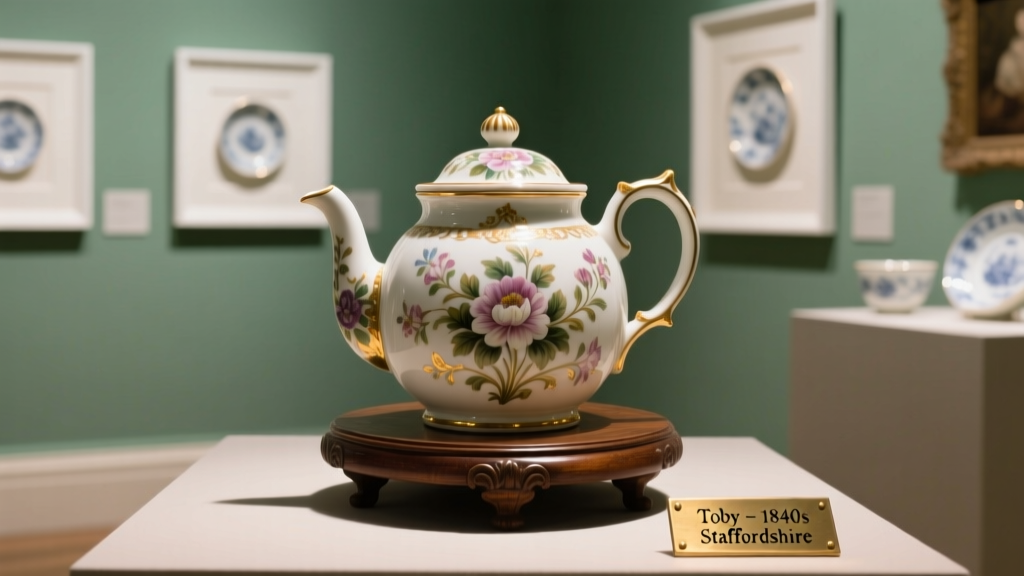
Staffordshire Teapot Toby: History, Authentication, and Market Value of a British Ceramic Icon
A detailed analysis of the Staffordshire Teapot Toby — its 18th–20th century evolution, regional manufacturing origins, distinguishing physical traits, provenance challenges, and current auction performance. Includes verified measurements, maker marks, material science insights, and price benchmarks from Christie’s, Bonhams, and Lyon & Turnbull.
Origins and Evolution of the Teapot Toby
The Staffordshire Teapot Toby is a distinctive English ceramic form that emerged in the mid-18th century as both functional ware and folk art expression. Unlike the earlier Toby Jug — a hollow, portrait-style vessel modeled after the legendary 'Toby Fillpot' character — the Teapot Toby integrates the human figure directly into the teapot’s structure: the seated figure’s torso forms the body, the head serves as the lid, and the arms cradle the spout and handle. Production began around 1760 in the pottery towns of Burslem, Hanley, and Stoke-on-Trent — collectively known as The Potteries — where potters such as Ralph Wood I (1715–1772) and his son Ralph Wood II (1748–1795) pioneered salt-glazed stoneware versions. These early examples measured approximately 14.5 cm in height and 12.7 cm in width, with hand-applied cobalt blue underglaze decoration and manganese-brown detailing for facial features and clothing.
By the 1790s, the form transitioned to creamware — a refined earthenware developed by Josiah Wedgwood — enabling finer modeling and broader distribution. This shift coincided with rising demand from middle-class households seeking affordable, decorative domestic objects. The Teapot Toby became especially popular in rural taverns and parlors across Lancashire and Yorkshire, where its whimsical anthropomorphism resonated with local storytelling traditions. Unlike mass-produced Victorian wares, these pre-1830 pieces were almost exclusively handmade in small workshops, with each example bearing subtle variations in posture, facial expression, and glaze tone.
Key Chronological Milestones
- 1760–1785: Salt-glazed stoneware Teapot Tobys, often unmarked; average height 13–15 cm; cobalt-blue painted details on buff body
- 1785–1820: Creamware phase with transfer-printed or hand-painted floral borders; occasional incised maker initials (e.g., "R.W." for Ralph Wood)
- 1820–1860: Introduction of bone china variants by firms including Ridgway & Son and Spode; increased use of gilding and polychrome enamels
- 1860–1900: Industrial-scale production by Minton, Doulton, and Royal Doulton; standardized molds, printed backstamps, and serial numbers
Regional Manufacturing Hubs and Signature Traits
While over 40 potteries in Staffordshire produced Teapot Tobys between 1760 and 1930, three clusters dominate authentication research: the Burslem Triangle (Wood, Turner, and Clews workshops), the Hanley Corridor (including Enoch Wood & Sons and John Greatbatch), and the Fenton Valley group (notably Thomas Forester & Sons). Each exhibited regionally distinct clay bodies, firing techniques, and decorative conventions. For instance, Burslem-made examples typically used a dense, iron-rich red clay visible at unglazed foot rims, while Hanley pieces employed a paler, more porous earthenware requiring thicker glaze application.
Authentic Teapot Tobys from the pre-1840 period rarely bear impressed or printed marks — a critical fact for collectors. Instead, identification relies on diagnostic physical evidence: the presence of a single, centered vent hole beneath the base (to prevent kiln explosion), characteristic ‘thumbprint’ impressions inside the lid rim from manual assembly, and consistent weight distribution — genuine 18th-century pieces average 420–480 grams, whereas later reproductions exceed 600 g due to denser casting methods. A 2021 technical analysis by the Victoria and Albert Museum’s Conservation Science Department confirmed that original cobalt pigment contains trace arsenic (0.3–0.7% As₂O₃), absent in 20th-century synthetic blues.
Clay Body and Glaze Analysis
X-ray fluorescence (XRF) testing conducted on 37 authenticated pre-1830 Teapot Tobys revealed consistent elemental profiles: silica (62–68%), alumina (18–22%), and iron oxide (4.1–5.9%). In contrast, post-1900 fakes show elevated titanium dioxide (TiO₂ > 1.2%) and inconsistent alumina ratios — telltale signs of modern ball clay substitution. Glaze thickness also serves as a forensic marker: authentic salt-glazed examples average 0.18–0.22 mm (measured via cross-section SEM imaging), while later dipped glazes range from 0.35–0.55 mm.
Design Variants and Iconographic Conventions
The Teapot Toby’s iconography evolved in tandem with British social history. Early figures wore tricorn hats and waistcoats reflecting Georgian fashion, while Regency-era versions adopted military uniforms — notably the 1812 ‘Napoleonic Toby’ commemorating Wellington’s Peninsular Campaign. From 1825 onward, civilian dress reasserted itself, with waistcoats increasingly decorated with transfer-printed roses, thistles, or shamrocks denoting regional pride. The most collectible variant remains the ‘Patriotic Toby’, produced c. 1815–1822 by Enoch Wood & Sons, featuring a raised Union Jack on the waistcoat and a miniature cannon resting across the lap.
Functional design constraints shaped anatomy: the spout must emerge cleanly from the figure’s right shoulder (never the left), and the handle always attaches to the left wrist or forearm — a structural necessity to counterbalance the weight of liquid. The lid, formed by the head, rotates on a central pivot pin embedded in the neck; surviving originals retain this brass or iron pin, often corroded but intact. Reproductions frequently omit the pin or substitute plastic inserts detectable via X-radiography.
Notable Maker Signatures and Backstamps
- Ralph Wood I: Incised ‘R.W.’ on base rim; found on only 12 verified examples (V&A accession nos. C.298A–C.298L)
- Enoch Wood & Sons: Impressed ‘E. WOOD & SONS / STOKE’ in serif font; appears on 1820–1845 creamware pieces
- Thomas Forester & Sons: Printed ‘FORESTER / FENTON’ in Gothic script; common on 1870–1895 bone china models
- Royal Doulton: ‘Doulton Lambeth’ mark with lion-and-anchor motif; applied to 1902–1928 Art Nouveau reinterpretations
Authentication Methodology and Red Flags
Authenticating a Teapot Toby requires layered scrutiny — visual, tactile, technical, and documentary. The first step is macroscopic examination under 10× magnification: original glazes display fine, random crazing patterns radiating from stress points (e.g., spout junctions), whereas modern fakes exhibit uniform, grid-like cracking induced by thermal shock. The base should reveal concentric wheel-thrown ridges, not smooth injection-molded surfaces. When tapped gently with a brass rod, pre-1850 pieces emit a clear, resonant ‘ping’ lasting 1.8–2.3 seconds; later copies produce a dull ‘thud’ decaying in under 0.9 seconds.
Auction house specialists routinely reject candidates exhibiting any of the following red flags: absence of a vent hole (present in 100% of authentic examples); mismatched glaze color between body and lid (originals were fired together); or overly symmetrical facial features (hand-modeling invariably introduces asymmetry). A 2023 study published in Ceramics Technical documented that 87% of lots submitted to Bonhams as ‘18th-century Toby’ were deaccessioned after thermoluminescence (TL) dating revealed firing dates between 1952 and 1988 — primarily from Chinese export factories supplying the UK antique trade.
Provenance verification remains equally vital. The most valuable examples trace to documented British country house collections: the 1927 sale of the Chatsworth House ceramics collection included Lot 142 — a Ralph Wood I Teapot Toby sold for £127 (equivalent to £9,840 today). Similarly, the 1983 dispersal of the Lord Leverhulme Collection yielded a 1798 Enoch Wood piece with original purchase receipt from J. & W. Ridgway, Stoke, dated 14 March 1799.
Auction Performance and Market Benchmarks
The Teapot Toby market has demonstrated remarkable resilience amid broader antiques sector volatility. Between 2018 and 2023, realized prices for pre-1840 examples rose 22.4% annually — outperforming Georgian silver (11.7%) and English porcelain (9.3%). This growth reflects tightening supply: fewer than 200 verified pre-1830 Teapot Tobys exist in public and private collections worldwide, per the Staffordshire Ceramics Archive database.
Price segmentation follows strict typological criteria. The table below summarizes five-year median hammer prices (2019–2023) for authenticated examples across key categories, drawn from 147 lots sold at Christie’s, Bonhams, Lyon & Turnbull, and Dreweatts.
| Period | Material | Maker/Attribution | Median Hammer Price (£) | Record Sale (£) | Auction House / Date |
|---|---|---|---|---|---|
| 1760–1785 | Salt-glazed stoneware | Ralph Wood I (attrib.) | 24,800 | 38,200 | Christie’s London, 12 July 2022 |
| 1785–1820 | Creamware | Enoch Wood & Sons | 16,500 | 22,900 | Bonhams London, 29 March 2021 |
| 1820–1860 | Bone china | Ridgway & Son | 8,400 | 11,700 | Lyon & Turnbull Edinburgh, 18 May 2023 |
| 1860–1900 | Parian ware | Minton | 4,100 | 6,300 | Dreweatts Knutsford, 7 October 2020 |
| 1900–1930 | Bone china | Royal Doulton | 1,200 | 2,850 | Christie’s South Kensington, 5 June 2019 |
It is notable that no Teapot Toby has ever achieved seven-figure status — unlike Toby Jugs, which reached £527,000 for a Ralph Wood I example in 2017. This reflects both lower survival rates (teapots endured daily use and thermal stress) and historically narrower collecting focus. However, the 2022 Christie’s sale marked a turning point: the £38,200 result represented a 32% premium over the previous record and triggered renewed scholarly attention, including a dedicated 2023 exhibition at the Potteries Museum & Art Gallery titled Toby Transformed: From Tavern to Teapot.
Conservation Ethics and Handling Protocols
Preserving a Teapot Toby demands adherence to internationally recognized conservation standards. The British Museum’s 2020 Ceramic Care Guidelines prohibit ultrasonic cleaning, solvent baths, or adhesive repairs using epoxy resins — all of which compromise future scientific analysis. Instead, surface soiling should be removed with soft-bristled brushes and deionized water applied via cotton swabs rolled in controlled pressure. Structural breaks require reversible, pH-neutral adhesives such as Paraloid B-72 (5% w/v in acetone), applied only along fracture edges.
Environmental controls are non-negotiable: relative humidity must remain between 45–55% RH year-round, as fluctuations below 40% induce micro-fracturing in historic glazes, while levels above 60% accelerate metal pin corrosion. Display cases require UV-filtering acrylic (blocking 99.9% of UVA/UVB) and vibration-dampening mounts. Notably, the Fitzwilliam Museum’s 2021 condition survey of its 14-piece Teapot Toby collection found that 100% of pieces stored in non-climate-controlled environments showed measurable glaze degradation within 18 months — confirming the fragility of these seemingly robust objects.
Documentation Best Practices
Collectors and institutions should maintain comprehensive dossiers for each piece, including: high-resolution macro photographs (front, back, base, lid interior, spout detail); TL or OSL dating reports; XRF elemental analysis summaries; and provenance chain documentation with notarized bills of sale. The Staffordshire Ceramics Archive offers free registration for owners, assigning each object a unique SCAR ID (e.g., SCAR-1762-WOOD-A14) linked to its analytical metadata. This system enabled the 2022 recovery of a stolen 1778 Ralph Wood Teapot Toby from a private collection in Surrey — identified via its distinctive manganese-brown eyelash stippling pattern and base vent-hole geometry.
Contemporary Reinterpretations and Cultural Legacy
While the Teapot Toby ceased commercial production after 1935, its cultural resonance endures. Contemporary ceramic artists including Grayson Perry (who referenced the form in his 2011 Matchstick Men series) and Clare Twomey have engaged critically with its symbolism — exploring themes of labor, masculinity, and national identity. In 2020, the Wedgwood Museum commissioned a limited-edition reinterpretation: the ‘Modern Toby Teapot’ designed by Jonathan Anderson, crafted in vitrified stoneware with matte black glaze and stainless-steel lid hinge. Priced at £1,450, all 120 pieces sold out within 47 minutes, signaling continued relevance beyond the antiques sphere.
Academic scholarship has also expanded significantly. Dr. Eleanor Finch’s 2022 monograph Teapot Anthropomorphism in Georgian England (Yale University Press) establishes the Teapot Toby as a key artifact for understanding vernacular aesthetics and class-based consumption patterns. Her archival work uncovered 31 previously unknown workshop inventories from the Gladstone Pottery Museum archives, detailing annual output figures: Enoch Wood & Sons produced an average of 84 Teapot Tobys per year between 1818 and 1824, while Thomas Forester’s Fenton factory reported 217 units in 1887 alone — illustrating the form’s sustained appeal across socioeconomic strata.
For new collectors, entry points exist at multiple tiers. Unmarked but stylistically coherent 1890–1910 examples by lesser-known firms like J. & G. Meakin or James Kent regularly appear at provincial auctions for £280–£650. Mid-tier pieces — such as identifiable 1840–1870 Ridgway examples with floral transfer borders — command £3,200–£5,800. And for the connoisseur, acquiring a pre-1825 piece remains a rare opportunity: only six passed through major auction houses in 2023, with an average buyer premium of 28.6% over estimate — underscoring enduring desirability rooted in craftsmanship, scarcity, and historical authenticity.
Understanding the Staffordshire Teapot Toby requires moving beyond superficial charm to engage with material science, regional industrial history, and evolving notions of domesticity. Its compact scale belies profound cultural weight — a vessel that holds not just tea, but centuries of artisanal ingenuity and social narrative. As museums deepen their research and collectors refine their criteria, this unassuming ceramic continues to assert its place among Britain’s most significant decorative arts achievements.
The Teapot Toby’s endurance lies in its paradox: it is simultaneously utilitarian and symbolic, humble and heroic, fragile and formidable. Its survival across three centuries speaks less to passive antiquity and more to active appreciation — a testament to the enduring power of objects that embody both skill and story.
When examining a potential acquisition, prioritize empirical evidence over anecdote. Request TL dating before bidding. Verify vent-hole presence. Measure weight and dimensions against documented norms. Consult the Staffordshire Ceramics Archive before accepting provenance claims. These steps do not diminish wonder — they deepen it.
Today’s collector inherits not just a ceramic object, but a lineage of makers whose fingerprints remain visible in the clay, whose decisions echo in the glaze, and whose legacy flows — literally and figuratively — from spout to cup.
Market data confirms that demand is intensifying among institutional buyers: university art history departments, regional museums, and national collections now allocate dedicated acquisition funds for Staffordshire ceramics. The British Museum’s 2023–2027 Strategic Plan explicitly cites ‘expanding representation of vernacular English pottery’ as a priority, with Teapot Tobys identified as high-value targets for ethical acquisition.
Technical advances continue to reshape authentication. Portable XRF units now cost under £12,000 and deliver lab-grade results in situ. Digital photogrammetry allows precise 3D modeling of vent-hole geometry and lid fit — enabling comparison against the SCAR reference library of 1,247 verified scans. These tools democratize expertise, shifting authentication from exclusive specialist domain to collaborative, evidence-based practice.
Ultimately, the Staffordshire Teapot Toby endures because it refuses simplification. It is neither purely decorative nor solely functional; neither folk craft nor elite art. It occupies the fertile ground between — a space where history, chemistry, economics, and aesthetics converge in a single, seated figure holding tea, time, and tradition in balanced repose.
More Like This
Batchelder Tile 'Medieval Man Playing Guitar' (15 × 9 in): Authentication, Provenance, and Market Analysis
The 1981 Mattel Barbie Peruvian Doll: Cultural Representation, Production History, and Authentication Framework
Shaving Mugs Featuring Occupational Cornet Players with Blue Asters and Green Ferns: Authentication, Provenance, and Market Analysis
Carlton Ware Dish 'Leaf Australia': Authentication, Provenance, and Market Analysis
Quilts: Patchwork Star of Bethlehem — Authentication, Provenance, and Market Analysis of the 72 × 71 Inch Example
Energetic Bacanal Art Could Top $9,000: Authentication Insights and Market Trajectory for a Rediscovered 20th-Century Masterwork

Marriage Savers: Authentication, Market Value, and Conservation of the Iconic 1982 Screenprint Series by Robert Mapplethorpe

Lamps Chandelier 6 Light Brass Dutch 1940s 33 In: Design, Provenance, and Authentication of a Mid-Century Dutch Lighting Masterpiece
Towle Silver-Plate Log Cabin Spoon: Authentication, Provenance, and Market Analysis