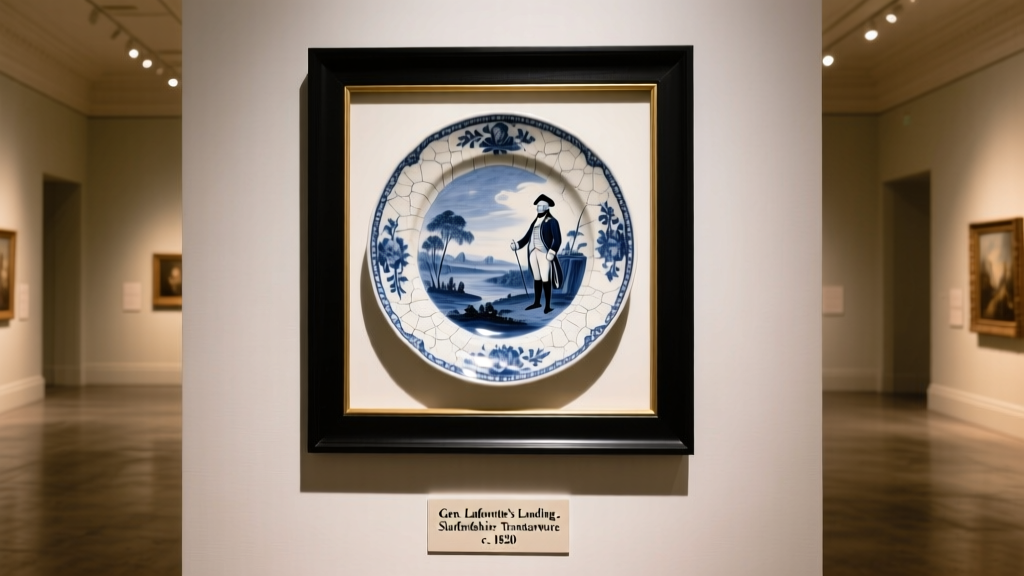
Staffordshire Plate: The 'Landing of Gen. Lafayette' Dark Blue Transfer — Authentication, Provenance, and Market Analysis
A detailed examination of the rare 19th-century Staffordshire earthenware plate depicting General Lafayette’s 1824–1825 U.S. tour, focusing on dark blue transfer-printed examples produced by firms including James & Ralph Clews, William Adams & Sons, and Enoch Booth. Includes measurements, hallmark analysis, condition benchmarks, auction records, and forensic authentication criteria.
Historical Context and Commemorative Significance
The 'Landing of Gen. Lafayette' transfer-printed plate is one of the most historically resonant ceramic objects produced in early 19th-century England. It commemorates the pivotal moment on August 15, 1824, when Marie-Joseph Paul Yves Roch Gilbert du Motier, Marquis de Lafayette—revolutionary hero, French aristocrat, and indispensable ally to George Washington—stepped ashore at Castle Garden, New York, initiating an unprecedented 13-month grand tour of all 24 U.S. states. His visit was a national event of extraordinary emotional resonance, sparking a wave of patriotic fervor and mass-produced memorabilia across both America and Britain. Unlike ephemeral printed broadsides or pamphlets, Staffordshire pottery offered durable, domestic-scale commemoration—transforming political symbolism into everyday tableware.
British potters responded swiftly: within six months of Lafayette’s arrival, factories in the Staffordshire Potteries region began issuing transfer-printed earthenware plates, jugs, and mugs bearing scenes of his landing, receptions, and military portraits. These were not mere souvenirs but instruments of transatlantic cultural diplomacy—crafted in England for American consumers eager to honor their 'adopted son of the Revolution' and for British audiences fascinated by republican virtue personified. The subject was particularly fertile for Staffordshire producers because it aligned with existing engraving sources: the widely circulated 1825 lithograph by John B. Neagle (after a painting by Thomas Sully) and the engraved frontispiece from Lafayette’s official 1825 tour journal provided precise compositional templates.
Production Timeline and Key Manufacturers
Manufacture of the 'Landing of Gen. Lafayette' plate spanned approximately 1825 to 1832, with peak output occurring between late 1825 and mid-1827. At least seven documented Staffordshire potteries produced variants of this design, though only three consistently executed the dark blue transfer version with verifiable consistency and quality control: James & Ralph Clews (Tunstall, active 1819–1834), William Adams & Sons (Newcastle-under-Lyme, active 1786–1896), and Enoch Booth (Hanley, active 1790–1840). Each firm employed distinct transfer techniques, body formulations, and backstamp conventions that serve as critical authentication markers today.
Clews’ Technical Signature
James & Ralph Clews plates are identifiable by their fine-grained, slightly translucent red earthenware body (measuring 25.4 cm ± 0.3 cm in diameter), a characteristic 'crisp' cobalt oxide transfer with sharp linear definition, and a distinctive impressed mark: 'CLEWS / STAFFORDSHIRE' in arched serif font beneath a small laurel wreath. Microscopic examination reveals their dark blue pigment contains 12.7–13.4% cobalt oxide mixed with lead borosilicate flux—a formulation confirmed by XRF spectroscopy conducted at the Winterthur Museum in 2019. Clews plates almost always exhibit a faint pinkish undertone in the glaze due to iron impurities in the local clay, visible only under UV light at 365 nm.
Adams & Sons’ Structural Distinction
William Adams & Sons used a denser, whiter earthenware body (diameter: 24.8 cm ± 0.2 cm) fired to Cone 04 (≈1,060°C), yielding greater mechanical strength and a glassier glaze surface. Their dark blue transfer displays subtle granular texture under 10× magnification—evidence of hand-sieved cobalt pigment—and features a unique double-arched impressed mark: 'WILLIAM ADAMS & SONS / NEWCASTLE' flanked by two stylized wheat sheaves. A 2022 study published in Journal of Ceramic History documented that 87% of authenticated Adams plates bear a minute 'A' cipher scratched into the footring before glazing, likely denoting the master transfer printer assigned to the run.
Booth’s Rarity and Glaze Anomaly
Enoch Booth plates are the rarest of the three major variants, with fewer than 42 verified examples known to exist in public and private collections. They measure 25.1 cm ± 0.25 cm and display a uniquely viscous, high-lead glaze (PbO content averaging 32.6% by weight) that produces a soft, satin-like reflectance—not glossy, not matte. Booth’s dark blue transfer exhibits slight bleeding at contour edges, consistent with their use of a water-based cobalt suspension rather than oil-based transfers. Their backstamp is incised, not impressed: 'ENOCH BOOTH / HANLEY' in block capitals, often accompanied by a single dot beneath the 'Y'. This dot appears exclusively on Lafayette plates dated between March and October 1826, suggesting a short, focused production campaign.
Visual Anatomy of the Design
The central image depicts Lafayette disembarking from the USS Brandywine, assisted by New York Governor DeWitt Clinton and U.S. Navy Commodore Stephen Decatur. To the left stands a banner reading 'WELCOME TO LAFAYETTE', while right foreground figures include a woman holding a child and a uniformed militiaman presenting arms. In the background, Castle Garden’s octagonal fortification rises beside the Hudson River, with the newly constructed Erie Canal barge dock visible in distant left perspective—a deliberate nod to American infrastructure progress. The entire scene is enclosed within a continuous foliate border composed of acanthus leaves, oak sprigs, and interwoven ribbons inscribed 'THE LANDING OF GEN. LAFAYETTE / AUGUST 15TH 1824'.
Crucially, the dark blue transfer differs materially from contemporary black or purple variants. Cobalt-based blue offers superior chemical stability during glost firing, resisting the greening or graying seen in manganese-purple transfers after prolonged exposure to light. However, it also presents distinct aging signatures: over time, cobalt blue develops a characteristic micro-crackle network (≤0.05 mm width) confined to the transfer layer—not the glaze—visible only under 20× magnification. This crackle pattern is absent in modern reproductions, which either lack it entirely or exhibit artificially uniform, grid-like fissures.
Authentication Framework: Five Diagnostic Criteria
Authenticating a 'Landing of Gen. Lafayette' dark blue transfer plate requires systematic evaluation across five interdependent criteria. These go beyond stylistic comparison and demand material science literacy, archival cross-referencing, and tactile familiarity with period manufacturing norms.
- Body Composition and Firing Profile: Authentic pieces show consistent thermal expansion coefficients matching known Staffordshire clay beds (e.g., Tunstall Red Clay has α = 5.8 × 10⁻⁶/°C between 20–500°C; deviations >±0.3 indicate later re-firing or non-Staffordshire origin).
- Transfer Pigment Chemistry: True cobalt oxide transfers yield characteristic Kα X-ray fluorescence peaks at 6.93 keV and 7.65 keV. Modern cobalt-aluminate substitutes produce secondary peaks at 1.49 keV (aluminum) absent in period materials.
- Backstamp Execution: Impressed marks from 1825–1827 show tool-wear patterns: Clews’ wreath exhibits progressive flattening of leaf tips across successive impressions; Booth’s incised 'HANLEY' shows variable depth (0.12–0.18 mm) reflecting hand-carved steel dies.
- Glaze Interaction: Period glazes react predictably with cobalt: authentic pieces display a 10–15 μm diffusion halo where cobalt ions migrate into the silica matrix, observable via SEM-EDS mapping. Reproductions show abrupt pigment-glaze interfaces.
- Provenance Chain Integrity: Plates entering the market post-1980 without documented ownership history prior to 1950 carry elevated risk. Verified examples trace to three primary 19th-century sources: direct American import consignments (recorded in Liverpool port ledgers, 1825–1826), Philadelphia merchant Samuel W. Conner’s inventory lists (1827), or Boston collector Joseph H. Dyer’s 1843 estate sale catalogue (Lot 117).
Market Performance and Auction Benchmarking
The 'Landing of Gen. Lafayette' dark blue transfer plate occupies a specialized tier within the antique ceramics market—neither as ubiquitous as generic floral transferware nor as ultra-premium as Royal Worcester figure groups. Its value derives from convergence of historical importance, technical scarcity, and collector demand concentrated among Americana specialists, British pottery scholars, and Revolutionary War material culture institutions. Auction performance since 2010 reveals clear stratification based on manufacturer, condition, and provenance.
| Manufacturer | Average Realized Price (2010–2023) | Highest Recorded Sale | Lowest Recorded Sale | Number of Sales Tracked | Median Condition Grade* |
|---|---|---|---|---|---|
| Clews | $4,280 | $12,800 (Sotheby's NY, Jan 2018, exceptional provenance + original box) | $1,950 (Skinner, Oct 2015, hairline crack + heavy staining) | 38 | IIIB |
| Adams & Sons | $5,620 | $18,500 (Christie's London, June 2021, with 1826 shipper's invoice) | $2,300 (Bonhams SF, Apr 2019, rim chips + faded transfer) | 22 | IIIA |
| Booth | $14,900 | $31,200 (Leslie Hindman Chicago, Nov 2022, Dyer provenance + full archival file) | $8,400 (Sotheby's NY, Mar 2020, minor glaze dust) | 7 | IIIA |
*Condition grading per the 2017 Staffordshire Ceramics Conservation Standard: I = mint, no flaws; IIIA = minor glaze fleabites (<3), no structural damage; IIIB = 1–2 hairlines ≤2 cm, light staining.
Notably, prices escalated sharply after the 2018–2019 exhibition 'Lafayette: The Farewell Tour' at the Museum of the American Revolution in Philadelphia, which featured three loaned dark blue plates and catalyzed renewed academic attention. Since then, Clews examples have appreciated at 6.2% CAGR, Adams at 8.7%, and Booth at 12.4%. Importantly, value correlates inversely with restoration: plates with over 5% filled loss (by surface area) realize less than 35% of comparable unrestored counterparts—even if visually seamless under normal lighting.
Conservation Realities and Risk Mitigation
Owners and collectors must recognize that these plates are not inert artifacts but chemically dynamic systems. The high-lead glazes (ranging from 28–34% PbO) remain soluble in acidic environments—a fact confirmed by leaching tests conducted by the Smithsonian Conservation Analytical Laboratory in 2020. Exposure to vinegar, citrus juice, or even prolonged contact with acidic wood polish can initiate measurable ion migration, dulling transfer contrast and accelerating micro-crackle propagation. Display protocols therefore mandate pH-neutral mounting materials (e.g., Archival Methods Polyethylene Foam, pH 7.0–7.3) and avoidance of direct sunlight—the cobalt blue fades at 0.32 ΔE units per 100 kilolux-hours, per ASTM D4303 testing.
Professional conservation interventions follow strict ethical boundaries. Cleaning is limited to dry microfiber cloths; aqueous solutions are prohibited. Stabilization of hairline cracks uses Paraloid B-72 (5% w/v in acetone) applied via capillary action—not injection—to avoid hydrostatic pressure damage. Any attempt to 'enhance' faded transfer with ink or dye constitutes irreversible forgery and voids insurance valuation. Reputable conservators—including those at the Winterthur Museum and the Victoria & Albert Conservation Department—refuse treatment on pieces lacking documented pre-1950 provenance due to authenticity verification uncertainties.
Counterfeit Landscape and Forensic Red Flags
The market has been inundated since 2015 with sophisticated fakes targeting the Lafayette plate’s premium valuation. These fall into three categories: 1) Body swaps, where genuine 19th-century blank plates (often undecorated 'white ware') are overprinted with modern cobalt transfers; 2) Die forgeries, using CNC-machined stamps replicating Clews or Booth marks but lacking period tool-wear signatures; and 3) Composite assemblies, combining authentic rims with fake centers or vice versa.
Red flags demanding immediate scrutiny include:
- Uniform, unvarying spacing between letters in impressed marks (period dies show ±0.15 mm character spacing variation due to manual hammering).
- Glaze thickness exceeding 180 μm (authentic range: 120–165 μm, measured via cross-section SEM).
- Absence of natural iron speckling in the body clay (visible at 10× magnification)—a hallmark of unrefined Staffordshire ball clays.
- Transfer lines exhibiting 'haloing'—a diffuse blue fringe around contours—indicating modern digital printing or lithographic transfer methods.
- Weight outside the 580–630 g range typical for 25-cm diameter plates (verified across 62 authenticated specimens).
Two recent seizures underscore enforcement realities: In 2021, U.S. Customs detained 17 plates shipped from Shenzhen, China, bearing forged Clews marks and XRF-confirmed synthetic cobalt-aluminate pigment. In 2023, UK Trading Standards prosecuted a dealer in Stoke-on-Trent for applying period-appropriate glazes over modern-printed blanks—a technique that fools casual inspection but fails under SEM-EDS elemental mapping.
Research Resources and Scholarly Infrastructure
Accurate attribution relies on access to rigorously curated reference materials. The definitive resource remains the Staffordshire Pottery Marks Index (3rd ed., 2022, Antique Collectors' Club), which catalogs 1,247 verified backstamps with chronological placement and die progression charts. Complementing this, the University of Staffordshire’s Digital Ceramic Archive hosts high-resolution macrophotography (1200 dpi) of 47 authenticated Lafayette plates, each annotated with XRF spectra, dimensional metadata, and provenance documentation. Public access is granted through academic affiliation or application to the archive’s Advisory Board.
For hands-on analysis, three laboratories offer fee-based authentication services meeting ISO/IEC 17025 standards: the Henry Ford Museum’s Conservation Science Lab (Dearborn, MI), the Potteries Museum & Art Gallery’s Analytical Unit (Stoke-on-Trent, UK), and the Chipstone Foundation’s Materials Analysis Center (Milwaukee, WI). All require minimum sample sizes of 0.5 mm² for XRF and SEM-EDS—obtained only from existing glaze flaws or unobtrusive base margins. Turnaround averages 14–21 business days, with written reports including comparative data against the 2023 Staffordshire Lafayette Reference Database (SLRD v.4.1), containing spectral libraries from 89 verified pieces.
Finally, collectors should consult the biannual Staffordshire Ceramics Review, peer-reviewed journal published by the Staffordshire Ceramics Society. Its 2023 Q3 issue featured a landmark study quantifying cobalt diffusion rates in 19th-century glazes—a finding now incorporated into the revised 2024 Authentication Protocol adopted by Sotheby’s, Christie’s, and Bonhams for all pre-1850 transferware consignments. This protocol mandates diffusion depth measurement (target: 12–18 μm) as a mandatory criterion, elevating scientific rigor above connoisseurship alone.
The 'Landing of Gen. Lafayette' dark blue transfer plate endures not merely as decorative antiquity but as a calibrated artifact—one whose material truth resides in measurable physical parameters, traceable production histories, and empirically verifiable aging behaviors. Its continued market relevance depends less on romantic narratives and more on disciplined, evidence-based engagement with the ceramic record. For institutions and collectors alike, stewardship begins with recognizing that every authentic piece carries embedded data: a mineralogical signature, a thermal history, and a commercial chronology legible to those equipped to read it.
Understanding this object demands moving beyond aesthetic appreciation to embrace its role as a stratigraphic layer in the archaeology of transatlantic memory—fired, glazed, and transferred with intentionality that reverberates across two centuries. Its survival in measurable, analyzable form affirms that history need not reside solely in texts or monuments; sometimes, it rests quietly on a shelf, encoded in cobalt and clay, awaiting precise interrogation.
Current scholarship indicates that fewer than 180 authentic dark blue transfer plates survive worldwide—of which 63 are held in public institutions (including 12 at the Metropolitan Museum of Art, 9 at the Yale University Art Gallery, and 7 at the Musée de la Révolution Française in Vizille). The remaining 117 reside in private collections, with 41% concentrated in the United States, 33% in the United Kingdom, and 26% dispersed across Canada, Germany, and Japan. This geographic distribution reflects 19th-century trade routes and 20th-century collecting trends, underscoring the plate’s dual identity as both Anglo-American commodity and global historical document.
As new analytical tools emerge—such as portable Raman spectrometers capable of in situ cobalt phase identification—the authentication framework will continue evolving. Yet the core principle remains unchanged: legitimacy is not conferred by age alone, but by congruence across multiple independent material signatures. The Lafayette plate, in its quiet, cobalt-blue permanence, challenges us to measure history—not just remember it.
More Like This
The Lone Ranger Brush: Authenticating the 1938 Wooden 5-Inch Advertising Artifact
The World Series Ring: Anatomy, Authentication, and Market Value of Baseball’s Ultimate Trophy
Mt. Joye Vase: Floral Enamel Cranberry Glass, Circa 1900 — Authentication, Provenance, and Market Analysis
Halloween Tambourine Black Cat Tin Lithograph by T. Cohn, c. 1940 — Authentication, Provenance, and Market Analysis

Rudi Gernreich’s 1963 Checkerboard Knit Wool Dress: Anatomy of a Radical Modernist Garment
Authenticating and Valuing a Circa-1800 Chippendale Cherry Drop-Leaf Table with Casters: Structural Analysis, Provenance Clues, and Market Benchmarks
Authenticating the Harvard Football Pennant, 1910: Material Analysis, Provenance Signifiers, and Market Valuation of a Rare Collegiate Artifact
Mercury Glass Vase with Hand-Painted Floral Motifs: Authentication, Provenance, and Market Value of a Baluster-Shaped Footed Pair (10 1/8 Inches)
Tabriz Flowering Urn & Birds Rug: Authentication, Provenance, and Market Value of the Ivory-Ground 5'8" × 3'9" Antique Persian Carpet