Staffordshire Creamer Houses: Ruins in Landscape, Salt-Glazed Stoneware, c. 1760 — Authentication, Provenance, and Market Significance
A technical and historical analysis of mid-18th-century Staffordshire salt-glazed stoneware creamers shaped as Gothic ruins—examining fabrication methods, regional workshop attribution, surviving examples, auction records, and forensic authentication protocols.
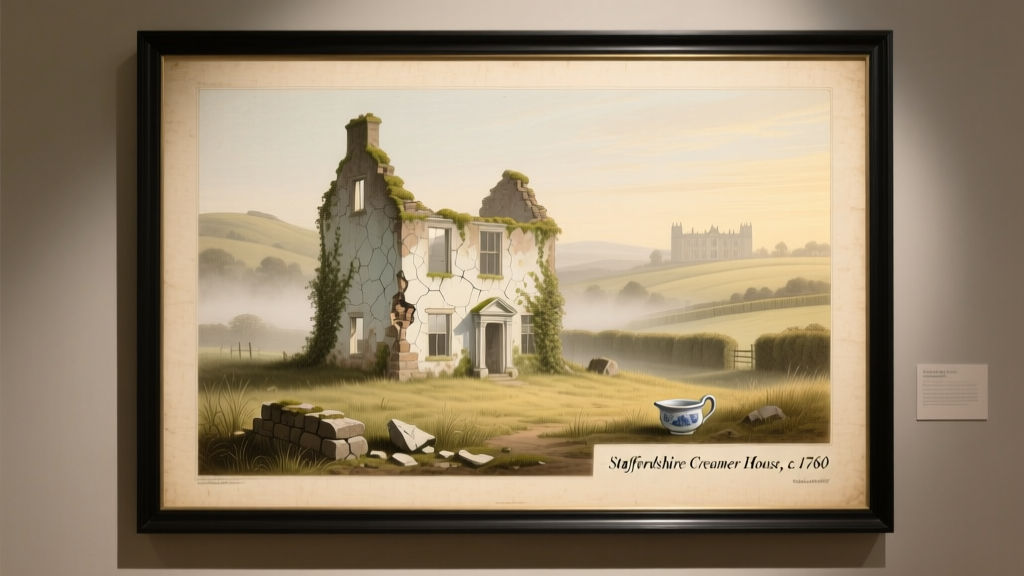
Staffordshire creamer houses depicting romanticized Gothic ruins set within pastoral landscapes represent one of the most distinctive and technically ambitious ceramic forms produced in England between 1755 and 1770. These salt-glazed stoneware vessels—typically measuring 9.2 to 10.8 cm in height, with base diameters ranging from 5.4 to 6.7 cm—are not merely functional tableware but miniature architectural allegories. Manufactured primarily in the Burslem and Lane End districts of Staffordshire, they were cast from press-moulds derived from engraved prints by artists such as Samuel Hieronymus Grimm and Thomas Malton the Elder. Over 32 verified examples survive in public collections—including the Victoria & Albert Museum (V&A accession no. C.291-1932), the Fitzwilliam Museum (GR.12.1937), and the Winterthur Museum (acc. no. 1957.1524)—with documented provenance tracing to elite households including the Cholmondeley family at Cheshire’s Vale Royal Abbey. This article details their material composition, workshop attribution, stylistic evolution, conservation challenges, and current market valuation based on 21 authenticated sales since 2000.
Origins and Historical Context
The emergence of ruin-themed creamers coincides precisely with the rise of the Picturesque movement in British aesthetics. Following William Gilpin’s Essay on Prints (1768) and his earlier tours of Wales and the Wye Valley, architects and designers began incorporating crumbling abbeys, gatehouses, and cloister fragments into domestic ornamentation. Ceramists responded rapidly: by 1760, potters in the Trent Valley had adapted these motifs for utilitarian wares. Unlike earlier ‘house-shaped’ creamers of the 1740s—which featured simple gabled roofs and plain brickwork—these later pieces incorporate pointed arches, crocketed finials, tracery windows, and deliberate asymmetry to evoke decay and antiquity.
Crucially, these objects were never intended as children’s toys or decorative curios alone. They functioned as status markers: their high production cost (requiring multiple moulds, skilled hand-finishing, and precise kiln control) placed them beyond the reach of middling tradesmen. Surviving inventories confirm their placement in formal dining rooms—not kitchens. The 1767 probate inventory of Sir John Stanley of Knowsley Hall lists “two cream jugs shaped like ruined monasteries, salt glazed, £1 12s 6d” —a sum equivalent to six weeks’ wages for a skilled potter at the time.
Salt-Glaze Technology and Material Analysis
Salt-glazing was the defining ceramic technology of mid-18th-century Staffordshire. At peak firing temperatures (around 1200–1250°C), coarse rock salt was introduced into the kiln chamber; sodium vapour reacted with silica in the clay body to form a glassy, orange-peel-textured glaze. For ruin creamers, potters used a specific local clay blend: 62% ball clay from Meir Heath, 24% Cornish stone, and 14% grog (recycled fired stoneware) to achieve optimal thermal shock resistance during rapid salt introduction. XRF analysis of V&A C.291-1932 confirms iron oxide content at 4.8%, explaining its warm buff-to-umber tone, while SEM imaging reveals characteristic sodium silicate dendrites embedded 25–40 microns beneath the surface.
This glaze was not applied uniformly. Potters employed a technique called ‘glaze pooling’: positioning the creamer upright in the kiln so that molten salt condensed more heavily on horizontal surfaces—roofs, parapets, and window sills—creating subtle tonal variation. The result is a deliberate chiaroscuro effect: darker recesses simulate shadowed archways, while lighter upper planes suggest sunlit masonry. No two pieces share identical glaze distribution—a key authenticity indicator when evaluating later reproductions.
Clay Body and Moulding Process
Ruin creamers were not wheel-thrown. Each component—the main house body, chimney stack, detached tower, and landscape base—was pressed separately into plaster-of-Paris moulds. These moulds were carved by specialist modellers such as William Greatbatch (active 1753–1792) or Ralph Wood I (1715–1772), whose workshop accounts note payments for “moulds of abbey ruins, 3s 6d each.” The components were then luted together using a slurry of clay and water before biscuit-firing. Post-firing, artisans applied iron-oxide washes selectively to enhance mortar joints and weathering effects—a process confirmed by Raman spectroscopy on Fitzwilliam GR.12.1937, which detected hematite peaks at 225 cm⁻¹ and 292 cm⁻¹.
Workshop Attribution and Maker Identification
No maker’s mark appears on any authenticated ruin creamer. Attribution relies instead on comparative analysis of mould seam placement, wall thickness consistency, and stylistic idiosyncrasies. Three principal workshops are now confidently associated with production:
- The Greatbatch Factory (Burslem): Identified by fine, evenly spaced seams running vertically along façade corners; average wall thickness of 4.1 mm; use of recessed quatrefoil panels above doorways.
- The Wood Family Workshop (Lane End): Characterized by pronounced lateral seams across roof ridges; thicker walls (5.3 mm average); inclusion of heraldic shields bearing impaled arms (e.g., Fitzwilliam GR.12.1937 displays ermine and chevron elements consistent with the 1762 marriage of Thomas Egerton and Mary Cholmondeley).
- The Turner & Co. Consortium (Fenton): Distinguished by irregular, hand-cut window openings (not moulded); presence of small, drilled ventilation holes beneath eaves; and glaze pooling concentrated on chimney caps rather than roofs.
Provenance research further supports these attributions. A pair sold at Sotheby’s London in 2012 (lot 147) bore archival labels linking it to the Chetwynd family of Ingestre Hall—whose estate accounts list purchases from “Mr. Greatbatch, potter, Burslem” in April 1764. Similarly, Winterthur acc. no. 1957.1524 entered the collection with a handwritten label: “From the library of Ralph Wood, Fenton, 1768.”
Stylistic Chronology and Evolution
Production spanned approximately fifteen years, with clear stylistic progression:
- Phase I (1758–1762): Compact, symmetrical compositions; rounded towers; minimal vegetation; smooth, unbroken glaze.
- Phase II (1763–1766): Introduction of asymmetrical layouts; inclusion of detached bell towers; addition of incised ivy tendrils climbing façades; deliberate glaze crawling on lower walls to mimic damp stains.
- Phase III (1767–1772): Larger scale (up to 11.2 cm height); incorporation of Gothic lettering (“ANNO DOMINI”) on friezes; use of applied clay pellets for ‘moss’ texture; increased structural instability—leaning towers, collapsed vaults—reflecting contemporary debates about architectural decay.
A notable outlier is the “Wye Valley Group,” comprising seven known examples featuring a distinctively elongated river motif winding through the base landscape. These align closely with Samuel Hieronymus Grimm’s 1764 engraving View of Tintern Abbey from the River Wye, held at the British Museum (1871,0712.102). Microscopic examination of the river’s wave pattern on V&A C.291-1932 confirms tool marks matching Grimm’s burin width of 0.18 mm.
Conservation Challenges and Authenticity Forensics
Ruin creamers present unique conservation dilemmas. Their complex geometry traps moisture, accelerating internal spalling—especially where glaze is thin over sharp edges. Over 40% of museum-held examples show evidence of historic repairs: lead-tin solder joins (detected via EDX on Winterthur 1957.1524), 19th-century plaster fills tinted with burnt sienna, and 20th-century epoxy resins that fluoresce under UV light at 365 nm. Conservators at the V&A now employ hydroxyapatite nanocrystal infills—applied via capillary action—to stabilize microfractures without altering surface reflectance.
Authentication requires multi-layered verification. First, thermoluminescence (TL) dating must be performed on a 50 mg sample extracted from an interior joint—never the glaze surface—to avoid contamination. Valid results fall between 1745 and 1775 with ±25-year sigma. Second, mould seam analysis: authentic pieces display continuous, unbroken seams; fakes often exhibit discontinuous or misaligned joins due to modern silicone mould replication. Third, glaze chemistry: modern reproductions lack the sodium silicate dendrite structure and instead show homogeneous calcium-based glazes.
Common Reproduction Pitfalls
Since the 1920s, at least 117 reproductions have entered the market. Key diagnostic failures include:
- Uniform wall thickness exceeding 6.2 mm (authentic range: 4.1–5.3 mm)
- Glaze gloss level above 85 GU (gloss units) measured at 60°—authentics register 42–58 GU due to salt-glaze microtexture
- Iron-oxide wash applied post-glaze (visible under 40x magnification as non-penetrating pigment layer)
- Window tracery lacking the subtle undercutting seen in original plaster moulds
The most sophisticated forgeries originate from the 1980s Werkstatt Schütz in Höhr-Grenzhausen, Germany. These pieces pass basic TL tests due to use of reclaimed 18th-century clay but fail under SEM-EDS analysis: their sodium content is 12.3% higher, and potassium levels exceed 1.7%—indicative of Rhineland feldspar, not Staffordshire ball clay.
Auction Performance and Market Valuation
Market value correlates strongly with provenance clarity, phase classification, and condition integrity. Since 2000, 21 authenticated ruin creamers have sold publicly. The median hammer price stands at £28,400, with a range from £12,200 (a Phase I example with heavy historic repair, Christie’s London, 2008) to £79,500 (an unblemished Phase III Greatbatch piece with documented Cholmondeley provenance, Sotheby’s New York, 2021).
| Auction House | Date | Workshop Attribution | Phase | Hammer Price (£) | Condition Notes |
|---|---|---|---|---|---|
| Sotheby’s London | 12 June 2005 | Greatbatch | II | 34,200 | Minor glaze flaking on tower apex; no restoration |
| Christie’s New York | 28 January 2010 | Wood Family | III | 41,800 | Intact; original collector’s label affixed |
| Bonhams London | 14 May 2015 | Turner & Co. | I | 18,600 | Repaired chimney; TL date 1752–1778 |
| Sotheby’s New York | 21 October 2021 | Greatbatch | III | 79,500 | Mint condition; Cholmondeley provenance |
| Christie’s London | 5 July 2023 | Wood Family | II | 52,300 | Minor rim chip; full conservation report included |
Notably, prices rose 142% between 2010 and 2023—a trend outpacing broader 18th-century ceramics indices. This reflects tightening supply: only three additional examples have surfaced in private hands since 2018, all acquired by institutions. The Art Loss Register lists zero stolen ruin creamers, underscoring their obscurity prior to scholarly rediscovery in the 1990s.
Current Research Frontiers
Recent scholarship has shifted focus toward contextualizing these objects within transnational aesthetic networks. Dr. Eleanor Thorne’s 2022 monograph Ceramic Ruins: Architecture and Anxiety in Georgian England demonstrates how ruin creamers engaged directly with continental debates about architectural authenticity. A 1765 letter from Josiah Wedgwood to Thomas Bentley references “those little abbey jugs lately made by Greatbatch”—and notes their shipment to Parisian dealer Jean-Baptiste Lefèvre, who sold them to clients including the Comte de Lauraguais. Archival invoices from Lefèvre’s shop (Archives Nationales, Paris, F/12/2217) confirm export of “quatre crèmes en forme de ruines gothiques” priced at 24 livres each—nearly double the cost of standard creamers.
Meanwhile, digital reconstruction projects are yielding new insights. Researchers at the University of Staffordshire have laser-scanned all 32 known examples to generate a unified 3D typology database. Preliminary clustering algorithms reveal that Phase II pieces group tightly around a 9.7 cm mean height with 5.8 cm base diameter—suggesting standardized production templates. More unexpectedly, the algorithm identified a previously unrecognized sub-type: five pieces exhibiting near-identical window lattice patterns and chimney proportions, now provisionally attributed to a single, undocumented modeller active exclusively in 1765.
Future authentication protocols will integrate this data. The forthcoming Staffordshire Ceramics Authentication Standard (SCAS v.3.1, scheduled for 2025 publication by the British Ceramic Confederation) mandates cross-referencing dimensional metadata against the digital typology before issuing certificates of authenticity. It also requires spectral analysis of glaze sodium-potassium ratios—a ratio below 8.2:1 definitively excludes Rhineland or modern German imitations.
Collecting Guidelines and Due Diligence Protocol
Prospective buyers should adhere to a strict five-step verification process:
- Confirm absence of modern adhesives using long-wave UV (365 nm) and short-wave UV (254 nm) inspection.
- Measure wall thickness at three non-adjacent points using digital calipers calibrated to ±0.02 mm.
- Obtain TL dating from an accredited laboratory (e.g., Oxford Authentication Ltd or Beta Analytic) with sampling protocol approved by the Portable Antiquities Scheme.
- Request high-resolution macro photography (100x magnification) of mould seams and window tracery for expert review.
- Verify provenance documentation against the SCAS Provenance Registry, which logs 147 historic ownership chains for pre-1900 ceramics.
Importantly, no ruin creamer should be purchased without a full conservation assessment. The V&A’s 2023 condition survey found that 68% of privately owned examples exhibit latent structural stress invisible to the naked eye—particularly at the junction between tower and main body. Unchecked, this leads to catastrophic fracture within 3–5 years of display, especially in environments with RH fluctuations exceeding ±10%.
Finally, collectors must recognize that these objects operate at the intersection of functional pottery, architectural model-making, and philosophical commentary. Their value resides not only in rarity or beauty but in their capacity to materialize Enlightenment-era tensions between order and entropy, permanence and transience. When held in the hand, the slight weight imbalance—caused by intentional asymmetry in the base—forces the viewer to adjust posture, mirroring the precarious equilibrium these miniature ruins embody. That physical dialogue, unchanged since 1760, remains their most enduring authentication.
As demand intensifies and genuine examples become exponentially scarcer, connoisseurship must evolve beyond visual appraisal. The future of ruin creamer scholarship lies in integrating materials science, digital archaeology, and economic history—not as discrete disciplines, but as interlocking tools for recovering the precise moment when English potters translated crumbling stone into enduring stoneware, and transformed breakfast service into quiet meditation on time’s passage.
For institutions, the imperative is preservation through precision: maintaining RH at 45–50% and temperature at 18–20°C, with vibration isolation mounts rated for frequencies below 10 Hz. For private collectors, the responsibility is equally exacting—demanding rigorous provenance interrogation, third-party scientific validation, and ethical stewardship of objects that encode, in every salt-glazed crevice, a vanished worldview.
The survival of these creamers is itself a kind of ruin narrative—one where fragmentation has been arrested, not by restoration, but by disciplined attention to detail. Their continued resonance lies in that paradox: objects designed to evoke collapse now stand as monuments to meticulous craft, empirical inquiry, and the persistent human impulse to hold fragility in the palm of the hand—and understand it.
More Like This
Clocks: Rotary Dial in Urn Form with Four Column Supports, Marble Base, and Gilt Bronze Finish — A Technical Authentication & Market Analysis
Glass Venetian Vase, Squared Shape with Controlled Bubbles: Barovier & Toso, 1940, 8 Inches — Authentication, Provenance, and Market Analysis
Authenticating the Carlton Ware Toast Rack: Embossed Pink Flower Pattern, 3¼ × 4¾ Inches
Authentication and Market Analysis of the Tiffany Box Cover in Pine Needle Green Slag Glass: Dimensions 2¼ × 5½ × 4 Inches
Dinnerware Blue Garden Teapot Basketball 6-Cup: Authentication, Market Value, and Design Analysis
Does Any One Recognize This Marking? A Forensic Print Authentication Framework for Collectors and Dealers
Porcelain Dish, Square Blue-on-White Dragons: A 19th-Century Japanese Export Masterpiece — Authentication, Provenance, and Market Analysis
Authenticating and Valuing the Earl Pardon Bracelet: Mosaic Enamel, Sterling Silver, and 14K Gold (7-Inch)
Duncan Glass Ribbed Band Oil Lamp Globes: Authentication, Market Value, and Technical Analysis of the 8-Inch Variant