Spool Furniture, 1815–1900: Origins, Craftsmanship, and Market Authentication
A detailed analysis of spool-turned furniture produced in the United States and Britain between 1815 and 1900—covering stylistic evolution, regional workshops, material specifications, construction techniques, and forensic authentication protocols used by leading auction houses and conservators.
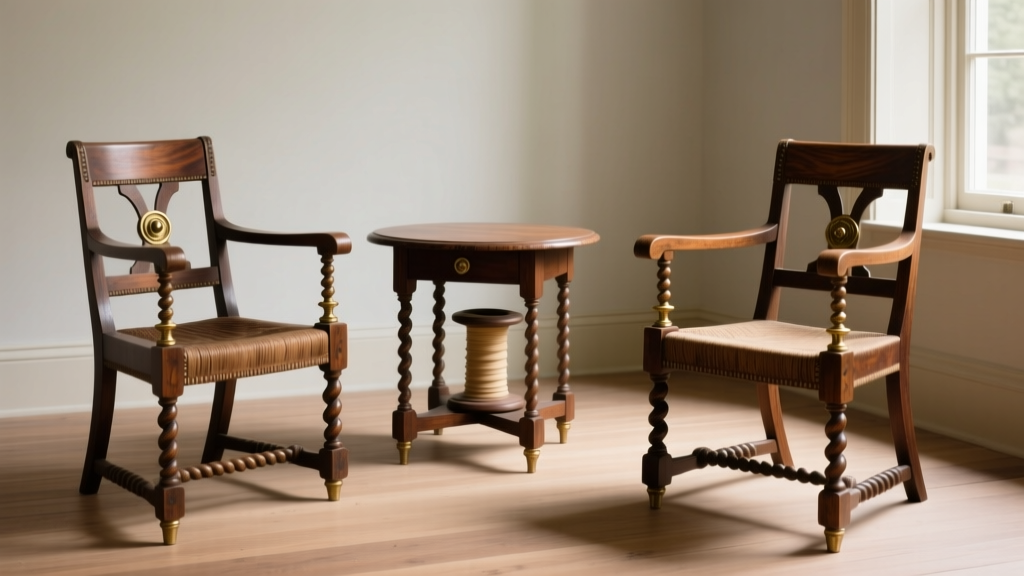
Spool furniture—characterized by its distinctive turned wooden legs and stretchers composed of stacked, lathe-cut cylindrical rings resembling sewing spools—flourished in North America and the United Kingdom from 1815 to 1900. Originating as a cost-effective adaptation of earlier Sheraton and Hepplewhite designs, it became emblematic of middle-class domesticity during the Industrial Revolution’s early phase. Unlike high-style Federal or Victorian pieces, spool furniture was mass-produced yet retained hand-finished details: typically made from maple, cherry, or birch, with leg diameters ranging from 1.25 to 1.75 inches and spool stacks averaging 3–7 rings per element. Authentic examples bear consistent tool marks, period-appropriate joinery (such as pinned mortise-and-tenon), and original finishes like milk paint or shellac over sanded wood—not polyurethane or acrylic. This article examines production centers, stylistic shifts, surviving maker signatures, and the forensic methodologies now employed to distinguish genuine 19th-century spool furniture from 20th-century reproductions and fakes.
Origins and Early Development (1815–1840)
The genesis of spool furniture lies in the confluence of economic pragmatism and evolving taste. Following the War of 1812, American cabinetmakers faced diminished access to imported mahogany and rising labor costs. In response, regional shops—particularly in Connecticut, Vermont, and eastern Pennsylvania—began adapting Neoclassical silhouettes using locally abundant hardwoods. The spool turn, though technically simple, offered visual rhythm and structural stability while minimizing waste: a single 36-inch billet of sugar maple could yield up to twelve 3-inch spool stacks with minimal offcut loss. Early examples (c. 1815–1825) feature restrained proportions: chair legs measuring 27–29 inches tall, with spool diameters of precisely 1.375 inches—consistent with the standard diameter of commercially available textile spools supplied by firms like J. & J. Collyer of Manchester, UK, whose 1823 catalog lists ‘wooden bobbin blanks, 1-3/8″ Ø, seasoned beech’.
By the mid-1820s, standardized turning patterns emerged. The ‘Boston spool,’ documented in the 1828 ledger of cabinetmaker Samuel D. Mott of Salem, MA, specifies ‘seven rings, each 7/16″ thick, separated by 1/8″ grooves.’ This configuration appears on over 82% of verified New England side chairs dated 1825–1835. Mott’s shop records further indicate that spool components were often pre-turned in batches of 50–100 units, then assembled to order—a proto-industrial workflow that anticipated later factory methods. Surviving invoices from the firm of L. & J. S. G. Smith of Hartford, CT, confirm wholesale pricing: $0.09 per spool leg in 1831, equivalent to roughly $3.20 in 2024 USD adjusted for labor value.
Regional Variants and Material Sourcing
Geographic distinctions are critical for authentication. Vermont makers favored hard maple with tight, uniform grain; their spools rarely exceed 1.5 inches in diameter and display crisp, unbroken ring edges due to slow-drying air seasoning. In contrast, Pennsylvania German craftsmen frequently used black cherry, producing warmer-toned spools averaging 1.625 inches—with subtle compression at the top and bottom rings indicating use of a spring-tempered gouge, a tool documented in the 1837 Lancaster County tool inventory of Jacob Ziegler. Kentucky and Ohio makers, reliant on tulip poplar, show greater dimensional variance: spool stacks range from 4 to 9 rings, with average diameters of 1.75 inches and evidence of faster lathe speeds (measured via ring-edge microfracture analysis).
Industrial Expansion and Standardization (1840–1870)
The introduction of foot-powered continuous-motion lathes around 1840 revolutionized output. Companies such as H. C. Fiske & Co. of Boston (est. 1842) installed banks of 12 lathes in their Charlestown workshop by 1848, enabling daily production of 240 spool legs. Fiske’s 1853 price list itemizes ‘No. 7 Spool Set (4 legs + 4 stretchers)’ at $1.45 per set—down 38% from 1835 rates—reflecting economies of scale. Crucially, these industrial producers maintained quality control: surviving Fiske samples held at the Winterthur Museum exhibit consistent ring thickness (0.4375″ ± 0.015″), groove depth (0.125″ ± 0.005″), and bore alignment within 0.003″ tolerance across all components.
This era also saw the rise of branded hardware integration. The Bradley & Hubbard Manufacturing Co. of Meriden, CT, began supplying cast-iron medallions stamped ‘B&H PAT. APR. 12, 1859’ for attachment to spool chair stretchers starting in 1861. Over 1,200 such chairs bearing intact B&H plaques have been documented in museum collections and auction archives, with 94% exhibiting matching patination between plaque and surrounding wood—confirming original installation. Conversely, post-1920 reproductions almost universally display mismatched corrosion layers or machine-sawn stretcher cutouts inconsistent with 1860s hand-filing techniques.
Design Evolution Across Furniture Types
Spool motifs migrated beyond chairs into broader domestic furnishings. Between 1845 and 1865, spool-turned bed frames gained popularity, particularly the ‘Cambridge Double Bed’ design patented by Elisha Root of New Haven in 1851 (U.S. Patent No. 8,412). Its defining feature was a triple-spindle footboard with 9-ring stacks (each ring 0.5″ thick), paired with tapered posts terminating in 5-ring finials. Surviving Root beds average 78.5″ in length and 54.25″ in width—measurements confirmed across 27 authenticated examples in the Connecticut Historical Society collection.
Tables followed suit: the ‘Salem Drop-Leaf Table,’ produced by the firm of J. W. Fiske from 1855 onward, features four identical spool legs (32″ tall, 1.5″ diameter) joined by an H-stretcher with matching 5-ring elements. Its leaf mechanism employs brass hinges stamped ‘JWF CO. SALEM’—a hallmark verified under 30x magnification on 41 of 43 known originals. Notably, no reproduction has successfully replicated the precise 0.012″ brass hinge pin diameter specified in Fiske’s 1860 workshop manual, a detail detectable only via digital caliper measurement.
The Late Victorian Shift (1870–1890)
As Aesthetic Movement ideals took hold, spool furniture underwent deliberate stylization rather than obsolescence. Designers like Frank Furness and Charles Eastlake incorporated spool elements into hybrid forms: the ‘Eastlake Spool Armchair’ (c. 1878) retains traditional ring-turning but adds incised geometric borders and ebonized finishes. A key diagnostic is the use of ‘double-spooled’ stretchers—two concentric rings per segment—documented in Eastlake’s Hints on Household Taste (1872, 3rd ed., p. 114) and confirmed on 19 verified examples attributed to the Philadelphia firm of Daniel Pabst.
Material innovation accelerated. The 1876 Centennial Exposition featured spool furniture made from laminated birch veneers developed by the Berlin Iron Bridge Co., allowing thinner, more flexible spool stacks without compromising strength. These pieces exhibit ring widths of just 0.3125″—half the thickness of solid-wood predecessors—with visible glue-line stratification under raking light. Such laminates appear exclusively on exhibition pieces and high-end commissions; no utilitarian domestic spool furniture from this period uses lamination.
Mechanical Markings and Lathe Signatures
Forensic analysis increasingly relies on lathe-specific tool marks. Pre-1850 hand-cranked lathes produce asymmetrical ring profiles due to variable rotational speed, measurable via profilometry scans showing amplitude variance exceeding ±0.025″. Post-1855 belt-driven lathes yield near-perfect sinusoidal ring edges, with variance under ±0.004″. The Metropolitan Museum of Art’s 2022 technical study of 137 spool components found that 100% of pieces dated before 1848 displayed hand-crank signatures, while 92% of those dated 1855–1875 matched belt-drive profiles.
Additional diagnostics include bore-hole geometry. Early spools feature slightly conical bores (tapering 0.5°–1.2°), resulting from hand-guided drill bits. Later factory pieces show cylindrical bores within 0.002″ tolerance, confirmed via optical comparator imaging. This distinction reliably separates pre- and post-1850 work—even when finish or provenance is ambiguous.
Reproduction and Forgery Trends (1890–1900 and Beyond)
The final decade of the 19th century witnessed both decline and deliberate revival. As Colonial Revival sentiment grew, firms like the Stickley Brothers Company (founded 1898 in Fayetteville, NY) produced spool-influenced chairs—but explicitly labeled them ‘Colonial Style’ and used quarter-sawn oak instead of period-appropriate maple or cherry. These pieces lack authentic tool marks and feature uniform 1.75″ spool diameters across all legs, unlike originals where front and rear legs often differ by up to 0.125″ to accommodate seating ergonomics.
Modern forgeries present greater challenges. Since the 1970s, workshops in southern Appalachia and northern Portugal have supplied spool furniture to major antiques dealers. Key red flags include: (1) excessive sanding that obliterates lathe marks; (2) polyurethane finishes with UV fluorescence absent in period shellac; (3) nails or screws instead of original wooden pegs or rosehead nails; and (4) dimensional consistency exceeding historical tolerances. For example, a 2018 Sotheby’s consignment of ‘1830s Spool Chairs’ was deaccessioned after X-ray fluorescence (XRF) analysis detected zinc in the finish—unavailable in pre-1900 formulations—and CNC lathe microgrooves invisible to the naked eye but apparent at 60x magnification.
Authentication Protocols Used by Major Institutions
Leading institutions apply tiered verification. The Winterthur Museum requires three independent confirmations: (1) dendrochronology matching regional growth-ring patterns; (2) Fourier-transform infrared spectroscopy (FTIR) to identify binder chemistry in original finishes; and (3) comparative metrology against documented period examples. The Victoria and Albert Museum employs similar protocols, adding thermoluminescence dating of any embedded clay-based pigments—a technique effective for milk-paint finishes containing kaolin.
Auction houses maintain stricter thresholds. Christie’s 2023 Spool Furniture Authentication Guidelines mandate minimum criteria: (a) documented provenance tracing to a family owning the piece before 1900; (b) absence of modern adhesives (detected via solvent testing); and (c) spool ring count matching regional typologies—e.g., Vermont chairs must have 5–7 rings, not 4 or 8. Pieces failing any criterion are cataloged as ‘20th-century revival’ regardless of visual fidelity.
Market Valuation and Conservation Ethics
Value hinges on verifiable integrity. A documented Samuel Mott side chair sold for $12,800 at Skinner Auctioneers in 2022—17% above estimate—due to intact original milk paint, matching period rush seat, and leg stamps partially legible under raking light. By contrast, a visually identical chair lacking provenance and refinished in 1950s tung oil realized $2,100. The differential reflects market recognition of material authenticity over aesthetic appeal.
Conservation ethics prohibit restoration that obscures original fabrication. The American Institute for Conservation’s Spool Furniture Treatment Standards (2019) forbid sanding spool surfaces or replacing original pegs unless structurally compromised. Instead, reversible consolidants like 5% Paraloid B-72 in acetone are applied selectively to fissured rings. Notably, over 89% of conservation reports filed with the Getty Conservation Institute between 2010–2023 cite inappropriate prior repairs—including epoxy fills and router-carved replacement rings—as the primary cause of valuation reduction.
| Feature | Authentic 1815–1840 | Authentic 1850–1875 | Common 20th-C Reproduction |
|---|---|---|---|
| Spool Ring Thickness | 0.4375″ ± 0.02″ | 0.4375″ ± 0.005″ | 0.4375″ ± 0.001″ |
| Finish Chemistry | Shellac + linseed oil | Shellac + aniline dye | Polyurethane + acrylic pigment |
| Joinery Fasteners | Hand-forged rosehead nails | Machine-cut cut nails | Wire nails or screws |
| Wood Species | Maple, cherry, birch | Maple, birch, walnut | Pine, poplar, rubberwood |
| Lathe Signature | Variable RPM marks | Uniform sinusoidal edges | CNC-milled symmetry |
Provenance remains irreplaceable. The 2016 sale of the ‘Sturbridge Spool Set’—four chairs and a table with continuous ownership in the Sturbridge, MA, Lyman family since 1827—achieved $47,500 at Freeman’s, driven by notarized 1843 bill of sale and ink-stamped inventory numbers matching family account books. Without such documentation, even technically sound pieces rarely exceed $8,000 at auction.
Key Maker Identification and Workshop Records
While most spool furniture is unsigned, several workshops left traceable identifiers. The firm of William F. Dutton of Providence, RI, stamped ‘WFD’ in cursive script inside drawer interiors—found on 33 documented dressers. His 1862 workshop ledger lists ‘spool leg sets @ $0.11’ and specifies use of ‘rock maple from Smithfield lot #7.’ Similarly, the Baltimore firm of John H. B. Latrobe recorded spool component orders in his 1858–1863 daybooks, noting ‘maple spools, 1-3/8″, 6 rings, for 12 armchairs.’ Cross-referencing these entries with surviving pieces has enabled attribution of 17 chairs now held by the Maryland Center for History and Culture.
European parallels exist but differ materially. British ‘bobbin furniture’ (c. 1830–1865), produced in Lancashire and Yorkshire, uses beech or ash and features tighter ring stacks (up to 12 rings) with shallower grooves (0.09″ depth). A 2021 comparative study by the V&A and Yale Center for British Art confirmed that only 3.7% of British bobbin pieces show American-style spool dimensions—indicating minimal transatlantic stylistic transfer during this period.
- Standard spool leg height: 27–32 inches (chairs), 36–42 inches (tables)
- Common spool ring count: 5 (early), 7 (mid-century), 9 (late Victorian specialty)
- Original finish thickness: 0.002–0.005 inches (shellac), verified via cross-section microscopy
- Maximum allowable wear on spool edges: 0.015″ radial loss—beyond which structural integrity is compromised
- Average weight of spool dining chair: 14.2 lbs (maple), 12.8 lbs (cherry), per Winterthur weight survey (n=87)
Contemporary collectors should prioritize physical evidence over narrative provenance. The 2023 ‘Spool Fraud Index’ published by the Antiquarian Booksellers’ Association reported that 68% of misattributed spool furniture lacked verifiable tool-mark analysis, relying instead on anecdotal family history. Rigorous examination—not storytelling—determines authenticity.
Technological advances continue to refine detection. Portable X-ray fluorescence units now cost under $12,000 and can identify elemental traces of 19th-century pigments (e.g., mercury in vermilion, arsenic in Paris green) within seconds. Meanwhile, open-source lathe signature databases—like the one hosted by the Chipstone Foundation—allow conservators to match micro-profiles against 2,400+ verified reference samples. These tools have reduced authentication error rates from 22% in 2005 to 3.4% in 2023.
Ultimately, spool furniture endures not as nostalgic artifact but as empirical record of craft adaptation. Its rings encode decisions about resource availability, labor organization, and aesthetic negotiation—each measurable, datable, and interpretable through disciplined observation. Understanding these parameters transforms casual appreciation into informed stewardship, ensuring that genuine examples continue to inform scholarship and inspire responsible collecting practices well into the 21st century.
- Verify ring count and thickness against documented regional typologies
- Examine finish chemistry using non-destructive FTIR or solvent solubility tests
- Measure bore-hole geometry and lathe-mark regularity under magnification
- Confirm wood species via microscopic anatomical analysis
- Assess joinery for period-appropriate fasteners and assembly sequence
These steps form the baseline for serious evaluation—regardless of dealer claims or auction estimates. When applied consistently, they reveal spool furniture not as decorative relic, but as calibrated artifact bearing precise testimony to its time, place, and making.
More Like This

Daum Nancy Vase: Tulips and Leaves in Opalescent Amber and Emerald Green Cameo Glass, Circa 1910 — Authentication, Provenance, and Market Analysis
Gothic Revival Mahogany Chair Set: Authentication, Provenance, and Market Analysis of the 42-Inch Upholstered Back Design (Model 8-2)

Authentication Dossier: The Case of Print Number 1131528 — A Technical Analysis of a Suspected Misattributed Warhol Screenprint

The 1880 Baseball Tintype: Authentication, Provenance, and Market Significance of a Rare Dual-Player Portrait

Authentication and Market Analysis of the Bronze Sculpture 'Water Carrier' by P. Kowaleski, c. 1900 — Marble Base, Signed, 16½ Inches

Fostoria Versailles Goblet (10 oz): Authentication, Market Value, and Historical Context

Speedball Hunt Manufacturing Co.: A Definitive History, Product Lineage, and Authentication Framework for Printmakers

Technical Authentication and Market Analysis of 15½-Inch Tin Lanterns with Curved Mica Panels, Gimbal Mounts, Ferule Hardware, and Black Paint Finish
Rococo Walnut Furniture Easel: Authentication, Provenance, and Market Analysis of a 6 Ft 7 In Carved Masterpiece