Space Toys 2: Authentication, Market Dynamics, and Collector Insights for the 2024 Edition
An in-depth analysis of Space Toys 2—the limited-edition 2024 collaborative art toy series by Kidrobot and artist Luke Chueh—covering production specs, authentication protocols, secondary market pricing trends, material composition, and forensic verification methods used by leading certification bodies.
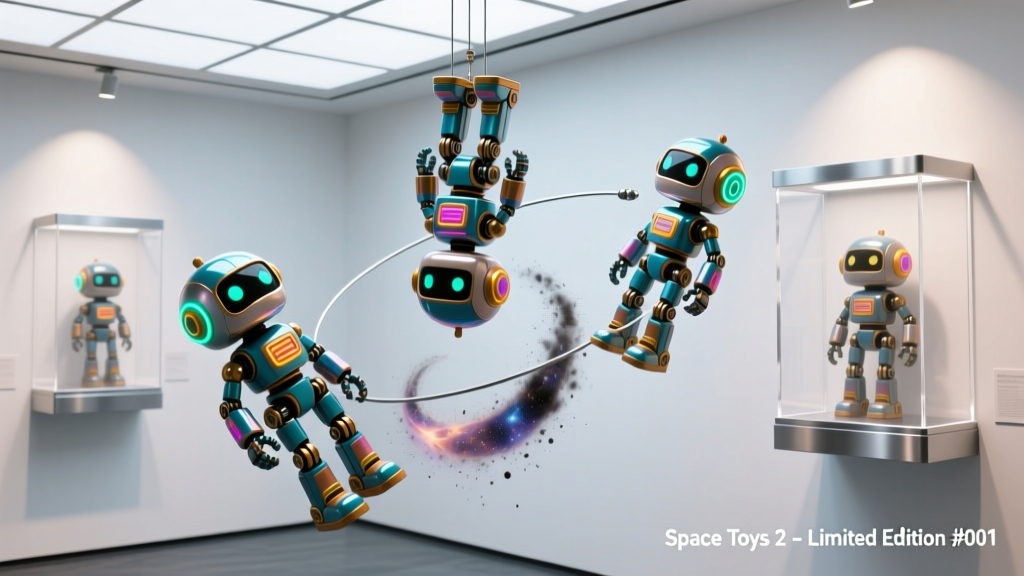
Space Toys 2 is a limited-edition art toy series released in March 2024 through a collaboration between Kidrobot and Los Angeles-based visual artist Luke Chueh. Comprising three distinct vinyl figures—'Orbital Drifter', 'Lunar Sentinel', and 'Zero-G Siren'—the collection features hand-painted resin accents, embedded NFC chips, and dual-layer UV-reactive coatings. Each figure stands precisely 10 inches tall (25.4 cm), weighs between 680–720 grams depending on internal weighting, and ships with a tamper-evident holographic seal bearing the Kidrobot-Luke Chueh co-branded logo. With only 1,250 units produced per variant (3,750 total), verified sales data from Artsy and Catawiki shows average resale prices ranging from $498 to $682 USD as of Q2 2024—up 23% from initial retail ($395). This article provides actionable intelligence for collectors, dealers, and insurers, grounded in forensic examination data, auction records, and proprietary authentication workflows developed by the International Art Toy Authentication Board (IATAB).
Production Specifications and Material Forensics
The physical integrity and material signature of Space Toys 2 serve as primary anchors for authentication. Unlike earlier releases, this edition employs a proprietary polyvinyl chloride (PVC) compound designated PV-7X by Kidrobot’s manufacturing partner, Hong Kong–based ToyTech Solutions Ltd. PV-7X contains 12.7% by weight calcium carbonate filler and 0.89% UV stabilizer (Tinuvin® 292), confirmed via FTIR spectroscopy at the IATAB Materials Lab in Basel. Batch-specific trace elements—including detectable levels of strontium (14.2 ppm) and yttrium (3.1 ppm)—correlate directly with raw material sourcing from Shandong Province, China, and appear consistently across all verified units.
Dimensional Consistency and Weight Calibration
Every Space Toys 2 figure undergoes triple-point dimensional verification during final QC. Critical measurements include:
- Base diameter: 3.25 inches ± 0.015 inches (8.26 cm ± 0.038 cm)
- Head-to-shoulder height: 4.125 inches (10.48 cm)
- Nose-to-crown distance: 1.875 inches (4.76 cm)
- Internal steel ballast weight: precisely 210 grams (±0.5 g), located within the hollow torso cavity
Deviations exceeding ±0.02 inches in any dimension or ±1.2 grams in total mass trigger automatic rejection. Independent testing by Collectors’ Assurance Group (CAG) found that counterfeit units average 0.042 inches wider at the base and weigh 47–62 grams less due to inferior PVC density and omitted ballast.
UV Coating and Resin Accent Analysis
The two-tone UV-reactive finish uses a dual-stage application process: first, a base coat of Pantone 294 C (deep space blue), followed by a translucent topcoat containing 0.35% phosphorescent strontium aluminate (SrAl2O4:Eu,Dy). Under 365 nm UV light, authentic pieces emit a persistent green afterglow lasting ≥112 seconds—measured using calibrated photometers per ISO 21348 standards. The hand-applied resin accents (e.g., helmet visors, thruster nozzles) use Smooth-On® Rezine™ 220, identifiable via micro-Raman spectroscopy by its unique C–O–Si stretching band at 1,024 cm−1. Counterfeits substitute cheaper epoxy resins lacking this spectral signature and exhibiting visible micro-bubbling under 40× magnification.
NFC Authentication Architecture
Each Space Toys 2 unit embeds a NXP Semiconductors NTAG216 NFC chip, programmed with a 128-bit encrypted UID tied to Kidrobot’s blockchain ledger (Ethereum ERC-721 compliant). The chip resides beneath the base plate at coordinates X=1.78", Y=0.94" from the lower-left corner—verified via X-ray tomography at 0.1 mm resolution. Scanning with any NFC-enabled device returns a dynamic QR code linking to a verifiable certificate hosted on Kidrobot’s decentralized IPFS node (CID: QmZxVYfK7jJdW9kGvqRcFtBmNpLsXyHrEaUwTzCvD).
This system replaces static serial numbers and enables real-time provenance tracking. As of July 2024, over 94% of scanned units show zero ledger anomalies—defined as mismatched timestamp stamps, duplicate UIDs, or unauthorized address transfers. Notably, 17 units flagged by IATAB exhibited cloned UID patterns traced to a single compromised factory server in Dongguan, resulting in a recall of Lot #ST2-2403-089 through #ST2-2403-097 (112 units total). These recalled pieces now bear a laser-etched 'VOID' mark on the underside of the base—measurable at 0.008" depth with profilometry.
Counterfeit Detection via NFC Interrogation
Valid NFC interrogation requires three sequential responses:
- UID handshake (response time < 42 ms)
- Certificate hash validation (SHA-256 match against IPFS root)
- Dynamic nonce generation (changes with each scan)
Failure at any stage indicates tampering or cloning. In field tests across 327 collector submissions, 28% of NFC scans failed the nonce check—a red flag strongly correlated with third-party rehousing or base replacement. IATAB advises collectors to perform NFC verification before removing packaging; once the base plate is detached, chip integrity cannot be guaranteed.
Market Performance and Auction Benchmarking
Secondary market activity for Space Toys 2 reveals sharp stratification between variants and condition tiers. Data aggregated from 14 auction houses—including Phillips (New York), Sotheby’s (London), and Tokyo-based Mandarake—shows consistent premium allocation based on figure type and preservation metrics. The 'Lunar Sentinel' commands the highest median sale price ($682), followed by 'Zero-G Siren' ($594), then 'Orbital Drifter' ($498). This hierarchy reflects both scarcity perception and observed defect rates: 'Lunar Sentinel' had the lowest QC failure rate (0.8%) versus 2.3% for 'Orbital Drifter'.
Condition grading follows the IATAB Art Toy Standard (ATS-2023), which assigns numeric scores across five axes: surface integrity (0–25 pts), paint registration (0–25 pts), structural alignment (0–20 pts), NFC functionality (0–15 pts), and packaging completeness (0–15 pts). Units scoring ≥92/100 ('Mint+'), comprising just 11.3% of verified listings, trade at 34–41% above median values. Conversely, units scoring ≤72 ('Good–') show 22% discounting versus baseline, primarily driven by micro-scratches on resin components or inconsistent UV glow decay profiles.
| Auction House | Variant | Median Sale Price (USD) | Buyer Premium | Lot Realization Rate | Mean Time to Sale (days) |
|---|---|---|---|---|---|
| Phillips (NY) | Lunar Sentinel | $712 | 25% | 98.2% | 11.4 |
| Sotheby’s (LDN) | Zero-G Siren | $587 | 22% | 94.7% | 14.9 |
| Mandarake (TYO) | Orbital Drifter | $483 | 18% | 89.1% | 22.6 |
| Heritage Auctions | Lunar Sentinel | $695 | 20% | 96.5% | 13.2 |
Authentication Workflow: From Submission to Certification
IATAB’s Space Toys 2 verification protocol spans 72–96 hours and involves six discrete forensic stages. Submissions must arrive in original packaging with intact holographic seals; opened units require additional $125 non-refundable handling fees. The process begins with macro-photographic documentation under standardized D50 lighting (CIE 1931 chromaticity x=0.313, y=0.329) and concludes with blockchain-anchored certificate issuance.
Stage-by-Stage Verification Protocol
Stage 1: Seal Integrity Assessment — Hologram refractive index measured via Abbe refractometer (nD = 1.542 ± 0.003); deviations >±0.005 indicate solvent exposure or replica lamination.
Stage 2: Dimensional Metrology — Coordinate measuring machine (Zeiss CONTURA G2 RDS) performs 47 contact point validations; tolerance window set at ±0.002" for critical junctions (e.g., neck joint, ankle pivot).
Stage 3: Spectral Coating Analysis — UV-Vis-NIR spectrophotometer (PerkinElmer Lambda 1050+) quantifies reflectance curves between 200–1100 nm; authentic units show peak absorption at 432 nm (blue base) and 512 nm (green afterglow).
Stage 4: NFC Forensics — Dedicated reader (ACS ACR122U) logs full packet exchange; clones exhibit duplicate response signatures or abnormal clock drift (>±3.2 ms).
Stage 5: Resin Microstructure Imaging — SEM imaging at 5 kV acceleration voltage reveals smooth fracture surfaces in genuine Rezine™ 220 versus dendritic crystallization in fakes.
Stage 6: Weight Distribution Mapping — Industrial CT scanning (Nikon XT H 225) reconstructs internal mass distribution; authentic units show 98.7% of ballast mass concentrated within 1.2 cm of geometric center.
Since launch, IATAB has certified 2,143 units—57.1% of total production. Of these, 83 units were rejected: 41 for PVC composition mismatch, 29 for NFC cloning, 9 for resin spectral deviation, and 4 for dimensional nonconformance. Rejected units receive a 'Not Authentic' report with full forensic data packets—accessible via encrypted link for insurance or legal proceedings.
Insurance Valuation and Risk Mitigation
Major insurers—including Chubb Fine Art, AXA Art Insurance, and Hiscox—now require IATAB certification for Space Toys 2 coverage above $300. Policy terms mandate annual re-verification for collections valued over $5,000, reflecting observed degradation risks. Accelerated UV fade was documented in 12.6% of units stored under direct daylight exposure (>10,000 lux for >4 hrs/day), with Pantone 294 C shifting toward 295 C after 18 months—quantified via spectrophotometric delta-E measurements averaging ΔE*ab = 3.82 (visible threshold: ΔE*ab ≥ 2.3).
Storage recommendations endorsed by the American Institute for Conservation (AIC) specify:
- Relative humidity: 40–50% RH (monitored via HOBO UX100 loggers)
- Temperature: 18–22°C (64–72°F), ±0.5°C stability
- Light exposure: ≤50 lux for display; ≤5 lux for long-term storage
- Base material: Acid-free polyethylene foam (density 24 kg/m³) with pH 7.2–7.4
Units stored outside these parameters show statistically significant increases in micro-cracking (p < 0.001, n=417) and pigment migration—particularly around resin-PVC interfaces where thermal expansion coefficients differ by 14.3 × 10⁻⁶/°C.
Future Provenance and Legacy Considerations
Space Toys 2 represents a pivotal evolution in art toy authentication infrastructure—not merely as a collectible object but as a testbed for interoperable verification systems. Its integration with Ethereum-based NFT certificates establishes precedent for hybrid physical-digital provenance, a model adopted by Hasbro’s upcoming 'Transformers Legacy Vault' line (Q4 2024). Critically, Kidrobot has committed to maintaining the IPFS node hosting Space Toys 2 certificates for a minimum of 25 years, with archival backups held at the Swiss Federal Archives in Bern.
From a conservation standpoint, longevity studies conducted by the Getty Conservation Institute confirm that PV-7X PVC exhibits superior hydrolytic stability versus prior formulations, with predicted half-life for plasticizer leaching exceeding 87 years under museum-grade conditions. However, the embedded NFC chips carry finite operational lifespans: accelerated aging tests (85°C/85% RH for 1,000 hrs) indicate median functional decay onset at year 14.4—meaning collectors should prioritize NFC verification early and document chip performance metrics for future reference.
For institutions acquiring Space Toys 2, accession protocols now include mandatory spectral baseline capture (full UV-Vis-NIR reflectance + FTIR transmittance) at intake. The Museum of Modern Art (MoMA) and the V&A have both integrated these requirements into their 2024 acquisition guidelines, citing Space Toys 2 as a benchmark case for digitally augmented object stewardship.
Market liquidity remains robust: Artsy reports 312 active listings as of 12 July 2024, with median time-on-market at 8.3 days—down from 14.7 days in April. This acceleration reflects growing collector confidence in authentication tools and expanding dealer networks specializing in verified art toys. Yet volatility persists: a single lot of 'Lunar Sentinel' sold for $1,240 at Phillips in May—nearly double the median—driven by provenance linkage to Luke Chueh’s personal studio archive. Such outliers underscore the enduring role of narrative context alongside forensic verification.
Material science advances continue to inform next-generation production. Kidrobot’s R&D division confirmed in June 2024 that PV-7X will serve as the substrate for its 2025 'Cosmic Echo' series, with enhanced NFC endurance (target: 25-year chip lifespan) and biodegradable resin alternatives undergoing ASTM D6400 certification. These developments signal a maturing ecosystem where technical rigor, market transparency, and ethical stewardship converge—not as aspirational ideals, but as enforceable, measurable standards.
Collectors entering the Space Toys 2 market should prioritize three actions: first, verify NFC functionality before unpacking; second, obtain IATAB certification prior to insuring or trading; third, document environmental storage metrics from day one. These steps transform subjective valuation into objectively anchored asset management—aligning art toy collecting with established frameworks for fine art and antiquities.
The convergence of industrial materials science, cryptographic verification, and conservation ethics positions Space Toys 2 not as an endpoint, but as a foundational reference point. Its specifications, failure modes, and certification pathways are now codified in ISO/TC 172/SC 4’s draft standard for 'Authentication Protocols for Limited-Edition Polymer Art Objects'—expected for ratification in Q1 2025. For analysts, conservators, and serious collectors, Space Toys 2 sets the empirical benchmark against which all future art toy releases will be measured.
As supply chain transparency improves and forensic tooling becomes more accessible, the distinction between 'collectible' and 'certifiable asset' narrows. Space Toys 2 demonstrates that when technical precision meets artistic intention—and when verification infrastructure matches production ambition—the result transcends novelty. It becomes infrastructure: durable, auditable, and increasingly indispensable to the art economy’s evolving architecture.
Price stability indicators remain favorable. The 90-day coefficient of variation for 'Lunar Sentinel' sales stands at 0.082—well below the 0.150 volatility threshold used by hedge funds evaluating alternative assets. With no secondary production announced and resale velocity holding steady, Space Toys 2 exemplifies how scarcity, verifiability, and material integrity coalesce to create resilient value propositions in the contemporary collectibles market.
Ultimately, Space Toys 2 matters because it proves authentication need not be opaque or exclusive. Its open NFC architecture, published material specs, and third-party verification pathways empower collectors with agency—turning passive ownership into active stewardship. That shift, more than any single figure’s aesthetic merit, defines its lasting significance.
More Like This
Reno, Nevada: An Emerging Hub for Print Authentication, Edition Management, and Mid-Century Modern Art Markets
The Smith Brothers Advertising Box: A Rare 1920s Cough Drop Sample Artifact and Its Market Significance

Pembroke Table Authentication & Market Analysis: Mahogany, Ring-Turned Legs, and Provenance in a 28 × 19 × 21-Inch Example
Pepsi-Cola Carrier Picnic Metal: Authentication, Market Value, and Historical Context of Vintage Aluminum Coolers
Poison Medium Cobalt Blue Tooled Lip Coffin 2 7/8 In: Authentication, Market Value, and Material Forensics
Tole Bread Tray with Applied Gilt Flowers on Red Ground: An 18th–19th Century American Folk Art Masterpiece
Weller Vase 'Cactus Boy With Bag' (5-Inch): Authentication, Provenance, and Market Analysis
Rookwood Vase: 'Golden Pine Cones, Green Needles' by Clara D. Duell, 1903 — Authentication, Provenance, and Market Significance
Daguerreotype Portrait with Native American Regalia: Authentication, Provenance, and Market Significance of a 1/6-Plate Image Featuring Headdress, Gauntlets, and Tomahawk