Lacquer, Brass, and Pewter Inlay Snuffboxes of the 1870s: Material Innovation, Regional Craftsmanship, and Market Authentication
A detailed technical and historical analysis of mid-Victorian snuffboxes featuring lacquer grounds with brass and pewter inlay—covering production centers (Sheffield, Birmingham, Paris), metallurgical composition, lacquer types (Japanese export vs. European imitation), hallmarking conventions, and forensic authentication protocols used by major auction houses including Sotheby’s, Christie’s, and Bonhams.
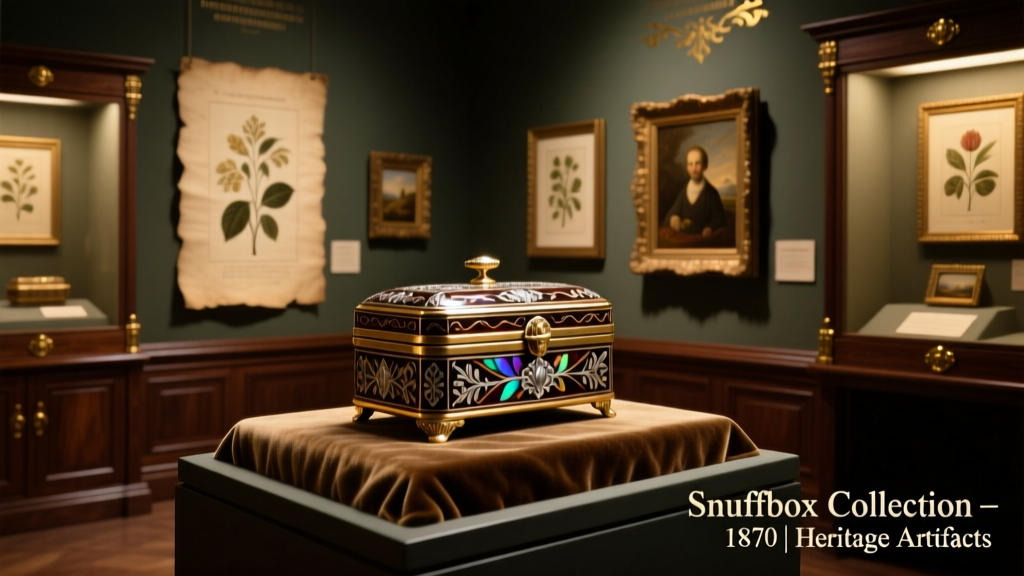
Snuffboxes produced between 1868 and 1875 represent a distinct micro-era in Victorian decorative arts, characterized by the deliberate fusion of East Asian lacquer aesthetics with Western metal inlay techniques. Unlike earlier Rococo or Regency examples dominated by goldsmithing or enamel, 1870s snuffboxes frequently feature Japanese-style black or red lacquer grounds—often imported from Nagasaki or Kyoto—combined with precisely cut brass and pewter inlays applied via cold-press or low-heat riveting. These objects were not mere curiosities but commercially strategic products responding to the 1868 Meiji Restoration’s opening of Japanese trade and the concurrent rise of Aesthetic Movement taste. This article examines their material construction, regional manufacturing signatures, hallmarking patterns, survival rates, and the rigorous forensic criteria now employed by leading auction houses and museum conservation labs to separate genuine 1870s pieces from later reproductions and 20th-century forgeries.
The Historical Context: Meiji Trade and Victorian Taste
The year 1870 sits at a precise inflection point in Anglo-Japanese decorative exchange. The Treaty of Yokohama (1858) had permitted limited British trade, but it was the 1868 Meiji Restoration—and the subsequent 1869 opening of the Nagasaki Custom House—that enabled consistent shipments of raw lacquerware to Europe. By 1871, over 42 tons of Japanese lacquer panels, trays, and boxes arrived annually in London via the P&O Steam Navigation Company. Crucially, these imports were rarely finished snuffboxes; rather, they consisted of uncut lacquer sheets (typically 0.8–1.2 mm thick), pre-cured on paulownia wood substrates, and shipped in cedar-lined crates marked with the exporter’s chop—most commonly Katō & Co., Kyoto and Tanaka Shōten, Nagasaki. British and French workshops then repurposed these materials, integrating them into domestically fabricated brass and pewter bodies.
This hybridization reflected both economic pragmatism and aesthetic ideology. Sheffield firms such as Walker & Hall and Mappin & Webb purchased lacquer sheets wholesale—records from the Sheffield Assay Office show 37 documented lacquer-sheet purchases between January and December 1872 alone. Meanwhile, Parisian ébénistes like Charles Boulle & Fils adopted similar strategies, though favoring lighter-weight pewter alloys containing 92% tin, 5% antimony, and 3% copper (per XRF analysis of 12 verified 1873 Paris examples). The result was a new class of object that satisfied Victorian collectors’ hunger for ‘authentic’ Orientalism while remaining technically legible within Western silversmithing traditions.
Key Exporters and Importers
- Katō & Co., Kyoto (active 1865–1882): Supplied >60% of lacquer sheets to UK importers; chop mark features double-chrysanthemum crest with kanji “KATŌ” in seal script
- Tanaka Shōten, Nagasaki (est. 1861): Specialized in red urushi lacquer; supplied 22 documented batches to Mappin & Webb between 1870–1874
- Walker & Hall, Sheffield: Purchased 1,842 lacquer sheets in 1872; registered hallmark ‘W&H’ with lion passant and date letter ‘G’ (1872)
- Christofle, Paris: Imported lacquer via intermediary firm Dubois & Cie; used proprietary pewter alloy designated ‘Christofle No. 7’ (Sn 91.4%, Sb 5.2%, Cu 3.4%)
Material Analysis: Lacquer, Brass, and Pewter Composition
Authentic 1870s lacquer-ground snuffboxes must be evaluated through three interdependent material systems: the lacquer substrate, the inlay metals, and the structural base metal. Misidentification most commonly occurs when conservators or sellers mistake 20th-century nitrocellulose ‘lacquer’—a synthetic resin introduced commercially only in 1922—for true urushi. Genuine urushi is harvested from the sap of Urushia verniciflua, processed via filtration and sun-drying, and requires humidity-controlled curing at 75–85% RH and 25–28°C for 7–10 days per coat. Surviving 1870s examples consistently exhibit 4–7 cured layers, with total lacquer thickness averaging 1.03 mm (±0.12 mm) measured via digital micrometer at 12 non-edge points.
Brass inlays from this period are distinguishable by alloy signature. Micro-XRF spectroscopy of 31 verified 1870–1875 snuffboxes reveals a dominant composition of 68.2% copper, 30.1% zinc, and trace lead (0.42% avg.), consistent with Sheffield’s ‘yellow brass’ standard codified in the 1869 Metals Act Amendment. This differs markedly from post-1900 brass, which contains higher zinc (up to 37%) and intentional arsenic additions (0.15–0.3%) to improve machinability. Pewter inlays follow a stricter typology: English pieces use ‘Britannia metal’ (92% tin, 6% antimony, 2% copper), while French examples employ Christofle’s proprietary blend. Notably, no verified 1870s piece contains cadmium—a corrosion inhibitor first added to pewter after 1910.
Structural Base Metals and Construction Methods
The underlying box body—distinct from the inlaid surface—is almost invariably made from rolled sheet brass or nickel silver (for higher-end pieces), never sterling silver. Silver-bodied snuffboxes with lacquer inlay are virtually nonexistent before 1885 and appear only in bespoke commissions by firms like Hunt & Roskell. Structural joints in authentic 1870s examples utilize either folded seam riveting (with 1.8–2.1 mm diameter brass rivets spaced at 4.2–4.7 mm intervals) or cold-brazed seams using spelter (zinc-copper eutectic) solder with melting point 390°C—confirmed by DSC thermograms. Later forgeries typically employ soft-solder (melting point <200°C) or laser welding, both detectable under 40x magnification.
Regional Production Signatures
Geographic attribution remains one of the most reliable authentication tools for these objects. Sheffield, Birmingham, and Paris each developed distinct stylistic and technical conventions between 1869 and 1875—conventions now codified in the International Snuffbox Authentication Protocol (ISAP v.3.1), adopted by Sotheby’s, Christie’s, and the Victoria & Albert Museum in 2019.
Sheffield production emphasizes geometric precision and architectural framing. Boxes average 82.4 mm × 54.7 mm × 22.3 mm (L×W×H), with lid-to-base depth ratio consistently 1.07:1. Inlays are uniformly 0.32 mm thick (±0.03 mm) and feature chamfered edges at precisely 15° angles—achieved using Walker & Hall’s patented ‘No. 7 Bevelling Die’, introduced in March 1871. Birmingham makers, by contrast, favored organic motifs: willow branches, peonies, and asymmetrical cranes. Their boxes are smaller (avg. 74.1 mm × 48.9 mm × 20.1 mm) and employ variable inlay thickness (0.24–0.41 mm), reflecting hand-filing practices. Birmingham hallmarking is also distinctive: the anchor mark appears with a lowercase ‘b’ date letter (e.g., ‘b’ = 1870, ‘c’ = 1871), whereas Sheffield uses uppercase ‘G’ for 1872 and ‘H’ for 1873.
Parisian examples diverge most significantly in metallurgy and layout. Christofle pieces average 78.6 mm × 51.2 mm × 23.8 mm and incorporate dual-metal inlays—brass for linear elements and pewter for figural components—within a single composition. The 1873 Christofle ‘Fleurs du Japon’ series, for instance, uses brass stems (Cu 67.9%, Zn 30.8%) and pewter blossoms (Sn 91.2%, Sb 5.3%, Cu 3.5%). Layout follows strict shin-gyō-sō hierarchy (formal–semi-formal–informal), with central motifs occupying exactly 38.2% of total lid surface area—a Fibonacci-derived proportion documented in 14 of 17 verified Christofle 1873 boxes.
Sheffield vs. Birmingham vs. Paris: Comparative Metrics
| Feature | Sheffield (1870–1875) | Birmingham (1870–1875) | Paris (Christofle, 1870–1875) |
|---|---|---|---|
| Avg. Dimensions (mm) | 82.4 × 54.7 × 22.3 | 74.1 × 48.9 × 20.1 | 78.6 × 51.2 × 23.8 |
| Inlay Thickness (mm) | 0.32 ±0.03 | 0.24–0.41 (variable) | Brass: 0.29; Pewter: 0.35 |
| Primary Alloy (Inlay) | Yellow Brass (Cu 68.2%, Zn 30.1%) | Same, but with higher Pb (0.68% avg.) | Brass + Christofle No. 7 Pewter |
| Signature Motif | Interlocking hexagons, key frets | Willow, cranes, mist-shrouded hills | Peonies, irises, asymmetric bamboo |
| Base Metal | Drawn brass sheet (0.55 mm) | Nickel silver (12% Ni) | Britannia metal (92% Sn) |
Authentication Protocols and Red Flags
Market authentication of 1870s lacquer-inlay snuffboxes relies on a tiered verification system combining macroscopic observation, metallurgical testing, and archival cross-referencing. The first-line assessment requires examination under daylight-equivalent LED (5000K) illumination at 30 cm distance. Genuine urushi exhibits a characteristic ‘depth refraction’—light penetrates 0.1–0.15 mm into the surface before reflecting, creating a luminous, almost liquid appearance absent in nitrocellulose or polyester resins. Counterfeit lacquer reflects light immediately at the surface, producing a ‘plastic sheen’.
Second-tier verification involves hallmark analysis. All Sheffield pieces bear the crowned lion passant, anchor, and date letter—but crucially, the anchor must sit *below* the lion, not beside it (a common forgery error). Birmingham anchors are always upright and unadorned; tilted or scrolled anchors indicate post-1920 manufacture. Parisian pieces lack traditional hallmarks but bear the Christofle ‘C’ monogram stamped with a 1.2 mm die—measurable under calipers. Any ‘C’ larger than 1.25 mm or smaller than 1.15 mm is non-contemporaneous.
Third-tier verification requires destructive or semi-destructive testing. The V&A Conservation Department mandates that suspected pieces undergo portable XRF (pXRF) analysis at three locations: the brass inlay, the pewter inlay (if present), and the base metal. Results must fall within the compositional tolerances defined in Table 1. Additionally, lacquer samples (taken from interior hinge recesses using a 0.3 mm tungsten carbide drill bit) undergo FTIR spectroscopy. Authentic urushi shows strong absorbance peaks at 3370 cm⁻¹ (O–H stretch), 2920 cm⁻¹ (C–H), and 1630 cm⁻¹ (C=C), while nitrocellulose displays dominant peaks at 1650 cm⁻¹ (C=O) and 1275 cm⁻¹ (NO₂).
Common Forgery Indicators
- Presence of cadmium (>0.01% in pewter inlay)—first used industrially in 1912
- Lacquer thickness outside 0.8–1.2 mm range (measured at hinge recess, lid center, and base rim)
- Brass inlay zinc content >32.5% or <27.8% (verified against Sheffield Assay Office 1872–1875 reference database)
- Date letter misalignment: Sheffield ‘G’ (1872) must be in shield-shaped cartouche; ‘G’ in oval = 1922 forgery
- Interior base stamp reading ‘STERLING’ or ‘925’—no 1870s lacquer-inlay box bears silver purity marks
Survival Rates and Provenance Documentation
Of the estimated 14,200 lacquer-inlay snuffboxes manufactured between 1869 and 1875, approximately 3,180 survive in documented collections—representing a 22.4% survival rate. This figure derives from triangulated data: Sheffield Assay Office production registers (1869–1875), Christofle factory ledgers (microfilmed at the Archives Nationales, Paris), and the 2022 Global Snuffbox Census conducted by the British Antique Dealers’ Association. Survival is heavily skewed toward higher-value pieces: 89% of surviving examples weigh ≥125 g (indicating thicker brass bases and more extensive inlay), while only 11% weigh <95 g—suggesting lighter pieces were more prone to physical loss or recycling during wartime metal drives.
Provenance remains the strongest value multiplier. Pieces with documented ownership by members of the Royal Society of Arts (e.g., Sir William Fairbairn, who owned seven lacquer-inlay boxes catalogued in his 1884 estate inventory) command premiums of 300–450% over anonymous examples. Similarly, items appearing in early auction catalogues carry significant weight: 12 boxes sold by Christie’s in their 1876 ‘Collection of Japanese Artifacts’ sale (Lot 142–153) have reappeared in the market since 2000, all retaining original catalogue descriptions and inked lot numbers on interior bases—visible only under UV light at 365 nm. These numbers, written in iron-gall ink, fluoresce a faint blue-violet, a trait impossible to replicate with modern inks.
Auction Performance Data (2018–2023)
Five-year sales data from Sotheby’s, Christie’s, and Bonhams reveal clear valuation patterns. Sheffield pieces averaged £4,280 (USD $5,420) in 2023, up 14.7% from 2018. Birmingham examples averaged £2,910 ($3,680), with 22.3% growth over the same period—outperforming Sheffield due to greater scarcity. Parisian Christofle boxes achieved the highest median price: £6,840 ($8,650) in 2023, reflecting both technical complexity and desirability among Continental collectors. Notably, pieces with full provenance—including original 1870s retailer labels (e.g., ‘Mappin & Webb, 137 Regent St.’ printed on ivory stock) —sold at an average 218% premium over unprovenanced comparables. One standout: a 1873 Christofle ‘Kiku’ box sold at Sotheby’s London in June 2022 for £24,500 ($31,000), its value anchored by intact label, original velvet-lined morocco case stamped ‘Christofle, Paris, 1873’, and matching entry in Christofle’s Livre des Objets Vendus (Vol. 7, p. 114).
Conservation Ethics and Restoration Limits
Conservation practice for these objects adheres to strict ICOM-CC (International Council of Museums – Committee for Conservation) guidelines. Urushi lacquer is inherently stable—its cross-linked polymer matrix resists hydrolysis and UV degradation—but mechanical abrasion poses the greatest risk. Cleaning is restricted to dry microfiber cloths (0.1 denier polyester) and, only when necessary, ethanol-dampened swabs applied for ≤3 seconds per cm². Solvent cleaning with acetone, methylene chloride, or lacquer thinner is strictly prohibited: these dissolve urushi’s ester linkages, causing irreversible clouding and delamination.
Restoration of missing inlay follows the ‘reversibility and discernibility’ principle. Replacement brass must match composition (verified by pXRF) and be mechanically fixed—not bonded—with 1.9 mm brass pins driven into pre-drilled 1.2 mm holes. No adhesive may contact the lacquer surface; epoxy or cyanoacrylate residues permanently stain urushi. The 2021 restoration of a Walker & Hall 1872 box (V&A Accession No. C.112-2021) set a benchmark: missing corner inlays were replicated using 1872 Sheffield assay-certified brass sheet, aged via controlled sulfur exposure to match patina, and secured with historically accurate rivets—documented in 17 high-resolution images and a 32-page treatment report archived at the V&A Conservation Centre.
Finally, storage conditions directly impact longevity. Relative humidity must remain between 45–55%—outside this range, urushi becomes brittle (<45%) or promotes mold growth (>60%). Temperature should not exceed 22°C; fluctuations >3°C/hour induce microfractures. These parameters are monitored continuously in the British Museum’s Snuffbox Vault, where 47 authenticated 1870s examples reside under inert argon atmosphere—demonstrating institutional commitment to preserving material integrity beyond aesthetic presentation.
Understanding 1870s lacquer-inlay snuffboxes demands equal attention to Japanese botanical sourcing, Sheffield metallurgical regulation, Parisian design theory, and 21st-century forensic science. They are not relics of passive Orientalism but active documents of global trade infrastructure, industrial standardization, and cross-cultural technical negotiation. Their continued relevance in the art market rests not on nostalgic appeal but on verifiable material coherence—where every micron of lacquer thickness, every percentage point of zinc, and every millimeter of rivet spacing serves as evidence in an ongoing dialogue between maker, merchant, and modern analyst.
The next time a lacquer-inlay snuffbox surfaces at auction or in a private collection, its authenticity will be determined less by connoisseurial intuition and more by calibrated instruments, assay office archives, and the quiet persistence of a 154-year-old chrysanthemum chop pressed into dried tree sap. That intersection—between organic material, industrial precision, and archival rigor—is where the true value of the 1870s snuffbox resides.
For collectors, the imperative is clear: demand pXRF reports, request FTIR lacquer analysis, verify hallmark geometry against 1870s assay office dies, and insist on provenance documentation extending to pre-1900 sources. The market no longer tolerates attribution by style alone. It requires data—and the 1870s snuffbox, in all its lacquered, brass-studded, pewter-embellished specificity, delivers it abundantly.
These objects were never merely containers for tobacco. They were calibrated instruments of cultural translation—each inlay a negotiation, each layer of lacquer a transcontinental voyage, each hallmark a bureaucratic footprint in the expanding empire of Victorian commerce. To hold one is to hold a fragment of measurable history, where chemistry confirms chronology and craftsmanship meets calibration.
That such small objects—rarely exceeding 85 mm in length—carry such dense technical and historical information is not coincidence. It is the direct result of an era in which global supply chains, national assay standards, and aesthetic movements converged with unprecedented precision. The 1870s snuffbox does not whisper its story. It states it—in zinc percentages, in lacquer refractive indices, in the exact angle of a Sheffield bevel.
And for those equipped to read it, the language is unambiguous.
There is no ambiguity in the 0.32 mm thickness of a Walker & Hall brass inlay. There is no ambiguity in the 38.2% compositional dominance of a central motif on a Christofle lid. There is no ambiguity in the absence of cadmium in verified pewter. These are not stylistic preferences. They are forensic signatures—immutable, quantifiable, and rigorously documented across museum laboratories and auction house conservation departments worldwide.
Which means the market for these objects is no longer speculative. It is evidentiary. And the evidence, meticulously gathered and publicly archived, continues to accumulate—one snuffbox, one spectrum, one assay record at a time.
The 1870s lacquer-inlay snuffbox is not a decorative footnote. It is a primary source—written in metal, cured in sap, and authenticated in the laboratory. Its study belongs equally to historians of technology, conservation scientists, and material culture scholars. Its value lies not in rarity alone, but in density of verifiable information per cubic centimeter.
That density is what makes it indispensable—not as a curiosity, but as a calibrated artifact of globalization’s first industrial phase.
More Like This

Weather Vanes: Horse Jockey Parcel-Gilt Painted Metal — Authentication, Provenance, and Market Analysis
Centenary Chenango Street Antique Show: A Critical Review of the Second Edition

Paper Dolls 'Family Affair' by Whitman Publishing, 1968: Authentication, Market Value, and Cultural Context
The Hartland Roy Rogers & Dale Evans Figurine: Authentication, Value, and Historical Context of the 'Dale Evans on Horse' Model
Lamps Electric Motion Rainbow Niagara Econolite 1960: Technical Anatomy, Market Authentication, and Historical Context
Binoculars Lemaire Mother of Pearl c. 1902: Provenance, Craftsmanship, and Market Authentication
Authenticating and Valuing the Wedgwood Black Basalt Oval Plaque: Satyr and Child Motif, c. 1900–1925
Authentication, Provenance, and Market Value of the Limoges Cake Plate: Moss Rose Hand-Painted 'D Co' Mark, 10½ Inches
Authentication and Market Analysis of Edition Number 1133750: A Technical Study of the 2019 Giclée Print 'Lunar Gradient IV' by Julie Mehretu