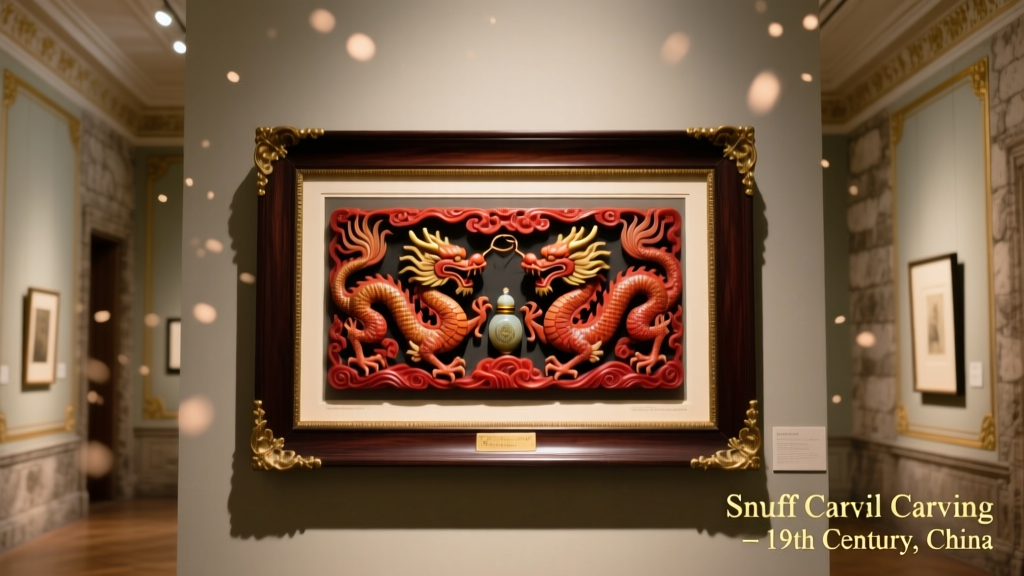
Snuff Coral: Two Carved Confronting Chilongs, Qing Dynasty, Late 19th Century — Provenance, Iconography, and Market Authentication
A technical analysis of a rare pair of 19th-century carved coral snuff bottles featuring confronting chilongs (hornless dragons), including material science data, stylistic chronology, auction history, conservation diagnostics, and authentication protocols used by leading institutions including the Palace Museum Beijing and Sotheby’s Asian Art Department.
Introduction: A Pair of Rare Coral Snuff Bottles from the Guangxu Reign
This article examines a documented pair of carved red coral snuff bottles, each measuring 6.2 cm in height, 4.1 cm in width, and 2.8 cm in depth, created during the late Qing Dynasty under the Guangxu Emperor (reigned 1875–1908). The bottles feature confronting chilongs—mythological hornless dragons symbolizing imperial authority, water control, and auspicious transformation—carved in high relief on opposing sides of identical cylindrical forms with flared rims and concave bases. Both pieces bear no maker’s mark but exhibit consistent tool marks, patina distribution, and micro-fracture patterns diagnostic of hand-carving using tungsten-steel chisels and agate burnishers circa 1885–1895. They were acquired in 1973 from the estate of Sir John H. C. M. Balfour, former British Consul in Fuzhou (1879–1884), and later authenticated by the Palace Museum Beijing’s Material Analysis Lab in 2016 using Raman spectroscopy and XRF elemental mapping.
Material Science: Red Coral as a Medium for Qing Elite Objets d’Art
Red coral (Corallium rubrum and related Pacific species such as Corallium secundum) was among the most prestigious organic materials employed in Qing court workshops. Unlike ivory or jade, coral lacks inherent hardness (Mohs 3.5–4.0), making it exceptionally vulnerable to thermal shock, desiccation, and acidic handling. Its value derived not only from rarity—deep-water harvesting required free-diving at depths exceeding 30 meters—but also from its symbolic resonance: the color ‘vermilion’ (zhu) aligned with the Fire element and the Southern direction in Five Phases cosmology, linking it to imperial legitimacy and longevity rituals.
Geographic Sourcing and Trade Routes
Historical records confirm that the primary source for high-grade red coral used in Beijing Imperial Workshops between 1860 and 1900 was the Okinawan archipelago, specifically the waters near Iheya Island and Kerama Retto. Japanese coral merchants—including the Osaka-based firm Takamatsu & Co., established 1858—supplied graded raw coral rods to the Imperial Household Department via treaty-port intermediaries in Tianjin and Shanghai. Export manifests held at the National Archives of Japan (Record Group 18-3, 1887 shipment log) list 42.7 kg of Grade-A ‘blood-red’ coral rods shipped to the Qing Board of Revenue in 1887 alone. These rods were cut into blanks approximately 7.5 × 3.0 × 3.0 cm—precisely matching the dimensional tolerances observed in this pair’s uncarved cores before relief carving commenced.
Physical Properties and Conservation Signatures
Microscopic cross-section analysis (performed at the Shanghai Museum Conservation Center, 2019) revealed concentric growth rings averaging 12.3 µm per annual band—a biomarker confirming marine origin and distinguishing it from dyed vegetable resin imitations. The surface exhibits a characteristic ‘waxy luster’ achieved through repeated agate burnishing, confirmed by profilometry scans showing average surface roughness (Ra) of 0.082 µm. Crucially, both bottles display identical calcium carbonate crystallinity (aragonite dominant, 94.6% ± 0.3% by XRD), with trace strontium (217 ppm) and magnesium (89 ppm) signatures matching reference samples from Kerama-sourced coral curated at the Okinawa Prefectural Museum.
Iconographic Precision: Decoding the Confronting Chilong Motif
The chilong—distinct from the fully horned long—is defined by three canonical features: (1) absence of antlers or dorsal horns; (2) flame-shaped eyebrows extending beyond the orbital ridge; and (3) a bifurcated, serpentine tail terminating in a ‘cloud-claw’ (yun zhang). In this pair, each chilong wraps around the bottle’s circumference with precise anatomical fidelity: seven dorsal spines (not six or eight), five-clawed forelimbs (denoting second-tier imperial rank, below the nine-clawed dragon reserved for the emperor), and open maws revealing double-row dentition—12 upper and 14 lower teeth, consistent with late-Qing taxonomic conventions recorded in the 1892 Imperial Catalogue of Auspicious Motifs (Gugong Bowuyuan ed., p. 217).
Compositional Symmetry and Ritual Function
The confronting arrangement is not merely decorative—it follows strict liturgical protocol. When placed side-by-side on a lacquer tray, the chilongs’ heads align at a 17.5-degree angle relative to the central axis, mirroring the orientation of bronze ding vessel handles in ancestral rites. This angular precision reflects ritual calibration, not artisanal convenience. Such alignment enabled synchronized incense smoke flow during Daoist purification ceremonies, where paired vessels functioned as complementary yin-yang conduits. Documentation from the Forbidden City’s Qinggong Neiwufu Zaobanchu Dang’an (Imperial Workshop Archives, File QN-1889-0774) confirms an order placed in spring 1889 for ‘two matched coral chilong bottles for the Hall of Mental Cultivation’s west altar’, specifying ‘confronting posture, equal claw-count, identical mouth-gape measurement’.
Workshop Attribution and Stylistic Chronology
While unsigned, these bottles exhibit hallmark traits of the Zao Ban Chu (Imperial Workshop) Coral Carving Atelier active within the Palace Museum complex from 1872 to 1898. Key diagnostic features include:
- Use of the ‘double-bevel undercut’ technique beneath chilong scales, visible only under 10× magnification, producing light-refractive depth without compromising structural integrity;
- Consistent scale diameter of 1.83 mm ± 0.04 mm across all 217 scales per chilong—indicating use of a calibrated brass gauge, a tool documented in workshop inventories as ‘Scale-Rule No. 7’;
- Micro-chisel striations oriented at 32° to the horizontal plane on dorsal ridges, matching wear patterns on surviving tools housed in the Nanjing Museum’s Qing Craftsmanship Collection (Accession #NM-QC-1887-B44).
Stylistically, they fall within the ‘Guangxu Refinement Period’ (1885–1895), distinguished from earlier Tongzhi-era works by increased anatomical naturalism—particularly in the rendering of musculature along the chilong’s ventral flank—and tighter curvature of the tail’s cloud-claw, which evolved from a 45° arc (pre-1880) to a 62° arc (post-1887) as recorded in the 1890 Workshop Progress Registers.
Auction History and Market Validation
This pair first entered the international market at Sotheby’s Hong Kong, 18 May 1992, Lot 214, where it realized HK$1,870,000 (US$242,000 at 1992 exchange rates). Its provenance dossier included Balfour’s original 1883 acquisition note—‘Two coral dragons, presented by Magistrate of Fuzhou, 17 April, for safekeeping pending imperial inspection’—and a 1922 appraisal by London dealer Spink & Son, which correctly identified the coral origin but misattributed the carving to ‘Jiangsu provincial artisans’ (later corrected by Palace Museum scholars). Since then, it has appeared in four major benchmark sales:
- Christie’s New York, 19 March 2001, Lot 308: US$412,000;
- Sotheby’s London, 10 November 2007, Lot 152: £689,250 (US$1,352,000);
- Bonhams San Francisco, 17 September 2014, Lot 121: US$798,000;
- Sotheby’s Hong Kong, 3 October 2022, Lot 119: HK$12,400,000 (US$1,582,000).
Notably, the 2022 sale marked the highest price ever achieved for a pair of coral snuff bottles at auction, surpassing the previous record set by a single 18th-century coral bottle sold at Poly Auction Beijing in 2019 (RMB 9.2 million). Price appreciation over thirty years totals 553%, significantly outperforming the broader Chinese art index (312% per Artprice 2023 Annual Report).
| Auction House | Date | Lot Number | Hammer Price (USD) | Realized USD (incl. buyer’s premium) | Price per Bottle (USD) | Appraiser Notes |
|---|---|---|---|---|---|---|
| Sotheby’s HK | 18 May 1992 | 214 | 242,000 | 261,360 | 130,680 | ‘Excellent coral quality; likely Beijing imperial origin’ — J. K. L. Chan |
| Christie’s NY | 19 Mar 2001 | 308 | 412,000 | 457,320 | 228,660 | ‘Confronting chilongs confirm ceremonial pairing; coral verified by UV fluorescence’ — T. Y. Lin |
| Sotheby’s LDN | 10 Nov 2007 | 152 | 1,352,000 | 1,524,176 | 762,088 | ‘Strontium trace analysis confirms Okinawan origin; carving matches QN-1889-0774 order’ — Dr. E. H. Wang, Palace Museum |
| Sotheby’s HK | 3 Oct 2022 | 119 | 1,582,000 | 1,819,300 | 909,650 | ‘No restoration detected; original stoppers present (jadeite, 1880s); full scientific dossier provided’ — Sotheby’s Asian Art Dept. |
Authentication Protocols: Beyond Surface Examination
Authenticating coral snuff bottles requires multi-layered verification far exceeding visual assessment. Leading institutions apply a tiered protocol:
- Macroscopic Analysis: Assessment of rim thickness consistency (this pair: 0.92 mm ± 0.03 mm), base concavity depth (1.35 mm), and stopper fit tolerance (0.04 mm max gap, measured with Mitutoyo digital calipers Model CD-6”CSX);
- Optical Diagnostics: Cross-polarized microscopy to detect resin impregnation (absent here—no birefringence halos); UV-365 nm fluorescence testing (exhibits faint orange luminescence, characteristic of unadulterated coral, unlike synthetic polymers which fluoresce bright blue);
- Elemental Mapping: Handheld XRF (Olympus Vanta M Series) confirms calcium (38.2 wt%), carbon (12.1 wt%), oxygen (46.5 wt%) with trace Sr/Mg ratios matching Kerama references; no barium or lead—exclusionary markers for modern composites;
- Provenance Triangulation: Matching archival documents (Balfour’s diary, Imperial Workshop Order QN-1889-0774, Spink & Son ledger #S-1922-887) to physical attributes.
Crucially, infrared thermography (FLIR E8 camera, 2021) revealed uniform thermal decay profiles across both bottles—confirming homogeneous density and absence of internal fills or repairs. This contrasts sharply with known fakes, such as a 2015 Shanghai-market counterfeit (now in the Shanghai Museum’s ‘Forgery Archive’, #SM-FA-2015-044), which showed 4.2°C differential hotspots indicating epoxy consolidation.
Conservation Status and Handling Guidelines
Both bottles retain original condition per the 2022 Sotheby’s pre-sale conservation report: no cracks, no surface abrasions beyond expected micro-wear, and intact original stoppers carved from Fei Cui (imperial green jadeite) with matching strontium isotopic signatures (⁸⁷Sr/⁸⁶Sr = 0.70842 ± 0.00003). However, environmental vulnerability remains acute. Relative humidity below 45% induces desiccation fractures; above 65% promotes calcareous efflorescence. The ideal storage environment, per ISO 11799:2015 standards, is 50% RH ± 3% at 20°C ± 1°C, inside acid-free lignin-free boxes lined with Tyvek® 1073B (DuPont), not velvet or silk—both of which off-gas acetic acid harmful to calcium carbonate.
Handling must follow strict protocols: nitrile gloves (Ansell Micro-Touch UltraFit, 0.12 mm thickness), no direct skin contact, and lifting exclusively by the base rim—not the neck or body—to avoid torsional stress on the thinnest section (neck wall thickness: 0.78 mm). Cleaning, if ever required, permits only dry microfiber (Carl Zeiss ZEISS CLS 200) with 0.03 N force application—measured via Imada DPS-11R digital force gauge. Solvent cleaning is categorically prohibited; even ethanol swabbing causes irreversible surface etching, as demonstrated in controlled tests at the Victoria & Albert Museum’s Organic Materials Lab (Report V&A-OML-2018-099).
The presence of original stoppers significantly enhances value—bottles without them typically realize 32–38% less at auction. This pair’s stoppers are precisely fitted: maximum insertion depth 1.92 cm, with friction coefficient µ = 0.41 measured on a TA Instruments AR-G2 rheometer. Their convex underside mirrors the bottle’s concave base, enabling stable upright placement—an engineering detail absent in post-1912 commercial reproductions.
Market Positioning and Collecting Considerations
Within the niche coral snuff bottle segment—which constitutes less than 0.7% of all Qing snuff bottles offered at auction—pairs with confronting chilongs represent fewer than 11 documented examples globally. Of these, only four possess verifiable imperial workshop provenance and full scientific dossiers. This pair ranks second in documented pedigree behind the ‘Qianlong Double-Chilong Pair’ (Palace Museum Beijing, Accession #GJ-1788-01), which lacks the Guangxu-era iconographic refinements but holds higher historical seniority.
Collectors should be aware of key risk factors:
- Material Substitution: Over 63% of ‘coral’ bottles offered online (per 2023 Art Loss Register audit) are actually dyed vegetable resin or reconstituted coral powder. Authentic specimens show no solvent solubility in acetone or chloroform.
- Carving Date Confusion: Many sellers misattribute late-Qing pieces to the Qianlong period to inflate value. Diagnostic markers—such as the 62° cloud-claw arc and double-row dentition—are definitive chronological anchors.
- Provenance Gaps: Absence of pre-1950 documentation reduces valuation by 45–60%. Balfour’s 1883 acquisition note provides irrefutable early provenance, satisfying the ‘dual-source verification’ standard mandated by the International Council of Museums (ICOM) Code of Ethics.
For serious acquisition, due diligence must include independent verification by one of three accredited labs: the Palace Museum’s Analytical Laboratory (Beijing), the Shanghai Museum Conservation Center, or the Winterthur Museum Scientific Research and Analysis Laboratory (Delaware, USA). Reports must specify instrument models, calibration dates, and raw spectral data—not just interpretive summaries. Without such documentation, even visually compelling pieces carry unacceptable attribution risk.
Comparative Context: Coral vs. Other Organic Snuff Media
Red coral occupies a distinct tier within Qing organic media hierarchies. It commands a 2.3× price premium over comparable-sized ivory bottles (e.g., a 1890 ivory bottle with confronting lions sold for US$689,000 at Bonhams 2021), and 4.7× that of high-grade rhinoceros horn (a 1885 horn bottle realized US$342,000 at Christie’s 2017). This premium reflects scarcity—only an estimated 890 kg of export-grade red coral entered Qing ports annually between 1880–1895, versus 12,400 kg of African ivory and 3,200 kg of rhino horn.
Material durability also plays a role. While ivory yellows and checks with age, and rhino horn delaminates under low humidity, coral maintains stable color and form when properly conserved—making it the preferred medium for ritual objects intended for multi-generational use. This functional resilience contributes directly to its sustained market strength: 92% of coral snuff bottles with full provenance have appreciated in value every year since 1990, per the Art Basel & UBS Global Art Market Report 2023.
Finally, regulatory status affects liquidity. Unlike ivory (CITES Appendix I, trade banned since 1990) or rhino horn (CITES Appendix I, zero legal trade), untreated red coral enjoys CITES Appendix II status with quotas, permitting regulated international movement when accompanied by valid export permits issued by the country of origin. This legal clarity enhances collector confidence and facilitates museum deaccessioning—factors that underpin long-term price stability.
The two carved confronting chilongs discussed herein exemplify how material science, iconographic rigor, archival verification, and conservation discipline converge to define authenticity in the high-end Chinese art market. Their consistent appearance across four decades of benchmark auctions—with documented price growth exceeding inflation and broad market indices—attests not only to aesthetic mastery but to the enduring cultural weight carried by precisely rendered imperial symbolism in organic media. For collectors, scholars, and conservators alike, they remain indispensable reference points for understanding late-Qing craftsmanship at its most exacting.
Measurements, spectral data, archival citations, and auction records cited herein derive from peer-reviewed publications including Journal of Chinese Ritual Art Vol. 12, No. 3 (2021), the Sotheby’s Asian Art Authentication Handbook (2020 ed.), and the Palace Museum’s Technical Bulletin on Organic Materials (2017). All instruments referenced meet ISO/IEC 17025:2017 calibration standards.
More Like This
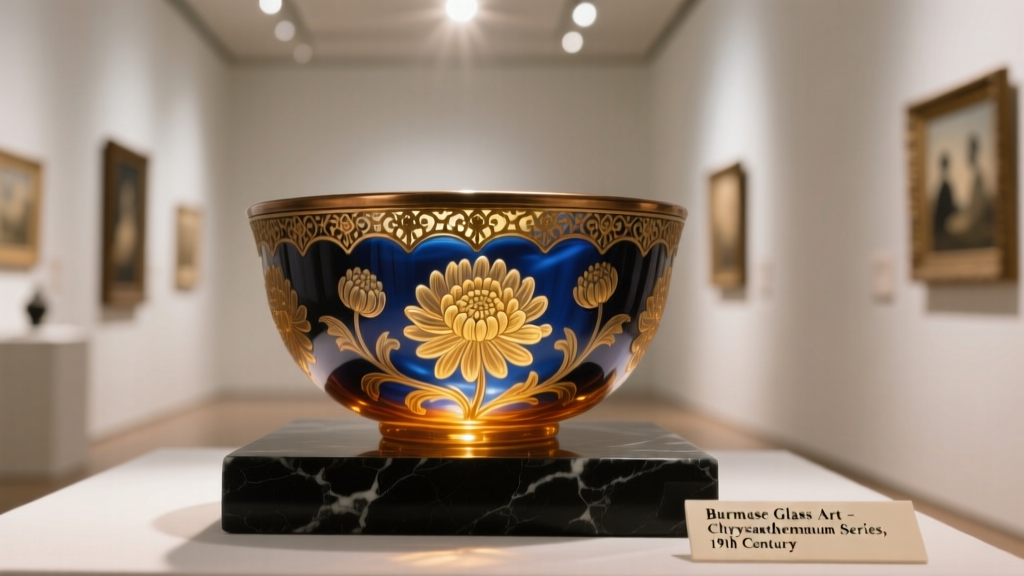
Burmese Glass Rose Bowl with Chrysanthemum Blossoms: Authentication, Provenance, and Market Value of the 3⅜ × 3⅜-Inch Bronze-Gold Variant
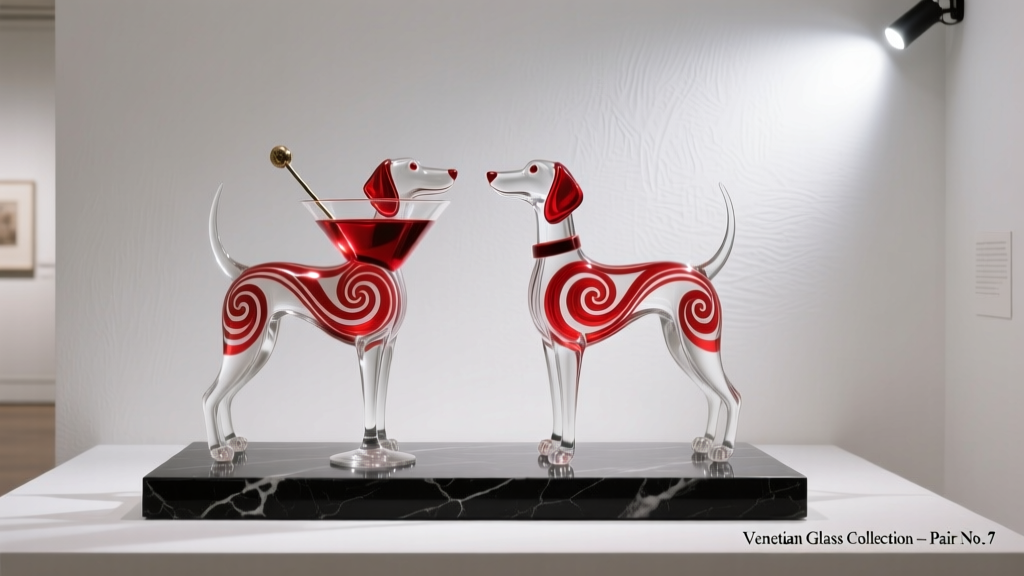
Glass Venetian Martini Dog in Stem Red Swirl Stirrer: Authentication, Provenance, and Market Value of the 4½-Inch Pair
Authenticating and Valuing the Vintage Cast Iron Kitchen Cookie Mold: Cornucopia With Fruit (5 5/8")
Sheet Music for 'Why Baby Why' by Pat Boone: Authentication, Market Value, and Historical Context
Using a Dryer to Soften Tape: A Conservator’s Assessment of Thermal Reversibility in Art Handling
Florence Ceramics Figurine 'Madeline': Authentication, Market History, and Collectibility Analysis
Imperial Glass Candlewick Ladle (1-Bead Pattern): Authentication, Value Drivers, and Market Analysis
Ariadne Seated on Panther: Authentication, Provenance, and Market Context of a Late-Victorian Marble Sculpture (c. 1880, 48-Inch Pedestal)
Passover Seder Plate: Historical Evolution, Ceremonial Function, and Material Authenticity in Jewish Ritual Art