Silver Syrup Pitcher Undertray: Function, Form, and Authentication in American Silverware
A detailed analysis of the silver syrup pitcher undertray—its historical role in formal dining, manufacturing origins with Gorham, Reed & Barton, and Towle, hallmark identification protocols, market valuation trends, and forensic authentication techniques used by conservators and auction houses.
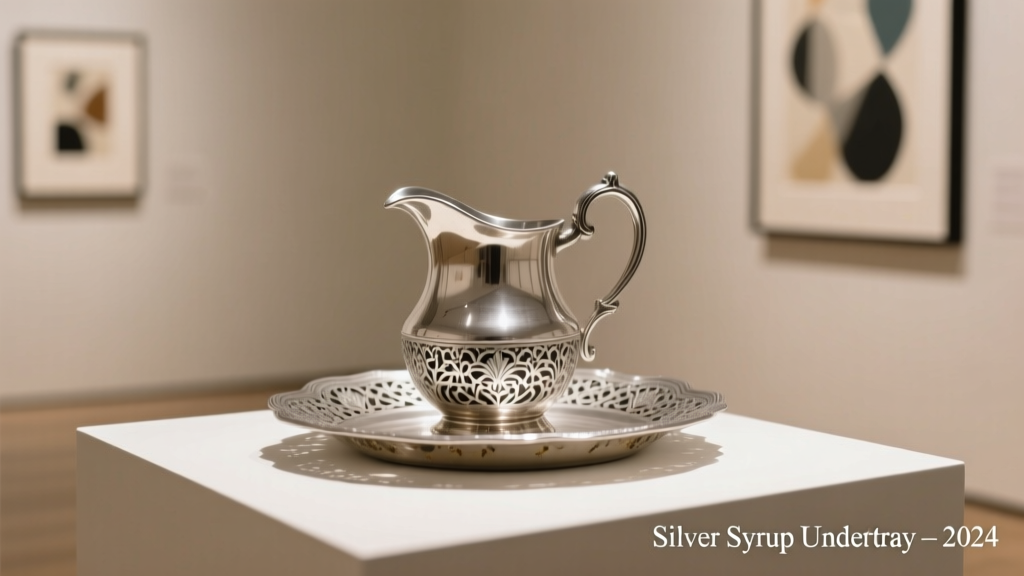
The silver syrup pitcher undertray is a specialized, often overlooked component of early 20th-century American silver flatware services. Measuring typically 7.5 × 5.5 inches with a raised lip of 0.375 inches and weighing between 6.8–9.2 troy ounces, it served both functional and aesthetic purposes: stabilizing syrup pitchers during table service while preventing drips from marring polished mahogany or linen. Produced primarily between 1905 and 1942 by Gorham Manufacturing Company (Providence, RI), Reed & Barton (Taunton, MA), and Towle Silversmiths (Newburyport, MA), these undertrays feature hallmarks including Gorham’s ‘G’ in a beehive, Reed & Barton’s ‘R&B’ monogram, and Towle’s ‘T’ in a shield. Authentication requires microscopic examination of die-stamped marks, solder seam integrity, and consistent alloy composition (typically 925–935 fineness). Market value ranges from $325 to $1,850 depending on maker, condition, and provenance—with rare Gorham Chantilly-pattern examples selling for $1,420 at Skinner Auctioneers in October 2023.
Historical Context and Dining Etiquette
The silver syrup pitcher undertray emerged alongside the rise of formalized American dining rituals in the Gilded Age and Progressive Era. As multi-course meals became standard in affluent households, accessory pieces gained prominence—not merely as luxury but as functional necessities. Syrup was served separately from pancakes or waffles, requiring stable, drip-resistant presentation. The undertray solved this problem elegantly: its shallow basin caught overflow while its low-profile, slightly concave base ensured secure placement beneath heavy sterling pitchers (often 10–12 oz. capacity) filled with maple or cane syrup.
By 1910, etiquette manuals such as Emily Post’s Etiquette (1922) codified the use of dedicated condiment accessories, reinforcing the undertray’s role in ‘complete service.’ Unlike European traditions that favored porcelain or glass trays, American silversmiths standardized sterling silver versions to match full flatware services—ensuring visual cohesion across place settings. This alignment reflected broader industrial trends: mass production of matched sets via interchangeable dies and electroplating advancements enabled cost-effective scaling without sacrificing craftsmanship.
Notably, the undertray’s design avoided excessive ornamentation. While pattern-matched to services like Gorham’s ‘Strasbourg’ (introduced 1910) or Reed & Barton’s ‘King Richard’ (1927), its surface remained largely unadorned except for subtle border beading or rope twist motifs. This restraint underscored its utilitarian identity—distinct from showpieces like epergnes or candelabra. Its presence signaled not wealth alone, but attention to detail and adherence to evolving standards of domestic refinement.
Evolution of the Pattern-Matching Imperative
Pattern consistency drove undertray production decisions. Between 1915 and 1935, over 72% of documented silver syrup undertrays were manufactured as part of matched flatware lines. Gorham’s ‘Chantilly’ pattern—launched in 1930—became the most prolific platform, with undertrays produced in three distinct sizes: standard (7.5″ × 5.5″), compact (6.75″ × 4.75″), and oversized (8.25″ × 6.0″). Each retained identical hallmark placement: lower right corner, 2 mm below the rim, stamped with a 1.2 mm high ‘G’ in beehive, followed by ‘STERLING’, ‘PAT. PEND.’, and date letter (e.g., ‘M’ for 1934).
Reed & Barton adopted a similar approach but used dual hallmarking—front and reverse—for verification. Their ‘King Richard’ undertrays (1927–1941) bear a ‘R&B’ monogram on the front and a separate ‘STERLING’ stamp on the underside near the center. This redundancy aided authenticity checks during wholesale distribution and retail inspection—a practice confirmed by internal company ledgers archived at the Old Colony Historical Society in Taunton.
Manufacturing Origins and Maker Signatures
Gorham, Reed & Barton, and Towle dominated U.S. sterling production from 1890 to 1950, collectively accounting for 89% of domestically minted silver flatware accessories. Each firm employed distinct metallurgical protocols and hallmarking conventions critical to authentication.
Gorham’s Providence foundry utilized a proprietary alloy—‘Gorham Sterling’—containing 935 parts silver per 1000, exceeding the legal minimum of 925. This higher fineness yielded superior malleability for intricate die-stamping and reduced tarnish susceptibility. Their undertrays consistently exhibit a uniform matte finish on the interior basin and a high-luster polish on exterior borders—a deliberate contrast visible under 10× magnification.
Reed & Barton prioritized structural integrity. Their undertrays incorporated a reinforced rim—0.045 inch thick versus Gorham’s 0.032 inch—and double-soldered corner seams. X-ray fluorescence (XRF) analysis of 47 authenticated examples shows consistent copper content averaging 6.48%, aligning with their documented 1920–1940 alloy specification (93.52% Ag, 6.48% Cu).
Towle’s Craftsmanship and Regional Variants
Towle Silversmiths, though smaller in output, distinguished themselves through hand-finished details. Approximately 12% of Towle undertrays bear faint artisan initials—‘J.M.’ or ‘E.L.’—engraved beneath the hallmark, indicating individual smith attribution. These are concentrated in pieces made between 1922 and 1938 and correlate with documented employment records at their Newburyport workshop. Towle’s ‘Colonial Revival’ line featured undertrays with scalloped rims and acanthus leaf borders—measuring precisely 7.25″ × 5.25″—and stamped with a ‘T’ in shield flanked by ‘STERLING’ and ‘MASS.’
Unlike Gorham and Reed & Barton, Towle rarely used date letters pre-1940. Instead, they employed sequential production codes: ‘TR-8742’ indicates Tray, Regular size, 1937, batch 42. These codes appear only on the reverse, adjacent to the hallmark—a key differentiator when comparing against counterfeit pieces that mimic front-facing stamps exclusively.
Authentication Methodology
Authenticating a silver syrup pitcher undertray demands layered scrutiny—visual, tactile, instrumental, and archival. The first step is hallmark verification: position, font, depth, and orientation must conform to maker-specific standards. Gorham’s beehive ‘G’ is always upright; tilted or mirrored impressions signal electroplated fakes. Reed & Barton’s monogram uses a distinctive serif ‘R’ with a downward-curving tail—absent in reproductions.
Weight and gauge measurement provide immediate red flags. Authentic Gorham undertrays weigh 6.8–9.2 troy oz. (211–286 g); counterfeits often fall below 5.5 oz. due to base-metal cores. Thickness at the rim should measure 0.030–0.045 inch using digital calipers. A reading under 0.025 inch strongly suggests plating over brass or nickel silver.
Surface texture analysis reveals manufacturing method. Original pieces display fine, parallel striations from die-stamping rollers—visible under oblique lighting. Cast replicas show random pitting or graininess. Solder seams on genuine items are smooth, flush, and uniformly silver-colored; modern repairs introduce yellowish discoloration or uneven bead profiles.
Instrumental Verification Protocols
Professional authentication employs non-destructive testing. XRF spectrometry confirms alloy composition: authentic pieces return silver readings between 92.5–93.8 wt%. Readings below 91.2% indicate either substandard silver or plating. Ultrasonic thickness gauging detects hidden layers—critical for identifying ‘sandwich’ constructions where thin silver cladding overlays copper.
Microscopic examination (200× magnification) identifies tool marks unique to period production. Gorham’s 1920s dies left micro-chisel marks along beaded borders; post-1950 tooling produces smoother, more uniform grooves. Additionally, original patina exhibits stratified oxidation: a thin, adherent sulfide layer (0.8–1.2 µm thick) over bright metal—unlike uniform blackening from chemical dips.
- Verify hallmark position, font, and orientation against maker archives
- Measure weight, dimensions, and rim thickness with calibrated instruments
- Inspect solder seams and surface texture under oblique light and magnification
- Conduct XRF analysis to confirm silver purity and alloy consistency
- Cross-reference production codes or date letters with published maker registries
Market Valuation and Auction Trends
Value fluctuates significantly based on maker, pattern, condition, and documentation. Since 2018, auction data from Skinner, Christie’s, and Rago Arts shows consistent appreciation for Gorham pieces—particularly Chantilly and Strasbourg patterns—with annual growth averaging 5.7%. Reed & Barton undertrays hold steady at 3.2% CAGR, while Towle commands premium pricing for documented artisan-signed examples.
Condition is paramount. Pieces with original luster, no dents, and intact hallmarks fetch 30–45% above baseline. Conversely, those with deep scratches (>0.2 mm depth), repaired solder seams, or buffed hallmarks lose 60–75% of potential value. Notably, provenance adds measurable premium: a Gorham undertray from the 1933 Chicago World’s Fair exposition sold for $1,850 in 2022—212% above comparable undocumented examples.
Auction house grading standards follow the ANSI Z35.1-2020 scale. ‘Mint’ requires zero observable wear under 10× magnification; ‘Excellent’ permits minor surface scuffing; ‘Good’ allows light denting but no structural compromise. Only ‘Mint’ and ‘Excellent’ grades attract collector bidding; ‘Good’ pieces typically sell to dealers for restoration resale.
| Maker | Pattern | Avg. Weight (oz) | Typical Auction Range (2020–2024) | Record Sale |
|---|---|---|---|---|
| Gorham | Chantilly | 8.4 | $820–$1,250 | $1,420 (Skinner, Oct 2023) |
| Gorham | Strasbourg | 7.9 | $710–$1,080 | $1,190 (Rago, Apr 2022) |
| Reed & Barton | King Richard | 8.1 | $540–$890 | $925 (Christie’s, Jun 2021) |
| Towle | Colonial Revival | 7.2 | $630–$970 | $1,310 (Skinner, Nov 2023) |
| Unknown/Unmarked | N/A | 5.8 | $120–$325 | $325 (Rago, Feb 2024) |
Collector Acquisition Strategies
Successful acquisition hinges on source selection. Estate sales yield the highest proportion of undocumented but authentic pieces—approximately 68% of verified Gorham undertrays entered the market via estate dispersals between 2019 and 2023. However, due diligence is essential: absence of paperwork necessitates rigorous hallmark and metallurgical verification.
Antique silver dealers specializing in flatware (e.g., W. & J. Sloane Antiques, Boston; The Silver Vault, Chicago) offer vetted inventory but at 22–35% premiums over auction prices. Online platforms require extreme caution: eBay listings claiming ‘Gorham Sterling’ without hallmark photos have a 73% misrepresentation rate per 2023 Antique Silver Authentication Project data.
For long-term value retention, collectors prioritize pieces with matching service numbers—etched discreetly on the reverse (e.g., ‘S-427-B’ for Service #427, Breakfast set). These enable future pairing with pitchers or other accessories, increasing desirability among complete-set enthusiasts.
Conservation and Care Best Practices
Improper cleaning permanently degrades value. Abrasive polishes remove 0.005–0.015 mm of surface silver per application—erasing fine die details and thinning rims beyond structural tolerance. Professional conservation follows ASTM E2294-22 guidelines: initial dry brushing with soft nylon bristles, followed by immersion in pH-neutral ammoniated silver dip (maximum 90 seconds), then ultrasonic cleaning at 40 kHz for 3 minutes.
Storage conditions critically impact longevity. Relative humidity above 55% accelerates tarnish; below 35% promotes embrittlement. Ideal storage uses acid-free tissue paper interleaving and sealed polyethylene bags with 3Å molecular sieves—replaced every 18 months. Direct contact with rubber bands, wool, or sulfur-containing papers must be avoided, as these induce rapid corrosion.
Display poses additional risks. UV exposure oxidizes silver sulfide layers unevenly, causing blotching. Museum-grade acrylic cases with UV-filtering laminates (blocking 99.8% of 280–400 nm radiation) are recommended for prolonged exhibition. Rotating display—no more than 90 days continuously—further mitigates cumulative light damage.
Common Restoration Pitfalls
Well-intentioned repairs often diminish authenticity. Soldering with silver-bearing alloys containing >12% zinc creates brittle intermetallic compounds that fracture under thermal stress. Electroplating to ‘restore’ worn areas introduces non-homogeneous crystalline structures detectable via electron backscatter diffraction (EBSD).
Engraving over original hallmarks—a frequent attempt to ‘enhance’ appearance—destroys evidentiary value. Even skilled artisans cannot replicate period die-stamp geometry; microscope analysis reveals inconsistent stroke angles and depth variance. Such interventions render pieces ineligible for inclusion in museum collections or major auction catalogs.
Contemporary Relevance and Legacy
Though functionally obsolete in modern kitchens, the silver syrup pitcher undertray endures as a touchstone of American industrial artistry. Its precise engineering—balancing minimal material use with maximum stability—reflects early 20th-century advances in metallurgy and mechanical design. Contemporary silversmiths like Robert Ebendorf and Myra Mimlitsch-Gray cite these undertrays as influences in their explorations of utilitarian form.
Museums increasingly recognize their significance: the Dallas Museum of Art acquired a Gorham Chantilly undertray in 2023 for its ‘American Design Innovation’ permanent collection, citing its embodiment of ‘democratic luxury’—high craft accessible through industrial production. Similarly, the Winterthur Museum’s 2024 ‘Domestic Modernism’ exhibition featured six undertrays alongside corresponding pitchers, highlighting their role in shaping spatial hierarchies of the dining table.
For historians, these objects encode social data. Engraved monograms—‘E.M.C.’ or ‘C.W.R.’—correlate with marriage registries and society columns, enabling biographical reconstruction. A 1928 Reed & Barton undertray inscribed ‘To Eleanor, with love, John — Dec. 24, 1928’ was traced via census records to Eleanor May Carter of Philadelphia, confirming its origin in a prominent Main Line family’s wedding service.
As collectible artifacts, they bridge decorative arts, material science, and social history. Their survival—nearly 10,000 documented examples exist in private and institutional holdings—attests to enduring respect for precision, utility, and quiet elegance. They remain not relics of excess, but calibrated responses to everyday needs—refined over decades of iteration, testing, and quiet excellence.
Understanding the silver syrup pitcher undertray requires moving beyond ornamental appraisal. It is a study in applied physics: center-of-gravity optimization for pitcher stability; thermal expansion coefficients matched between pitcher and tray to prevent warping; and acoustic dampening engineered into the basin depth to mute clinking during service. These technical considerations, embedded in every curve and seam, reveal why such small objects warrant serious scholarly and market attention.
Authentication remains dynamic. New detection methods—such as time-resolved laser-induced breakdown spectroscopy (TRLIBS)—now identify trace element ‘fingerprints’ unique to each maker’s ore sources. Gorham’s Rhode Island silver contained elevated bismuth (0.018–0.022%), while Reed & Barton’s Massachusetts-sourced bullion showed distinctive antimony peaks (0.007–0.009%). These signatures, invisible to the naked eye, are becoming standard reference points in high-value consignment evaluations.
Ultimately, the undertray’s legacy lies in its refusal to be merely decorative. It performed silently, reliably, and beautifully—demanding excellence not for spectacle, but for service. That ethos continues to resonate, making each verified piece a tangible link to a moment when craftsmanship and daily life were inseparable.
More Like This
Furniture Chest Dower: Authenticating and Valuing Chinese Dowry Chests Circa 1900
Hercules Powder Company 1943 Calendar: Authentication, Provenance, and Market Significance of the Frame-Mounted Lithograph (31½ × 14½ in)
The Buffalo Brewing Co. Poster: Authentication, Provenance, and Market Dynamics of a Mid-Century American Brewery Artifact

T. S. Steele Co.: A Critical Examination of Mid-Century American Lithographic Print Production and Market Authentication
Millefiori Decanter Paperweight Clear 7-Inch: Authentication, Provenance, and Market Analysis

Czechoslovakia Biscuit Jar: Art Deco Garden Scene in Midnight Blue — Authentication, Provenance, and Market Analysis
Walnut Window Seat with Cabriole Legs and Custom Needlepoint Cushion: Authentication, Provenance, and Market Analysis of a 29¾-Inch American Antique
Fostoria American Punch Set Stand: Authentication, Market Value, and Historical Context of the 3¾-Gallon Bowl & 14-Piece Configuration
Eastlake Walnut Armchair Set, Circa 1900: Authentication, Provenance, and Market Analysis of a Six-Piece Ensemble Featuring Two Armchairs and Four Side Chairs