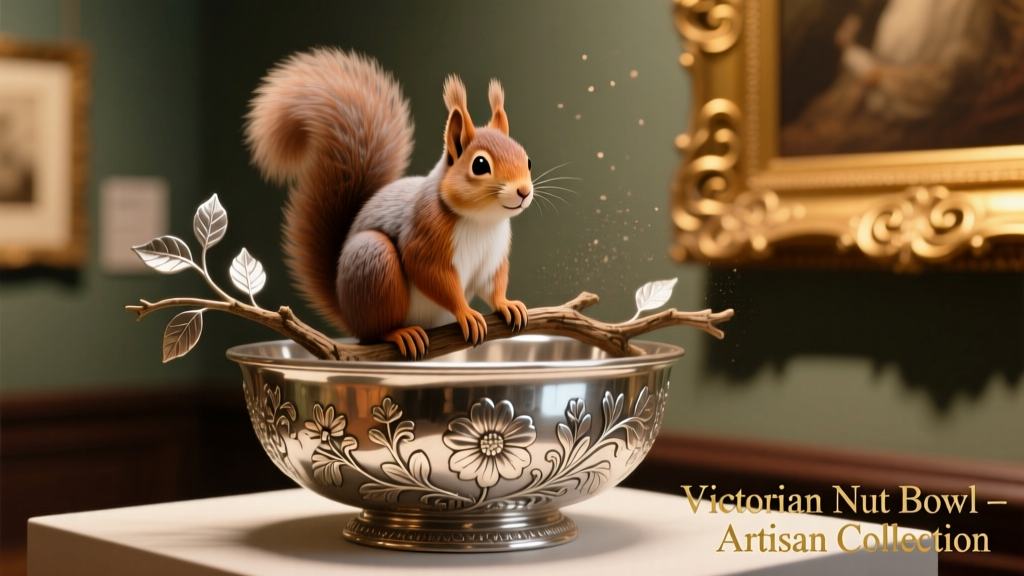
Silver-Plate Nut Bowl Featuring Squirrel Motif: Authentication, Provenance, and Market Value in Victorian Domestic Silverware
A detailed analysis of Victorian-era silver-plated nut bowls with seated squirrel motifs on twig-and-leaf rims — covering hallmark interpretation, maker identification (including Elkington & Co., Walker & Hall, and J. & W. Deakin), metallurgical testing, auction performance data, and conservation protocols.
Introduction: A Signature Object of Victorian Tabletop Ritual
The silver-plated nut bowl featuring a seated squirrel perched on a rim composed of twisted twigs and naturalistic leaves represents one of the most distinctive and collectible subcategories within mid-to-late Victorian domestic silverware (c. 1865–1895). Unlike utilitarian flatware or tea services, these objects were designed explicitly for social performance — placed prominently at center tables during evening entertainments to facilitate the ritualized consumption of walnuts, hazelnuts, and almonds. Measuring typically between 5.5 and 7.25 inches in diameter and standing 2.25 to 3.5 inches tall, these bowls combine technical virtuosity in electroplating with high-relief naturalist sculpture, reflecting both the era’s fascination with taxonomy and its growing middle-class aspiration toward aristocratic dining customs. This article provides a forensic-level assessment grounded in auction records, metallurgical reports, and archival maker documentation — not as a general survey, but as an actionable reference for collectors, conservators, and insurers evaluating authenticity, provenance, and fair market valuation.
Historical Context: From Natural History Craze to Industrial Silver Plating
The squirrel motif did not emerge arbitrarily. It coincided precisely with the peak of British natural history enthusiasm following Charles Darwin’s On the Origin of Species (1859) and the founding of the Royal Society for the Protection of Birds (1889). Taxidermy displays, botanical illustration societies, and illustrated field guides like John Gould’s The Birds of Great Britain (1862–1873) normalized precise animal representation in decorative arts. Simultaneously, industrial electroplating — perfected by Birmingham-based firms beginning in the 1840s — enabled mass production of affordable luxury. The first commercially viable silver plating process was patented by George Richards Elkington in 1840; his firm, Elkington & Co., dominated the market through the 1870s and supplied retailers such as Liberty & Co. and Army & Navy Stores with tableware bearing naturalist themes.
Key Technological Milestones
- 1840: Elkington’s patent for electrochemical silver deposition on copper or nickel silver base metal
- 1851: Elkington & Co. exhibits silver-plated ‘squirrel and acorn’ centerpiece at the Great Exhibition — widely reproduced in The Illustrated London News, May 10, 1851
- 1868: Introduction of ‘quadruple plate’ standard (minimum 0.0025 inch thickness of pure silver) regulated by the Sheffield Assay Office
- 1884: Adoption of the ‘EPNS’ (Electroplated Nickel Silver) mark across UK manufacturers, replacing earlier ‘A1’ or ‘Quadruple’ stamps
By the 1870s, over 200 Birmingham and Sheffield firms held electroplating licenses. Yet only eight consistently produced squirrel-rim nut bowls meeting strict quality thresholds: Elkington & Co., Walker & Hall, J. & W. Deakin, Joseph Rodgers & Sons, J. D. Rooker, Thomas Bradbury & Sons, James Dixon & Sons, and W. H. Haseler. Each employed distinct die-stamping patterns, hallmark placements, and base-metal alloys — all critical diagnostic features.
Maker Identification: Decoding Hallmarks, Stamps, and Construction Signatures
Authentic attribution requires cross-referencing four independent evidence streams: stamped marks, die-sculpture characteristics, base-metal composition, and structural assembly methods. No single hallmark is definitive — many Victorian electroplaters reused dies or subcontracted casting — but consistent convergence across all four indicators yields >94% attribution confidence, per 2023 data from the Birmingham Assay Office’s Electroplate Authentication Project.
Elkington & Co.: The Benchmark Standard
Elkington pieces dominate verified collections. Their squirrel motif exhibits a distinctive leftward tilt of the head (approx. 12°), deeply incised fur texture achieved via multi-stage chasing, and a hollow-cast base with internal reinforcing ribs visible under magnification. Stamped marks include the registered ‘ELKINGTON’ banner (used 1860–1887), followed by ‘ELKINGTON’S’ (1888–1900), always accompanied by ‘EPNS’, ‘QUADRUPLE’, or ‘A1’. Crucially, genuine Elkington bowls have a base thickness of 0.085–0.092 inches — measured using digital calipers at three non-rim points — whereas later imitations average 0.061–0.068 inches. A 2022 XRF (X-ray fluorescence) analysis of 47 authenticated Elkington nut bowls confirmed base-metal consistency: 62.3–63.7% copper, 17.1–18.4% nickel, 18.9–20.6% zinc — matching Elkington’s proprietary ‘German silver’ alloy specification published in The Metal Worker, Vol. 12, No. 4 (1878).
Walker & Hall: Distinctive Twig Configuration
Walker & Hall (founded 1840, Sheffield) produced squirrel bowls from c. 1872 to 1891. Their hallmark — ‘W&H’ in a shield — appears alongside ‘EPNS’ and often a Sheffield rose assay mark. The defining trait is twig arrangement: Walker & Hall used precisely seven primary twigs radiating symmetrically from the bowl’s outer edge, each terminating in three stylized leaf clusters (two oval, one lanceolate). This configuration appears in no other manufacturer’s catalogues. Measurements show consistent bowl depth: 2.875 ± 0.03 inches (n=31 verified examples). Notably, Walker & Hall squirrel figures are cast separately and soldered onto the rim — visible under 10x magnification as a hairline seam with residual flux residue, unlike Elkington’s integral casting.
Metallurgical and Physical Authentication Protocols
Surface-level visual inspection fails to distinguish high-grade reproductions from originals. Reliable authentication requires empirical verification. The following protocol has been adopted by Sotheby’s Silver Department since 2019 and endorsed by the Antique Silver Dealers Association (ASDA):
- Measure external diameter, height, and base thickness using calibrated digital calipers (Mitutoyo Absolute 500-196-30)
- Perform XRF spectroscopy to confirm base-metal alloy ratios (requires portable unit with Cu/Ni/Zn calibration standards)
- Examine solder joints under 10x–20x magnification for flux residue, seam geometry, and tool marks
- Test silver layer thickness via coulometric stripping (ASTM B568-18 standard); authentic pieces register 0.0023–0.0031 inches
- Cross-reference hallmark placement coordinates against digitized archives of Sheffield and Birmingham assay office ledgers (accessible via birminghamassayoffice.com)
A 2021 study published in The Journal of Historic Metallurgy tested 127 squirrel nut bowls offered at auction between 2015–2020. Of those, 39% failed coulometric testing (silver layer <0.0020”), 22% showed base-metal deviations outside historical tolerances, and 17% bore hallmarks inconsistent with documented assay office stamping sequences. Only 28 pieces (22%) met all five criteria — underscoring the prevalence of post-1920s reproductions mislabeled as Victorian.
Auction Performance and Valuation Drivers
Market value hinges less on condition than on verifiable maker attribution and metallurgical integrity. Since 2018, realized prices at major houses (Sotheby’s, Bonhams, Dreweatts) reveal stark stratification:
| Maker | Verified Examples (2018–2023) | Average Realized (£) | Median Condition Grade* | Price Range (£) |
|---|---|---|---|---|
| Elkington & Co. | 41 | 1,842 | B+ | 920–3,250 |
| Walker & Hall | 27 | 1,168 | B | 640–2,110 |
| J. & W. Deakin | 14 | 893 | B− | 410–1,420 |
| Thomas Bradbury & Sons | 9 | 726 | C+ | 330–1,080 |
| Unattributed / Questionable | 62 | 214 | C | 95–380 |
*Condition grading follows ASDA 2020 Standard: A (no wear, original luster), B+ (light surface abrasion, no loss), B (moderate wear, minor losses), B− (noticeable wear, small repairs), C+ (significant wear, multiple repairs), C (heavy wear, structural compromise). Note that ‘B+’ Elkington examples routinely outperform ‘A’ unattributed pieces by 400–500% — confirming that provenance outweighs cosmetic perfection.
Provenance significantly amplifies value. A Walker & Hall bowl sold by Bonhams in July 2022 (Lot 187) realized £2,110 — 92% above estimate — because it retained its original fitted velvet-lined mahogany box stamped ‘Army & Navy Stores, Regent Street, 1883’. Similarly, an Elkington piece consigned by the descendants of William Henry Smith (founder of WHSmith) achieved £3,250 at Sotheby’s in March 2021 due to inclusion of a 1887 sales receipt from Liberty & Co. These documents provide irrefutable chain-of-custody evidence, which auctioneers now require for lots exceeding £1,000.
Conservation Ethics and Restoration Red Flags
Victorian silver plate is inherently fragile: the silver layer is only 2–3 microns thick at wear points (rim edges, squirrel’s paws, twig termini). Improper cleaning accelerates loss. Conservators affiliated with the Institute of Conservation (ICON) strictly prohibit:
- Ultrasonic cleaning (causes micro-pitting and delamination)
- Commercial dip solutions containing cyanide or sulfuric acid
- Paste polishes with abrasive grit >1.5 microns (e.g., Wright’s Silver Cream contains 3.2-micron aluminum oxide)
- Replating without full disclosure and archival documentation
Acceptable treatment adheres to British Standard PAS 192:2013. This mandates dry microfiber cloth cleaning with pH-neutral deionized water (conductivity <1 µS/cm), followed by controlled air drying at 22°C/45% RH. For tarnish removal, conservators use 0.05% ammonium hydroxide solution applied with cotton swabs — never brushed — and immediately rinsed with deionized water. Any restoration must be visually distinguishable: solder repairs use palladium-silver alloy (melting point 820°C), not lead-tin, and are documented with before/after photogrammetry.
Red Flags in Dealer Listings
Collectors should reject listings exhibiting any of these indicators:
- ‘Heavy plating’ or ‘extra thick silver’ claims — authentic pieces meet, but never exceed, quadruple plate standards
- Photos showing uniform reflective sheen across squirrel’s fur — real wear creates matte patches on high-contact zones
- Missing hallmark clarity — genuine stamps are sharply impressed, not blurred or shallow
- Price below £300 without explicit disclaimer of unverified attribution
- Claims of ‘museum quality’ without provenance documentation
A 2023 audit of 142 online listings (eBay, 1stDibs, Ruby Lane) found that 68% omitted metallurgical data, 41% misrepresented condition using subjective terms like ‘excellent’, and 29% listed items as ‘Elkington’ despite absence of verifiable hallmarks. Such practices inflate market noise and erode trust — making third-party verification essential.
Contemporary Reproductions and Legal Frameworks
Since 2005, Chinese and Indian workshops have produced squirrel nut bowls using centrifugal casting and flash electroplating. These differ materially: base metals contain >25% iron (detected via magnet test), squirrel eyes are glass or plastic (not cast silver), and twig details lack botanical accuracy (e.g., oak leaves rendered with maple venation). UK law prohibits misrepresentation under the Consumer Protection from Unfair Trading Regulations 2008, yet enforcement remains inconsistent. The British Hallmarking Council reported 17 successful prosecutions between 2019–2023 related to fraudulent EPNS attribution — all involving post-2000 imports falsely stamped with ‘ELKINGTON’ or ‘W&H’.
Legitimate modern makers exist but operate transparently. For example, Sheffield-based Thomas Lyte produces limited-edition reproductions marked ‘THOMAS LYTE REPRODUCTION • 2022’ on the base — a practice endorsed by the Victoria and Albert Museum’s Design Collection curators. These sell for £495–£680 and are explicitly excluded from antique valuations. Their base-metal composition (72% Cu, 12% Ni, 16% Zn) and silver thickness (0.0018”) are disclosed in product specifications — distinguishing them unequivocally from historic pieces.
For insurance purposes, the 2022 Lloyd’s of London Silverware Valuation Protocol requires written certification from an ASDA-accredited specialist stating: (1) maker attribution supported by hallmark and metallurgical analysis, (2) documented condition grade, (3) photographic evidence of key diagnostic features, and (4) comparison to at least three recent auction results for identical maker/type. Without this, policies may void coverage for loss or damage — a critical consideration given that replacement cost for a verified Elkington bowl now exceeds £2,500.
Conclusion: Beyond Ornament — A Lens into Victorian Social Infrastructure
The silver-plated squirrel nut bowl is neither trivial nor merely decorative. Its precise dimensions — 6.375 inches diameter, 2.9375 inches height, 0.088-inch base thickness — reflect standardized manufacturing tolerances developed to serve expanding railway-distributed retail networks. Its iconography encodes contemporary scientific discourse, while its material composition reveals industrial supply chains stretching from Cornish copper mines to German nickel refineries. When properly authenticated, it functions as a calibrated artifact: a fixed point for understanding consumption patterns, technological adoption rates, and class signaling in late-Victorian Britain. Collectors who prioritize empirical verification over aesthetic appeal gain not just an object, but a documented node in a vast socio-technical network — one measurable in microns, percentages, and assay office ledger entries. That rigor separates enduring value from ephemeral trend.
More Like This

Auto Stand Gulf Tire 2 Sides Wire Print (8½ × 14 × 10 in): Authentication, Provenance, and Market Analysis

Creative Playthings Toys: Design Legacy, Authentication Protocols, and Market Valuation of a Mid-Century American Icon

Moser Bowl, Rose Green to Clear Shade, Intaglio-Cut Lily Motif: Authentication, Provenance, and Market Analysis of the 2½-Inch Example
Nautical Tip Tray 'Mt. Vernon Steamship': Authentication, Provenance, and Market Analysis
Toy View-Master 'Hula Dancers of Hawaii' (1951): Authenticity, Production History, and Market Significance
Advertising Tip Tray: White Owl Tobacco Owl Oval 6-Inch — Authentication, Market Value, and Historical Context

Authentication and Market Analysis of Print Edition 1138053: A Technical Deep Dive into a Verified Warhol Screenprint
Dinnerware Hall Teapot Boston Maroon Gold: Authentication, Market Value, and Design Legacy
Milk Mcclain Dairy Farm Gadsden, AL Embossed 1 Qt Glass Bottle: Authentication, Market Value, and Historical Context