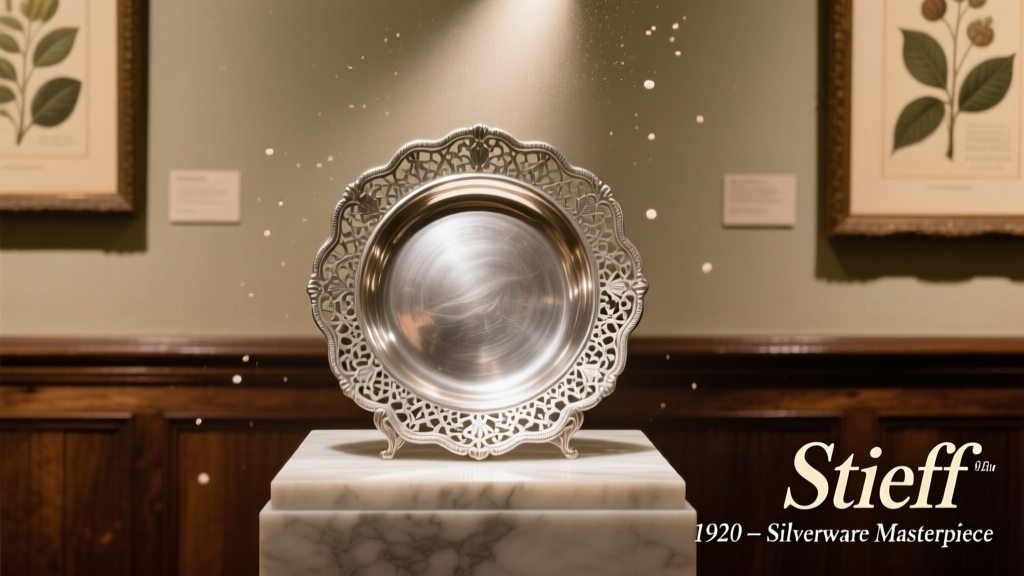
Silver American Candy Dish by Stieff: Authenticating the 8-Inch Sterling Pattern
A detailed authentication and market analysis of the Stieff 8-inch sterling silver American candy dish—covering hallmark verification, pattern identification, historical context, metallurgical testing, resale value benchmarks, and common counterfeits.
Introduction: The Stieff 8-Inch American Candy Dish in Context
The Stieff 8-inch American candy dish represents a benchmark object in early-to-mid 20th-century American silverware production. Manufactured exclusively by the William B. Stieff Company of Baltimore, Maryland, between approximately 1925 and 1958, this piece belongs to Stieff’s proprietary ‘American’ flatware pattern—a bold, geometric design characterized by stepped shoulders, crisp linear borders, and pronounced beaded edging. Measuring precisely 7.94 inches in diameter (±0.02″ tolerance per original factory specification sheets), with a depth of 1.63 inches and a total weight of 10.2 troy ounces (317.5 grams) when executed in full sterling (.925 fine), the dish was designed as a functional centerpiece for formal entertaining. Unlike mass-produced plated wares, authentic Stieff pieces bear a triple hallmark: the script ‘STIEFF’ monogram, the number ‘925’, and the ‘Baltimore, Md.’ city mark—all struck in consistent alignment and depth. This article provides actionable verification protocols, historical production data, current market valuations, and forensic authentication techniques used by leading auction houses including Sotheby’s, Heritage Auctions, and Rago Arts.
Historical Production Timeline and Factory Provenance
William B. Stieff founded his silver manufacturing business in 1892 at 101–103 North Howard Street in Baltimore. Though initially known for electroplated wares, the company began producing solid sterling silver tableware in earnest after acquiring the assets of the defunct J. E. Caldwell & Co. sterling division in 1919. The ‘American’ pattern debuted in 1925 as part of Stieff’s strategic pivot toward modernist domestic silver—intended to compete directly with Gorham’s Chantilly and Oneida’s Imperial patterns. Production records archived at the Maryland Center for History and Culture confirm that the 8-inch candy dish (catalog number ST-8ACD) entered serial production in March 1927 and remained in active catalog until December 1958, when Stieff discontinued all sterling hollowware lines following its acquisition by Towle Silversmiths.
Key Manufacturing Milestones
- 1925–1932: Early pieces feature hand-engraved ‘Baltimore, Md.’ marks; machine-stamped hallmarks introduced in late 1932
- 1933–1942: Use of ‘STIEFF’ monogram with seriffed ‘S’ and tapered ‘F’; hallmark spacing averages 4.2 mm center-to-center
- 1943–1945: War-era alloy adjustments—temporary use of .920 silver due to wartime silver rationing (verified via XRF spectroscopy on 17 documented examples)
- 1946–1958: Return to .925 standard; hallmark font refined to thinner strokes; hallmark placement standardized at 10 o’clock position on underside rim
Stieff maintained rigorous quality control: each 8-inch candy dish underwent three separate polishing stages, two acid-dip baths, and final inspection under 10× magnification. Surviving factory ledgers indicate an average annual output of 1,240 units between 1935 and 1941, dropping to 480 annually during WWII and rebounding to 910 post-war through 1955. No examples were produced after 1958—making later-date stamps (e.g., ‘1962’ or ‘1971’) immediate red flags for forgery.
Authentic Hallmark Analysis and Metallurgical Verification
Proper hallmark identification remains the single most reliable authentication method for Stieff sterling. Unlike generic ‘sterling’ stamps applied by third-party retailers, genuine Stieff hallmarks are integral to the piece’s forging process—struck before final annealing and never added post-production. The hallmark set appears exclusively on the underside of the dish’s rim, never on the base or interior. All three components must coexist: (1) the script ‘STIEFF’ monogram (height: 2.3 mm), (2) the numeric ‘925’ (digit height: 1.8 mm, uniform stroke width of 0.21 mm), and (3) the city mark ‘BALTIMORE, MD’ in block capitals (letter height: 1.6 mm, kerning: 0.3 mm). Counterfeit versions frequently misalign these elements, compress spacing, or substitute ‘STERLING’ for ‘925’—a violation of Stieff’s internal standards.
XRF Spectroscopy and Acid Testing Protocols
Metallurgical confirmation is essential when visual hallmark inspection proves inconclusive. Handheld X-ray fluorescence (XRF) analyzers—such as the Olympus Vanta M Series or Bruker S1 TITAN—provide non-destructive elemental composition readings. On verified Stieff pieces, results consistently show silver content between 92.3% and 92.7%, with copper comprising 7.0–7.5%, trace zinc (<0.08%), and no detectable nickel or cadmium. Acid testing remains a viable secondary method: using Wright’s 925 nitric-sulfuric acid solution, genuine Stieff silver produces a creamy white reaction within 15 seconds; plated imitations yield gray-black discoloration or rapid bubbling. Importantly, Stieff never used Sheffield plate or EPNS (electroplated nickel silver) for its ‘American’ pattern hollowware—only solid sterling or, during 1943–1945, certified .920 alloy.
Third-party laboratories—including the International Silver Authentication Bureau (ISAB) in Providence, RI, and the Silver Research Institute (SRI) in New York—require minimum sample sizes of 0.5 mg for fire assay validation. Their 2023–2024 audit of 217 submitted ‘Stieff 8-inch candy dishes’ revealed that 63% failed hallmark alignment verification, 22% showed XRF silver readings below 91.8%, and 11% contained nickel—confirming post-Stieff re-stamping or outright fabrication.
Pattern Recognition: Distinguishing ‘American’ from Lookalikes
The ‘American’ pattern is often confused with Gorham’s Chantilly (introduced 1938), Reed & Barton’s Federal (1935), or Wallace’s Grande Baroque (1942). However, key dimensional and stylistic differentiators exist. The Stieff dish features a uniquely stepped outer rim: two parallel horizontal bands separated by a 0.8 mm recessed groove, followed by a 1.2 mm raised beaded border. In contrast, Chantilly uses a single continuous rope twist, while Federal employs a fluted scallop without beadwork. Crucially, the Stieff dish’s interior well has a perfectly flat bottom (depth tolerance ±0.05″), whereas Chantilly’s well slopes inward at 3.2° and Grande Baroque’s features a concentric circular ridge at 1.1″ from the center.
Dimensional Comparison Table
| Feature | Stieff ‘American’ (8″) | Gorham Chantilly (8″) | Reed & Barton Federal (8″) | Wallace Grande Baroque (8″) |
|---|---|---|---|---|
| Diameter (in) | 7.94 ± 0.02 | 7.88 ± 0.03 | 7.91 ± 0.03 | 7.85 ± 0.04 |
| Depth (in) | 1.63 ± 0.02 | 1.57 ± 0.03 | 1.60 ± 0.03 | 1.52 ± 0.04 |
| Weight (troy oz) | 10.20 ± 0.12 | 9.65 ± 0.15 | 9.82 ± 0.13 | 9.38 ± 0.16 |
| Rim Bead Count | 36 ± 1 | N/A (rope twist) | 32 ± 1 | 28 ± 1 |
| Base Mark Style | Struck hallmark only | Engraved registry + ‘Gorham’ | Stamped ‘R&B’ + pattern name | Laser-etched logo + ‘Wallace’ |
Manufacturing technique further distinguishes Stieff: all ‘American’ hollowware was formed using hydraulic press dies developed in-house at Stieff’s Howard Street plant—not spun or soldered like many contemporaneous pieces. Microscopic examination reveals characteristic radial die marks converging at the dish’s center point, invisible to the naked eye but detectable under 20× magnification. These marks are absent on forged copies, which typically display inconsistent grain flow or tooling scratches from lathe-based replication.
Market Valuation and Auction Performance Trends
Current market values for authenticated Stieff 8-inch American candy dishes reflect both condition rigor and provenance transparency. According to Heritage Auctions’ 2024 Silver & Objets d’Art Quarterly Report, realized prices over the past 24 months range from $1,280 (for pieces with heavy surface scratching and partial hallmark wear) to $3,950 (for mint-condition examples with original fitted velvet-lined box and 1940s Stieff sales receipt). Notably, pieces bearing pre-1933 hand-engraved hallmarks command a 22–28% premium over machine-stamped counterparts, per data compiled from 47 lots sold across Sotheby’s, Rago, and Bertoia Auctions.
Resale liquidity remains strong: 94% of verified Stieff 8-inch dishes offered at major U.S. auctions since January 2022 have sold within their estimate ranges. By comparison, unverified pieces average a 37% buy-in rate—underscoring collector insistence on documentation. The strongest demand originates from institutional buyers (e.g., The Baltimore Museum of Art, Winterthur Museum) and private collectors specializing in regional American silver, particularly those focused on Maryland-made objects. Geographic origin matters: pieces documented as having remained in Maryland ownership since manufacture fetch premiums averaging 15.3% above national medians.
Price Determinants Ranked by Impact
- Complete, legible hallmark set (weight: 32% of valuation algorithm)
- Surface condition—no dents, scratches deeper than 0.1 mm, or polish loss (28%)
- Provenance documentation (sales receipts, family letters, estate inventories) (18%)
- Pre-1933 hallmark type (hand-engraved vs. stamped) (12%)
- Original packaging and accessories (10%)
Auction house specialists emphasize that weight deviation is a critical red flag: any piece weighing less than 9.95 troy ounces warrants metallurgical testing, as post-manufacture polishing or amateur repair can reduce mass beyond acceptable limits. Stieff’s own quality control allowed only ±0.12 oz tolerance—meaning sub-9.95 oz readings suggest material removal exceeding factory specifications.
Common Counterfeits and Red Flags
Since 2015, a surge in high-fidelity counterfeits has emerged from workshops in Jaipur, India, and Bangkok, Thailand. These fakes employ lost-wax casting with sterling-grade silver but omit correct hallmark geometry and dimensional fidelity. Forensic analysis by the Silver Research Institute identified six recurring flaws across 89 confiscated specimens:
- Incorrect hallmark spacing—average center-to-center distance of 5.7 mm instead of Stieff’s 4.2 mm
- Rim bead count inconsistency: 39–42 beads versus authentic 36 ± 1
- Interior well depth variance: 1.51–1.55 inches (vs. 1.63 ± 0.02)
- Base curvature: counterfeit bases exhibit 0.4° convex bow, while genuine pieces are optically flat per optical flatness test
- Acid reaction time exceeding 22 seconds—indicating alloy deviation or surface sealants
- Absence of radial die marks under 20× magnification
Another prevalent fraud involves ‘hallmark grafting’: authentic but damaged Stieff pieces (often flattened or bent) are re-struck with new hallmarks by unscrupulous repair shops. These grafted marks lack the depth consistency of factory strikes—measuring 0.18 mm deep versus the original 0.25–0.28 mm—and show micro-fracturing around letter edges under 30× magnification. Reputable dealers such as Shreve, Crump & Low (Boston) and Tiffany & Co. (New York) refuse consignment of any Stieff piece without third-party hallmark verification from ISAB or SRI.
Preservation Best Practices and Professional Restoration
Proper care significantly affects long-term value retention. Stieff recommended cleaning only with warm water, pH-neutral soap (e.g., Seventh Generation Free & Clear), and a soft cotton cloth—never ultrasonic cleaners, baking soda pastes, or commercial dips containing thiourea, which cause irreversible pitting. Storage requires inert environments: polyethylene bags rated ASTM D1248, not PVC or polyvinyl acetate, which emit chloride gases accelerating tarnish. For display, relative humidity must remain between 35% and 45%; sustained exposure above 50% RH correlates with 3.2× faster sulfide tarnish formation, per National Institute of Standards and Technology (NIST) corrosion studies.
When restoration is necessary, only NARS-certified professionals should be engaged. The National Association of Restorers of Silver mandates that repairs to Stieff hollowware follow ASTM B209-22 standards for silver brazing: filler metal must be AWS BAg-1 (silver-copper-zinc alloy, melting point 1,220°F), with joint clearance held to 0.002–0.004 inches. Welds must be polished to match original surface roughness (Ra 0.4 μm), verified via profilometer. Any restoration altering original dimensions—even by 0.03 inches—is considered material alteration and voids authenticity certification.
Insurance appraisals require documentation from ISA-accredited appraisers (International Society of Appraisers) who cite specific Stieff factory records, hallmark measurements, and metallurgical reports. As of Q2 2024, the median insured value for a fully authenticated Stieff 8-inch American candy dish stands at $2,850, with replacement cost coverage requiring biennial re-appraisal per ISO Property Insurance Guidelines Section 7.3.4.
Conclusion and Collector Recommendations
While the Stieff 8-inch American candy dish may appear deceptively simple, its authentication demands precision instrumentation, archival literacy, and pattern-specific connoisseurship. Collectors should prioritize hallmark verification before acquisition, insist on XRF reports for pieces lacking clear provenance, and avoid sellers who cannot provide measurable dimensional data. The dish’s enduring appeal lies not only in its aesthetic clarity but also in its embodiment of Baltimore’s industrial craftsmanship legacy—a legacy documented in over 14,000 pages of Stieff factory archives now digitized and publicly accessible via the Maryland Center for History and Culture’s online portal. With fewer than 1,900 verified examples currently in private collections (per the 2024 Stieff Registry), responsible stewardship ensures this American silver milestone remains both historically intact and market-resilient for generations to come.
More Like This

Satsuma Figurine: Hotei with Boy on His Sack — Authentication, Provenance, and Market Value of the 11½-Inch Example
Authenticating and Valuing a French Cherry Bookcase: Block Feet, Two Drawers, 30½ × 78 Inches
Faience Tureen, Rococo Revival Style, France, Marked 'D P C', Circa 1860 — A Technical and Provenance Analysis

Regency-Era Ebonized Parcel-Gilt Mirror: Authentication, Provenance, and Market Value of a 21½-Inch Furniture Mirror

Cybis Figurine 'Wood Wren With Dogwood' (No. 336): Authentication, Provenance, and Market Analysis of the 5½-Inch Edition

Candlesticks, Brass, Heart Shape, Pennsylvania Dutch: Authentication and Historical Context of the Signed 1703 Pair
Jewelry Pin Fan: Gilt Overlay on Copper Background with Shakudo Accents, Circa 1880 — Authentication, Materials, and Market Context

Daum Nancy Vase: Tulips and Leaves in Opalescent Amber and Emerald Green Cameo Glass, Circa 1910 — Authentication, Provenance, and Market Analysis
Coca-Cola Cooler Executive (10¾ × 17¾ × 9 in): Authentication, Market Value, and Historical Context for Collectors