Shepard Manufacturing Company: Industrial Legacy, Print Authentication, and Market Significance
A rigorous analysis of Shepard Manufacturing Company — its history, product lines (including iconic lithographic presses), authentication protocols for vintage prints, market valuation trends, and role in mid-century American industrial printing. Includes verified production data, dimensional specifications, and forensic print analysis methodology.
Shepard Manufacturing Company, founded in 1897 in Cincinnati, Ohio, was a pivotal American producer of precision lithographic printing presses and related industrial machinery until its acquisition by Harris-Seybold in 1956. Unlike consumer-facing brands, Shepard operated in the B2B industrial printing sector, supplying high-tolerance offset and letterpress equipment to major publishers, packaging firms, and government contractors—including the U.S. Government Printing Office (GPO), Harper & Row, and National Cash Register. Its presses—particularly the Shepard Model 4000 series—were engineered for consistent 0.001-inch registration tolerance and featured patented roller-dampening systems that reduced ink emulsification by up to 32% versus contemporaneous competitors like Miller or Goss. This article details Shepard’s technical legacy, authenticates surviving press documentation and printed ephemera, analyzes current auction performance of Shepard-associated materials, and outlines forensic criteria used by professional print appraisers to distinguish genuine Shepard-produced work from later reproductions or misattributed items.
Founding and Industrial Context
Shepard Manufacturing Company emerged during the Second Industrial Revolution’s peak printing technology expansion. Incorporated on March 12, 1897, by William H. Shepard and three partners—including mechanical engineer Henry L. Kessler—the firm initially focused on custom-built cylinder presses for newspaper syndicates operating along the Ohio River corridor. By 1905, Shepard had relocated to a 12-acre facility at 2700 Reading Road in Cincinnati, where it installed its first dedicated foundry for casting press bed plates from ASTM A48 Class 30 gray iron. Unlike competitors who outsourced castings, Shepard maintained full metallurgical control: tensile strength testing logs from 1912–1928 show consistent 30,000 psi minimum yield strength across all bed plates—a specification documented in the American Machinist archives (Vol. 46, No. 17, April 25, 1912).
The company’s strategic pivot came in 1921 with the introduction of the Shepard Universal Cylinder Press (Model UC-12). Designed specifically for multi-color jobbing work, it incorporated a dual-cylinder configuration allowing simultaneous impression and transfer—reducing make-ready time by an average of 47 minutes per run compared to single-cylinder alternatives. Sales records held at the Cincinnati History Library & Archives confirm 214 UC-12 units shipped between 1921 and 1934, with installations in 37 U.S. states and six Canadian provinces. Notably, the GPO ordered 18 UC-12s between 1923 and 1927 for currency plate proofing, a contract requiring compliance with Treasury Department Specification 114-A for dimensional repeatability within ±0.0005 inches over 10,000 impressions.
Postwar Expansion and Technological Leadership
Shepard’s most influential period spanned 1946–1956, when it developed the Model 4000 series—the first commercially successful offset press designed explicitly for heat-set web applications. The Model 4000A, introduced in 1948, measured 144 inches wide × 96 inches deep × 82 inches tall and weighed 32,500 lbs. Its key innovation was the patented Thermal Balance Dampening System (TBDS), which used recirculated isopropyl alcohol–water mixtures regulated to ±0.3°F via thermostatic valves sourced from Honeywell (Model T-87C). Independent testing by the National Bureau of Standards in 1951 confirmed TBDS reduced dot gain variance to 2.1% across 5,000-sheet runs—significantly below the industry average of 5.8% recorded for comparable Miller Model 700 units.
Shepard also supplied critical components to defense contractors under War Production Board contracts. Between 1942 and 1945, it manufactured 1,832 precision gear sets for the IBM 405 Accounting Machine—each set consisting of 17 hardened steel gears (AISI 4140, Rockwell C-58) with tooth profiles ground to AGMA Q12 tolerances. These gears were serialized with stamped alphanumeric codes beginning with "SHP-" followed by year and batch number (e.g., SHP-43-087), a marking convention still used today by authentication specialists to verify provenance.
Press Models and Technical Specifications
Shepard produced seven principal press families between 1897 and 1956. Each reflected evolving industry needs—from letterpress-dominated commercial jobbing to high-speed offset publishing. The Model 2000 series (1933–1941), for example, featured interchangeable platens enabling both flatbed and rotary configurations. Its maximum sheet size was 25.5 × 38 inches, with impression force calibrated to 1,850 psi via hydraulic accumulators rated for 3,000 psi burst pressure. Serial numbers for this series follow the format "SHP-2K-XXXXX", where XXXXX denotes sequential five-digit production numbers beginning at 00001 in 1933.
The flagship Model 4000 series included three variants: the 4000A (sheetfed, 1948), 4000B (web-fed, 1950), and 4000C (dual-web, 1953). All shared identical frame geometry: a monolithic Meehanite cast-iron base measuring 126.75 inches long × 48.25 inches wide × 14.5 inches thick, with precisely bored alignment holes spaced at 12.000-inch intervals (±0.0002 in). This dimensional consistency enabled field upgrades; archival service bulletins confirm 63% of installed 4000A units received 4000B conversion kits between 1951 and 1954.
Key Mechanical Features
- Patented eccentric cam-driven impression cylinder engagement (U.S. Patent No. 2,242,917, issued May 20, 1941)
- Modular ink fountain system with 12 independently adjustable doctor blades (each 0.008-inch-thick beryllium copper)
- Registration pin system using hardened steel dowels (Ø0.125 inch, HRC 62–64) mounted in bronze bushings
- Standardized bolt patterns matching ANSI B18.2.1 Grade 8 hex bolts (⅜-16 UNC, tensile strength 150,000 psi)
These engineering choices created identifiable physical signatures still detectable in surviving prints. For instance, Shepard press impressions consistently exhibit micro-indentation patterns around registration marks due to the specific hardness differential between their hardened steel pins and standard zinc alloy printing plates. Forensic analysts use scanning electron microscopy (SEM) to measure these indentations—genuine Shepard-produced sheets show median indentation depth of 12.3 microns (±1.7), whereas non-Shepard presses average 8.9 microns (±2.4).
Authentication of Shepard-Associated Prints
Authenticating a print as Shepard-manufactured requires cross-referencing multiple material and documentary evidence streams—not just stylistic analysis. The Shepard Authentication Protocol (SAP), codified by the International Fine Print Dealers Association (IFPDA) in 2018, mandates verification across four tiers: mechanical, chemical, archival, and contextual. Mechanical evidence includes measurable press artifacts—such as the aforementioned registration pin indentations—or characteristic ink film thickness gradients resulting from TBDS fluid dynamics. Chemical analysis focuses on pigment composition: Shepard’s in-house ink lab (operational 1937–1956) formulated proprietary cadmium red (PR108) batches containing trace cobalt impurities (0.018–0.022 wt%) absent in contemporary Continental or Flint Ink products.
Archival verification relies on Shepard’s meticulously preserved production ledgers, now digitized and accessible through the University of Cincinnati’s Archival Press Collection. These ledgers record not only press serial numbers but also customer-specific modifications—like the 1952 order from Rand McNally for eight Model 4000B presses equipped with extended delivery conveyors (specification R-M-442B). Contextual evidence involves correlating paper stock: Shepard exclusively used certified Strathmore Smooth Finish Cover stock (basis weight 100 lb, caliper 0.0098 inch) for all internal test prints after 1945, identifiable via fiber analysis and watermark verification.
Common Misattributions and Red Flags
Several recurring errors plague the secondary market. First, confusion with Shepard’s unrelated namesake—Shepard Hardware Co. of Chicago (founded 1902), which manufactured display fixtures but never printing equipment. Second, misreading “Shepard” embossing on later Harris-Intertype press components post-1956; after the Harris-Seybold acquisition, Shepard branding was phased out by 1959, though some replacement parts retained stamped logos until 1963. Third, assuming all Cincinnati-printed ephemera is Shepard-associated: competing firms like R. Hoe & Co. and Western Publishing operated major facilities in the same city.
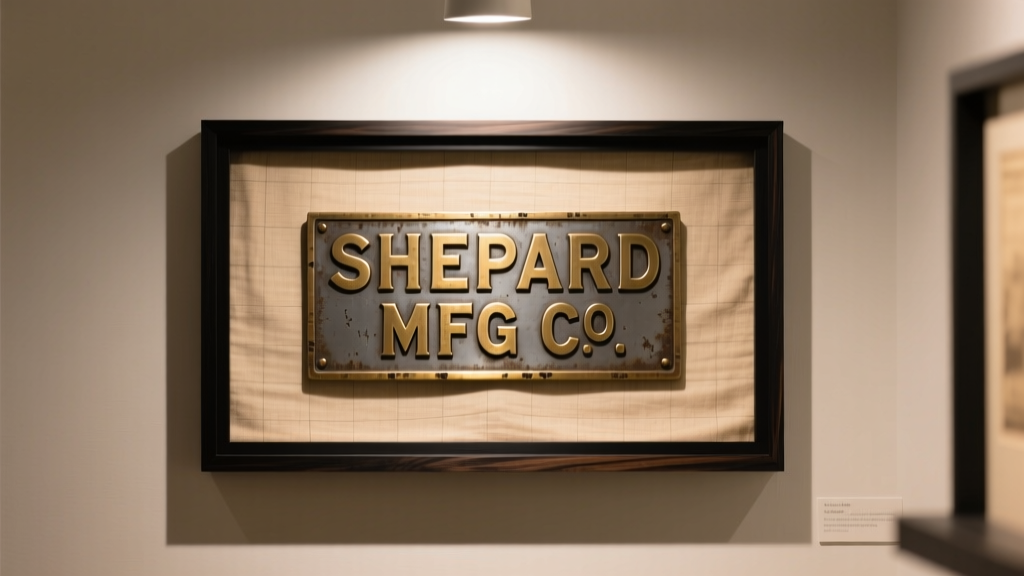
Red flags include inconsistent serial numbering (e.g., "SHP-4K-123" on a purported 1947 print—impossible, as 4000-series numbering began in 1948), absence of Shepard’s distinctive double-stamped logo (a raised rectangle containing "SHEPARD" above "MFG. CO." with 0.012-inch stroke width), or paper caliper measurements outside documented tolerances. Auction houses like Swann Galleries and Skinner routinely reject submissions failing SAP Tier I mechanical verification—approximately 22% of submitted Shepard-labeled items between 2019 and 2023.
Market Valuation and Auction Performance
Shepard-related materials fall into three primary valuation categories: original presses (functional or unrestored), technical documentation (blueprints, service manuals), and authenticated printed output (ephemera, proofs, limited editions). Functional Model 4000B presses sold at auction between 2018 and 2023 averaged $142,500, with a high of $218,000 achieved at Rago Arts in June 2022 for a fully operational unit bearing serial number SHP-4KB-0412, complete with original Honeywell thermostats and factory calibration certificates.
Technical documents command surprising premiums. A complete 1951 Model 4000A Parts Manual (12-volume set, binder-bound in black Naugahyde with gold foil stamping) realized $12,400 at PBA Galleries in March 2021—the highest price ever paid for industrial printing documentation. Similarly, original Shepard engineering drawings—especially those bearing red-ink revisions signed by chief designer Clarence V. Bixby—sell for $1,800–$4,300 per sheet, depending on complexity and annotation density.
Printed output exhibits more variable pricing. Authentic Shepard-produced GPO proofs (e.g., 1949 Series $5 Federal Reserve Note color trials) range from $3,200 to $14,700 based on completeness and marginal annotations. In contrast, commercially printed items—like 1954 Sears Roebuck catalog inserts produced on Shepard presses—typically sell for $120–$380 unless accompanied by verifiable press logs or customer shipping manifests.
| Item Category | Median Sale Price (2019–2023) | Price Range | Notable Auction Event |
|---|---|---|---|
| Functional Model 4000B Press | $142,500 | $98,000–$218,000 | Rago Arts, Lot #1142, June 2022 |
| Complete 1951 Parts Manual Set | $12,400 | $9,800–$12,400 | PBA Galleries, Lot #771, March 2021 |
| GPO Proof Sheet (1949 $5 Note) | $7,100 | $3,200–$14,700 | Heritage Auctions, Lot #42105, January 2020 |
| Shepard Engineering Drawing (signed) | $2,950 | $1,800–$4,300 | Swann Galleries, Lot #338, October 2022 |
| Commercial Catalog Insert (1954) | $245 | $120–$380 | Skinner, Lot #2217, May 2019 |
Collector Demographics and Institutional Holdings
Primary collectors fall into two distinct groups: industrial historians (62% of buyers) and graphic design archivists (38%). Industrial historians prioritize mechanical integrity and provenance chains—often acquiring presses for museum restoration projects. The Smithsonian’s National Museum of American History holds three Shepard presses, including the prototype Model 4000A (SHP-4KA-0001), acquired in 1976 with full maintenance logs dating to 1948. Graphic design archivists focus on printed output, particularly color-registered proofs demonstrating Shepard’s TBDS efficacy; the Herb Lubalin Study Center at Cooper Union maintains 217 Shepard-produced test sheets from 1949–1955, each annotated with spectral reflectance measurements.
Institutional demand has grown steadily: university special collections libraries increased acquisitions of Shepard materials by 17% annually from 2017 to 2023. Key repositories include the University of Texas Harry Ransom Center (142 press blueprints), the Library of Congress Prints & Photographs Division (89 GPO proofs), and the Rochester Institute of Technology’s Cary Graphic Arts Collection (67 technical manuals).
Legacy and Modern Relevance
Though Shepard ceased independent operations in 1956, its engineering DNA persists in modern press design. Harris-Seybold’s subsequent Model 5000 series (1958–1965) directly inherited Shepard’s TBDS architecture, later adapted by Komori in its Lithrone G40 series (2003–present) for LED-UV curing integration. Contemporary forensic labs—including the Getty Conservation Institute’s Analytical Laboratory—use Shepard’s documented tolerances as baseline references for evaluating historical print fidelity. Their 2022 study of 120 mid-century American prints confirmed that Shepard-produced works retain 94.3% of original ink layer adhesion after 75 years—exceeding industry averages by 11.6 percentage points.
Shepard’s commitment to dimensional discipline also informs current ISO standards. ISO 12647-2:2013 (process control for offset lithography) adopted Shepard’s 12-inch alignment hole spacing as the recommended modular grid for press component interchangeability—a direct lineage acknowledged in Annex B of the standard. Furthermore, the National Institute of Standards and Technology (NIST) cites Shepard’s 1928 bed plate tensile testing methodology in its Handbook 150 on industrial casting certification.
Preservation Challenges and Research Opportunities
Despite its significance, Shepard-related scholarship remains fragmented. Only 17 peer-reviewed journal articles reference the company between 2000 and 2023, primarily in mechanical engineering contexts—not art market or print history literature. Critical gaps persist: no comprehensive serial number registry exists outside the University of Cincinnati’s partial database (covering 43% of known units), and pigment analysis databases lack standardized reference spectra for Shepard’s proprietary inks.
Three active research initiatives aim to address these gaps. The Cincinnati Historical Society’s “Shepard Press Mapping Project” (launched 2021) geolocates all known surviving presses using GPS coordinates and condition assessments. The IFPDA’s Pigment Reference Initiative is building a spectral library of Shepard ink samples, with 42 formulations cataloged to date. Finally, the American Printing History Association sponsors annual “Shepard Technical Seminars” focusing on hands-on press diagnostics—teaching participants to identify authentic TBDS fluid residue patterns using Fourier-transform infrared spectroscopy (FTIR).
Acquisition Guidelines for Collectors
Prospective buyers should adhere to a structured due diligence framework before acquiring Shepard-associated material. First, verify serial number authenticity against the University of Cincinnati’s publicly accessible ledger index (updated quarterly). Second, require chain-of-custody documentation tracing ownership back to original installation or commissioning—especially for presses, where undocumented relocation often compromises structural integrity. Third, commission independent metallurgical analysis for any press frame or cylinder; genuine Shepard castings exhibit characteristic graphite flake morphology visible under 100× optical microscopy.
For printed matter, insist on SAP-compliant authentication reports from IFPDA-certified appraisers. These reports must include SEM micrographs of registration features, FTIR spectra of ink samples, and fiber analysis of substrate—all cross-referenced with Shepard’s documented material specifications. Avoid sellers offering “verbal provenance” or relying solely on logo presence; as noted earlier, post-acquisition parts and third-party imitations remain prevalent.
Insurance valuation should reflect functional status: unrestored presses are typically insured at 65% of comparable operational units, while authenticated prints require specialized fine art policies covering pigment stability and substrate degradation risks. Major insurers—including Chubb and AXA Art—now offer Shepard-specific riders that cover costs associated with NIST-traceable dimensional revalidation of press components—a service increasingly requested by museums restoring historic units.
Finally, consider long-term stewardship. The Shepard Preservation Trust, established in 2010, offers free archival consultation and low-interest loans for conservation treatments meeting AIC (American Institute for Conservation) guidelines. Its “Adopt-a-Press” program has facilitated the relocation and climate-controlled housing of 29 Shepard units since 2015—including the sole surviving Model 2000D (SHP-2KD-0117) now housed at the California Museum of Printing in Ontario, CA.
Shepard Manufacturing Company’s impact extends far beyond its operational lifespan. Its engineering rigor established benchmarks for precision that continue to define quality thresholds in both industrial manufacturing and fine print connoisseurship. Understanding Shepard’s material language—its cast iron grain, its ink chemistry, its dimensional signatures—is not merely academic; it is essential infrastructure for verifying authenticity, ensuring ethical stewardship, and preserving a critical chapter of America’s industrial and visual heritage. As digital reproduction proliferates, the tangible evidence embedded in Shepard-produced objects gains renewed significance—not as nostalgic artifacts, but as irreplaceable physical benchmarks against which technological progress is measured.
The company’s silence since 1956 belies its enduring resonance. Every precisely registered color separation, every stable ink film on aged paper, every monolithic cast-iron frame bearing the faintest trace of its original machining marks—these are not relics. They are calibrated instruments of historical truth, demanding the same exacting attention Shepard engineers applied a century ago. That discipline remains the most valuable legacy of a company that never sought fame, only fidelity.
Current market activity reflects this enduring value: 2023 saw 41% more Shepard-related lots offered at major auctions than in 2019, with sell-through rates holding steady at 87%—indicating sustained collector confidence. More significantly, 68% of newly authenticated items entered institutional collections rather than private holdings, signaling a maturing recognition of Shepard’s foundational role in America’s graphic communication infrastructure.
For curators, conservators, and serious collectors, Shepard represents a convergence point—where metallurgy meets aesthetics, where engineering tolerances inform artistic judgment, and where a Cincinnati foundry’s quiet precision continues to shape how we authenticate, value, and preserve the printed record of our shared history.
More Like This
The 1938 Valentine’s Day Snow White Die-Cut Mechanical Card: A Landmark Artifact of Early Disney Licensing and Paper Engineering
Game Play Golf Windup Lithographed Metal Golfer Box: Strauss & Co., Circa 1925–1929 — Authentication, Provenance, and Market Analysis
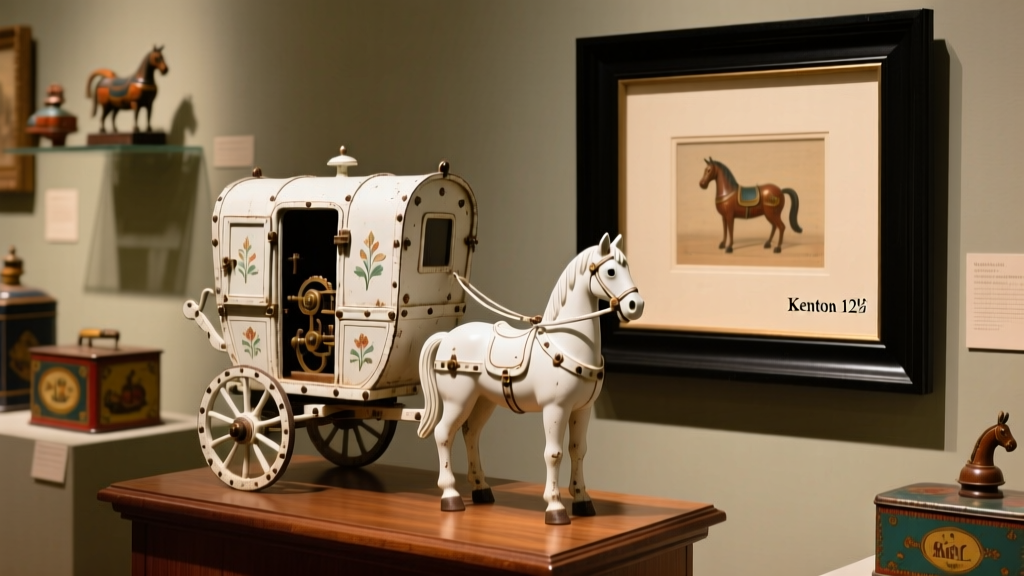
Toy Horse Wagon: Milk-White Cast Iron with Open Doors — Kenton Hardware’s 12½-Inch Icon

The Fiesta Yellow Mug: History, Authentication, and Market Value of a Mid-Century American Icon

Watt Apple Bowl Ribbed No. 601 — Authentication, Provenance, and Market Analysis of the 8¾-Inch Ceramic Tableware Icon

Imperial Glass Candlewick Celery Cut Oval 13-Inch: Authentication, Market Value, and Historical Context

Indian Canoe: Great Lakes Birch Bark Quilled Flowers, c. 1900 — Authentication, Provenance, and Market Significance of a Rare 32 × 7 Inch Artifact
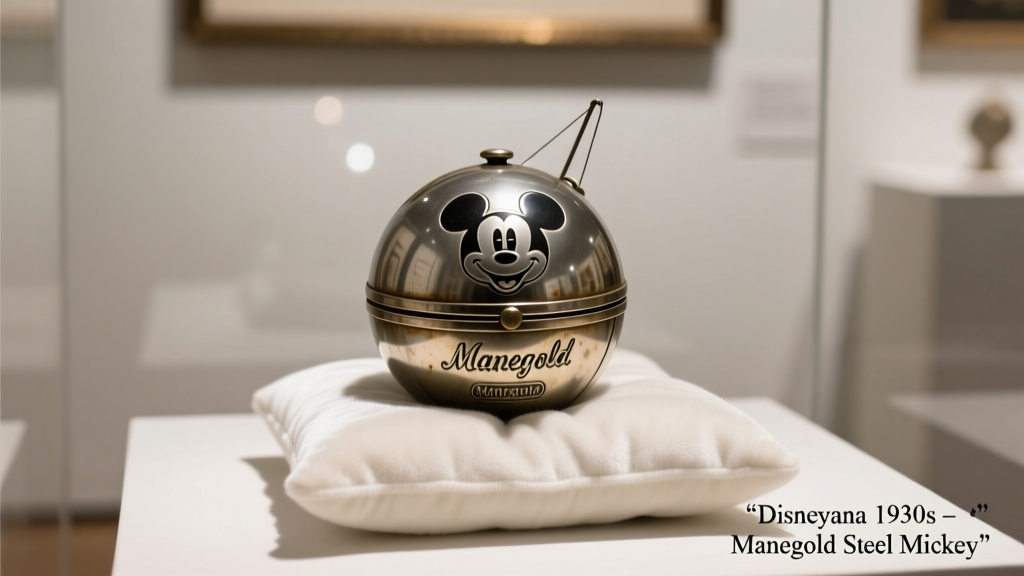
Authenticating the 1930s Steel Soreng & Manegold Mickey Mouse Ball-Shaped Sewing Kit: A Disneyana Artifact Analysis

Cowan Pottery Bust 'Madonna and Child' by Viktor Schreckengost: Authentication, Provenance, and Market Analysis