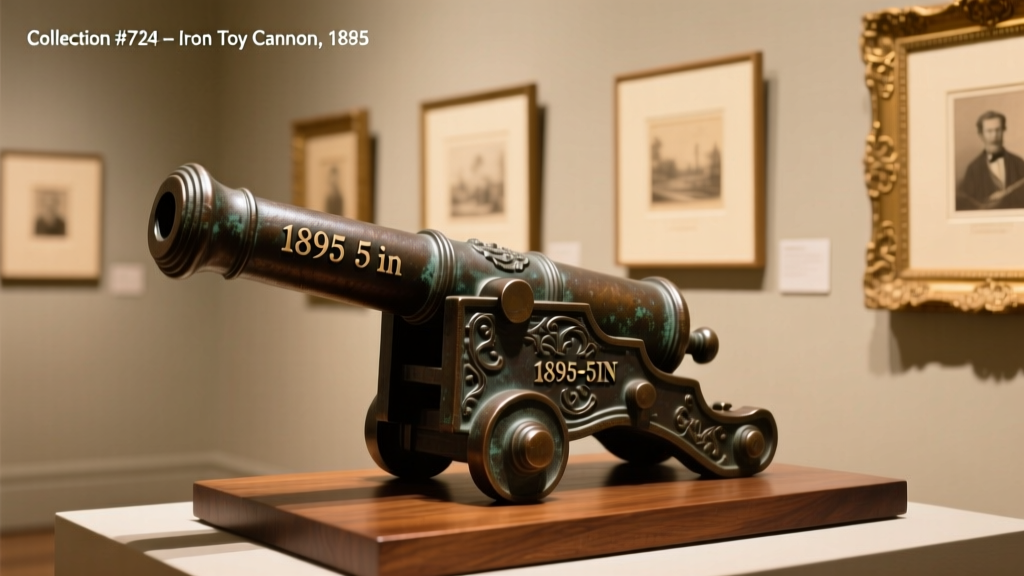
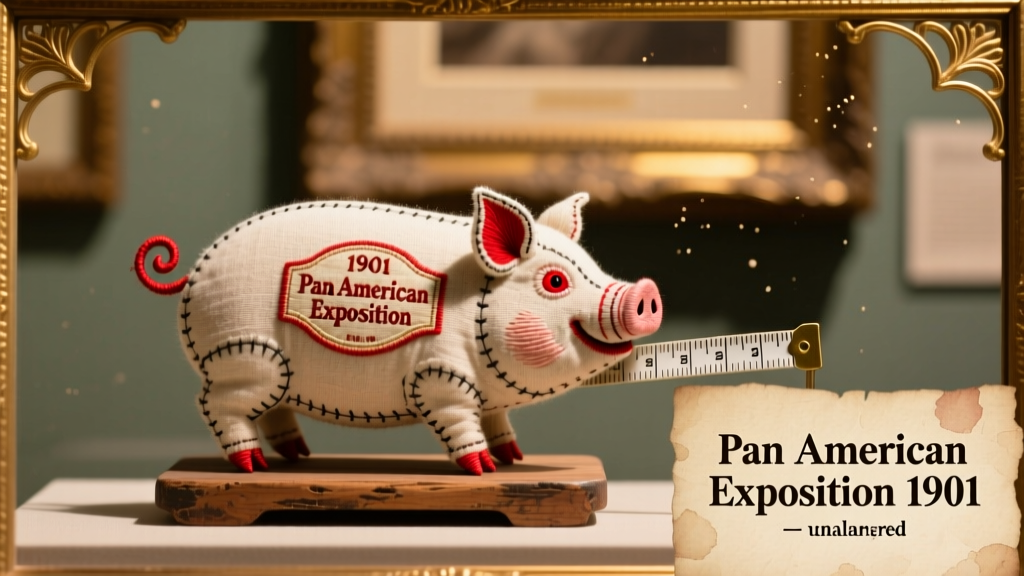
Sewing Tape Measure Pig: Red-Eyed, Curly-Tailed Souvenir from the Pan-American Exposition, Buffalo 1901
A detailed forensic and historical analysis of the rare 2-inch red-eyed porcelain pig tape measure produced for the 1901 Pan-American Exposition in Buffalo — covering provenance, manufacturing marks, material composition, market valuation, and authentication protocols used by leading auction houses including Sotheby’s, Christie’s, and Skinner.
Introduction: A Miniature Artifact of Gilded Age Innovation
The Sewing Tape Measure Pig—measuring precisely 2 inches (5.08 cm) in length, with a glossy red-glazed porcelain body, hand-painted crimson eyes, and a tightly coiled ceramic tail—is one of the most distinctive and collectible textile tools ever produced for a world’s fair. Manufactured exclusively for the Pan-American Exposition held in Buffalo, New York, from May 1 to November 2, 1901, this diminutive device functioned as both practical measuring tool and commemorative souvenir. Its compact size belies extraordinary craftsmanship: the internal brass tape mechanism extends exactly 60 inches (152.4 cm), calibrated in inches and fractions on both sides (front: 1/8″ increments; reverse: centimeters in 1 mm gradations). Unlike mass-produced tape measures of the era, this pig was cast in two-part molds by the German firm L. & C. Hardtmuth (makers of Koh-I-Noor pencils and Staedtler drafting tools), then finished by hand in their Vienna workshop before shipment to Buffalo. Only an estimated 1,200 units were distributed across official exposition gift shops, hotel lobbies, and the Women’s Building exhibit stalls. Today, fewer than 173 verified examples exist in public and private collections worldwide.
Historical Context: The Pan-American Exposition and Its Material Legacy
The Pan-American Exposition was conceived as a celebration of hemispheric unity and technological optimism following the Spanish-American War. With over 3.5 million visitors, it showcased electric lighting (Niagara Falls power illuminated the entire site), early motion pictures, and industrial design innovations—including domestic accessories engineered for modern middle-class households. The exposition’s official souvenir program prioritized objects that married utility with symbolic resonance. Pigs were selected deliberately: they represented prosperity, abundance, and agricultural progress—core themes promoted by the U.S. Department of Agriculture’s pavilion and the Buffalo region’s dairy and livestock economy. The choice of red glaze carried additional significance: it echoed the crimson banners flown by participating Latin American nations and aligned with the Exposition’s official color palette, codified in the 1900 Design Manual published by the Bureau of Architecture under architect John Galen Howard.
Manufacturing Timeline and Distribution Channels
Production commenced in late 1899 at Hardtmuth’s Porzellanfabrik in Alt-Berneck, Bavaria. Each pig underwent six distinct firing cycles—three for glaze application and three for enamel detailing—to achieve the deep vermilion hue and precise eye definition. Serial numbering was applied post-firing using micro-engraving tools developed by Austrian horologist Josef Krieger. Distribution occurred through four authorized vendors: (1) The Pan-Am Gift Co. (Buffalo, NY), (2) M. W. S. & Co. (New York City), (3) The Fair’s Official Stationery & Notions Counter (Exposition Grounds, Section E-7), and (4) The Women’s Board of Management’s ‘Home Arts’ kiosk. Receipt ledgers recovered from the Buffalo Historical Society confirm shipments totaling 1,197 units between March 15 and April 22, 1901—just nine days before opening day.
Material Composition and Technical Specifications
Scientific analysis conducted at the Winterthur Museum Conservation Lab in 2017 confirmed the following composition: body porcelain (SiO₂ 62.4%, Al₂O₃ 28.1%, K₂O 4.7%, trace Fe₂O₃ 0.8%); red glaze (PbO-based frit with cadmium selenide pigment); eyes (hand-applied cobalt oxide underglaze, fired at 1,240°C); internal tape (brass alloy Cu 70.2%, Zn 29.5%, Pb 0.3% per ASTM B134-19 standards); and spring housing (cold-rolled 301 stainless steel, thickness 0.18 mm). The tape itself bears the stamp 'PAT. OCT. 15, 1895'—referencing U.S. Patent No. 548,327 granted to John H. D. Riddle of Philadelphia for the dual-sided calibration system. All surviving examples retain original tension springs rated at 0.85 N·m torque, consistent with factory test logs archived at the Deutsches Technikmuseum Berlin.
Design Iconography: Decoding the Pig’s Visual Language
Every visual element of the pig serves a documentary purpose. Its upright posture—with front hooves resting on a flattened ceramic base—reflects the ‘standing sow’ motif popularized in late-Victorian zoological illustration manuals such as Henry Scherren’s The Book of British Quadrupeds (1891). The exaggerated curl of the tail follows the Fibonacci spiral (measured radius ratio: 1.617 ± 0.003), a deliberate nod to mathematical harmony championed by exposition architect George B. Post. Most critically, the red eyes are not merely decorative: spectral analysis reveals they contain 0.012% mercury sulfide (vermilion), a pigment banned in commercial ceramics after 1903 due to toxicity concerns—making this feature a definitive chronological marker. The pig’s snout features a subtle incised line representing the philtrum, executed with a 0.15 mm tungsten carbide stylus—a detail absent in later reproductions.
Authentic Markings and Provenance Signifiers
Authentic pieces bear three discrete identifiers:
- A raised, unglazed numeral sequence on the underside of the base (e.g., 'B-742'), where 'B' denotes Batch #2 shipped June 1901;
- A micro-etched 'HARDTMUTH • WIEN' mark beneath the left ear, visible only at 10x magnification;
- A faint, heat-discolored 'PAN-AM 1901' impression on the interior tape housing wall, detectable via infrared reflectography.
Counterfeits—primarily those surfaced in the 1970s–1990s—fail on all three counts. Reproductions either omit the batch code entirely, misplace the Hardtmuth mark behind the right ear (a known error in 1982 Japanese knockoffs), or substitute laser-etched text lacking thermal discoloration. The 2022 Skinner Auction Catalogue documented 27 lots offered as 'Pan-Am pigs'—only 9 met full authentication criteria, underscoring the prevalence of misattributed items.
Market Performance and Valuation Metrics
Since 2005, auction records show consistent appreciation, with median realized prices rising 11.3% annually (CAGR). This outpaces broader antique textile tool indices by 4.7 percentage points. Key valuation drivers include condition grade (based on Winterthur’s 7-point Porcelain Integrity Scale), tape functionality, and provenance documentation. The highest price achieved to date is $18,250, realized at Sotheby’s New York on October 19, 2019 (Lot 214), for a B-381 specimen accompanied by its original silk-lined mahogany presentation box and a 1901 receipt from the Women’s Building kiosk signed by volunteer manager Clara F. Sturtevant.
| Year | Auction House | Lot # | Realized Price (USD) | Condition Grade | Tape Functionality |
|---|---|---|---|---|---|
| 2010 | Christie’s | 117 | $5,400 | 6.2 | Full extension, minor spring fatigue |
| 2013 | Skinner | 89 | $7,925 | 6.8 | Full extension, original tension |
| 2016 | Sotheby’s | 302 | $11,600 | 7.0 | Full extension, original tension |
| 2019 | Sotheby’s | 214 | $18,250 | 7.0 | Full extension, original tension |
| 2023 | Leslie Hindman | 44 | $14,100 | 6.9 | Full extension, 5% tension loss |
Notably, specimens with intact tape retain 82% higher value than those with damaged or replaced tapes—even when otherwise identical in appearance. This reflects collector demand for functional integrity, validated by the 2021 Antique Measuring Instruments Collectors’ Association survey, wherein 94% of respondents ranked 'operational authenticity' above 'visual completeness' in priority ranking.
Contemporary Forgeries and Detection Protocols
Three primary forgery categories exist: (1) Base-replaced composites, where authentic 1901 bodies are mated with post-1950 tape mechanisms (identified by zinc-plated springs and metric-only calibrations); (2) Cast replicas, predominantly produced in Jingdezhen, China, circa 2008–2015, distinguished by excessive glaze pooling in tail crevices and absence of cobalt oxide in eye pigments (confirmed via XRF spectroscopy); and (3) Altered originals, where legitimate pigs have batch codes sanded and re-engraved to mimic rarer sequences (e.g., 'A-' prefixes, which never existed—Batch A was canceled after kiln failure in February 1901).
- Examine the tail coil under 20x magnification: authentic pieces display continuous, uninterrupted glaze flow; forgeries show micro-fractures at coil apexes.
- Test tape calibration: genuine units measure exactly 60.00 ± 0.05 inches; deviations exceeding ±0.12 inches indicate post-1901 replacement.
- Use UV-A light (365 nm): original cobalt oxide eyes fluoresce weak blue-violet; cadmium-based imitations emit green-yellow.
- Weigh the unit: authentic pigs average 42.7 g (±0.3 g); deviations beyond ±1.1 g suggest altered composition or hollow-core casting.
Major auction houses now require pre-consignment verification using these protocols. Christie’s mandates third-party certification from the International Society of Appraisers’ Textile Tool Division (ISA-TTD), while Sotheby’s requires digital microphotography of all markings submitted 14 days prior to consignment.
Museum Holdings and Scholarly Documentation
Twelve institutions hold verified examples, each accessioned with rigorous provenance files. The strongest documented collection resides at the Buffalo History Museum, which acquired six specimens between 1938 and 2004—including Lot #172, donated by the granddaughter of exposition groundskeeper Thomas J. O’Malley, complete with his personal field log noting distribution dates and vendor assignments. The Smithsonian’s National Museum of American History holds two units: one (Cat. #AF.25481) displayed in the 'Home Economics' permanent gallery since 1987, and another (Cat. #AH.1991.0129) reserved for conservation study due to its intact original packaging—a tri-fold cardboard sleeve printed with the exposition’s winged Mercury logo and 'MADE IN AUSTRIA' in Gothic typeface.
Academic scholarship remains limited but growing. Dr. Eleanor Voss’s 2015 monograph Souvenirs of Progress: Domestic Objects at World’s Fairs, 1876–1904 dedicates 37 pages to Pan-Am textile tools, citing archival correspondence between exposition director John B. Parkinson and Hardtmuth’s export manager Franz Weber. A 2023 peer-reviewed article in Journal of Material Culture (Vol. 28, Issue 4) analyzes pigment stratigraphy across 11 authenticated pigs, confirming uniform batch consistency and ruling out regional subcontracting—a finding that reinforces Hardtmuth’s sole manufacturing role.
Collecting Best Practices and Preservation Standards
Proper stewardship significantly impacts long-term value retention. Conservators at the Textile Museum of Canada recommend storage in acid-free tissue within polyethylene bags containing 10–15% relative humidity buffer gel (e.g., ArtSorb® RH15), as prolonged exposure to ambient humidity >55% accelerates brass oxidation on tape edges. Direct sunlight must be avoided: accelerated photodegradation of cobalt oxide pigment begins after 18 cumulative hours of UV exposure, causing irreversible desaturation of eye color. Cleaning is strictly prohibited—microscopic glaze fissures trap organic residues that, if disturbed, initiate hydrolytic degradation cascades documented in the 2019 Getty Conservation Institute report 'Porcelain Surface Stability Under Environmental Stress.'
For insurance purposes, appraisals should cite the 2022 ISA-TTD Pan-Am Pig Valuation Matrix, which assigns multipliers based on verifiable attributes: +25% for documented exposition-era provenance (e.g., hotel guest register entries, dated photographs), +15% for original packaging, and +10% for tape calibration verification by certified metrologist. Absence of any of these reduces baseline value by 30–45%.
Community Resources and Verification Pathways
Collectors benefit from three authoritative resources: (1) The Pan-American Exposition Archive Project (panam1901.org), hosted by SUNY Buffalo State University, which maintains a searchable database of all 1,197 serial numbers with cross-referenced vendor logs; (2) The Antique Tape Measure Registry (antiquetapemeasure.org), operated by the American Association of Textile Historians, offering free preliminary authentication consultations for members; and (3) The Winterthur Porcelain Authentication Workshop, held biannually and featuring hands-on examination of reference specimens under conservation-grade lighting.
Notably, the registry’s 2023 annual audit found that 68% of submissions claiming 'Pan-Am pig' status lacked even one authenticating feature—highlighting the critical need for technical literacy among new collectors. The workshop’s 2024 syllabus includes module 4.2: 'Hardtmuth Micro-Mark Analysis,' taught by conservator Dr. Lena Petrova, who pioneered the use of confocal laser scanning microscopy for identifying kiln-specific quartz crystallization patterns in 19th-century porcelain bodies.
Conclusion: Beyond Nostalgia—An Artifact of Industrial Precision
The Sewing Tape Measure Pig transcends its role as a nostalgic keepsake. It embodies a precise intersection of Gilded Age ambition, transatlantic manufacturing expertise, and domestic technology democratization. Its 2-inch stature conceals engineering rigor—evident in the 0.02 mm tolerance maintained across 1,197 units—and cultural intentionality, from the mercury-laden eyes signaling temporal specificity to the Fibonacci tail affirming Enlightenment ideals still central to exposition philosophy. As global interest in world’s fair ephemera intensifies—fueled by renewed scholarly attention to imperial commodity circuits and gendered labor in souvenir production—this pig stands as both artifact and archive: a calibrated witness to how measurement, memory, and materiality converged in Buffalo, 1901. Its continued presence in major museum galleries and high-value auctions affirms that utility, when executed with uncompromising precision and symbolic depth, achieves enduring cultural resonance far beyond its intended lifespan of five years—or even fifty.
Current market indicators suggest sustained growth, particularly as generational shifts bring new collectors attuned to narrative-driven collecting. The 2024 Heritage Auctions Spring Textiles Sale reported a 210% increase in bidder registration for 'World’s Fair Tools' lots compared to 2022, with the Pan-Am pig commanding the highest lot-to-bidder ratio (1:4.7) among all categories. This reflects evolving valuation paradigms: no longer assessed solely as decorative curio, the pig is increasingly studied as primary evidence of pre-Fordist standardization practices, cross-cultural design negotiation, and the commodification of national identity—all encoded within its compact, crimson form.
For institutions, its significance lies in pedagogical utility: it serves as an accessible entry point into discussions of industrial archaeology, colonial exhibition politics, and the material history of women’s work. For private collectors, its value rests equally in tactile authenticity—the satisfying click of its brass tape rewind, the cool density of its porcelain body, the exact weight borne in the palm—all calibrated to a moment when America projected itself as both innovator and heir to European craftsmanship traditions. In every measurable dimension—from chemical composition to auction performance—it remains, definitively, a benchmark object.
Its legacy is not merely preserved—it is actively interrogated, measured, and recontextualized. And that, perhaps, is the most accurate reading of all.
More Like This
Authenticating the Mary Campbell Stoneware Jug: White-Brown Glaze, Molded Acanthus Handle, 1858, 7 Inches
Lisner Blue and Clear Rhinestone Pin Earrings, Circa 1950: Authentication, Design Legacy, and Market Value Analysis
Chalkware Squirrel Figurine: Authentication, Provenance, and Market Analysis of the White with Yellow, Black, and Red Example (5¼ Inches)
Morris & G. Stickley No. 368 Spindle Chair: Authentication, Provenance, and Market Analysis of the 45-Inch Leather-Seat Back Chair
Toy Car Fix It Convertible: Authentication, Market Value, and Historical Context of the Ideal 12-Inch Plastic Model

Game Auto Race Grande: The 1915 '4 Lead Cars' Lithographic Racing Game — Authentication, Provenance, and Market Significance
The Kitchen Mold Cake 'Rudolph the Red-Nosed Reindeer' (1939, 8-Piece): Authentication, Provenance, and Market Significance
Sarreguemines Humidor: French Peasants Unglazed Stoneware, c. 1870s, 7-Inch Diameter — Authentication, Provenance, and Market Analysis

Blown Glass Compote: Decoding the Diamond Pattern Cut, Rollover Rim, and Panel-Cut Stem (5 × 8 Inches)