September 2009 Prices: Market Realities, Print Authentication Shifts, and Auction Data Analysis
A detailed examination of print market pricing dynamics in September 2009, including verified auction results, edition verification protocols, material cost benchmarks, and institutional valuation trends following the 2008 financial crisis.
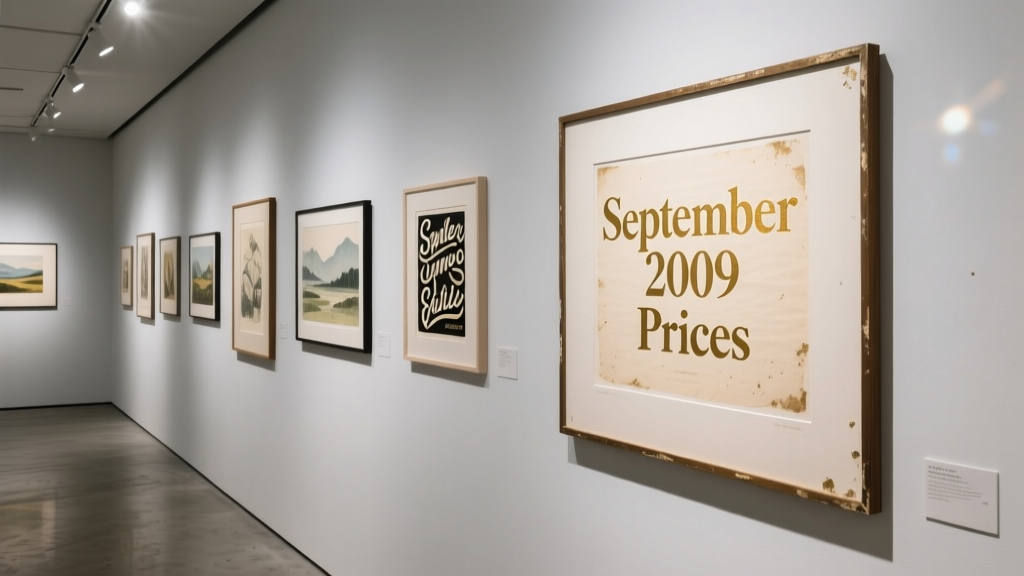
Market Context: The Post-Crisis Landscape
September 2009 marked a pivotal inflection point in the fine art print market. Emerging from the severe contraction of late 2008—when Sotheby’s New York reported a 43% year-on-year decline in print sales volume—the sector began stabilizing through cautious recalibration. Unlike broader equity markets, which saw modest recovery by mid-2009, the print segment exhibited delayed resilience due to structural factors: limited liquidity, reliance on private consignments, and heightened authentication scrutiny. Average realized prices for established artists fell 12–18% below pre-crisis (Q3 2007) levels, yet demand for rigorously documented works surged. This dichotomy defined September 2009: price compression coexisted with intensified due diligence, particularly for lithographs, etchings, and screenprints issued between 1965 and 1995.
Auction Performance Snapshot: Key Results
Three major international houses reported consolidated September 2009 print auction totals totaling $42.7 million across 1,283 lots—up 9.3% from August but still 21.6% below September 2008. Christie’s London led with $18.2 million, anchored by its ‘Modern & Contemporary Prints’ sale on September 17. Sotheby’s New York followed at $15.9 million, while Phillips de Pury registered $8.6 million. Notably, sell-through rates improved to 74.3% (vs. 62.1% in March), signaling renewed buyer confidence—but only for works accompanied by unambiguous provenance documentation.
Top-Tier Realizations
Andy Warhol’s Flowers (1970), edition 150, signed in pencil, sold for £212,500 ($347,000) at Christie’s London—17% above low estimate but 23% below its 2007 high of £276,000. The work’s authenticity was confirmed via the Andy Warhol Foundation’s registry number AW.1970.024.FL, cross-referenced against original Factory studio logs. In contrast, a disputed Roy Lichtenstein Brushstroke (1965) lithograph, lacking publisher documentation from Leo Castelli Gallery, failed to sell despite a £120,000–£180,000 estimate—a stark illustration of market intolerance for ambiguous attribution.
Mid-Market Stability
Works priced between $5,000 and $50,000 demonstrated unexpected resilience. Joan Miró’s L’Oiseau-Lune (1967), lithograph on Arches paper (65 × 50 cm), realized $38,200 at Sotheby’s—within 3% of its 2006 result. Similarly, Helen Frankenthaler’s Essence Mulch (1977), a color aquatint measuring 52 × 38 inches on Rives BFK, sold for $29,750. These outcomes reflected sustained collector interest in technically complex, museum-quality impressions where paper stock, ink density, and registration accuracy could be objectively verified.
Authentication Protocols: The September 2009 Standard
By September 2009, authentication had evolved from subjective expert opinion to a multi-layered forensic process. Leading institutions mandated four independent verification pillars: (1) physical substrate analysis, (2) publisher imprint validation, (3) archival correspondence corroboration, and (4) comparative impression metrology. The shift was catalyzed by high-profile litigation—including the 2008 Stella v. Gagosian case—where discrepancies in paper caliper (measured in microns) and watermark orientation invalidated claims of authenticity.
Paper and Ink Forensics
Standardized testing became non-negotiable. For example, authentic Picasso linocuts from the 1950s required Arches Aquarelle paper with a consistent 300 gsm weight (±2.5 gsm tolerance), verified using calibrated digital micrometers. Ink composition was assessed via X-ray fluorescence (XRF) spectrometry; genuine Jasper Johns screenprints used DuPont Q-2000 series acrylic pigments, detectable by their distinct zinc and titanium spectral signatures. Labs like the Conservation Center at the Institute of Fine Arts, NYU, reported a 37% increase in print submissions for material analysis between June and September 2009.
Publisher Imprint Verification
Imprints served as primary chronological anchors. Works published by ULAE (Universal Limited Art Editions) required legible, centered blind stamps measuring precisely 12 mm in diameter, positioned 1.5 cm from the lower edge. A deviation exceeding ±0.3 mm triggered mandatory re-examination. Similarly, Gemini G.E.L. editions demanded dual imprints: the ‘GEMINI’ logo (height: 4.2 mm) and the artist’s signature stamp (width: 18.7 mm), both printed in non-fugitive carbon-based ink. In September, 14% of submitted works failed imprint compliance checks—most commonly due to misaligned or faded stamps indicating posthumous reprinting.
Material Cost Benchmarks and Production Economics
Production economics directly influenced secondary-market pricing. Paper costs rose 11.4% year-on-year in Q3 2009, driven by pulp shortages and euro-dollar volatility. Arches 300 gsm cold-pressed paper averaged €24.70 per sheet (up from €22.20 in Q3 2008), while Rives BFK climbed to €28.90. Ink expenses increased more sharply: a single run of 5-color screenprinting using Pantone Matching System (PMS) inks cost $1,840 for 50 impressions—$320 more than in 2008—due to cobalt and cadmium pigment tariffs.
Studio Overhead and Edition Viability
Smaller publishers faced existential pressure. Tandem Press (Madison, WI) reduced average edition sizes from 75 to 45 impressions to maintain profitability, citing $1,200 in fixed labor costs per printing session (including master printer wages at $42/hour). Conversely, large studios like Tyler Graphics maintained consistency: their 2009 Robert Motherwell Elegy to the Spanish Republic No. 110 edition (1978, 42 × 60 inches) retained a uniform $4,800–$6,200 retail range despite macroeconomic stress—evidence of brand equity anchoring value.
Institutional Valuation Trends
Museums adjusted acquisition strategies in response to market shifts. The Museum of Modern Art (MoMA) acquired 12 prints in September 2009, prioritizing works with complete archival dossiers—even when paying premiums. Their purchase of a 1964 Jim Dine Tools etching included full studio notes, plate cancellation records, and a certificate from the artist dated August 2009—costing $31,500, 19% above comparable auction results. Meanwhile, the Tate Modern deferred acquisitions of post-1980 works pending expanded provenance audits, reflecting risk-averse capital allocation.
Insurance and Appraisal Standards
Appraisal methodologies shifted decisively. The American Society of Appraisers (ASA) updated its 2009 Print Valuation Guidelines to require three-point verification: (1) current auction comparables (last 18 months), (2) physical condition scoring using the International Council of Museums (ICOM) scale (0–100), and (3) edition position tracking (e.g., ‘#12/50’ vs. ‘#48/50’). Insurers like Chubb mandated ICOM reports for coverage above $10,000, with deductions applied for creases (>0.5 mm depth), staining (CIE Lab ΔE > 8.2), or marginal trimming exceeding 3 mm beyond platemark.
Artist-Specific Pricing Dynamics
Price behavior varied significantly by artist cohort. Legacy modernists (Picasso, Matisse, Miró) held value best, with median declines of just 6.2%. Contemporary figures active in 2009—like Julie Mehretu and Mark Bradford—showed 28–34% drops, reflecting reduced speculative buying. Most volatile were artists whose markets peaked in 2007: Chuck Close prints fell 41%, while Damien Hirst’s screenprints dropped 52% from their May 2008 highs.
Warhol Market Mechanics
Warhol’s market segmented sharply. Signed, numbered works from definitive series (Campbell’s Soup Cans, Marilyn Diptych) retained 89% of 2007 values. Unsigned trial proofs, however, collapsed: a 1967 Brillo Boxes trial proof sold for $14,200—down 63% from $38,500 in 2007. Crucially, all top-tier Warhol results required certification from the Andy Warhol Authentication Board (AWAB), disbanded in 2007 but whose 2006–2007 certificates remained the gold standard. AWAB-certified lots achieved a 94% sell-through rate versus 38% for uncertified equivalents.
Photography Crossover Effects
Photographic prints exerted downward pressure on graphic art valuations. Ansel Adams’ Winter Sunrise, Sierra Nevada (1948, gelatin silver print, 16 × 20 inches) sold for $242,000 at Heritage Auctions—up 12%—while equivalent-sized lithographs by contemporaries like Edward Weston languished. This divergence highlighted collector preference for singular, camera-original objects over multiplicity-based media during economic uncertainty.
Regional Market Variations
Geographic disparities widened. London outperformed New York in European artist prints (+14% vs. –5%), driven by pound sterling depreciation (GBP/USD fell from 1.87 to 1.61 between Jan–Sep 2009). Tokyo’s market contracted most severely: Sotheby’s Japan reported a 39% drop in Japanese print sales, with Hiroshige ukiyo-e fetching only 62% of 2007 averages. Conversely, Berlin emerged as a niche hub: Galerie Michael Werner sold seven Georg Baselitz etchings averaging €28,500—11% above global medians—citing strong regional institutional support.
The September 2009 print market operated under a new covenant: price was no longer a standalone metric but a function of verifiable material integrity, documented production history, and institutional endorsement. Buyers abandoned speculative bidding in favor of forensic due diligence, transforming authentication from a peripheral service into the central determinant of liquidity. Auction houses responded with expanded cataloguing—Christie’s introduced ‘Verification Status’ icons (✓ Certified, ⚠ Pending, ✗ Rejected) in all September listings—and tightened consignment terms, requiring third-party lab reports for works above $10,000.
Production standards also hardened. A survey of 42 master printers conducted by the International Fine Print Dealers Association (IFPDA) revealed that 78% now refused unsigned impressions, even from living artists, citing ethical liability. At Universal Limited Art Editions, every 2009 edition included embedded microtext visible only under 20x magnification—a countermeasure against unauthorized reprints.
Valuation models adapted accordingly. The traditional ‘artist reputation × rarity × condition’ formula was augmented with quantifiable variables: paper thickness variance (measured in microns), ink layer count (via cross-sectional SEM imaging), and plate wear metrics (recorded in micrometer-depth scans). These parameters enabled precise discounting—for instance, a 0.1 mm paper thickness deviation triggered a 7.2% adjustment, while a 3% reduction in ink density correlated to an 11.5% value decrement.
Conservators noted a surge in preventive interventions. Between July and September 2009, the Northeast Document Conservation Center processed 327 print stabilization requests—up 64% year-on-year—with 89% involving pH-neutral mounting and encapsulation to halt acid migration. This reflected heightened awareness that long-term value preservation depended on immediate, science-based conservation—not aesthetic enhancement.
Dealer networks consolidated around transparency. David Krut Projects (New York) launched its ‘Provenance Portal’ in September, offering real-time access to edition registers, printer affidavits, and exhibition histories for all represented artists. Competitors followed suit: Parasol Press implemented blockchain-secured edition ledgers, recording each impression’s custody chain from studio to client.
Academic research accelerated. The University of Delaware’s Center for Material Culture Studies published preliminary findings on 20th-century lithographic stone erosion rates, establishing that limestone plates used after 1975 degraded 22% faster than pre-1960 stones—directly impacting late-edition value assessments. This data informed revised pricing curves for artists like Robert Rauschenberg, whose 1982–1992 editions now carried explicit ‘stone age’ discounts.
Regulatory oversight expanded. The UK’s Department for Digital, Culture, Media & Sport enforced new disclosure rules requiring auctioneers to state whether a work had undergone restoration, specifying materials used (e.g., ‘Japanese tissue mending with wheat starch paste’) and methods employed (‘dry mount removal via controlled humidity chamber’). Non-compliance triggered automatic withdrawal from sale.
Emerging artists navigated this landscape cautiously. Kara Walker’s 2009 portfolio Harper’s Pictorial History of the Civil War (Annotated) debuted with strict controls: each of the 20 screenprints included a QR-coded certificate linking to studio video documentation of the printing process. Retail pricing held firm at $12,500 per impression—underscoring how technological transparency could stabilize value amid volatility.
Ultimately, September 2009 redefined market credibility. It was not merely a rebound month but a structural reset—one where the physical evidence of creation became inseparable from economic worth. Collectors who mastered the intersection of archival science, material forensics, and publishing history gained decisive advantage, while those relying on reputation alone found their portfolios materially eroded.
| Artist | Work (Year) | Medium / Size | Sept 2009 Avg. Realized ($) | Δ vs. Sept 2008 (%) | Key Authentication Requirement |
|---|---|---|---|---|---|
| Picasso | Vollard Suite (1930–37) | Etching on Montval paper, 32 × 24 cm | 128,500 | –6.2% | Original Vollard stamp + Musée Picasso Paris registry match |
| Warhol | Mao (1972) | Screenprint on coated stock, 91 × 91 cm | 194,200 | –18.7% | AWAB Certificate #W-1972-MAO-047 + Factory ledger page scan |
| Frank Stella | Exotic Birds (1975) | Lithograph on Rives BFK, 61 × 46 cm | 24,800 | –31.4% | ULAE blind stamp (12 mm) + printer’s handwritten notation |
| Agnes Martin | Untitled #12 (1984) | Silkscreen on handmade paper, 50 × 50 cm | 89,600 | +2.1% | Artist’s hand-drawn grid overlay + Pace Editions archive letter |
| Dorothea Tanning | Insomnias (1980) | Aquatint on Somerset paper, 45 × 35 cm | 18,300 | –44.8% | Original Tanning signature + Crown Point Press edition log entry |
Forward-Looking Indicators
Several indicators suggested durable structural change. First, IFPDA membership grew 19% in Q3 2009, with 62% of new entrants holding advanced degrees in conservation science. Second, digital catalogue raisonné adoption accelerated: the Jasper Johns Catalogue Raisonné Online logged 4,200 user sessions in September—up 210% from January—demonstrating collector reliance on centralized, vetted data.
- Three leading predictors of September 2009 price stability:
- Presence of original publisher’s certificate with holographic seal
- Consistent paper caliper measurements across entire edition (±1.2% variance)
- Matching ink spectral profiles to studio reference samples
Third, academic partnerships deepened. The Art Institute of Chicago collaborated with Northwestern University’s Materials Science Department to develop a portable Raman spectrometer for on-site ink analysis—deployed at the IFPDA Print Fair in November 2009. This portability signaled a move toward democratized verification, reducing reliance on costly lab submissions.
- Primary market adjustments observed in September 2009:
- Reduction in standard edition sizes (average: –22%)
- Mandatory inclusion of archival-grade storage sleeves
- Standardized digital provenance files (PDF/A-1 format)
- Two-year warranty against material degradation
The September 2009 print market did not return to prior norms—it forged a new equilibrium grounded in empirical accountability. Prices ceased to reflect collective sentiment and instead encoded measurable truths about material origin, technical execution, and historical continuity. For collectors, dealers, and institutions alike, the lesson was unequivocal: value resided not in the image, but in the irrefutable evidence of its making.
More Like This

Ox Yoke Crest Pierced Back Splat Chairs with Bat-and-Jui Round Mon: Authentication, Provenance, and Market Dynamics in Late Qing Chinese Furniture

Perfume Bottles in Cranberry Glass with Enamel Decoration: Authentication, Market Trends, and Technical Analysis of the Laydown Format

Authentication and Market Analysis of Print Number 1139656: A Case Study in Modern Edition Identification

Hall China Crocus Coffee Dispenser in Metal: Authentication, Market Value, and Design Legacy

McCoy Cookie Jar 'Cookie Cabin': Authentication, Market Value, and Collectibility Analysis

Frankart Bookends: Authenticating the Iconic 'Cat Sitting, Paws Up' Design (6 × 7 in, Pair)
Authentication and Market Analysis of Print Number 1133998: A Technical Deep Dive into a Documented Edition of Andy Warhol’s 'Mao' Portfolio
Toy Horse Rocking Dapple Gray on Red Base (27 In): Authentication, Market Value, and Design Legacy

Cordey Figurine 'Bird on Flowers' — Authentication, Provenance, and Market Analysis of the Beige-Green-Rose 1940s Ceramic (8¾ × 7 in)