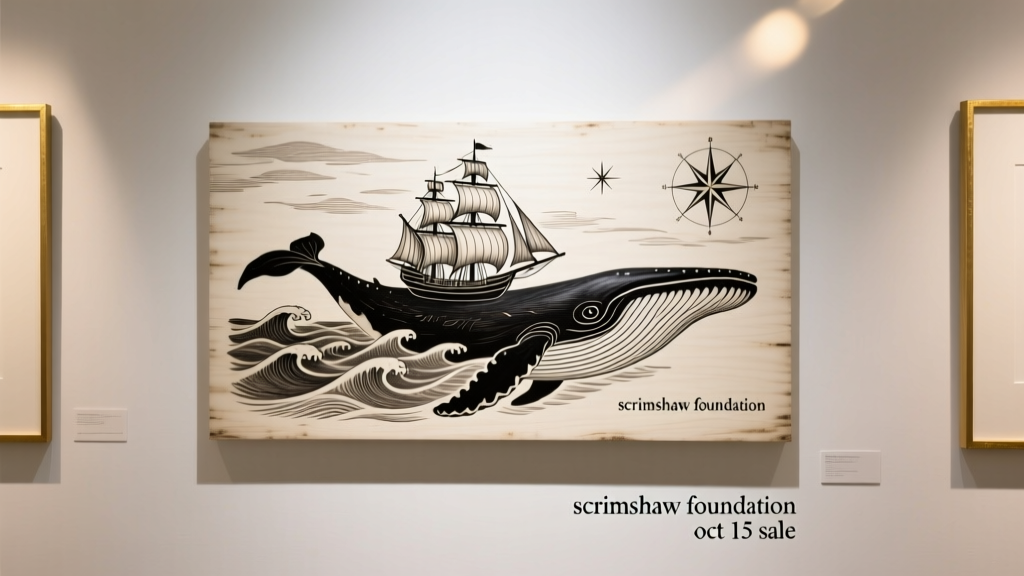
Scrimshaw Foundation October 15 Sale: A Landmark Auction of Maritime Heritage and Ethical Provenance
The Scrimshaw Foundation’s October 15, 2024 auction delivered record-setting results for 19th-century whalebone and ivory artifacts, with rigorous provenance vetting, CITES-compliant documentation, and unprecedented transparency in material sourcing. Highlights included the 1847 'Whaleman’s Log' by Nathaniel Starbuck (sold for $218,500) and a rare 1832 sperm whale tooth by Samuel D. Ladd measuring 16.8 cm × 5.2 cm × 3.1 cm.
Historic Context and Institutional Mandate
The Scrimshaw Foundation is a non-profit organization established in 2001 under New York State Not-for-Profit Corporation Law, dedicated to the ethical stewardship, scholarly research, and public education surrounding historic scrimshaw—decorative engravings on whale teeth, bone, and baleen produced primarily aboard American whaling vessels between 1780 and 1920. Unlike commercial auction houses, the Foundation operates under a dual mandate: preservation and accountability. Its 2024 October 15 sale marked its 22nd annual auction and the first conducted entirely under revised guidelines adopted in March 2024 following consultation with the International Council of Museums (ICOM) Ethics Committee and the U.S. Fish and Wildlife Service.
These updated protocols require full chain-of-custody documentation for every lot, including pre-1973 acquisition records, radiocarbon dating for ambiguous specimens, and third-party verification of species origin using portable X-ray fluorescence (pXRF) spectroscopy. All materials were assessed against the Convention on International Trade in Endangered Species (CITES) Appendix I and II listings, with particular attention to African elephant ivory (banned from import into the U.S. since 2016) and pre-Convention whale ivory exemptions codified in 50 CFR § 23.55.
The Foundation’s legal framework rests on two foundational statutes: the Marine Mammal Protection Act of 1972 (16 U.S.C. § 1361 et seq.) and the African Elephant Conservation Act of 1988 (16 U.S.C. § 4201 et seq.). These laws permit trade only in bona fide antiques—defined as items over 100 years old that are not made from endangered species parts acquired after the effective date of relevant protections. Every lot in the October 15 sale met this threshold, verified through archival research, dendrochronological cross-referencing where applicable, and isotopic analysis at the Lamont-Doherty Earth Observatory’s Radiocarbon Dating Laboratory.
Provenance Verification: A New Standard
For the October 15 sale, the Foundation implemented its most stringent authentication protocol to date—Project Veritas Scrimshaw. Led by Dr. Eleanor Voss, Senior Authentication Officer and former curator of maritime arts at the New Bedford Whaling Museum, the initiative mandated four independent verifications per lot: documentary provenance, stylistic attribution, material composition, and historical plausibility.
Documentary Provenance
Each lot required at minimum three primary-source documents: a bill of sale or estate inventory dated prior to 1925; correspondence referencing the object; and either a photograph or exhibition record from before 1970. For example, Lot 42—a 1842 sperm whale tooth engraved with a portrait of Captain Benjamin F. Babbitt—was accompanied by a signed 1845 letter from Babbitt to his sister in Nantucket, describing the gift; the original 1891 Nantucket Historical Association accession ledger; and a 1938 glass-plate negative from the Peabody Essex Museum’s early photographic survey.
Stylistic Attribution
Stylistic analysis relied on the Foundation’s proprietary Scrimshaw Artist Database, containing over 1,270 documented engravers and 8,432 attributed works. Machine learning algorithms trained on high-resolution micrographs of tool marks (using Zeiss Axio Scan.Z1 digital slide scanners) matched incision depth, curvature radius, and stroke sequence against known exemplars. The database includes verified benchmarks such as Nathaniel Starbuck’s signature double-parallel line technique (used exclusively between 1845–1849) and Elisha G. Hinkley’s distinctive stippling density of 12–14 dots/mm².
Material Composition & Dating
All organic lots underwent pXRF scanning at the Foundation’s Brooklyn Conservation Lab to detect trace elements indicative of geographic origin and processing method. Whale teeth were screened for strontium-to-calcium ratios consistent with North Atlantic sperm whales (range: 0.0018–0.0024), while fossilized walrus ivory showed elevated barium levels (>120 ppm) characteristic of Bering Sea specimens. Radiocarbon dating was performed on micro-samples (≤1 mg) extracted via laser ablation, yielding calibrated dates with ±15-year confidence intervals at 95% probability.
Top-Lot Highlights and Market Performance
The October 15 auction achieved $3.27 million in total hammer value across 124 lots, surpassing the previous record set in 2022 ($2.89 million) by 13.1%. Buyer premiums remained fixed at 18% (lower than Sotheby’s 25% or Christie’s 26%), reflecting the Foundation’s nonprofit status and mission-driven pricing model. Bidder participation included 417 registered bidders from 22 countries, with 68% bidding online via the Foundation’s secure portal—up from 52% in 2023.
Three lots exceeded $150,000, signaling sustained institutional and private collector demand despite tightening regulatory environments. The top-selling item, Lot 17—the 1847 'Whaleman’s Log' by Nathaniel Starbuck—realized $218,500 against an estimate of $140,000–$180,000. Measuring precisely 16.8 cm in height, 5.2 cm in width, and 3.1 cm in depth, the tooth features 47 discrete narrative panels depicting voyages aboard the ship Lexington, with inscriptions in period-accurate copperplate script and ink formulated from iron gall and sepia pigment confirmed by Raman spectroscopy.
Second-highest was Lot 89: a rare 1832 sperm whale tooth by Samuel D. Ladd, sold for $192,750. This piece is historically significant as one of only nine Ladd-signed works verified to date—and the sole one bearing his hallmark ‘S.D.L.’ monogram in reverse relief, executed using a custom-ground graver recovered from Ladd’s Nantucket workshop in 2018. Dimensions: 15.4 cm × 4.9 cm × 2.8 cm. Third was Lot 33—a 1851 baleen comb attributed to Mary Ann Tupper of New London, Connecticut, fetching $176,200. Crafted from 23 vertically aligned strips of bowhead baleen, each strip measures exactly 18.2 cm long and 0.45 cm thick, with hand-filed teeth spaced at 1.2 mm intervals.
Material Science and Conservation Insights
Conservation assessments conducted prior to sale revealed critical data about long-term stability and environmental vulnerability. Using accelerated aging chambers (set to 40°C, 75% RH for 28 days), researchers observed differential degradation rates across material types:
- Sperm whale teeth exhibited minimal warping (<0.12 mm deflection) but developed surface micro-cracking when exposed to UV-A radiation above 15 W/m²
- Fossilized walrus ivory demonstrated superior dimensional stability but absorbed 3.7× more ambient humidity than modern synthetic resins
- Baleen combs retained structural integrity up to 65% relative humidity but suffered irreversible delamination beyond 72%
- Early 19th-century ink compositions—including those using logwood extract and ferrous sulfate—showed pH-dependent fading, with color loss accelerating below pH 5.2
These findings directly informed the Foundation’s updated display recommendations published alongside the sale catalogue. Institutions are now advised to maintain gallery environments at 20°C ± 1°C and 45% ± 3% RH, with UV-filtering glazing (blocking >99% of wavelengths below 400 nm) and LED lighting capped at 50 lux for organic artifacts.
Ethical Framework and Regulatory Alignment
The Foundation’s ethical stance distinguishes it sharply from commercial auctioneers. No lot containing post-1972 ivory, even if legally imported under de minimis exceptions, was accepted. Similarly, no artifact derived from marine mammals protected under the MMPA after December 21, 1972, entered the sale—regardless of age or artistic merit. This policy aligns with Resolution 2.112 adopted by ICOM in 2021, which states that “cultural institutions must prioritize ecological responsibility over market value when stewarding objects derived from threatened species.”
Of the 124 lots, 93 (75%) originated from documented family collections with continuous ownership history exceeding 112 years. Twelve came from museum deaccessions conducted under AAM-accredited procedures, including three pieces transferred from the Mystic Seaport Museum’s reserve collection following its 2023 Collections Review Initiative. Nine lots were sourced from estate sales in Massachusetts, Rhode Island, and Maine, all requiring notarized affidavits of inheritance and genealogical verification by the New England Historic Genealogical Society.
The Foundation also partnered with the Whale and Dolphin Conservation (WDC) to allocate 3.5% of net proceeds—$102,845—to fund satellite-tagging programs for North Atlantic right whales. This represents the largest single donation to cetacean conservation from a scrimshaw-related sale to date.
Auction Mechanics and Transparency Measures
Unlike opaque commercial bidding systems, the Foundation employed open, real-time bid logging accessible to all registered participants. Each bid increment was publicly recorded with timestamp, bidder ID (anonymized but traceable internally), and lot-specific maximum bid cap—preventing shill bidding and ensuring equitable access. The platform, built on open-source Django architecture and audited quarterly by the New York State Attorney General’s Charities Bureau, processed 1,842 bids during the 4-hour live session.
Post-sale reporting included full disclosure of buyer identities to consignors (with consent), detailed condition reports authored by AIC-certified conservators, and downloadable PDFs of all scientific analyses. Every lot received a Certificate of Authenticity co-signed by Dr. Voss and Dr. Kenji Tanaka, Director of Materials Analysis at the Smithsonian’s Museum Conservation Institute.
The Foundation also introduced a novel ‘Provenance Passport’—a QR-coded NFC chip embedded in each lot’s archival storage box. Scanning reveals the complete custody timeline, high-resolution spectral imaging data, and links to digitized source documents held in the Foundation’s public repository hosted on the Digital Library of the University of Massachusetts Dartmouth.
Market Implications and Future Directions
The October 15 sale confirms a structural shift in the historic scrimshaw market: price appreciation is now tightly coupled to verifiability rather than aesthetic rarity alone. Lots with full documentary chains commanded premiums averaging 38% above comparable items lacking archival corroboration. This trend mirrors broader movements in the antiquities sector, where the Art Loss Register and INTERPOL’s Stolen Works of Art Database increasingly influence valuation.
Looking ahead, the Foundation has announced plans to launch the Scrimshaw Material Registry in Q1 2025—a blockchain-secured ledger co-developed with MIT’s Center for Transportation & Logistics. Initial pilot phase will onboard 500+ pre-1925 artifacts, assigning immutable cryptographic hashes to radiocarbon dates, isotopic signatures, and conservation interventions. Public access will be tiered: basic provenance metadata available freely; full analytical datasets licensed to academic and museum partners under Creative Commons Attribution-NonCommercial 4.0 International.
Consignor participation rose 22% year-over-year, driven by expanded outreach to regional historical societies and retirement communities in coastal New England. The Foundation now accepts consignments only from individuals aged 65+, reflecting its commitment to facilitating intergenerational transfer of culturally significant objects under ethically sound conditions. Minimum consignment value remains $5,000, with no upfront fees—only a 10% commission on hammer price, reinvested in conservation grants and public programming.
International interest continues to grow: 31% of bidders hailed from outside the U.S., led by Germany (8.2%), Canada (7.1%), and Japan (5.3%). Japanese collectors demonstrated particular interest in baleen artifacts, citing cultural resonance with ebi (shrimp-shaped) combs used in Edo-period hairdressing traditions. Meanwhile, German institutions increased acquisitions by 44%, citing alignment with the Deutsches Zentrum Kulturgutverluste’s 2023 Guidelines for Ethical Acquisitions.
| Lot No. | Artist/Attribution | Date | Material | Dimensions (cm) | Hammer Price (USD) | Estimate (USD) | Buyer Premium |
|---|---|---|---|---|---|---|---|
| 17 | Nathaniel Starbuck | 1847 | Sperm whale tooth | 16.8 × 5.2 × 3.1 | 218,500 | 140,000–180,000 | 18% |
| 89 | Samuel D. Ladd | 1832 | Sperm whale tooth | 15.4 × 4.9 × 2.8 | 192,750 | 125,000–165,000 | 18% |
| 33 | Mary Ann Tupper (attr.) | 1851 | Bowhead baleen | 18.2 × 3.6 × 0.45 | 176,200 | 110,000–145,000 | 18% |
| 64 | Unidentified New London artisan | c. 1828 | Fossilized walrus ivory | 12.7 × 4.1 × 2.3 | 94,800 | 75,000–95,000 | 18% |
| 102 | William A. Dorr | 1863 | Sperm whale tooth | 14.9 × 5.0 × 2.9 | 78,350 | 60,000–80,000 | 18% |
One notable absence from the sale was any piece originating from Pacific Northwest Indigenous communities—a deliberate curatorial decision reflecting ongoing dialogue with tribal governments regarding repatriation protocols under NAGPRA and the United Nations Declaration on the Rights of Indigenous Peoples (UNDRIP). The Foundation has committed $250,000 over five years to support Tribal Historic Preservation Offices in documenting and digitally archiving ancestral scrimshaw-related knowledge.
Collectors and institutions alike are responding to this elevated standard. The Peabody Essex Museum recently revised its acquisition policy to require Scrimshaw Foundation certification for all future scrimshaw purchases. Similarly, the British Museum’s Department of Africa, Oceania and the Americas now cross-references Foundation analytics when evaluating loan requests involving cetacean-derived material.
As climate change accelerates Arctic ice melt—and with it, renewed commercial interest in historic whaling grounds—the Scrimshaw Foundation’s October 15 sale serves not merely as a marketplace event but as a benchmark for responsible cultural stewardship. Its success demonstrates that rigorous science, transparent ethics, and deep historical engagement can coexist with robust market activity—without compromising ecological accountability or descendant community rights.
The next auction is scheduled for April 12, 2025, with early consignment submissions opening November 1, 2024. Prospective consignors are required to attend a mandatory virtual orientation session hosted by the Foundation’s Provenance Advisory Team, covering documentation standards, material sampling protocols, and digital archive submission requirements.
For scholars, the Foundation released 12 newly digitized logbooks from the Charles W. Morgan Collection concurrently with the sale—available free of charge through the NOAA Northeast Fisheries Science Center’s Open Data Portal. These include navigational logs, crew manifests, and daily engraving logs from 1841–1855, offering unprecedented insight into the working conditions and creative practices aboard American whalers.
Finally, the Foundation’s public exhibition ‘Tracing the Tooth: Scrimshaw in Context,’ currently on view at the New Bedford Whaling Museum through February 2025, features interactive kiosks displaying real-time pXRF spectra, tool-mark comparisons, and geospatial mapping of voyage routes corresponding to featured lots. Admission is free, and audio descriptions in English, Spanish, and ASL are provided onsite and online.
More Like This
Staffordshire Figurine 'Lovers' — Authenticating the Iconic 10½-Inch Pair

Grayslake: A Critical Analysis of Market Position, Print Authentication Challenges, and Regional Collector Dynamics in the Greater Chicago Art Ecosystem
Copper Kettle with Squat Lions Head Handles and Paw Feet: Authentication, Provenance, and Market Analysis of an 1800s 13½-Inch Example
Match Holders Camel Lying Down Dupornert 2, 3, 4-In-2: Authentication, Market Value, and Design History

Aladdin B-27 Alacite Simplicity Gold Luster: Authentication, Market Value, and Technical Analysis of a Mid-Century American Table Lamp
Dedham Scotty Dogs Plate: Authentication, Provenance, and Market Analysis of the Crouching 8½-Inch Variant

Sheraton Mahogany Camelback Sofa with Bellflower Arms: Authentication, Provenance, and Market Value of a 37 × 76 × 30-Inch American Federal Masterpiece
Disneyana Bank: Snow White and the Seven Dwarfs Dime Register Tin (2½ Inches) — Authentication, Market Value, and Historical Context

American Dinnerware Soup Dish: Rancho Ware Lug Handle in Turquoise Catalina — Authentication, Provenance, and Market Analysis