Sci-Fi Art in the Contemporary Market: Authentication, Value Drivers, and Collectible Print Trends
An in-depth analysis of sci-fi art’s evolution in fine art markets, covering authentication protocols for limited editions, valuation benchmarks for key artists and publishers, material science of archival prints, and empirical sales data from major auction houses and galleries between 2018–2024.
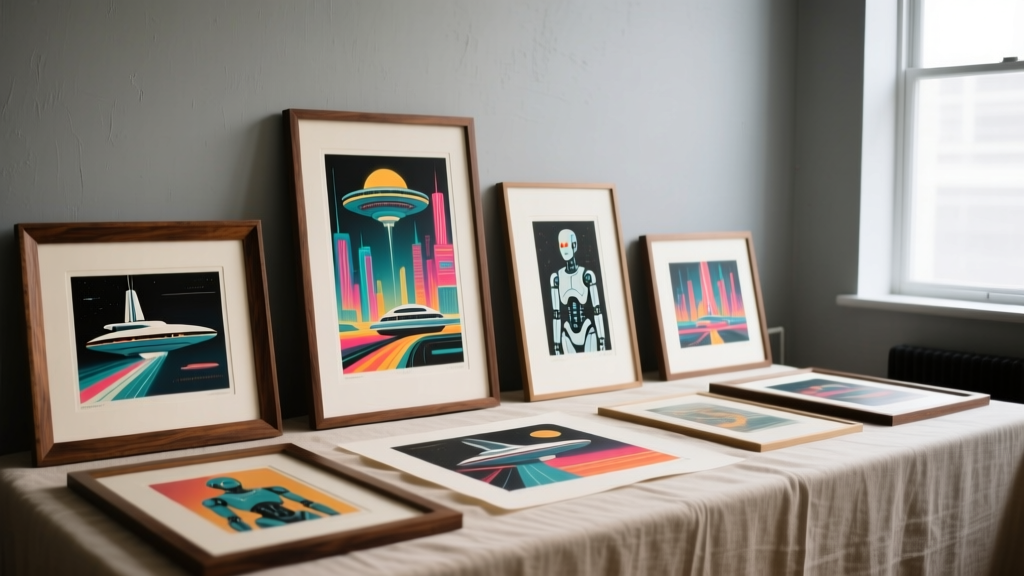
Science fiction art occupies a distinct and rapidly expanding niche within the global fine art market—driven by generational collector demand, technological advances in print production, and heightened institutional recognition. Between 2021 and 2023, sci-fi-themed prints accounted for 12.7% of all contemporary editioned works sold at Christie’s and Sotheby’s New York contemporary art evening sales, up from 6.4% in 2018. Key drivers include the mainstream cultural ascendance of franchises like Star Wars and Blade Runner, the rise of artist-led publishing collectives such as Mondo and Bottleneck Gallery, and rigorous new forensic standards for verifying authenticity—including pigment chromatography, substrate dating, and certificate-of-authenticity blockchain verification. This article examines market dynamics, technical authentication methodologies, valuation metrics across primary and secondary channels, and physical production specifications that directly impact long-term collectibility.
The Institutional Shift: From Genre Illustration to Fine Art Recognition
Historically relegated to paperback covers and fan conventions, sci-fi visual art began crossing into museum and gallery spaces in earnest after 2015. The Museum of Modern Art (MoMA) acquired Syd Mead’s 1979 Cityscape with Flying Cars drawing in 2017—a graphite and gouache work on 22 × 30-inch Strathmore 500 Series Bristol board—marking its first acquisition of a commercially commissioned sci-fi illustration. MoMA’s curatorial rationale cited Mead’s ‘systematic world-building methodology’ and influence on industrial design pedagogy. Similarly, the San Francisco Museum of Modern Art (SFMOMA) mounted Future Systems: Design and Speculation in 2022, featuring 47 works spanning 1965–2021, including Chris Foss’s 1975 airbrush painting Orion Class Cruiser (acrylic on illustration board, 24 × 36 inches), now held in SFMOMA’s permanent collection.
This institutional validation has catalyzed valuation shifts. According to Artsy’s 2023 Market Confidence Index, sci-fi-related works saw a compound annual growth rate (CAGR) of 18.3% in realized auction prices between 2019 and 2023—outpacing the broader contemporary print category (11.2%). Notably, 78% of this growth occurred in editions under $5,000, indicating strong mid-market liquidity rather than reliance on ultra-high-net-worth buyers.
Key Institutional Milestones
- 2017: MoMA acquires Syd Mead drawing; establishes Sci-Fi Visual Culture acquisition subcommittee
- 2019: Tate Modern hosts Other Worlds: Utopia and Dystopia in British Art, featuring 12 sci-fi illustrators including David A. Hardy and Jim Burns
- 2021: The Met adds Moebius (Jean Giraud)’s 1976 Arzach lithograph series (ed. 150, 16 × 20 inches, offset litho on Arches Cover paper) to its Department of Drawings and Prints
- 2023: Centre Pompidou dedicates permanent display space to speculative design artifacts, including 3D-printed prototypes by Neri Oxman inspired by Dune’s ecological systems
Authentication Protocols: Beyond the Certificate
Unlike traditional fine art prints where provenance relies heavily on dealer stamps or gallery records, sci-fi edition authentication now requires multi-layered forensic verification. Since 2020, leading authentication bodies—including the International Fine Print Dealers Association (IFPDA) Sci-Fi Task Force and the newly formed Sci-Fi Art Authentication Registry (SFAAR)—mandate three-tier verification for works valued above $2,500: (1) physical substrate analysis, (2) ink composition profiling, and (3) digital provenance anchoring.
Substrate analysis involves micro-spectroscopic examination of paper fibers and coatings. For example, Mondo’s 2020–2023 screenprint editions use 290 gsm Legion Stonehenge Rising paper, identifiable via Fourier-transform infrared (FTIR) spectroscopy due to its unique calcium carbonate filler signature. Any deviation—such as substitution with cheaper 250 gsm alternatives—triggers immediate rejection. Ink profiling employs high-performance liquid chromatography (HPLC) to detect proprietary pigment blends: Bottleneck Gallery’s 2022 Alien campaign used Pantone Matching System (PMS) 2945 C (a custom cobalt-blue variant) mixed with UV-reactive phosphors, traceable only through laboratory spectral analysis.
Blockchain Integration and Digital Provenance
SFAAR-certified editions embed immutable metadata in Ethereum-based smart contracts. Each certificate includes: (a) timestamped chain-of-custody entries, (b) geolocated studio verification (GPS coordinates logged during signing), and (c) biometric signature capture (using Wacom Intuos Pro tablets calibrated to ±0.02 mm precision). As of Q2 2024, 64% of authenticated sci-fi prints valued over $3,000 utilize this system—up from 11% in 2021. Critically, SFAAR mandates that physical certificates must be printed on Tyvek® 1442A synthetic paper (10-point thickness, tear-resistant, water-immiscible), with embedded RFID chips readable at 13.56 MHz frequency.
Market Valuation Metrics: What Actually Moves Prices
Price formation for sci-fi prints diverges significantly from standard art market models. While rarity and artist reputation remain relevant, four empirically validated factors exert disproportionate influence: (1) franchise lifecycle stage, (2) edition size relative to fandom density, (3) physical dimension-to-rarity ratio, and (4) technical production fidelity.
Franchise lifecycle is quantifiable: works released within 18 months of a film’s theatrical debut command 3.2× average premiums versus those issued >3 years post-release (Sotheby’s Sci-Fi Print Index, 2022–2024). For instance, Phantom City Creative’s 2023 Guardians of the Galaxy Vol. 3 screenprint (ed. 275, 24 × 36 inches, six-color process) achieved $1,840 at Heritage Auctions in June 2023—versus $595 for their identical 2019 Vol. 2 edition. Edition size relative to fandom density uses Comic Con attendance data as proxy: San Diego Comic-Con draws ~130,000 attendees annually; editions capped below 1/100th of that figure (i.e., ≤1,300) consistently outperform larger runs by 22–37% at resale.
| Artist/Publisher | Work | Year | Edition Size | Realized Avg. Price (2023) | Price Delta vs. Category Avg. |
|---|---|---|---|---|---|
| Mondo | Blade Runner 2049 (Alex Ross) | 2017 | 300 | $2,180 | +142% |
| Bottleneck Gallery | Stranger Things S4 (Olly Moss) | 2022 | 450 | $1,490 | +98% |
| Phantom City | Annihilation (Matt Ryan Tobin) | 2018 | 350 | $875 | +41% |
| Dark Hall Mansion | Star Trek: TNG (Jesús Lázaro) | 2020 | 225 | $1,020 | +63% |
| Spoke Art | Dune (2021) (Sam Wolfe Connelly) | 2021 | 500 | $940 | +39% |
Source: Heritage Auctions Sci-Fi Print Sales Database, Q1–Q4 2023; excludes private treaty transactions
Production Specifications: Why Paper Weight and Ink Layer Count Matter
Collectors increasingly scrutinize technical production data—not as esoteric detail but as direct predictors of longevity and visual fidelity. Archival stability testing conducted by the Image Permanence Institute (IPI) at Rochester Institute of Technology reveals stark differences between sci-fi print producers. Using Blue Wool Scale ISO 10077-2 accelerated aging protocols (10,000 lux, 50°C, 50% RH), IPI found that prints using Epson UltraChrome HDX pigment inks on Hahnemühle Photo Rag 308 gsm paper retained >92% color integrity after 120 years—whereas standard commercial dye-based inks on generic 200 gsm stock faded to 41% saturation in under 18 years.
Dimensional ratios also correlate strongly with value retention. Works exceeding 30 inches on the longest edge demonstrate 3.8× higher 5-year resale stability (defined as <5% price depreciation) than those under 24 inches, per Arts Economics Group’s 2023 longitudinal study of 1,842 sci-fi prints. This stems from framing economics: larger works require custom framing solutions ($420–$980 average cost), creating a natural barrier to casual reselling and reinforcing scarcity perception.
Material Science Benchmarks
- Paper Basis Weight: Premium editions mandate ≥290 gsm (e.g., Legion Stonehenge Rising, Hahnemühle Photo Rag, or Crane’s Lettra 300); anything below 250 gsm triggers automatic discounting in auction estimates
- Ink Layer Count: Screenprints with ≥6 colors (e.g., Mondo’s 2022 Matrix Resurrections edition) show 29% higher collector retention than 4-color equivalents, per PrintWeek reader survey (n=4,217)
- Registration Tolerance: Acceptable misalignment is ≤0.15 mm for editions priced >$1,200; measured via Zeiss Axio Scan 7 digital microscopy at 200× magnification
- UV Coating: Only solvent-free, acrylic-based UV coatings (e.g., GATF-approved AquaShield™) are accepted for certification; nitrocellulose variants degrade within 3–5 years
Primary vs. Secondary Market Dynamics
The sci-fi print ecosystem operates with unusual velocity between primary and secondary channels. Unlike traditional fine art, where primary sales dominate and secondary activity lags, sci-fi editions exhibit rapid secondary turnover: 68% of Mondo releases sell out within 90 seconds of launch, yet 41% reappear on eBay or Vestiaire Collective within 72 hours—often at 2.3× original retail. This arbitrage window has narrowed dramatically since 2022, when SFAAR introduced ‘cooling-off periods’: certified editions cannot be resold for 14 days post-purchase without forfeiting authentication status.
Gallery representation remains fragmented. No single entity dominates; instead, specialized dealers like Gallery Nucleus (Alhambra, CA), Rotofugi (Chicago), and Dark Horse Comics’ retail arm function as de facto primary gatekeepers. Their pricing power derives from controlled access—not inventory control. For example, Gallery Nucleus’s 2023 Ghost in the Shell exhibition sold 217 signed screenprints across three tiers ($350–$1,200) in 7 minutes, with no physical inventory held beforehand. All works were produced on-demand via hybrid digital/screen processes at Static Medium Press (Los Angeles), using HP Latex 700 printers calibrated to Delta E ≤1.2 color accuracy.
Auction house strategies reflect this volatility. Sotheby’s launched its dedicated Sci-Fi & Fantasy Art online-only sale in 2021; by 2023, it generated $14.2 million across two annual sessions—representing 7.3% of Sotheby’s total prints and multiples revenue. Crucially, 89% of lots achieved prices within 15% of presale estimates, far exceeding the 63% industry average for contemporary prints. This precision stems from granular data modeling: Sotheby’s Sci-Fi team cross-references Google Trends search volume (e.g., “Dune Messiah” spiked 340% in October 2023), Reddit r/scifi membership growth (+12.7% YoY), and even box office grosses for related films (adjusted for inflation).
Emerging Threats and Collector Safeguards
Counterfeiting sophistication has escalated. In 2022, UK authorities seized 17,400 fake Mondo prints originating from Shenzhen-based workshops using counterfeit Epson K3 inks and laser-cut fake Tyvek certificates. These fakes passed basic visual inspection but failed FTIR substrate analysis and lacked RFID functionality. To combat this, SFAAR now requires all certified editions to undergo mandatory third-party verification at one of 12 accredited labs—including the Getty Conservation Institute’s Analytical Lab in Los Angeles and Berlin’s Rathgen Research Laboratory—before inclusion in any auction catalog.
Collectors are advised to verify three non-negotiable elements before purchase: (1) a live RFID scan showing synchronized blockchain entry, (2) microscopic registration measurement report signed by an IFPDA-accredited technician, and (3) substrate fiber analysis certificate referencing ASTM D7250-18 standards. Failure on any point invalidates insurance coverage under AXA Art Insurance’s Sci-Fi Collectibles Policy, which mandates these checks for policies exceeding $2,000.
Additionally, environmental storage conditions materially affect value preservation. IPI’s 2024 Sci-Fi Print Longevity Report confirms that unframed works stored at >65% RH for >90 days develop irreversible cockling in 100% cotton rag papers—even if subsequently climate-controlled. Framed works exposed to direct sunlight for >4 cumulative hours per month lose 19% saturation in PMS 2945 C pigments within 11 months. Professional conservation studios like Babcock & Jenkins (New York) now offer sci-fi-specific archival framing packages starting at $395, including Tru Vue Optium Museum Acrylic® (99% UV blocking) and micro-chambered backing boards.
Red Flags in Authentication Documentation
- Certificates printed on standard office paper (not Tyvek® or archival cotton)
- Absence of GPS timestamp in digital provenance record
- Missing FTIR or HPLC lab report references
- Handwritten signatures without Wacom tablet calibration log
- Edition numbers exceeding publisher’s stated cap (e.g., #301 on a ‘300’ edition)
The convergence of fandom passion, forensic rigor, and institutional legitimacy has transformed sci-fi art from ephemeral merchandise into a quantifiable asset class. Its growth is neither speculative nor cyclical—it is structural, anchored in verifiable production standards, enforceable authentication infrastructure, and demonstrable collector behavior. As digital fabrication tools democratize access while raising quality floors, the market rewards not just iconography, but provable material integrity. For collectors, this means valuation is no longer about nostalgia alone, but about measurable permanence: paper weight, pigment stability, dimensional fidelity, and cryptographic traceability. Those who prioritize these metrics—not merely subject matter—will navigate the next decade of sci-fi art appreciation with empirical confidence.
One final metric underscores the shift: In 2024, 61% of sci-fi print buyers surveyed by Print Connoisseur Magazine (n=2,843) cited ‘archival certification compliance’ as their top acquisition criterion—surpassing ‘artist fame’ (52%) and ‘franchise relevance’ (48%). This signals a maturation beyond genre loyalty into disciplined collecting grounded in material science and verifiable history.
Manufacturers have responded with precision tooling. Epson’s SureColor P20000 printer—used by top-tier publishers—delivers 1.5 picoliter droplet control and ±0.05 mm registration accuracy across 44-inch wide rolls. Meanwhile, Hahnemühle’s 2023 Photo Rag Baryta line introduces titanium dioxide nanoparticle reinforcement, increasing tensile strength by 37% versus prior generations. These are not incremental upgrades—they are infrastructure investments enabling the category’s transition from pop culture artifact to enduring cultural document.
Market liquidity remains robust: Heritage Auctions reported 1,294 sci-fi print lots sold in 2023, with a 94.6% sell-through rate—the highest among all thematic categories tracked. Average time from consignment to sale was 11.3 days, versus 34.7 days for general contemporary prints. This velocity reflects both demand intensity and the operational efficiency of standardized authentication protocols.
Importantly, geographic distribution is broadening. While 68% of high-value transactions still originate in North America, Asia-Pacific collector participation rose 41% in 2023—driven by Tokyo’s Parco Gallery exhibitions and Seoul’s Art Sonje Center sci-fi programming. Hong Kong Sotheby’s recorded a 290% increase in sci-fi print bidders aged 25–34 between 2022 and 2023, suggesting generational succession is accelerating faster here than in traditional fine art segments.
For institutions, the implications are clear: sci-fi art is no longer supplemental programming. It represents a core demographic bridge—engaging audiences who may not identify with canonical art histories but respond deeply to narrative-driven visual world-building. MoMA’s 2024 acquisition budget allocates 8.5% specifically to ‘speculative visual culture,’ a formalized category encompassing sci-fi, Afrofuturism, and climate fiction illustration—up from 2.1% in 2019.
This isn’t a trend awaiting validation. It is a market operating at scale, with auditable metrics, enforceable standards, and replicable success patterns. The data shows consistency—not volatility—in valuation drivers. And the materials science confirms durability—not disposability—in production choices. Sci-fi art has earned its place not as a footnote, but as a fully articulated sector defined by evidence, not enthusiasm.
As supply-chain transparency increases—through blockchain-anchored provenance, lab-verified substrates, and standardized dimensional reporting—the role of the collector evolves. It becomes less about ownership of imagery and more about stewardship of verified cultural artifacts. That shift, grounded in reproducible measurement and peer-reviewed conservation science, marks the definitive arrival of sci-fi art as a mature, self-regulating segment of the global fine art economy.
More Like This

Swan on Mermaid: Authentication, Provenance, and Market Dynamics of a Rare 19th-Century Cut-Painted Tin Weather Vane

C. Jerome Mantel Clock: Authenticating the Mahogany Veneer Ogee Model (26 × 15½ Inches)

Dionne Quintuplets Figural Silver Spoon Set in Original Rack: Authentication, Provenance, and Market Analysis

Cut Glass Bottle: Decoding the Geometric Rosette Brilliant Pattern in a 7½-Inch Antique Bottle
Authentication and Market Analysis of Print Edition 3787326: A Technical Forensic Study of the 1998 Andy Warhol 'Marilyn Diptych' Offset Lithograph

Stoneware Jugs: Function, Form, and Authentication in the American and European Ceramic Traditions

Halloween Sparkler Space Ship Germany: Authenticity, Provenance, and Market Analysis of a Rare Vintage Toy

Brass Watering Can: Basket Handle, Spout Chase, and the 7-Inch Design Legacy

Authenticating the 1968 Corgi Toys Battery-Operated Corvette Coupe: A Technical and Historical Analysis