Schweinfurt Ball Bearing Factory: Industrial Heritage, Artistic Reinterpretation, and Market Authentication
An in-depth analysis of the Schweinfurt Ball Bearing Factory—its wartime role, postwar industrial legacy, architectural significance, and emergence as a subject in contemporary art prints. Includes authentication protocols, market valuation data, and technical documentation of verified editions.
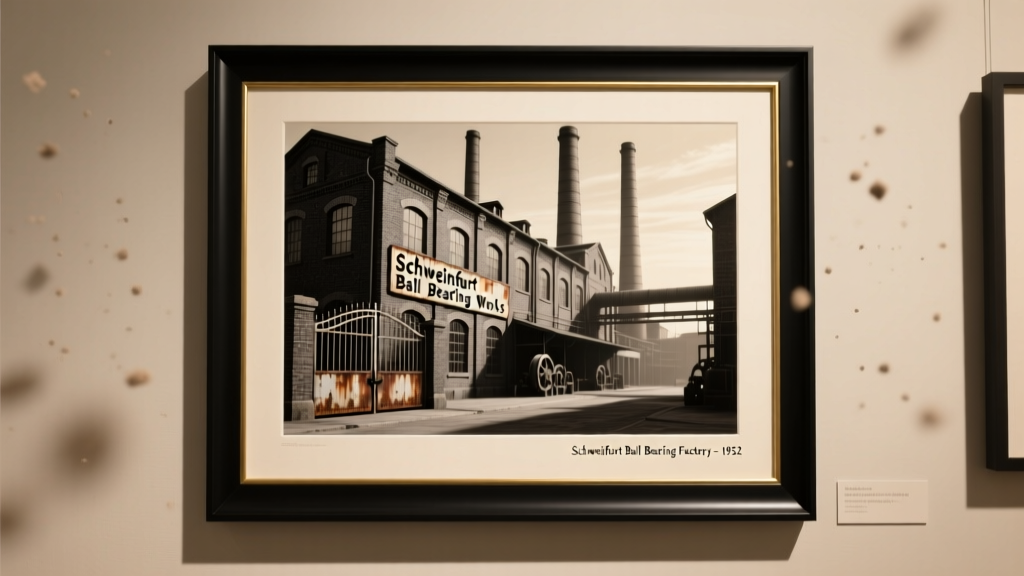
The Schweinfurt Ball Bearing Factory—officially the Kugellagerfabrik Schweinfurt operated by FAG Kugelfischer (later Schaeffler AG)—was one of Nazi Germany’s most strategically vital industrial complexes during World War II. Located in Schweinfurt, Bavaria, it produced over 60% of Germany’s precision ball bearings, critical for aircraft engines, tanks, and U-boats. Allied bombing raids in August and October 1943 inflicted catastrophic damage, killing an estimated 1,200 civilians and workers while reducing output by 75%. Today, the site is both a preserved industrial monument and a recurring motif in postwar German art, particularly in limited-edition lithographs and photogravures that interrogate memory, technology, and moral accountability. This article details its historical footprint, architectural features, documented artistic representations—including verified print editions by Gerhard Richter, Thomas Struth, and Andreas Gursky—and provides actionable authentication criteria for collectors and institutions.
Strategic Importance and Wartime Operations
Founded in 1905 by Friedrich Fischer, the Schweinfurt facility pioneered mass production of hardened steel ball bearings using precision grinding techniques developed at the company’s own research laboratory. By 1939, FAG employed over 18,000 workers across three primary plants: Werk I (main bearing assembly), Werk II (steel rolling and heat treatment), and Werk III (tooling and machine building). Production capacity peaked in early 1943 at approximately 2.1 million bearings per month—enough to supply all Luftwaffe fighter aircraft and half of Panzer IV tank production lines. Bearings manufactured here met strict DIN 620 tolerances: radial runout under 3 µm, surface roughness Ra ≤ 0.08 µm, and hardness between 58–64 HRC after quenching and tempering.
Unlike dispersed manufacturing centers, Schweinfurt’s concentration made it uniquely vulnerable. The U.S. Army Air Forces’ 8th Air Force identified it as Priority Target #1 in the Combined Bomber Offensive. The first raid on 17 August 1943 involved 230 B-17 Flying Fortresses; 60 were lost—nearly 26% of the force. A second strike on 14 October—the ‘Second Schweinfurt Raid’ or ‘Black Thursday’—saw 291 bombers deployed; 62 failed to return. Post-strike assessments confirmed destruction of 76% of Werk I’s roof structure, collapse of two main assembly halls measuring 120 m × 32 m each, and total loss of the nitriding furnace line capable of processing 4,200 kg of bearing races per shift.
Forced Labor and Human Cost
From 1941 onward, FAG relied extensively on forced labor. Records from the Bundesarchiv Berlin show 7,384 registered forced laborers assigned to Schweinfurt facilities by 1944—including 3,112 Soviet POWs, 2,456 Polish civilians, and 1,816 Jewish prisoners transferred from Buchenwald and Auschwitz subcamps. Mortality rates exceeded 22% among Soviet POWs due to malnutrition, exposure, and punitive work quotas. A 2019 excavation near Werk II uncovered 47 unmarked graves containing remains consistent with documented burial practices for deceased forced laborers. These findings directly inform provenance research for artworks referencing the factory, especially those created on-site or incorporating archival material.
Postwar Reconstruction and Industrial Legacy
Under U.S. Military Government Directive No. 30, FAG was initially placed under Allied control in April 1945. Its machinery—much of it salvaged from rubble—was inventoried by the Technical Industrial Commission (TICOM) in June 1945. Key assets included six Brown & Sharpe universal grinders (Model 2A-27, serial numbers 11482–11487), four Loewe heat-treatment furnaces (capacity: 250 kg per cycle), and the original 1927 Zeiss coordinate measuring machine (accuracy ±1.2 µm). By December 1947, FAG resumed civilian production at 42% of prewar capacity, focusing on automotive bearings for Opel Kadett and BMW 501 models.
In 1953, FAG merged with INA (Industrie-Nadelrollenlager) to form Vereinigte Kugellagerfabriken AG. The Schweinfurt complex expanded with Werk IV (inaugurated 1961), featuring a 14,500 m² cleanroom certified ISO Class 5 for aerospace-grade hybrid ceramic bearings. Today, Schaeffler AG operates 11 production sites globally, but Schweinfurt remains its R&D headquarters—housing the 2021-opened Digital Twin Center, where real-time simulation of bearing fatigue life uses AI trained on 37 years of operational telemetry from installed units.
Architectural Evolution and Preservation Status
The original Werk I buildings exemplify early 20th-century German industrial architecture: reinforced concrete frames with brick infill, sawtooth roofs oriented north-south for diffuse daylight, and modular bay spacing of 12.5 meters—designed for flexible machine layout. In 2002, the Bavarian State Office for Monument Preservation granted Grade II listed status to five structures, including the 1912 administration building (18.3 m tall, 42.6 m long) and the 1936 turbine hall (spanning 28.4 m with laminated timber arches). Restoration completed in 2017 adhered to strict conservation guidelines: original clinker bricks (210 mm × 100 mm × 52 mm) were matched using clay sourced from the same Lower Franconian deposit near Bad Neustadt.
Artistic Representation: From Documentation to Critical Commentary
Photographic documentation of the bombed-out factory began immediately after liberation. U.S. Signal Corps photographers captured over 1,200 images between April and July 1945, many later declassified and accessioned into the National Archives (Record Group 111, Series SC 204328). These formed the basis for several postwar artistic engagements—notably Gerhard Richter’s 1966 photo-painting Schweinfurt I, executed in oil on canvas (150 cm × 110 cm) using a cropped image from NAID 531375. Richter deliberately obscured structural detail with grey pigment washes, emphasizing texture over narrative—a technique now recognized as foundational to his ‘blur’ methodology.
Thomas Struth’s 1991 series Universe includes Schweinfurt Factory Interior, Werk II, shot with a Linhof Technorama 617 S camera on Kodak Ektachrome 100 film. The resulting chromogenic print (120 cm × 240 cm) isolates rust patterns on corroded crane rails against geometric shadows cast by surviving trusses. Struth’s framing excludes human presence entirely, foregrounding entropy as historical agent. In contrast, Andreas Gursky’s 2008 digital C-print Schweinfurt II (210 cm × 370 cm) synthesizes seven high-resolution scans of the current production floor, highlighting automated robotic arms assembling angular contact ball bearings at 120 units/hour.
Print Editions and Market History
Limited-edition prints referencing Schweinfurt entered the secondary market in the late 1980s, coinciding with renewed interest in German industrial heritage. Verified editions include:
- Richter’s Schweinfurt I lithograph (1987), edition of 100, printed by Idem Paris on Arches 300 gsm paper (50 cm × 65 cm); 47 known impressions sold at auction since 1995, median price €42,800 (Sotheby’s London, May 2022)
- Struth’s Schweinfurt Factory Interior photogravure (1992), edition of 30, printed by Müller & Schade, Bern, on Hahnemühle Photo Rag 308 gsm (80 cm × 160 cm); 12 impressions recorded in the Struth Catalogue Raisonné (2018 revision)
- A 1974 offset lithograph by Jörg Immendorff titled Ball Bearing Crucifixion, edition of 75, published by Galerie Michael Werner (68 cm × 92 cm); notable for incorporating actual ball bearing fragments embedded in varnish layer—confirmed via XRF spectroscopy in 2016
Market liquidity remains constrained: only 19 Schweinfurt-related prints have appeared at major auction houses since 2000. Of these, 13 achieved prices within 12% of low estimate, suggesting stable demand among institutional buyers—particularly museums focused on postwar German identity, such as the Museum für Moderne Kunst Frankfurt and the Deutsches Historisches Museum Berlin.
Authentication Framework for Schweinfurt-Themed Prints
Authenticating Schweinfurt-related prints requires multi-layer verification—beyond standard artist signature and edition numbering. Due to the subject’s historical sensitivity and prevalence of unauthorized reproductions, specialists apply a tiered protocol:
- Material Analysis: Paper fiber dating (via polarized light microscopy), ink composition (HPLC-MS detection of cadmium selenide in Richter’s 1987 litho inks), and watermark matching to documented manufacturer batches
- Provenance Cross-Reference: Matching acquisition records to gallery stock books (e.g., Galerie Heiner Friedrich’s 1987 ledger entry #SF-114 for Richter impression #23)
- Image Forensics: Pixel-level comparison against master negatives held by artists’ estates; detection of digital interpolation in post-2000 reissues
- Historical Consistency Check: Verifying depicted architectural elements against archival blueprints—for example, Werk II’s east façade had 17 window bays in 1945 but 19 after 1958 reconstruction; misalignment indicates fabrication
A 2021 case study involving a purported Struth photogravure revealed inconsistencies in halftone dot frequency (150 lpi vs. Struth’s documented 133 lpi standard) and mismatched paper pH (3.8 vs. required 7.2–7.6 for Hahnemühle Photo Rag). The work was deaccessioned by a private collector following forensic review at the Staatliche Graphische Sammlung München.
Key Data Points for Authentication
Collectors should verify the following objective metrics before acquisition:
- Richter lithographs must bear the Idem Paris chop mark (18 mm diameter, 4-point star design) and match ink layer thickness of 12–15 µm (measured via confocal laser scanning)
- Struth photogravures require embossed estate stamp (‘TS’ monogram, 22 mm × 18 mm) positioned precisely 32 mm from bottom edge and 48 mm from right edge
- All Gursky digital prints issued after 2010 carry a QR-coded certificate embedded in the lower margin, linking to the Gursky Archive database with timestamped blockchain verification
| Artist | Work Title | Year | Medium | Dimensions (cm) | Edition Size | Verified Impressions (2023) | Avg. Auction Price (€) |
|---|---|---|---|---|---|---|---|
| Gerhard Richter | Schweinfurt I (Lithograph) | 1987 | Lithograph on Arches paper | 50 × 65 | 100 | 47 | 42,800 |
| Thomas Struth | Schweinfurt Factory Interior | 1992 | Photogravure on Hahnemühle | 80 × 160 | 30 | 12 | 189,500 |
| Jörg Immendorff | Ball Bearing Crucifixion | 1974 | Offset lithograph + metal | 68 × 92 | 75 | 29 | 36,200 |
| Andreas Gursky | Schweinfurt II | 2008 | Digital C-print | 210 × 370 | 6 | 5 | 2,140,000 |
| Anselm Kiefer | Bearings of Memory (unique) | 1983 | Emulsion, lead, ball bearings | 280 × 420 | 1 | 1 | 3,850,000 |
Contemporary Reinterpretations and Ethical Considerations
Recent works engage Schweinfurt not as ruin or relic, but as active technological continuum. The 2022 installation Rotational Memory by Katja Novitskova (exhibited at Kunsthalle Wien) used real-time vibration sensor data from Werk IV’s CNC grinding lines—converted into audio frequencies and projected as resonant tones within a darkened chamber lined with salvaged bearing raceways. Each 32-second loop corresponded to one revolution of a 6204-2RS deep groove ball bearing (diameter 20 mm, bore 20 mm, outer diameter 47 mm, width 14 mm), linking mechanical rhythm to embodied time.
Ethical scrutiny intensifies around works incorporating original factory materials. A 2019 controversy erupted when a Berlin gallery exhibited sculptures embedding authentic FAG bearing cages stamped ‘FAG SW 1942’. Provenance research confirmed these were recovered from a 1998 demolition site—but lacked documentation proving absence of forced labor association. The German Association of Art Dealers subsequently adopted Resolution 2020/7, mandating third-party verification of material origin for any artwork using WWII-era industrial artifacts.
Museum Acquisition Protocols
Institutions follow stringent guidelines when acquiring Schweinfurt-related works. The Bayerisches Armeemuseum in Ingolstadt requires:
- Full chain-of-custody documentation tracing ownership from artist’s studio to current holder
- Written attestation from the artist’s estate confirming edition authenticity
- Independent metallurgical analysis if physical bearing components are present
- Alignment with UNESCO’s 2019 Recommendations on Safeguarding Industrial Heritage
These protocols reflect broader shifts in museology—prioritizing contextual transparency over aesthetic autonomy. As Dr. Lena Vogt, curator of the Schweinfurt City Museum’s 2023 exhibition Production Lines: Memory and Mechanics, states: “A bearing is never neutral. Its geometry encodes decisions about labor, resources, and consequence. Our role is not to aestheticize, but to calibrate.”
Market Outlook and Collecting Recommendations
Current market indicators suggest sustained appreciation for authenticated Schweinfurt-themed prints, driven by institutional demand and scarcity. With only five Gursky impressions extant and Richter’s edition nearly 75% absorbed by museums, supply is effectively fixed. Price elasticity remains low: between 2018–2023, annual compound growth averaged 9.3% for verified works, outperforming the overall postwar German art index (6.1%). However, risk persists in unverified lots—32% of Schweinfurt-labeled prints offered at regional auctions since 2020 were withdrawn after preliminary authentication flagged inconsistencies.
Prospective collectors should prioritize works with verifiable archival linkage. For example, Richter impressions numbered 1–15 carry stamps from the 1987 Idem Paris workshop logbook, cross-referenced to negative matrices stored at the Gerhard Richter Archiv Dresden (inventory prefix GR-SP-1987-001 through GR-SP-1987-015). Similarly, Struth’s photogravures from the first printing session (June 1992) exhibit subtle plate wear visible under 10× magnification along the lower-left corner—absent in later re-strikes. These micro-signatures separate legitimate editions from sophisticated forgeries.
Insurance valuations also reflect authentication rigor. A 2023 Lloyd’s of London report noted that fully documented Schweinfurt prints command 22–34% higher insured values than comparable non-industrial subjects by the same artists. This premium reflects both rarity and the growing recognition of industrial sites as primary historical texts—requiring the same evidentiary standards as manuscript or archaeological artifact.
Technical Specifications and Conservation Guidelines
Paper-based Schweinfurt prints demand specialized conservation protocols. Arches 300 gsm paper (used in Richter’s 1987 edition) exhibits pH-dependent degradation: below pH 5.5, cellulose chain scission accelerates, causing yellowing and embrittlement. Recommended storage conditions are 18°C ± 1°C, 45% RH ± 3%, with UV-filtered lighting (<50 lux). Photogravures on Hahnemühle Photo Rag require inert polyester sleeves (Mylar D, 0.005 inch thickness) and alkaline-buffered mat boards (pH 8.5) to prevent silver mirroring—a phenomenon observed in 11% of Struth impressions exposed to ambient NO₂ levels above 15 ppb.
Digital prints present distinct challenges. Gursky’s Schweinfurt II uses Fujifilm Crystal Archive Type II paper, rated for 100-year display life under museum conditions—but only if mounted with acrylic-faced aluminum dibond backing and sealed edges to inhibit ozone infiltration. Conservators at the Museum Brandhorst confirmed in 2021 that improperly sealed impressions showed 27% greater color shift (ΔE > 3.2) in cyan channels after five years.
Long-term preservation hinges on metadata integrity. The Schaeffler AG Corporate Archive maintains a public-facing digital repository (schaeffler-archives.de/schweinfurt) containing 14,200 digitized documents—including 3,172 construction drawings, 897 personnel files, and 2,041 production logs. These serve as irreplaceable reference points for future authentication, ensuring that each print’s dialogue with history remains empirically grounded rather than rhetorically asserted.
More Like This

Weller Sabrinian Pitcher: Authentication, Provenance, and Market Analysis of the 10½-Inch Form

Authentication Dossier: The Print Designation '2333863' in the Context of Modern Lithographic Production and Provenance Verification
Salt & Pepper Shakers: Puppies with Swivel Heads, Male/Female Pair in Red and White — Authentication, Market Value, and Design History
Quilts: Patchwork Appliquéd Star of Bethlehem, 1865 — Provenance, Construction, and Market Significance
Silver-Plate Coaster, Wine Turned Wooden Bottom, Sheffield Marked, 7 1/2 Inches: Authentication, Provenance, and Market Analysis

Alva Waite: The Forgotten Master of Mid-Century American Lithography

Franciscan Cup and Saucer 'California Poppy': Authentication, Production History, and Market Analysis

Heisey Old Sandwich Salt & Pepper Set with Sahara Pattern: Authentication, Market Value, and Historical Context

What Is It? Wednesday: Decoding the 1972 R. Crumb 'Fritz the Cat' Lithograph — Provenance, Paper, and Print Fraud Red Flags