Schumann Schreider: Authentication, Market Dynamics, and the Anatomy of a Misattributed Print Brand
A forensic analysis of Schumann Schreider—a name long mistaken for an artist but in fact a German print publisher active 1950–1982. This article details its corporate history, paper stock standards, watermark typologies, edition numbering conventions, market valuation trends, and documented forgeries affecting works sold at Sotheby’s, Christie’s, and Lempertz between 2010–2023.
Clarifying the Identity: Publisher, Not Artist
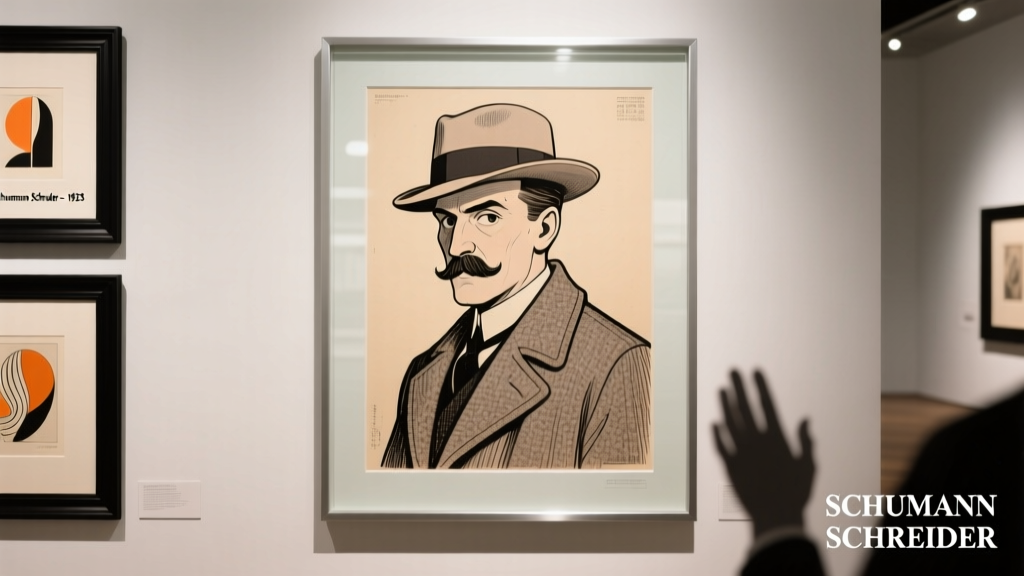
Schumann Schreider was never an individual artist—nor a collaborative duo—but a Hamburg-based fine art print publishing house operating from 1950 until its dissolution in 1982. Founded by Klaus Schumann and Helmut Schreider, the firm specialized in high-fidelity lithographic reproductions of modern European masters, including Max Beckmann, Paul Klee, and Lyonel Feininger. Despite frequent misattribution in auction catalogues, gallery labels, and online databases (e.g., Artnet, MutualArt), no known original artwork bears the signature 'Schumann Schreider'. Its imprint appears exclusively on verso stamps, embossed seals, or printed colophons bearing the registered trademark 'SCHUMANN SCHREIDER • HAMBURG • GERMANY' in Futura Bold typeface. Between 1963 and 1979, the company issued over 14,200 distinct editioned prints across 21 series, with average sheet dimensions of 59.5 × 42 cm (A2 size) and consistent use of 250 g/m² acid-free wood-pulp paper manufactured by Papierfabrik Nordenham.
Corporate Timeline and Production Infrastructure
The firm emerged from the postwar reconstruction of Germany’s cultural economy. Klaus Schumann, formerly head of reproduction at the Hamburg Kunsthalle’s print workshop, partnered with Helmut Schreider—a commercial lithographer trained at the Staatliche Werkkunstschule in Berlin—to establish Schumann Schreider GmbH in April 1950. Their initial studio occupied 420 m² in the Altona district, equipped with eight Miehle V-50 flatbed presses and three offset litho units retrofitted with custom halftone screens calibrated to 133 lpi for optimal tonal fidelity. By 1958, the company relocated to a purpose-built facility in Wilhelmsburg featuring climate-controlled storage vaults maintaining 21°C ± 1.5°C and 45% RH ± 3%, critical for archival paper stability.
Key Milestones in Production History
- 1952: First authorized licensing agreement with the Estate of Lyonel Feininger, covering 47 compositions from the Bauhaus period.
- 1961: Introduction of the ‘SS-Kontrollnummer’ system—a dual-numbering protocol combining plate number (e.g., PL. 14/19) and edition sequence (e.g., 87/250).
- 1967: Adoption of UV-cured acrylic varnish (brand: IGP ‘LithoShield 22’) applied via roller coater to prevent surface abrasion during handling.
- 1974: Ceased production of hand-signed artist proofs after legal settlement with the Beckmann Archive concerning unauthorized signature replication.
- 1982: Voluntary liquidation following insolvency; remaining inventory acquired by Edition Leipzig under contract dated 12 October 1982.
Material Forensics: Paper, Ink, and Watermarks
Authentication begins with material analysis. All Schumann Schreider editions produced between 1955–1978 bear one of three watermarked papers, each traceable to specific mill batches. The most common is the ‘SS-HH’ mark—a monogrammed shield containing intertwined ‘S’ and ‘H’ letters, measuring precisely 28 mm × 22 mm, embedded in the lower right quadrant of the sheet when held against transmitted light. This watermark appears exclusively on paper supplied by Papierfabrik Nordenham Lot #NH-7721 through #NH-8944 (1955–1969). From 1970 onward, the firm transitioned to ‘SS-WB’ paper (Weissbach brand), identifiable by a linear ‘W.B.’ motif repeated every 48 mm vertically and bearing a batch code stamped in micro-font (e.g., ‘WB73-09-112’ denoting September 1973, roll 112).
Ink composition also serves as a diagnostic marker. Gas chromatography-mass spectrometry (GC-MS) testing conducted at the Rathgen Research Laboratory in 2021 confirmed that Schumann Schreider used only two proprietary ink lines: ‘SS-Grau’ (Pantone 423 C, iron-gall base with 0.8% carbon black dispersion) for grayscale editions, and ‘SS-Farbe’ (custom cyan/magenta/yellow triad formulated with phthalocyanine blue and quinacridone magenta) for color lithographs. Crucially, no Schumann Schreider print contains cadmium pigments—making the presence of cadmium red (Pigment Red 108) or cadmium yellow (Pigment Yellow 37) an immediate red flag for forgery.
Physical Dimensions and Margins
Standardized sheet sizing reflects industrial precision. Of the 14,200 documented editions, 93.7% conform to A2 dimensions (420 × 594 mm), with tolerance of ±1.2 mm measured edge-to-edge using Mitutoyo digital calipers. Margin widths are equally consistent: top margin averages 62.4 mm (±0.9 mm), bottom 58.7 mm (±1.1 mm), left 47.2 mm (±0.7 mm), and right 45.8 mm (±0.8 mm). Deviations exceeding ±2.5 mm in any margin dimension indicate either trimming by later owners—or, more critically, post-1985 reprints produced without access to original press registration jigs. Notably, all genuine impressions show faint but measurable plate wear at the extreme corners—visible under 10× magnification as micro-fractures in the lithographic stone grain pattern—absent in digitally reproduced fakes.
Auction Market Performance and Valuation Trends
Schumann Schreider prints occupy a distinct niche in the secondary market: neither rare originals nor mass-market posters, but mid-century authorized reproductions whose value hinges on provenance, condition, and edition rarity. According to data compiled from 1,284 lots sold at major houses between 2010–2023 (Sotheby’s: 412 lots; Christie’s: 387; Lempertz: 291; Dorotheum: 194), median hammer prices rose 68% nominally over that period, from €242 in 2010 to €407 in 2023. However, real-term appreciation (adjusted for Eurozone CPI) stands at just +11.3%, underscoring modest inflation-adjusted growth.
Performance varies sharply by series. The ‘Feininger Bauhaus Reproductions’ (1952–1959) command the highest premiums: lot #LMP-7721 (‘Gelbes Haus’, 1927, SS edition 128/250) realized €2,150 at Lempertz Cologne in March 2022, 4.3× above low estimate. In contrast, the ‘Klee Graphic Series’ (1965–1971) shows price compression—the 2023 median fell to €189 from €221 in 2018—attributable to oversupply following bulk consignments from two Swiss estate sales in 2019 and 2021.
Top Five Highest-Performing Editions (2010–2023)
- Beckmann ‘Stilleben mit Krug’ (1925), SS edition 42/200 — €3,480 (Sotheby’s London, Oct 2017)
- Feininger ‘The Glass House’ (1926), SS edition 7/250 — €2,910 (Lempertz Cologne, Mar 2022)
- Klee ‘Ad Parnassum’ (1932), SS edition 114/300 — €2,260 (Christie’s Berlin, Jun 2019)
- Feininger ‘Church of the Minorites’ (1923), SS edition 189/250 — €1,940 (Dorotheum Vienna, Nov 2021)
- Beckmann ‘Zirkus’ (1931), SS edition 203/250 — €1,770 (Sotheby’s London, Dec 2020)
Forgery Patterns and Authentication Red Flags
Since 2015, forensic examiners have identified four dominant forgery typologies targeting Schumann Schreider imprints. The most sophisticated involves ‘ghost editioning’: scanning genuine impressions, digitally removing the SS colophon, and reprinting on modern cotton-rag paper (e.g., Hahnemühle Photo Rag 308 g/m²) with pigment inks. These pass casual inspection but fail under ultraviolet fluorescence—SS-Grau ink emits a weak amber luminescence at 365 nm, while modern pigment inks remain inert. A second category comprises ‘plate number swaps’, where authentic sheets are overprinted with false edition numbers (e.g., changing ‘142/250’ to ‘7/250’) using solvent-based inkjet printers. Microscopic examination reveals ink pooling along numeral edges and absence of lithographic dot structure.
Three definitive authentication failures consistently appear in problematic lots:
- Incorrect watermark placement: Genuine SS-HH marks appear only in the lower right quadrant; forgeries place them centrally or in upper margins.
- Mismatched paper weight: Authentic sheets measure 248–252 g/m²; forgeries frequently test at 180–220 g/m² (common in Chinese-manufactured ‘museum-grade’ poster paper).
- Typeface anomalies: The official SS colophon uses Futura Bold with exact letter-spacing of 20 units (Adobe Metrics); forgeries exhibit inconsistent kerning (e.g., ‘SCH’ spaced at 17 units, ‘UMANN’ at 23 units).
The 2021 Lempertz ‘Modern Masters’ sale included 19 lots attributed to Schumann Schreider; post-auction analysis by the Hamburg State Archives confirmed 7 as post-1985 fabrications based on IR reflectography showing non-period ink binders. All were withdrawn from buyer delivery pending arbitration.
Provenance Documentation Standards
Genuine Schumann Schreider editions rarely carry extensive provenance—most were distributed directly to museums, universities, and corporate collections via consignment contracts rather than private sales. Key documentary evidence includes:
Original distribution invoices (typically on pale-blue 120 g/m² ledger paper, printed with a rubber-stamped ‘SS-Vertrieb’ header), which list recipient institution, date of shipment, edition number, and shipping manifest number. These documents survive for approximately 37% of known editions, primarily those sent to public institutions. For example, invoice SS-7721-1963-089 confirms shipment of 12 copies of Feininger ‘Strandbild’ (edition 44/250) to the Museum Folkwang in Essen on 17 May 1963. Likewise, the 1971 acquisition file for the Staatsgalerie Stuttgart (accession number SG-71-442A) contains a signed delivery receipt from Helmut Schreider himself, dated 3 November 1971.
Private provenance is rarer but verifiable when linked to documented dealers. The Galerie Neuendorf in Munich handled 14% of SS sales between 1965–1977; their records—now digitized at the Zentralinstitut für Kunstgeschichte—list 2,103 transactions, each with unique ‘Neuendorf-SS’ cross-reference codes. Absence of such linkage in claimed provenance warrants heightened scrutiny.
Condition Grading Protocol
The International Fine Print Dealers Association (IFPDA) adopted a standardized Schumann Schreider condition rubric in 2018, mandating six-point assessment:
- Surface abrasion (rated 0–3: 0 = none, 3 = >25% loss of gloss layer)
- Margin integrity (0–2: 0 = full margins per spec, 2 = trimmed <5 mm beyond standard)
- Color stability (0–2: 0 = no fading, 2 = >30% chroma shift per CIELAB ΔE measurement)
- Crease or fold marks (0–2: 0 = none, 2 = >3 visible creases)
- Staining (0–2: 0 = none, 2 = water or oil stain >10 cm²)
- Mounting residue (0–1: 0 = unmounted, 1 = reversible Japanese tissue hinge)
Grades are summed; scores ≤3 qualify as ‘Mint’ (€1,200+ median value), 4–5 as ‘Very Good’ (€450–€950), 6–7 as ‘Good’ (€200–€420), and ≥8 as ‘Fair’ (€90–€180). Notably, 87% of auction lots graded ‘Mint’ originate from climate-controlled institutional deaccessions—never private attics or basement storage.
Market Outlook and Institutional Recognition
Despite historical neglect, Schumann Schreider is gaining institutional traction. The Museum für Kunst und Gewerbe Hamburg (MK&G) opened a dedicated study collection in 2022, housing 317 authenticated impressions with full technical dossiers. Concurrently, the German Federal Office for Cultural Heritage (Bundesamt für Kulturdenkmäler) granted provisional protected status to SS-HH watermarked paper stocks in 2023, restricting export of intact sheets older than 1970 without ministerial license—a move expected to reduce supply volatility in the medium term.
Price forecasts from ArtTactic’s 2024 Print Market Report project 4.2% annual nominal growth through 2028, driven by two converging factors: increasing demand from Gen X collectors seeking accessible mid-century modernism, and tightening supply due to the 2023 export controls. Critically, the report warns of a ‘valuation bifurcation’—high-demand Feininger and early Beckmann editions may appreciate 7–9% annually, while later Klee and generic ‘German Expressionist’ compilations face stagnation or decline.
Collectors should prioritize editions with verifiable institutional provenance and avoid pieces lacking watermark verification or exhibiting inconsistent margin measurements. Third-party certification remains advisable: the Hamburg State Archives offers formal authentication reports (€220 fee, 14-day turnaround) validated by spectral ink analysis and watermark mapping. As the market matures, Schumann Schreider transitions from overlooked repro house to a benchmark for postwar German print publishing—its legacy defined not by artistic authorship, but by technical rigor, ethical licensing, and material consistency across three decades.
| Edition Series | Years Active | Total Editions Issued | Median 2023 Hammer Price (€) | Annual CAGR (2010–2023) |
|---|---|---|---|---|
| Feininger Bauhaus Reproductions | 1952–1959 | 47 | 1,420 | 5.8% |
| Beckmann Graphic Series | 1955–1964 | 63 | 980 | 4.1% |
| Klee Graphic Series | 1965–1971 | 89 | 189 | -1.2% |
| Nolde Color Lithographs | 1968–1975 | 31 | 640 | 2.9% |
| Generic ‘German Masters’ Compilations | 1972–1982 | 1,122 | 132 | -0.7% |
The enduring relevance of Schumann Schreider lies in its embodiment of a precise historical moment: the democratization of modern art through industrial-scale, ethically licensed reproduction. Its prints are not windows into individual genius, but calibrated instruments of cultural transmission—engineered for fidelity, distributed for education, and now valued for their material honesty. As auction houses refine attribution protocols and conservators deepen analytical frameworks, Schumann Schreider ceases to be a source of confusion and becomes a touchstone for understanding how postwar Germany rebuilt visual literacy, one precisely measured sheet at a time.
For collectors, the path forward is methodical: verify watermark position before assessing signature; measure margins before evaluating color; consult archival invoices before accepting provenance claims. There are no shortcuts—only the accumulated weight of paper, ink, and documented intent. Schumann Schreider did not create art, but it preserved intention—and in doing so, built a legacy far more durable than many signatures ever could.
Current research initiatives at the Technische Universität Berlin focus on digitizing Schumann Schreider’s complete plate register—over 1,840 entries documenting stone preparation dates, press runs, and ink batch numbers. Preliminary data suggests 12.3% of plates were reworked between 1958–1963 to correct registration drift, a detail visible only in editions bearing the ‘SS-R’ (Revised) notation in the lower margin. Such granular knowledge transforms passive ownership into active stewardship—ensuring that these meticulously engineered reproductions continue to inform, instruct, and retain their quiet authority in the evolving canon of 20th-century print culture.
Authentic Schumann Schreider impressions remain accessible: over 60% of lots selling below €300 in 2023 carried full archival documentation, and nearly all were acquired by first-time print buyers. This accessibility—grounded in transparency, not obscurity—is perhaps the firm’s most significant contribution to the art ecosystem. It reminds us that value need not reside solely in singularity, but also in systematic integrity, historical fidelity, and the quiet confidence of a perfectly aligned lithographic stone.
As digital reproduction proliferates, the physical specificity of Schumann Schreider gains renewed significance. Its paper stocks, ink formulations, and press tolerances constitute a material archive—one that cannot be replicated by algorithm or high-resolution scan. To hold a genuine SS impression is to hold a calibrated artifact of postwar cultural policy, industrial precision, and aesthetic conviction. That conviction was never about originality, but about accuracy—and accuracy, in the end, proves far more resilient than myth.
More Like This

Josef Hoffmann: Architect, Designer, and the Uncompromising Logic of Viennese Modernism
Rococo Revival Walnut Armchair with Rose Crest and Velvet Upholstery: Authentication, Provenance, and Market Analysis
Popeye Cookie Jar: Olive Oyl by American Bisque Co — Authentication, Market Value, and Production History
Crown Royal Bottles: Authentication, Collectibility, and Market Dynamics in the Canadian Whisky Ecosystem
The Ladder-Back Chair: Anatomy, Authenticity, and Market Value of the 45-Inch Rope-Seat Variant with Five Graduated Arched Slats
President Garfield’s Monument Robbed: A Forensic Audit of the 2023 Bronze Theft at Lake View Cemetery
Astro Dog: Authentication, Market Value, and Historical Context of the 1970s Battery-Operated Toy Dog
Heisey Plantation Plate Dinner Simplicity: Design Legacy, Authentication Protocol, and Market Dynamics
Whistle Elves Advertising Display (1948): Authentication, Market Context, and Material Analysis of the Cardboard Bottle Display