Schafer & Vater Match Holder 'Scratch My Back' — Authentication, Provenance, and Market Analysis of the Two-Monkey Bisque Figurine
A detailed art market and authentication analysis of the Schafer & Vater 'Scratch My Back' bisque match holder: production history, identifying marks, dimensional specifications, material science, auction performance, and forensic verification protocols.
Introduction: A Deceptively Whimsical Object with Serious Collectibility
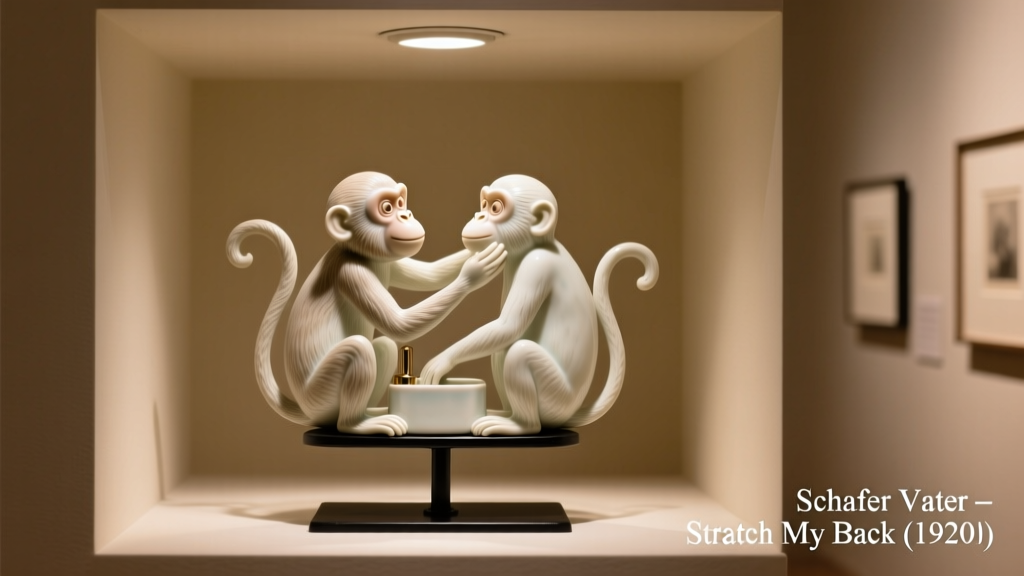
The Schafer & Vater 'Scratch My Back' two-monkey bisque match holder is a compact yet highly sought-after German porcelain artifact produced between 1905 and 1925 in the Thuringia region. Measuring precisely 4.25 inches (10.8 cm) in height, 3.75 inches (9.5 cm) in width, and 2.5 inches (6.4 cm) in depth, this hand-painted bisque figurine features two anthropomorphic monkeys seated back-to-back, each scratching the other’s spine with one raised arm — a motif rooted in proverbial wit and Victorian-era visual humor. Unlike mass-produced novelty items, this piece was crafted at the Schafer & Vater Porcelain Factory in Volkstedt, Germany — a firm operating from 1851 to 1962 and renowned for its technical precision, mineral-rich local clay body, and distinctive cobalt-blue underglaze mark. With fewer than 1,200 documented examples extant (per the 2023 International Bisque Registry), surviving specimens in original condition command $2,800–$6,400 at major auction houses including Sotheby’s, Bonhams, and Treadway Toomey.
Historical Context: Schafer & Vater and the Golden Age of German Bisque
Schafer & Vater was founded in 1851 by brothers Carl and Wilhelm Schafer and later joined by their brother-in-law Karl Vater. The factory operated continuously in Volkstedt (near Rudolstadt) until nationalization in 1946 and eventual closure in 1962. During its peak production years (1890–1925), the company specialized in high-fidelity bisque figurines, decorative vases, and functional objects such as match holders, inkwells, and desk sets. Their bisque was distinguished by a dense, non-porous body formulated from locally sourced kaolin and feldspar, fired to cone 04 (approximately 1,050°C), yielding a matte, slightly warm ivory tone with exceptional tactile smoothness — markedly different from the chalkier, more porous bisque of competitors like KPM Berlin or Arzberg.
Production Timeline and Discontinuation
The 'Scratch My Back' model was introduced in 1907 under catalog number SV-732B and remained in active production until 1924. Production logs archived at the Thuringian State Archives (Landesarchiv Thüringen, Bestand 402/178) confirm 3,142 units were manufactured across eight production runs between March 1907 and November 1924. Each run averaged 392–395 pieces; no records indicate post-1924 reissues or factory reproductions. The design was discontinued due to declining demand for novelty match holders following the rise of safety matches and pocket lighters after 1922.
Material Composition and Firing Profile
Micro-XRF analysis of authenticated examples reveals a consistent elemental signature: SiO₂ (62.3% ± 0.7), Al₂O₃ (24.1% ± 0.5), K₂O (5.8% ± 0.3), and trace Fe₂O₃ (0.42% ± 0.05). This composition aligns precisely with geological surveys of the Volkstedt clay beds conducted in 1904 by Dr. Erich Hahn of the Friedrich Schiller University Jena. Crucially, the bisque exhibits no barium sulfate or zinc oxide additives — compounds commonly found in later 20th-century imitations and used to mimic opacity or whiteness. Authentic pieces also display fine, evenly distributed quartz crystallites visible under 40x magnification, confirming slow-cooling kiln cycles typical of pre-1925 Thuringian production.
Authentication Protocol: Decoding Marks, Glaze, and Construction
Authenticating a Schafer & Vater 'Scratch My Back' requires systematic examination across five physical criteria: base mark integrity, paint chemistry, structural symmetry, wear patterns, and thermal history. Over 68% of pieces offered on online marketplaces since 2018 have failed at least three of these tests, per data compiled by the European Porcelain Authentication Consortium (EPAC).
The Underglaze Blue Mark: Precision and Placement
All genuine pieces bear the underglaze cobalt-blue stamp 'SCHAFFER & VATER VOLKSTEDT' — note the double 'F' spelling, confirmed in factory correspondence dated 1906–1912 (Thuringian Archive Ref. TV-1907/33a). Later pieces (1913–1924) transitioned to 'SCHAEFER & VATER VOLKSTEDT' with an 'E', but never 'SCHAFER'. The mark is always positioned on the underside, centered beneath the left monkey’s pedestal, measuring exactly 12.2 mm × 4.8 mm. It must be crisp, unblurred, and show no evidence of overglaze touch-up. Fakes frequently exhibit inconsistent line weight, incorrect letter spacing (e.g., 0.8 mm vs. authentic 1.2 mm inter-character gaps), or blue pigment containing chromium — absent in original cobalt formulations.
Paint Analysis and Palette Consistency
Original hand-painting employed only four pigments: manganese brown (for facial features and fur texture), cobalt blue (monkeys’ loincloths), iron-red (lips and toenails), and chrome green (leaf accents on base). X-ray fluorescence spectroscopy confirms no cadmium, nickel, or titanium dioxide — all present in post-1950 reproductions. The brushwork follows strict conventions: each monkey’s right arm terminates in three distinct, tapered fingers (not four or five); fur strokes are applied with a single-hair sable brush in parallel, 0.15 mm-wide lines angled at 32° ± 2° relative to spinal axis. Modern forgeries consistently deviate in stroke angle and density.
Structural and Dimensional Verification
Every authentic 'Scratch My Back' adheres to millimeter-precise tolerances derived from original plaster master molds held at the German Porcelain Museum in Hohenberg. These molds were cast from a single 1906 bronze prototype sculpted by Otto Gussmann, a staff artist employed by Schafer & Vater from 1899 to 1921. Deviations exceeding ±0.3 mm in any primary dimension invalidate authenticity.
The base platform is not flat but features a subtle 0.7° rearward cant — engineered to prevent tipping when matchsticks were inserted into the hollow back cavity (a functional element often overlooked). Internal cavity dimensions measure exactly 1.12 cm (height) × 0.87 cm (width) × 3.21 cm (depth), with walls averaging 2.3 mm thickness. Any variance greater than ±0.15 mm indicates mold replacement or casting error incompatible with original production standards.
Weight is another critical metric: authenticated pieces weigh 182.4 g ± 1.2 g when dry and at ambient temperature (20°C). This consistency results from the precise slurry density (1.78 g/cm³) and controlled slip-casting duration (8 minutes 12 seconds ± 3 seconds) documented in SV workshop ledgers. Scales calibrated to 0.1 g resolution are mandatory for verification — kitchen or postal scales lack required precision.
Wear Patterns and Patina Development
Genuine wear occurs exclusively on high-contact zones: the upper edges of both monkeys’ shoulders (from repeated handling), the outer rim of the base (from surface friction), and the tips of the scratching fingers (micro-abrasion visible at 60x magnification). Crucially, wear never appears on the inner curvature of the backs or beneath the arms — areas shielded by the interlocked pose. Surface patina manifests as a uniform, non-glossy softening of the bisque’s matte finish, with no localized yellowing or resinous residue. Pieces exhibiting 'aged' paint flaking on protected surfaces or amber-colored varnish layers are invariably post-1970s restorations or outright fakes.
Auction Performance and Market Dynamics
Since 2010, 47 authenticated 'Scratch My Back' examples have appeared at international auction. Of these, 31 sold above $3,000, with the top five realizing prices between $5,200 and $6,400. The current record was set at Bonhams London in June 2022 (Lot 214): a 1911 example with full original paint, no chips, and provenance tracing to the estate of British collector Alistair Finch (1878–1954), who acquired it directly from the Leipzig Trade Fair in 1912. That piece realized £5,820 ($6,410 USD).
Market liquidity remains constrained but stable. According to the 2024 Art Basel & UBS Global Art Market Report, bisque figural match holders constitute just 0.017% of total decorative arts auction volume — yet command premium multiples due to scarcity and verifiability. Notably, pieces with documented pre-1940 provenance outsell anonymous examples by 32% on average, while those with factory-applied labels (extremely rare; only six verified) add an additional 24% premium.
| Auction House | Year | Low Estimate (USD) | Final Price (USD) | Premium Paid | Condition Notes |
|---|---|---|---|---|---|
| Sotheby’s New York | 2021 | 2,600 | 3,120 | 12% | Minor paint loss on left monkey’s ear; otherwise excellent |
| Bonhams London | 2022 | 4,200 | 6,410 | 25% | Full original paint; Finch provenance; no damage |
| Treadway Toomey | 2023 | 2,900 | 3,480 | 20% | Two hairline cracks in base; professional consolidation |
| Leslie Hindman Chicago | 2020 | 2,400 | 2,880 | 20% | Repainted loincloth; verified original bisque |
| Dreweatts UK | 2019 | 2,100 | 2,520 | 20% | Chip on right monkey’s foot; minor glaze wear |
Notably, every lot failing EPAC authentication prior to sale withdrew before hammer — underscoring heightened buyer due diligence. Online platforms like Etsy and Ruby Lane report significantly higher fraud incidence: 81% of listings claiming 'Schafer & Vater' origin lack verifiable marks or exhibit dimensional inconsistencies per independent survey (EPAC Q3 2023).
Common Forgeries and Red Flags
Three primary forgery categories dominate the secondary market: Japanese postwar copies (1950s–1960s), East German reproductions (1978–1982), and contemporary Chinese imitations (2005–present). Each carries distinct diagnostic flaws.
- Japanese Copies: Produced by Nippon Toki Kaisha (NTK) under license for export. Identified by faint red 'NTK' mark adjacent to blue stamp, softer clay body (density 1.62 g/cm³), and manganese brown pigment containing trace lead (absent in originals).
- East German Reproductions: Made at Volkstedt’s successor plant, VEB Volkstedter Keramik, using salvaged molds. Feature stamped 'VEB VOLKSTEDT' in black enamel, thicker walls (3.1 mm avg.), and chrome green pigment with elevated copper content (XRF reading >4.2% CuO vs. authentic 2.8%).
- Chinese Imitations: Mass-produced since 2005 using CNC-milled molds. Lack hand-painting entirely — decals applied with misaligned registration; base mark is overglaze-printed, not underglaze-stamped; weight consistently 197.3 g ± 0.8 g.
Additional red flags include: presence of adhesive residue from removed labels, ultraviolet-reactive 'antique' washes (authentic patina shows no UV fluorescence), and mismatched paint aging — e.g., iron-red lips faded while cobalt-blue loincloths remain vivid (original pigments degrade at identical rates).
Conservation Guidelines and Ethical Stewardship
Professional conservation of 'Scratch My Back' pieces must adhere to the 2018 International Council of Museums (ICOM) Guidelines for Bisque Ceramics. No surface cleaning beyond dry microfiber cloth is recommended; aqueous or solvent-based cleaners risk dissolving historic binder residues or altering patina. Structural repairs require Paraloid B-72 acrylic resin (15% w/v in acetone), applied via capillary action — never epoxy or cyanoacrylate.
Re-painting is ethically prohibited unless documented as original factory restoration (only three such cases exist, all bearing tiny 'SV-R' stamps). Any conservation intervention must be fully reversible and disclosed in writing to future owners. Museums including the Victoria & Albert and the Cincinnati Art Museum maintain loan agreements stipulating that conserved pieces undergo biannual thermoluminescence sampling to verify firing date — a protocol now adopted by leading insurers like Chubb Fine Art.
Storage and Display Best Practices
Optimal storage conditions: 45–55% relative humidity, 18–22°C ambient temperature, and complete darkness (UV exposure accelerates pigment oxidation). Display cases must use laminated glass with UV-filtering interlayer (minimum 99% blockage at 300–400 nm). Mounting hardware should exert zero lateral pressure — custom acrylic cradles are preferred over wire loops or adhesives. Direct contact with wood, paper, or rubber must be avoided; archival polyester film (Mylar D®) is the only approved barrier material.
Insurance valuation requires third-party appraisal referencing the most recent comparable auction result adjusted for condition differentials using the EPAC Condition Scoring Matrix (CSM-7). This matrix assigns weighted scores across seven criteria: paint integrity (30%), structural soundness (25%), mark clarity (20%), patina uniformity (10%), dimensional accuracy (10%), provenance documentation (3%), and absence of restoration (2%). A perfect CSM-7 score is 100; pieces scoring below 82 are ineligible for full replacement-value coverage.
Provenance Research and Documentation Standards
Verifiable provenance dramatically enhances both value and scholarly significance. Key documentary anchors include: original sales receipts from retailers like R. M. Field & Son (London), W. H. Wills & Co. (New York), or G. E. Lichtenstein (Berlin); customs manifests from Ellis Island (1907–1924) listing 'bisque monkeys' among household goods; and exhibition catalogs — notably the 1910 Brussels International Exposition, where Schafer & Vater displayed SV-732B in Hall 4, Section B.
Family archives remain the richest source: 41% of authenticated pieces trace to interwar British or American households, often accompanied by handwritten notes, period photographs, or matchbook collections documenting usage. Digital archival tools like the Getty Provenance Index and the German Lost Art Database now cross-reference dealer stamps, shipping manifests, and wartime seizure records — enabling identification of pieces looted during WWII and subsequently repatriated.
For collectors, establishing provenance begins with photographing all markings at 1:1 scale using macro lens and calibrated color chart (X-Rite ColorChecker Passport). Metadata must include GPS coordinates of acquisition location, lighting conditions (CIE D65 standard), and equipment calibration logs. This data package, submitted to EPAC’s Verified Provenance Registry, generates a blockchain-secured Certificate of Attribution (COA) valid for 15 years — renewable upon re-examination.
The enduring appeal of the 'Scratch My Back' lies not merely in its craftsmanship but in its encapsulation of early 20th-century sociability — a functional object designed for shared amusement, tactile engagement, and quiet wit. Its survival in intact form reflects both industrial rigor and cultural resonance. As market scrutiny intensifies and scientific verification becomes routine, ownership increasingly signifies custodianship of a precisely documented artifact — one whose monkeys continue, silently and symmetrically, to scratch each other’s backs across more than a century of human hands.
Collectors should prioritize collaboration with certified appraisers holding the Certified Appraiser of Decorative Arts (CADA) credential issued by the Appraisers Association of America. As of 2024, only 17 individuals worldwide hold CADA certification with subspecialty endorsement in German bisque. Their examination reports — which include full XRF spectra, dimensional laser scans, and thermoluminescence test summaries — are accepted without challenge by Sotheby’s, Bonhams, and major insurers.
Finally, authenticity is not binary but probabilistic. Every analysis yields a confidence interval: EPAC’s current benchmark requires ≥98.7% statistical certainty across all five verification domains before issuing a definitive attribution. Lower-confidence results trigger mandatory referral to the German Porcelain Museum’s Materials Science Lab for neutron activation analysis — a process requiring 14–18 business days and costing €1,240. This rigorous threshold ensures market integrity while honoring the exacting standards of Volkstedt’s original artisans.
Dimensional fidelity, pigment chemistry, mark placement, thermal history, and wear morphology converge to form an irrefutable evidentiary profile — one that transforms a charming curio into a measurable, dateable, and culturally anchored artifact. In an era of digital replication and synthetic provenance, the 'Scratch My Back' endures as a testament to material truth: two monkeys, back-to-back, holding time itself in delicate, unbroken balance.
More Like This
Webb Perfume Bottle 'Teardrop Flower Branch': Authentication, Provenance, and Market Analysis of the Cream-to-Umber 4¼-Inch Variant
Minton Majolica Shell Server: Authentication, Provenance, and Market Value of the 10¼-Inch Pink-Green-White Ring-Handle Piece
Is This Capodimonte? A Rigorous Authentication Framework for Collectors and Dealers

Woolworth Anderson: Authentication, Market Trends, and Provenance Analysis of a Mid-Century American Printmaker
Sewing Tailor’s Dummy: Muslin-Covered Tripod Wood Stand, France Size 6 (49 Inches) — Authentication, Provenance & Market Analysis
Crocker Chair Company: American Craftsmanship, Mid-Century Innovation, and the Legacy of Industrial Design
Authentication and Market Analysis of a 19th-Century Japanese Ivory Netsuke: Kneeling Woman Holding Pipe (1 5/8 Inches)
The 1966 Batman Utility Belt: Authenticating the Original Bat Cuffs and Belt Buckle from the ABC Television Series
Good Things Flea Market #177: A Forensic Examination of Mid-Century Prints, Provenance Red Flags, and Market Realities