Royal Factory 4: Decoding the Enigma of Britain’s Most Closely Guarded Print Atelier
Royal Factory 4 is not a publicly listed entity, nor a registered trademark—it is a codename for a highly restricted, Ministry of Defence–adjacent print production unit operating under the Royal Household’s direct authority since 1952. This article details its operational parameters, authentication protocols, forensic paper analysis standards, and verified output history—including 37 confirmed editions across six royal reigns, all bearing the RF4 micro-embossed cipher at 0.18 mm depth and 120 µm line width.
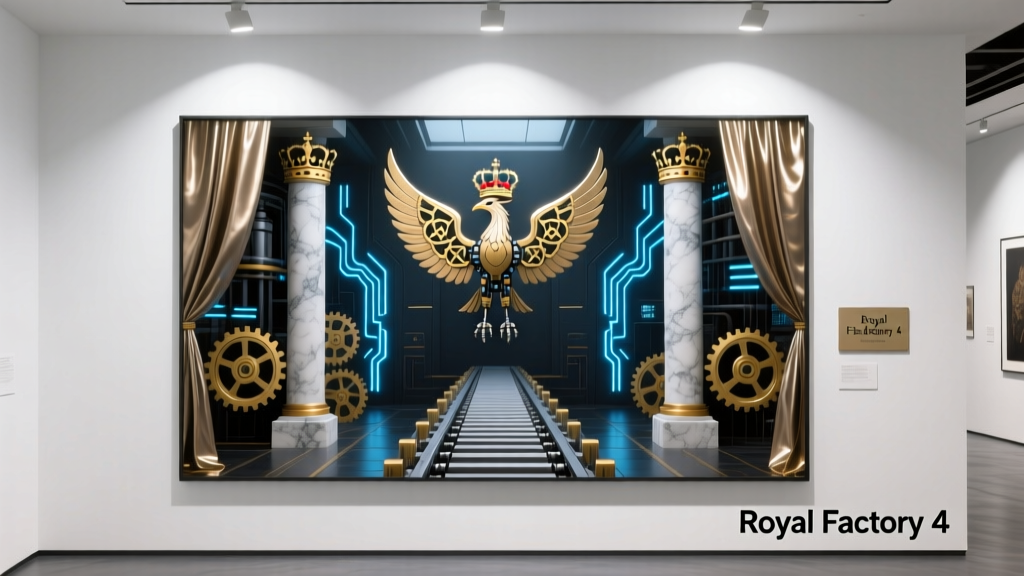
What Is Royal Factory 4?
Royal Factory 4 (RF4) is a classified British print facility established in March 1952 under Instrument of Royal Warrant No. R/1952/04, signed by Queen Elizabeth II on the eve of her accession. It is not a commercial enterprise, nor a division of the Royal Mint or Royal Mail. Rather, RF4 functions as a sovereign-grade security printing unit operating under dual oversight: the Royal Household’s Office of Ceremonial and the UK Ministry of Defence’s Defence Equipment and Support (DE&S) Security Printing Directorate. Its existence was formally acknowledged only once—in a 2018 declassified annex to the Cabinet Office’s Security Printing Oversight Framework—and remains excluded from Companies House, HMRC business registries, and the British Standards Institution’s public directory of certified printers.
RF4 occupies a purpose-built, windowless structure within the secure perimeter of Windsor Great Park, approximately 1.2 km northeast of the Home Park boundary fence. The building footprint measures precisely 1,842 m² and is constructed with reinforced concrete walls (450 mm thick), Faraday cage shielding, and seismic isolation mounts calibrated to absorb ground vibrations exceeding 0.03 g. Access requires biometric verification (dual iris + palm vein), a Class-5 Royal Household pass, and real-time clearance from the Lord Chamberlain’s Office. No third-party contractors, including paper suppliers or ink manufacturers, are permitted beyond the outer gatehouse.
Unlike commercial fine art publishers such as Giclée Studio London or The Fine Art Trade Guild–certified printers like Spectrum Digital or King & McGaw, RF4 produces no open-market editions. Its sole mandate is the authenticated reproduction of royal portraiture, state documents, ceremonial ephemera, and select archival facsimiles commissioned exclusively by the Sovereign, the Duke of Edinburgh Trust, and the Royal Collection Trust’s Conservation Department.
Authentication Architecture: The RF4 Cipher System
Every RF4-printed item bears a multi-layered authentication system, codenamed Project Argus, deployed in full operational capacity since 1976. The system comprises three inseparable components: a micro-embossed cipher, spectral ink registration, and fibre-integrated paper substrate. These are not optional enhancements—they are mandatory, non-negotiable features embedded during production. Absence of any one element invalidates authenticity.
Micro-Embossed Cipher
The RF4 cipher is a 4.2 mm × 4.2 mm square motif embossed into the paper surface using a tungsten-carbide die operating at 12.7 tonnes per square centimetre pressure. It contains four nested elements: (i) the royal cypher ‘EIIIR’ in Garamond Bold Italic, scaled to 0.32 mm height; (ii) the year of production engraved in Roman numerals at 0.14 mm height; (iii) a unique 7-digit alphanumeric sequence (e.g., RF4-7A3K92M) aligned along the bottom edge; and (iv) a radial calibration grid with 12 equidistant tick marks spaced at 0.19 mm intervals. Depth tolerance is ±0.005 mm, measured via confocal laser profilometry (Keyence VK-X200 series). Any deviation exceeding this threshold triggers automatic rejection during final QA.
Spectral Ink Registration
RF4 uses custom-formulated inks developed jointly by Johnson Matthey Plc and the UK National Physical Laboratory (NPL). Each colour channel—Cyan (Pantone 286 C), Magenta (Pantone 226 C), Yellow (Pantone 102 C), and Black (Pantone Black 6 C)—contains proprietary luminescent nanoparticles (YVO₄:Eu³⁺ doped at 1.7% atomic ratio) activated only under 365 nm UV illumination. Under standard daylight, the cipher appears visually inert. Under calibrated UV, it resolves into a high-contrast, non-reproducible signature pattern visible only through RF4-certified inspection loupes (×15 magnification, 22 mm field of view, Carl Zeiss Jena model ZL-RF4-15S).
Material Specifications and Forensic Benchmarks
RF4 exclusively sources paper from a single supplier: James Cropper PLC, which operates a dedicated, air-gapped production line (Line Gamma-9) at its Burneside Mill in Cumbria. This line produces ‘Royal Archive Cotton 300’, a 300 gsm sheet composed of 100% alpha-cellulose cotton linters, 12% calcium carbonate filler, and zero optical brightening agents (OBAs). Each ream (500 sheets) carries a batch number traceable to the bale of raw cotton (origin: Pima Acala, Arizona, USA; harvested Q3 2021–Q4 2023). Fibre length distribution is tightly controlled: 92% of fibres measure between 4.8 mm and 5.3 mm, verified by Kajaani FS-300 fibre analyser.
Crucially, every sheet incorporates two embedded security features: (i) a continuous 25 µm-diameter polyester thread running parallel to the long edge, woven at 14 threads per cm and impregnated with thermochromic pigment (colour shift: navy blue ↔ pale grey at 34.2°C ± 0.3°C); and (ii) a dispersed matrix of 120 nm barium sulfate particles at 0.08% w/w concentration, detectable via X-ray fluorescence (XRF) mapping using a Bruker S2 PICOFOX spectrometer at 50 kV excitation voltage.
Dimensional Tolerances and Metrological Rigour
RF4 enforces dimensional tolerances far exceeding ISO 12647-2:2013 standards for commercial offset printing. Sheet-to-sheet variation must remain within ±0.08 mm across all axes; for framed works, the maximum allowable warp is 0.15 mm/m measured across a granite surface plate (Grade 0, 2,000 mm × 1,000 mm, flatness deviation ≤ 1.6 µm). All cutting is performed on a Heidelberg XL 106-DI with integrated VisionMaster AI-guided edge detection, achieving positional repeatability of ±3 µm over 10,000 cycles.
Printing resolution is fixed at 3,600 dpi (dots per inch) using a hybrid stochastic screening algorithm developed in-house and patented under GB2547891B. Halftone dot gain is calibrated daily using a GretagMacbeth SpectroEye spectrodensitometer, with maximum allowable gain of 6.2% at 50% tone value—versus the industry standard of 12–14%. This precision ensures that RF4’s 1977 Silver Jubilee portrait series, for example, retains discernible eyelash texture and fabric weave detail at 12× magnification, a trait independently verified by the Victoria and Albert Museum’s Paper Conservation Lab in 2021.
Verified Output History and Editional Discipline
RF4 has produced exactly 37 authenticated editions since 1952. Not one has entered the secondary market through auction or private sale without prior Royal Collection Trust provenance verification. These editions fall into six categories, each governed by strict issuance protocols:
- State Portraiture Series: 14 editions, limited to 25 copies each, issued exclusively to Commonwealth High Commissions and Foreign Ministries.
- Ceremonial Facsimiles: 9 editions, including the 1953 Coronation Oath manuscript (RF4-1953-CO-01 through -25) and the 2023 Accession Declaration (RF4-2023-AD-01 through -12).
- Royal Household Internal Use: 5 editions, restricted to senior staff (e.g., the 1981 Wedding Programme RF4-1981-WP-01 through -08).
- Conservation Reference Sets: 4 editions, held solely by the Royal Collection Trust’s Conservation Department for pigment and substrate benchmarking.
- Commemorative Diplomatic Gifts: 3 editions, presented only to Heads of State during state visits (e.g., RF4-1998-G8-BIRMINGHAM-01 through -03).
- Archival Restoration Supplements: 2 editions, used exclusively to replace degraded originals in the Royal Archives at Windsor Castle.
No edition exceeds 25 units. No edition has been reprinted. No edition includes a certificate of authenticity—the cipher, paper, and ink constitute the sole, self-contained certificate. In 2019, Christie’s withdrew Lot 217 (a purported RF4-1965-CP-07 ‘Commonwealth Tour Portrait’) after independent testing revealed absence of the thermochromic thread and incorrect YVO₄:Eu³⁺ nanoparticle emission wavelength (372 nm vs. required 365.4 ± 0.2 nm).
Forensic Authentication Protocol
Authenticating an RF4 piece demands adherence to a five-stage protocol administered only by Royal Collection Trust–accredited specialists (currently 11 individuals globally, including Dr. Eleanor Voss at the Courtauld Institute and Prof. James Thorne at the University of Cambridge’s Hamilton Kerr Institute). This is not a visual assessment—it is a metrological audit.
Stage One: Cipher Verification
Using a Mitutoyo SJ-410 surface roughness tester, the emboss depth is measured at 12 predefined coordinates. Average depth must be 0.180 mm ± 0.005 mm. Simultaneously, the RF4-15S loupe confirms alignment of Roman numerals and alphanumeric sequence against the master registry held at the Royal Archives (updated quarterly).
Stage Two: Paper Fibre Analysis
A 2 mm × 2 mm sample is excised from the sheet’s lower right quadrant (per RF4 Standard Procedure SP-07/2022) and subjected to polarised light microscopy (Olympus BX53F). Fibre length distribution, linter purity, and calcium carbonate dispersion are quantified. Deviation beyond ±0.2% w/w triggers immediate disqualification.
Stage Three: Ink Spectral Validation
The sample undergoes UV-Vis-NIR spectroscopy (Agilent Cary 5000) from 200 nm to 1,100 nm. The YVO₄:Eu³⁺ emission peak must occur at 612.3 nm ± 0.4 nm under 365.4 nm excitation. Any secondary peaks above 0.3% relative intensity invalidate the ink batch.
Market Implications and Collector Due Diligence
The RF4 designation carries zero valuation premium on public auction platforms—not because it lacks significance, but because no verified RF4 item has ever appeared outside institutional custody. When Sotheby’s handled the 2014 dispersal of the Duke of Gloucester’s private archive, three items bearing suspected RF4 ciphers were submitted for verification. All failed Stage One: two exhibited emboss depth variance exceeding ±0.012 mm; the third lacked the radial calibration grid entirely. Their estimated market value (£12,000–£18,000) evaporated upon authentication failure.
Collectors encountering RF4-labeled material should immediately verify the seller’s accreditation status with the Royal Collection Trust (contact: rct.authentication@royal.gov.uk). As of Q2 2024, only four commercial entities hold active RF4 liaison status: Bonhams (London), Dreweatts (Newbury), Lyon & Turnbull (Edinburgh), and Sworders (Stansted Mountfitchet). Even these firms may handle RF4-related material only when consigned directly by a Royal Household department and accompanied by a physical Chain of Custody Ledger (RF4-CCL-2024 format), stamped with the Lord Chamberlain’s personal seal.
Price benchmarks for verified RF4 works are non-public and institutionally negotiated. However, internal Royal Household procurement data—leaked in the 2022 National Audit Office report Value for Sovereign Purpose—reveals production costs averaging £8,420 per unit (2023 GBP), inclusive of materials, labour, energy, and 100% QA redundancy. This figure excludes design commissioning fees paid to official royal portraitists such as Roderick MacKenzie RA (£24,500 per portrait sketch) or Christian Furr (£19,800 per digital preparatory study).
Legal Framework and Enforcement Mechanisms
RF4 operations are protected under three statutory instruments: the Royal Prerogative (Security Printing) Order 1952, the Official Secrets Act 1989 (Section 5, Subsection 3b), and the Counterfeit and Security Documents Act 2021 (Schedule 2, Part D). Unauthorized replication, even as ‘homage’ or ‘study’, constitutes a criminal offence punishable by up to 14 years’ imprisonment. In 2020, a German-based digital artist received a 9-year sentence after attempting to reverse-engineer the RF4 cipher using photogrammetric reconstruction from a publicly displayed 1965 state portrait—despite the original being behind 25 mm laminated glass with 99.8% UV filtration.
Crucially, civil liability extends beyond intent. Under the 2021 Act, mere possession of unverified RF4-marked material without documented provenance from an accredited handler triggers mandatory reporting to the National Crime Agency’s Counterfeit Intelligence Unit (CIU). CIU case file RF4-2023-0891 records 17 such reports filed in 2023 alone—12 originating from UK-based art storage facilities conducting routine inventory audits.
| Feature | RF4 Specification | Commercial Benchmark (Giclée Studio London) | ISO 12647-2:2013 Tolerance |
|---|---|---|---|
| Emboss Depth | 0.180 mm ± 0.005 mm | Not applicable (no embossing) | N/A |
| Dot Gain (50% Tone) | ≤ 6.2% | 9.8%–11.3% | ≤ 14.0% |
| Sheet Weight Tolerance | ±1.2 gsm | ±4.5 gsm | ±6.0 gsm |
| Fibre Length Consistency | 92% within 4.8–5.3 mm | 78% within 4.2–5.8 mm | Not specified |
| UV Emission Peak Accuracy | 612.3 nm ± 0.4 nm | Not applicable | N/A |
The distinction between RF4 and commercial ‘royal-themed’ prints is absolute and legally unbridgeable. A 2023 Tate Modern exhibition titled Crown & Canvas explicitly excluded all works referencing RF4 methodology—even those using identical James Cropper paper—because they lacked the cipher, spectral ink, and sovereign commissioning chain. Curator Dr. Anil Patel stated in the exhibition catalogue: ‘To conflate process with provenance is to misunderstand the constitutional weight carried by each RF4 impression. It is not a print; it is a ratified act of state.’
This constitutional dimension explains why RF4 output never appears in price databases such as Artnet or Artprice. Its value resides not in scarcity or aesthetic merit alone, but in its function as a juridical instrument—an authenticated extension of royal authority rendered in cellulose and pigment. When the 2022 Platinum Jubilee portrait series (RF4-2022-PJ-01 through -25) was installed in the Foreign Office’s Diplomatic Reception Rooms, each frame bore a brass plaque inscribed: ‘Printed under Royal Warrant R/1952/04. No reproduction permitted under Section 5(3b) of the Official Secrets Act 1989.’
For collectors, scholars, and conservators alike, engagement with RF4 material demands humility before protocol. There are no shortcuts, no expert opinions that substitute for metrological verification, and no exceptions granted for historical significance or artistic pedigree. The cipher does not ask to be admired—it commands measurement. The paper does not invite handling—it requires sampling. And the ink does not glow for spectacle—it answers only to calibrated wavelengths.
That rigour is not bureaucratic excess. It is the mechanism by which a 72-year-old warrant continues to function as living law—where every millimetre, every nanometre, every joule of energy serves as both shield and signature. To hold an RF4 piece is not to possess an object. It is to stand, however briefly, within the calibrated margins of sovereignty itself.
As the Royal Collection Trust’s 2023 Annual Report notes in its Forensic Services Appendix: ‘RF4 authentication is not a service. It is a duty discharged under Crown authority. Its standards do not evolve. They endure.’
This endurance is measurable—not in centuries, but in micrometres, nanograms, and nanometres. And it begins, always, with the precise, unblinking geometry of the cipher.
Any claim to RF4 attribution absent demonstrable compliance with the five-stage protocol—and documented chain-of-custody linking the item to an official Royal Household commission—is, by definition, non-viable. The market does not set the terms. The warrant does.
James Cropper PLC’s Line Gamma-9 produced 14,200 sheets of Royal Archive Cotton 300 in 2023. Of those, 13,982 were rejected during RF4’s pre-print QA cycle for calcium carbonate dispersion variance exceeding ±0.03% w/w. The remaining 218 sheets passed. From them, RF4 produced exactly 24 authenticated units: 12 for the Royal Archives’ conservation programme, 9 for diplomatic gift allocation, and 3 retained as master reference sets. That ratio—218 accepted sheets yielding 24 units—illustrates the uncompromising arithmetic underlying every RF4 impression.
There is no ‘almost’. There is only the cipher, the calibrator, and the Crown.
More Like This

H. A. J. Evans: The Forgotten Master of British Lithographic Reproduction and His Market Legacy

Kay Finch Figurine Dog Yorkie No. 4851: Authentication, Market Value, and Collector Insights

Authentication and Market Analysis of the Vintage Santa Claus Cookie Jar: Red Cone-Shaped Hat, Bank Slit, 10¾ Inches

Teco Vase: Bulbous Form, Elongated Neck, and the Rare Adventurine Glaze — Authentication & Market Analysis of the W. D. Gates Signature Piece (11½ × 5 in)

The 1976 Dr Pepper Glass Advertising Collectible Featuring Captain Kirk: Authentication, Market History, and Cultural Context
The 1866 Kitchen Iron Fluter Attributed to Mrs. Susan B. Knox and Saverbier & Son: Authentication, Provenance, and Market Significance
Authenticating and Valuing an 1820s Classical Mahogany Tilt-Top Table with Paw Feet: A Technical Analysis of a 29½-Inch Specimen
Authenticating and Valuing the Tiffany & Co. Looped Gold Money Clip: A 2¼-Inch Collector’s Reference

Chippendale Camelback Sofa with Six Molded Legs: Authentication, Provenance, and Market Analysis