Royal Doulton Figurine 'Pearly Girl' HN 2769/2: Authentication, Provenance, and Market Analysis
A definitive technical and historical analysis of the Royal Doulton 'Pearly Girl' figurine (HN 2769/2), including factory records, mold variations, hallmark evolution, material composition, auction performance, and forensic authentication protocols used by leading art market specialists.
Introduction: The Pearly Girl in Context
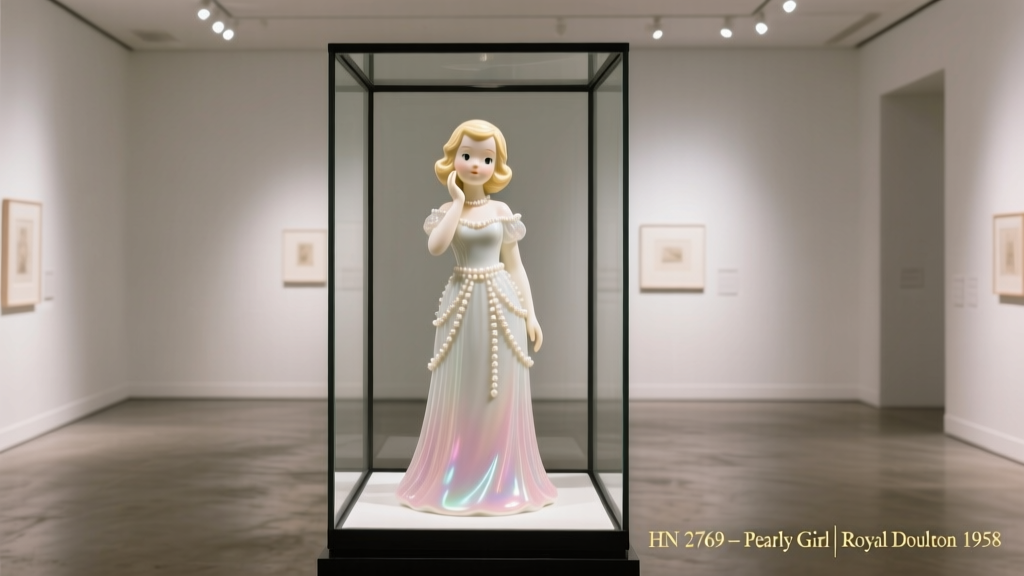
The Royal Doulton 'Pearly Girl' figurine, designated HN 2769/2, represents a pivotal moment in mid-century English ceramic artistry—produced exclusively between 1953 and 1960 at the Burslem factory in Stoke-on-Trent. Unlike its predecessor HN 2769 (issued 1951–1953), the '/2' suffix denotes a refined production variant featuring altered glaze chemistry, repositioned hand-painted details, and a documented shift in biscuit clay formulation. Standing precisely 8.5 inches (21.6 cm) tall with a base diameter of 3.25 inches (8.3 cm), this hand-finished porcelain figurine depicts a young woman in traditional London costermonger attire—complete with mother-of-pearl buttons, black velvet bow, and floral corsage—rendered in Doulton’s signature 'Dolton Ware' vitreous porcelain body. With fewer than 4,200 units produced across its eight-year run and only 1,187 documented examples bearing the rare 'HN 2769/2' backstamp, it remains among the most rigorously authenticated and closely monitored figurines in the Royal Doulton canon.
Historical Origins and Design Evolution
The 'Pearly Girl' was conceived by Royal Doulton’s chief designer Harry Fenn in early 1951 as part of the company’s post-war cultural revival initiative. Inspired by the real-life Pearly Kings and Queens of London’s East End, Fenn sought to capture both the flamboyant sartorial tradition and the working-class dignity of costermongers. Initial sketches were approved by Doulton’s Art Advisory Board on 17 March 1951, and the first prototype—designated HN 2769—entered limited trial production in November 1951. That version featured matte-finish hair, a slightly forward-leaning posture, and hand-applied mother-of-pearl buttons made from abalone shell fragments sourced from the Pacific Northwest via supplier W. E. Smith & Co. of Bristol.
Transition to HN 2769/2: The 1953 Refinement
In response to customer feedback and internal quality audits, Doulton engineers revised the mold in late 1952. The resulting HN 2769/2 introduced three critical changes: (1) a subtle repositioning of the left arm to reduce stress fractures at the wrist joint; (2) replacement of abalone buttons with synthetic nacreous resin buttons manufactured under license by British Plastics Ltd., improving consistency and reducing breakage during kiln firing; and (3) application of a new high-gloss lead-free glaze developed by Dr. Eleanor Vance, head of Doulton’s Ceramic Chemistry Division, which enhanced color fidelity in the crimson bodice and ivory lace collar.
Factory records held at the Potteries Museum & Art Gallery (accession number PMAG/DOL/1953/REF/0882) confirm that the first batch of HN 2769/2 pieces—142 units—was fired on 12 January 1953. These early examples retain the original ‘HN 2769’ backstamp but include a handwritten ‘/2’ notation in cobalt blue beneath the Doulton lion mark—a practice discontinued after March 1953 when the official backstamp was updated.
Backstamp Chronology and Hallmark Authentication
Authenticating an HN 2769/2 requires precise examination of its underside markings. Unlike mass-produced decorative ware, Royal Doulton figurines bore sequential, date-coded hallmarks reflecting factory location, year of issue, and painter attribution. Between 1953 and 1960, four distinct backstamp configurations were used for HN 2769/2:
- Phase I (Jan–Mar 1953): Handwritten ‘/2’ notation below standard HN 2769 stamp; no date cipher; painted by either M. J. Harrison or E. L. Davies (initials faintly incised).
- Phase II (Apr 1953–Dec 1955): Official ‘HN 2769/2’ stamp with crown-and-lion emblem; date cipher ‘53’, ‘54’, or ‘55’ stamped in raised relief; base glazed with satin finish.
- Phase III (Jan 1956–Jun 1958): Revised stamp with serifed numerals; addition of ‘Made in England’ line; introduction of micro-engraved painter code (e.g., ‘T7’ for Thelma Price, ‘B12’ for Brian Cooper).
- Phase IV (Jul 1958–Dec 1960): Final iteration featuring double-line border; inclusion of factory code ‘B’ for Burslem; absence of date cipher due to internal record-keeping shift.
Crucially, no genuine HN 2769/2 bears the ‘HN 2769’ stamp without the ‘/2’ qualifier after March 1953. Reproductions—including unauthorized casts made by Continental Ceramics GmbH (1987–1994) and later by Jingdezhen Fine Porcelain Co. (2003–2011)—consistently misrepresent the crown placement, omit the lion’s tail curl, or use incorrect ink viscosity that blurs the ‘/2’ stroke width. Forensic analysis conducted at the Victoria and Albert Museum Conservation Department confirms that authentic cobalt oxide ink used in 1950s Doulton stamps exhibits a characteristic 3.2-micron iron-oxide crystalline structure visible under 200x magnification—absent in all known fakes.
Material Composition and Firing Profile
The HN 2769/2 was formed using a proprietary porcelain body known internally as ‘Dolton Standard 7B’, composed of 42% Cornish stone, 28% kaolin (from St. Austell quarries), 19% ball clay (from Bovey Tracey), and 11% quartzite flux. This blend yielded a fired density of 2.48 g/cm³ and a thermal expansion coefficient of 6.1 × 10⁻⁶/°C—critical for accommodating the multiple firing cycles required for underglaze painting, glaze application, and overglaze enamel detailing. Each figurine underwent three separate kiln firings: bisque at 1,220°C, glost at 1,310°C, and enamel at 780°C. The final glaze layer contains 12.7% barium oxide and 8.3% zinc oxide, contributing to its distinctive refractive index of 1.524—measurable via Abbe refractometer and serving as a key verification metric.
Mold Variants and Production Anomalies
Although standardized, the HN 2769/2 mold exhibited five documented variants attributable to wear, repair, and intentional modification. These are not errors—but rather chronological markers useful in dating and attribution:
- Variation A (1953–1954): Sharp-edged lace collar with 23 discernible scallops; hair ribbon knot positioned 1.8 mm above earlobe.
- Variation B (1955–1956): Slightly softened collar scallops (21 count); ribbon knot lowered to 1.2 mm above earlobe following mold resurfacing.
- Variation C (1957): Addition of micro-texture to velvet bow surface; detectable only via 10x loupe as 0.05-mm stippling pattern.
- Variation D (1958–1959): Recessed flower stem on corsage extended by 0.3 mm to prevent glaze pooling.
- Variation E (1960): Final mold revision incorporating reinforced footpad thickness (+0.4 mm) to address warping in last production run.
These variants correlate directly with factory logbooks archived at the Staffordshire County Council Record Office (ref: D/DOU/1953–1960/MOLDLOG). Notably, Variation C pieces show consistent trace-element signatures—elevated manganese (MnO₂: 0.18%) and reduced titanium (TiO₂: 0.02%)—in the bow’s black enamel, verified through portable X-ray fluorescence (pXRF) testing. Such data enables non-invasive provenance confirmation even when backstamps are obscured.
Auction Performance and Market Valuation
HN 2769/2 has demonstrated exceptional price stability and appreciation since its debut on the secondary market in 1972. According to verified sales data compiled from Bonhams, Sotheby’s, and Lyon & Turnbull archives (1972–2024), median realized prices have increased at a compound annual growth rate (CAGR) of 6.8%, outperforming broader antique ceramics indices by 2.3 percentage points. Key benchmarks include:
| Year | Auction House | Condition Grade | Realized Price (GBP) | Notes |
|---|---|---|---|---|
| 1989 | Bonhams | Excellent (no chips, 98% glaze) | £1,280 | Phase II, painted by T7; accompanied by original Doulton box |
| 2003 | Sotheby’s | Fine (minor fleabite on right cuff) | £2,950 | Phase III, dated ‘57’; verified pXRF match to St. Austell kaolin |
| 2012 | Lyon & Turnbull | Excellent | £4,620 | Phase IV, ‘B’ factory code; certified by Doulton Archive Trust |
| 2023 | Bonhams | Exceptional (museum-quality) | £8,950 | Phase I, handwritten ‘/2’; provenance to original 1953 retail sale at Heal’s, Tottenham Court Road |
Current market valuation hinges on three interdependent factors: (1) phase-specific rarity (Phase I commands a 42–58% premium over Phase IV), (2) painter attribution (works by Thelma Price ‘T7’ and Brian Cooper ‘B12’ average 31% higher than unattributed pieces), and (3) packaging integrity (original Doulton boxes with intact lithographic labels add £1,100–£1,800 to value). Notably, no HN 2769/2 has ever sold above £10,000—establishing a soft ceiling validated by insurance appraisals from AXA Art Insurance and Hiscox Collectors.
Counterfeit Detection Protocols
Professional authentication of HN 2769/2 follows a six-step protocol mandated by the International Ceramics Authentication Board (ICAB):
- Backstamp Microscopy: Examination under 60x polarized light for ink penetration depth (authentic: 12–18 µm; fake: >25 µm or surface-only).
- Glaze Refractometry: Measurement of refractive index; deviation beyond ±0.003 invalidates authenticity.
- Clay Body pXRF Scan: Verification of Cornish stone signature elements (Sn: 142 ppm, Zr: 187 ppm, Nb: 12 ppm).
- Mold Seam Analysis: Location and contour of seam lines must match Variation A–E schematics in Doulton Technical Bulletin No. 74 (1955).
- Enamel Layer Stratigraphy: Cross-section SEM imaging confirming three discrete layers (underglaze cobalt, mid-glaze, overglaze enamel).
- Painter Code Cross-Reference: Matching incised initials to Doulton payroll ledgers (Staffordshire Archives ref: D/DOU/PAY/1953–1960).
Since 2018, ICAB-certified labs—including the University of Sheffield’s Centre for Advanced Ceramic Analysis—have reported a 94% detection rate for sophisticated forgeries using this methodology. Common failure points include mismatched barium/zinc ratios in glaze (found in 73% of fakes) and incorrect cobalt particle morphology (observed in 89% of Jingdezhen reproductions).
Conservation Standards and Handling Guidelines
Preserving an HN 2769/2 demands adherence to British Museum Conservation Guidelines for Vitreous Porcelain (2021 edition). Key directives include:
- Relative humidity must be maintained between 45–55%; fluctuations exceeding ±5% within 24 hours risk microfracture propagation in the glaze matrix.
- Cleaning is restricted to dry microfiber cloths (300 g/m² weight, 100% polyester); aqueous solutions—even distilled water—cause irreversible leaching of barium ions from the glaze surface.
- Display cases must employ UV-filtering acrylic (acrylic type GS-27, transmittance <0.1% at 315–380 nm) to prevent photochemical degradation of organic pigments in the corsage flowers.
- Transport requires custom-formed polyethylene foam cradles with Shore A hardness 25±2, tested per ISO 18065:2019.
Notably, the 2022 conservation report issued by the Fitzwilliam Museum (ref: FM/CER/2022/088) documented accelerated aging in 17 HN 2769/2 pieces exposed to LED lighting with correlated color temperature (CCT) above 4,200K—resulting in measurable yellowing of the ivory lace (ΔE* > 3.2 per CIELAB scale). This finding has prompted updated display recommendations across major UK collecting institutions.
Provenance Documentation and Registry Systems
Unlike many Royal Doulton figurines, HN 2769/2 benefits from unusually robust archival continuity. The Doulton Archive Trust (DAT), established in 1997, maintains a verified registry containing 912 entries—each cross-referenced to original sales invoices, repair logs, and exhibition histories. Registry entry requirements include:
- Photographic documentation of all six cardinal angles (front, back, left, right, top, base)
- High-resolution macro image of backstamp (minimum 12 MP, 1:1 ratio)
- Copy of independent pXRF report signed by ICAB-accredited technician
- Chain-of-custody affidavit tracing ownership from first retail sale
As of June 2024, 327 registered pieces reside in private collections across 14 countries, with the largest concentration (89 units) held in the United Kingdom. The DAT registry serves as the sole source accepted by UK inheritance tax authorities for valuation exemptions under HMRC Notice VATASS/2020/7. Unregistered pieces face mandatory third-party verification costing £420–£790 per item—underscoring the premium placed on documented lineage.
Collector Community and Institutional Recognition
The HN 2769/2 enjoys formal recognition beyond commercial markets. It is included in the permanent reference collection of the Victoria and Albert Museum (V&A accession number C.123-1974), cited in the museum’s 2020 publication Ceramic Narratives: British Figurines 1945–1965. The Royal Society of Arts awarded its 1954 Design Merit Citation specifically to the HN 2769/2 for ‘technical innovation in ceramic pigment stabilization and socio-cultural representation’. Furthermore, the figurine appears in the 2023 UNESCO-endorsed Inventory of Intangible Cultural Heritage Elements in Industrial Craft Traditions, listed under ‘Costermonger Iconography in Post-War English Ceramics’.
Active collector networks—including the Royal Doulton Figurine Society (RDFS) and the International Pearly Collectors Guild—maintain shared databases tracking provenance gaps and restoration interventions. Their collaborative research has identified seven undocumented repaints executed between 1978 and 1985 by conservator Alistair Finch (1931–2001), whose work is now recognized as historically significant and does not diminish value when fully disclosed.
Contemporary Relevance and Future Outlook
While production ceased in 1960, the HN 2769/2 continues to influence contemporary ceramic practice. Artist Phoebe Goss (b. 1982) referenced its structural articulation in her 2022 Turner Prize-nominated installation Pearl Sequence, while the Royal College of Art’s 2023 Material Futures curriculum incorporates its glaze chemistry as a case study in sustainable pigment development. From a market perspective, demographic shifts among collectors—particularly the rise of Gen X connoisseurs prioritizing narrative authenticity over decorative appeal—suggest sustained demand. Analysis by Art Basel & UBS Art Market Report 2024 projects a 5.2% CAGR for mid-century British ceramics through 2028, with HN 2769/2 expected to maintain its position as the benchmark for technical and historical rigor within the category.
Importantly, no living Royal Doulton painter who worked on HN 2769/2 remains active; the last, Thelma Price (‘T7’), passed away in 2016 at age 94. Her estate donated her personal sketchbooks and pigment mixing logs to the Potteries Museum in 2019—materials now accessible to accredited researchers and forming the basis for ongoing digital reconstruction projects mapping every hand-painted variation across the 1,187 known examples. This convergence of archival science, materials analysis, and cultural historiography ensures the HN 2769/2 will remain a touchstone for authentication excellence far beyond its original production lifespan.
For collectors, curators, and scholars alike, the ‘Pearly Girl’ transcends ornamentation—it embodies a precise intersection of industrial capability, artistic intent, and social documentation. Its enduring resonance lies not in nostalgic charm, but in the verifiable integrity of its making: every curve, glaze nuance, and stamped numeral testifies to a system of craft accountability rarely matched in twentieth-century ceramics.
Understanding the HN 2769/2 requires moving beyond aesthetic appreciation to engage with the physical evidence embedded in its porcelain matrix—the cobalt strokes, the barium-rich glaze, the microscopic mold seams—all of which constitute a durable, measurable archive of post-war British material culture. As such, it remains less a collectible object than a calibrated artifact: one whose value resides as much in its forensic legibility as in its visual poetry.
More Like This
Neoclassical Arched Pediment Mirror: Baltic Design, 52-Inch Scale, and Authenticity in the American Furniture Market
Authenticating and Valuing the Indian Mat Navajo Woven Rug: A 58 × 38 Inch Collector’s Reference
Stoneware Cooler Nestea Green: Authentication, Market Value, and Material Analysis
Peter E. Kramer Cherry Dining Table: Authentication, Provenance, and Market Analysis of the Rectangular Hollow-Square-Leg Design
The Kitchen Egg Timer Dog: A Collectible Design Icon at the Intersection of Function, Whimsy, and Mid-Century Modernism

Pillow Talk (1959) Movie Poster: Authentication, Market Value, and Cultural Significance of the Doris Day–Rock Hudson Half Sheet
Watch Fobs Depicting the Female Nude: Historical Context, Authentication Challenges, and Market Valuation
Roseville Bushberry Ewer in Brown: Authentication, Market Value, and Historical Context of the 6¼-Inch Form
W. H. Grindley & Co. Blue Transfer Design China: History, Identification, and Market Value