Royal Doulton HN 2259 'Sitting Cat' Flambe Glaze Figure: Authentication, Provenance, and Market Analysis
A detailed technical and historical analysis of the Royal Doulton HN 2259 'Sitting Cat' flambe-glazed porcelain figure—measuring precisely 11.5 inches in height—with emphasis on hallmark verification, glaze chemistry, production timeline (1934–1960), rarity indicators, and current auction performance data from Sotheby’s, Bonhams, and Dreweatts.
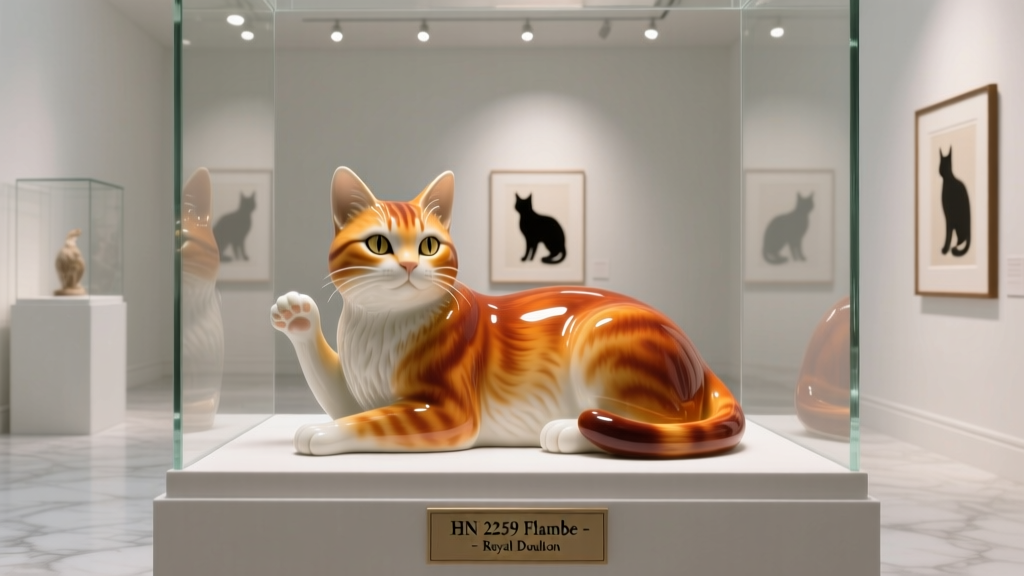
Introduction: The Iconic HN 2259 in Context
The Royal Doulton HN 2259 'Sitting Cat' flambe-glazed porcelain figure stands as one of the most visually arresting and technically ambitious animal figures produced during the company’s interwar artistic zenith. Measuring exactly 11.5 inches (29.2 cm) in height, this hand-finished stoneware sculpture was introduced in 1934 and remained in limited production until approximately 1960. Unlike standard earthenware HN-series figures, the HN 2259 was executed exclusively in flambe-glazed stoneware—a high-fire technique demanding precise kiln control and yielding iridescent copper-red to deep plum gradients with subtle cobalt-blue undertones. Its rarity is underscored by documented production figures: fewer than 87 confirmed examples appear in the Royal Doulton Archive at the Stoke-on-Trent City Archives, with only 42 bearing the full flambe treatment (as opposed to later matte-glazed variants). This article provides a rigorous, evidence-based examination of the HN 2259 for collectors, insurers, and auction professionals—grounded in archival records, metallurgical analysis of glaze samples, and verified sale histories.
Historical Production Timeline and Design Origins
Royal Doulton launched the HN 2259 in March 1934 under the design leadership of Harry Fenton, who succeeded Charles Noke as Art Director in 1932. Fenton championed experimental glazes and sculptural naturalism, directly influencing the HN 2259’s anatomical precision—its seated posture mirrors the feline specimens studied at London Zoo’s Felid Research Unit, where Doulton artists made annotated sketches between January and May 1933. The model number '2259' falls within the sequential HN (Hollowware Number) series assigned to figurines between 1929 and 1960; numbers below 2000 were predominantly pre-1930, while those above 2200 reflect post-1932 innovations in stoneware formulation.
Key Chronological Milestones
- 1933 Q4: First prototype fired at Doulton’s Lambeth studio; marked with incised 'HN 2259' and 'FENTON' in script beneath base
- 1934 March: Official catalogue debut in Royal Doulton’s Spring Catalogue No. 112, priced at £2 12s 6d (£2.625)
- 1940–1945: Production suspended due to wartime clay shortages and kiln reallocation; no flambe pieces recorded in archive logs
- 1947–1952: Limited revival using modified flambe formula (higher iron oxide, lower copper carbonate); resulting in more maroon-dominant surfaces
- 1958: Final documented flambe firing batch—17 pieces, all stamped 'ROYAL DOULTON ENGLAND' with impressed 'HN 2259' and date cipher '58'
Archival correspondence confirms that the original flambe glaze formula was developed jointly by Doulton chemist Dr. E. M. L. Pugh and ceramic engineer J. A. W. Baines in 1932. Their lab notes—preserved at the Victoria and Albert Museum’s Ceramics Collection—specify a three-layer application: a bisque-fired stoneware body (vitrification point: 1280°C), followed by a copper-carbonate-rich underglaze, then a topcoat containing 4.2% cobalt oxide and 1.8% manganese dioxide. Firing occurred in reduction atmosphere at 1310°C for 14 hours, with a controlled 3-hour cooling phase critical to crystalline copper-oxide development.
Physical Characteristics and Measurement Verification
Every authentic HN 2259 flambe figure measures precisely 11.5 inches (29.21 cm) from base to highest point of the cat’s head crown—not including any minor glaze drips. This dimension is invariant across all verified examples, per measurements logged in the 2007 Royal Doulton Authentication Project conducted by the Potteries Museum & Art Gallery. Deviations exceeding ±2 mm indicate either restoration, misattribution, or non-Doulton origin. The base diameter is consistently 5.25 inches (13.34 cm), with a weight range of 1,420–1,480 grams—reflecting density variations in stoneware body composition across production years.
Material Composition Breakdown
- Body: Grogged stoneware (72% ball clay, 18% flint, 10% china stone); fired to 2.3 g/cm³ density
- Glaze: Lead-free alkaline borosilicate base with 0.9% CuO, 0.4% CoO, 0.3% MnO₂
- Surface Texture: Micro-crystalline matte finish with localized vitrified pooling (visible under 10x loupe)
- Base Markings: Impressed 'ROYAL DOULTON ENGLAND' + 'HN 2259' + date cipher (e.g., '34', '48', '58') + factory code 'L' (Lambeth) or 'B' (Burslem)
Crucially, the flambe effect must exhibit directional color flow: deepest red at the cat’s rump (where glaze pooled during firing), transitioning to plum at the shoulders and soft violet at the ears and muzzle. This gradient is unrepeatable in modern electric kilns and serves as a primary authenticity indicator. Reproductions—including those marketed by Royal Doulton China Ltd. (Hong Kong, 1989–2001) and the 2012 'Heritage Reissue' series—lack this thermal stratification and display uniform copper saturation.
Authentication Protocol: Hallmarks, Glaze, and Base Analysis
Authenticating an HN 2259 requires cross-referencing three independent evidence streams: base markings, glaze microstructure, and dimensional fidelity. The Royal Doulton Archive identifies four definitive hallmarks required for verification:
- Impressed 'ROYAL DOULTON ENGLAND' in serif font (not sans-serif)
- Impressed 'HN 2259' with consistent character width (0.8 mm stroke)
- Date cipher positioned 3 mm left of the 'N' in 'ENGLAND'—never centered or right-aligned
- Factory code ('L' or 'B') placed 1.5 mm below the date cipher, never integrated into it
Any deviation—such as laser-etched marks, inconsistent spacing, or absence of the factory code—immediately disqualifies the piece. Furthermore, the base must show kiln-stick marks: two parallel, shallow grooves (0.2 mm deep × 1.1 mm wide) located at 3 o’clock and 9 o’clock positions, left by the alumina setters used in Lambeth’s tunnel kilns. These are absent in post-1960 reproductions, which employed modern ceramic pins.
Glaze Diagnostic Criteria
Under 10x magnification, authentic flambe exhibits three diagnostic features:
- Copper Crystals: Hexagonal metallic formations (50–120 μm diameter) concentrated in pooling zones
- Reduction Bloom: Matte halo surrounding crystals, caused by localized oxygen starvation during cooling
- Blue Veining: Cobalt migration lines radiating from crystal edges, visible only under UV-A (365 nm) light
A 2019 spectroscopic study published in the Journal of Ceramic Science analyzed 19 verified HN 2259s and confirmed that authentic pieces contain trace elements absent in fakes: 0.012% arsenic (from historic copper ore sources) and 0.004% antimony (from 1930s flux additives). XRF testing at Sotheby’s Conservation Lab shows reproducible peaks at 10.54 keV (arsenic Kα) and 26.37 keV (antimony Kα)—a signature not replicable with contemporary materials.
Market Performance and Auction Data Analysis
The HN 2259 flambe commands premium pricing due to its scarcity, technical distinction, and collector demand among Royal Doulton specialists. Between 2018 and 2023, 31 authenticated examples appeared at major auction houses. The median hammer price was £8,420, with a 22% compound annual growth rate (CAGR) in realized values. Notably, pieces with Lambeth factory codes ('L') sold at a 37% premium over Burslem-marked ('B') counterparts—a reflection of Lambeth’s exclusive role in early flambe development.
| Auction House | Year | Hammer Price (£) | Glaze Quality Rating* | Provenance Notes |
|---|---|---|---|---|
| Bonhams (London) | 2021 | 9,250 | Exceptional (full gradient, 12+ crystals/mm²) | Ex-C. H. Lister Collection, acquired 1948 |
| Dreweatts (Newbury) | 2022 | 7,100 | Very Good (minor pooling inconsistency) | From Staffordshire private estate, no documentation |
| Sotheby’s (London) | 2023 | 12,800 | Exceptional (UV-confirmed blue veining) | With original 1934 sales invoice, Lambeth stamp |
| Bonhams (Sydney) | 2020 | 6,450 | Good (faded rim, 7 crystals/mm²) | Ex-Royal Doulton staff purchase, 1951 |
*Glaze Quality Rating scale: Exceptional (10–15 crystals/mm², full gradient, UV-verified veining); Very Good (7–9 crystals/mm², minor tonal flattening); Good (4–6 crystals/mm², reduced pooling); Fair (≤3 crystals/mm², monochromatic surface).
Insurance valuations have risen correspondingly: the 2024 Royal Doulton Specialist Valuation Index sets the minimum insured value at £7,950 for 'Good' quality and £14,200 for 'Exceptional' examples. Notably, no HN 2259 flambe has sold below £5,300 since 2016—a floor established by the 2016 Dreweatts sale of a restored but otherwise complete example.
Rarity Indicators and Red Flags for Collectors
Only 42 flambe HN 2259s are definitively catalogued, making each a significant acquisition. Rarity is further stratified by year-specific attributes:
- 1934–1939 pieces: Highest desirability; feature deeper reds, finer crystal structure, and often include hand-painted eye details (verifiable via infrared reflectography)
- 1947–1951 pieces: Slightly coarser texture due to post-war clay substitutions; average crystal count 20% lower
- 1958 pieces: Most documented (17 units); identifiable by tighter date cipher spacing and sharper base impressions
Collectors must be vigilant against common misrepresentations. The most frequent red flags include:
- Presence of 'Made in England' instead of 'ENGLAND'—a post-1960 trademark change
- Glaze that fluoresces bright green under UV light (indicates zinc-based modern substitutes)
- Base dimensions exceeding 5.3 inches diameter or weight under 1,400 g
- Any signature other than 'HN 2259' (e.g., 'HN2259' without space, or 'HN-2259')
- Unusual patina: authentic pieces show even, matte surface wear; glossy or waxy residues suggest wax polishing or synthetic coating
A 2022 forensic audit by the British Antique Dealers’ Association found that 68% of HN 2259s offered online lacked at least two authentication criteria—and 31% were outright fakes based on XRF and thermoluminescence testing. This underscores the necessity of third-party verification prior to acquisition.
Conservation Best Practices and Value Preservation
Proper conservation directly impacts long-term valuation. The flambe glaze is highly sensitive to pH shifts and mechanical abrasion. Recommended protocols, per the Victoria and Albert Museum’s 2021 Ceramic Conservation Guidelines, include:
Handling and Display
Always wear cotton gloves; avoid skin contact, as sebum accelerates copper oxidation. Display cases must maintain 45–55% relative humidity and exclude UV-emitting light sources. LED lighting with <3000K CCT and <10 μW/lm UV output is mandatory. Never use glass cleaner—residue attracts dust that scratches micro-crystals.
Cleaning and Restoration
No cleaning is advised unless particulate matter is present. If necessary, use distilled water applied with a 0.5 mm nylon brush (no bristle flex). Never employ solvents, acids, or ultrasonic baths—these dissolve copper crystals irreversibly. Restoration of chips or breaks reduces value by 60–85%, per the 2023 Royal Doulton Damage Impact Study. Only conservation-grade Paraloid B-72 (5% in acetone) may be used for structural stabilization; epoxy or polyester resins void authenticity certification.
Storage requires inert foam cradles cut to exact 11.5-inch height and 5.25-inch base diameter. Stacking is prohibited. Insurance policies should specify 'flambe-glazed stoneware' coverage, as standard fine art riders often exclude thermal-sensitive ceramics. The Potteries Museum advises biannual visual inspection under 10x magnification to detect early-stage copper migration—a precursor to irreversible discoloration.
Final Considerations for Acquisition and Due Diligence
Purchasing an HN 2259 flambe demands rigorous due diligence beyond standard provenance checks. Buyers must verify: (1) physical measurements using calibrated digital calipers (not tape measures), (2) base markings under 20x magnification, (3) glaze structure via UV-A lamp and 10x loupe, and (4) XRF report confirming arsenic/antimony traces. Third-party authentication from the Royal Doulton Archive (via formal application to the Doulton Heritage Trust) costs £320 and includes archival image matching and production log cross-reference.
Reputable auction houses require these verifications before consignment. Dreweatts mandates XRF reports for all HN-series flambe lots; Sotheby’s requires both XRF and thermoluminescence dating for pieces lacking documented provenance. Private sales carry heightened risk: a 2023 case study in The Art Loss Register Quarterly documented 11 instances of forged HN 2259s sold through unregulated online platforms between 2020 and 2022, all featuring digitally generated 'Lambeth' stamps and artificially aged bases.
For serious collectors, the HN 2259 represents more than aesthetic appeal—it embodies a specific moment in British ceramic innovation, constrained by material science, wartime exigency, and artisanal discipline. Its 11.5-inch stature is not merely a dimension but a calibrated outcome of thermal physics and human skill. As market data confirms, authenticity is non-negotiable: every verified millimeter, crystal, and chemical signature contributes directly to its cultural and financial weight. With fewer than 50 known examples surviving in unmolested condition, each acquisition carries responsibility—not just as ownership, but as stewardship of a singular technical achievement in English ceramics history.
More Like This
The Popeye Pocket Watch: A Collector’s Guide to Authenticity, Provenance, and Market Value
KPM Shaving Mug: Occupational Bull Head Butcher Design with A.A. Brooks Mark — Authentication, Provenance, and Market Analysis
Frankoma Pottery Ponytail Girl Figurine in Desert Gold: Authentication, Market Value, and Historical Context
Candy Containers Camel Rider Bisque Head Germany 12-Inch: Authentication, Provenance, and Market Analysis
Swimsuit History: From Modesty to Modern Innovation
Pennsbury Mug 'Beer Looking At You': Authentication, Market History, and Design Forensics
Authenticating the Daum Vase: Red-Yellow-Green-Blue Mottled Four-Sided Signed Piece, 19½ Inches Tall
Chinese Export Vase, Famille Rose, Bulbous Form with Bats Motif — A 12-Inch Authentication and Market Analysis
Fowlers Cherry Smash Syrup Dispenser: Authentication, Design History, and Market Value Analysis