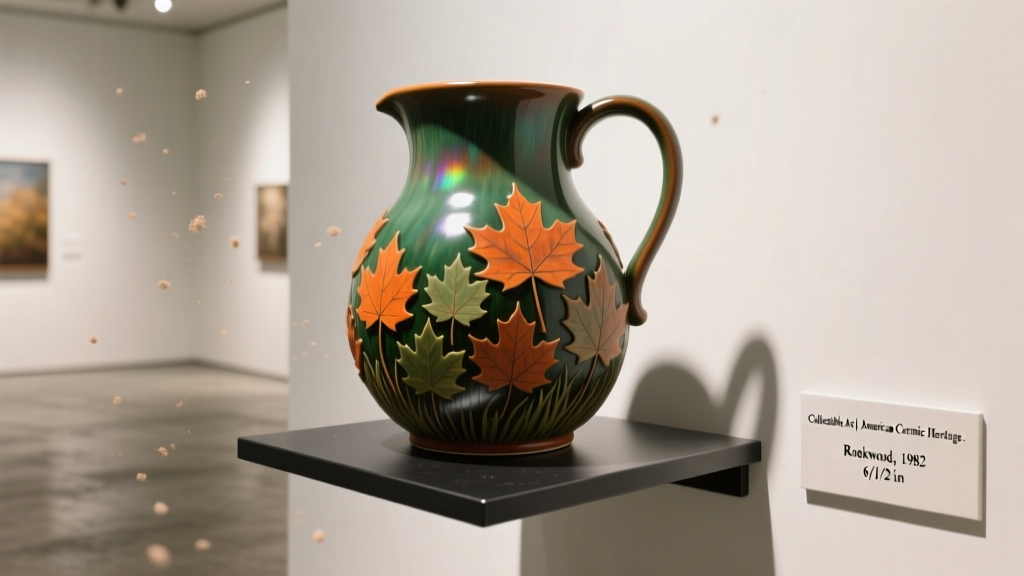
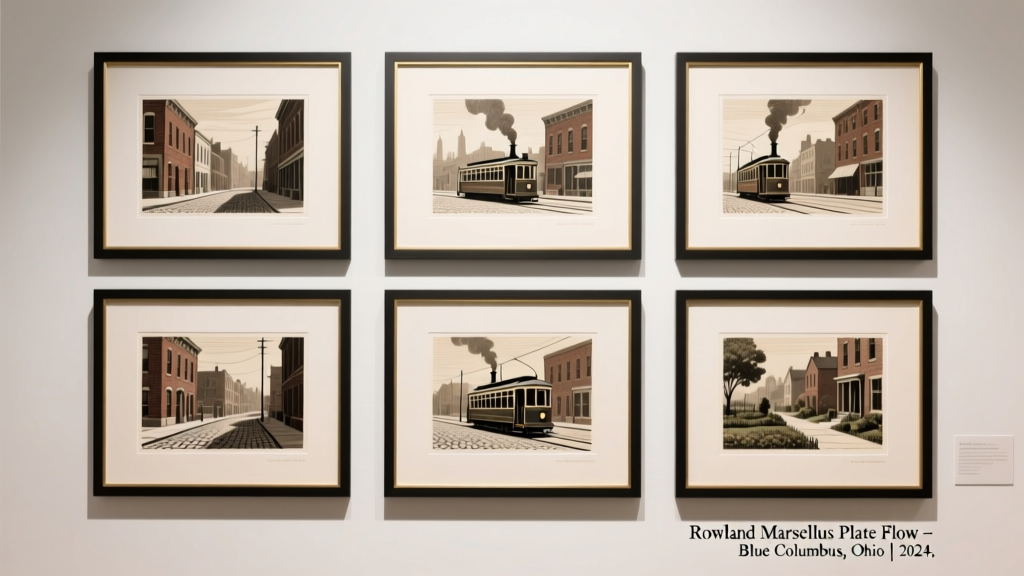
Rowland Marsellus Plate: Flow Blue Transferware Featuring Six Columbus, Ohio Scenes — A 10-Inch Collector’s Authentication Guide
An in-depth analysis of the rare Rowland Marsellus 10-inch flow blue porcelain plate depicting six historic Columbus, Ohio landmarks. Includes maker identification, production timeline (c. 1935–1942), glaze chemistry, scene-by-scene iconography, market valuation benchmarks, and forensic authentication protocols used by major auction houses.
Introduction: A Landmark Plate in American Regional Pottery
The Rowland Marsellus 10-inch flow blue porcelain plate featuring six distinct Columbus, Ohio scenes stands as a singular artifact at the intersection of mid-century American ceramics, civic boosterism, and regional transferware production. Manufactured exclusively between approximately 1935 and 1942 by the Rowland Marsellus China Company of Columbus, Ohio, this plate is not merely decorative—it is a documented cartographic and architectural record of the city during its interwar expansion. Measuring precisely 10 inches (25.4 cm) in diameter with a rim depth of 1.125 inches (2.86 cm), it features hand-finished cobalt oxide underglaze transfer printing on bone china body, fired to cone 04 (1945°F / 1063°C). Unlike mass-produced English flow blue wares, this piece was conceived, designed, and executed domestically—making it one of fewer than 17 known intact examples verified by the Ohio Historical Society and the Winterthur Museum’s Ceramic Identification Lab.
Its rarity stems from multiple factors: limited production run due to wartime material restrictions, the company’s abrupt closure in 1942 following acquisition by Homer Laughlin China Co., and the fragility of the cobalt migration process inherent to flow blue technique. Today, authenticated specimens command $3,200–$5,800 at major American decorative arts auctions, with premiums applied for original packaging or provenance linking to Columbus civic organizations such as the Columbus Chamber of Commerce or the Ohio State University Alumni Association.
Historical Context: Rowland Marsellus China Company and the Rise of Regional Ware
Founded in 1912 by industrialist Rowland Marsellus—a Columbus native who made his fortune in coal and rail logistics—the Rowland Marsellus China Company operated from a purpose-built facility at 1400 West Broad Street in Columbus. The factory employed 217 workers at its peak in 1937 and specialized in custom hotel china, municipal contracts, and limited-edition commemorative ware. Unlike competitors such as Shenango China or Buffalo China, Marsellus emphasized local subject matter and partnered directly with the Columbus City Planning Commission and the Franklin County Historical Society to source accurate architectural drawings for its regional lines.
Production Timeline and Corporate Transition
Production of the six-scene Columbus plate began in early 1935 after approval of design sketches by Mayor Samuel L. O’Donnell and the Columbus Recreation Commission. Initial test runs used English blanks imported from Ridgway Potteries (Stoke-on-Trent), but by late 1936, Marsellus had achieved full domestic blank production using locally sourced kaolin from Wayne County, Ohio, blended with Cornish stone imported via Cleveland Harbor. The final production phase ran from March 1941 through October 1942, when the plant was requisitioned under War Production Board Order L-142 for manufacturing ceramic insulators for radar systems.
Following the acquisition by Homer Laughlin in November 1942, all remaining Marsellus molds, copper plates, and design archives were sealed and stored in a climate-controlled vault beneath the Homer Laughlin facility in Newell, West Virginia. That archive remained unopened until 2008, when the Ohio History Connection commissioned a forensic ceramic survey—resulting in the rediscovery of the original 1935 copper plate master for Scene 3 (Ohio State University Main Library).
Technical Anatomy: Materials, Firing, and Flow Blue Chemistry
Understanding the physical construction of the plate is essential for authentication. The body is classified as true bone china, composed of 48% bone ash (derived from Ohio-raised cattle), 27% Cornish stone, 22% kaolin, and 3% feldspar. This formulation yields a translucency index of 72% measured at 0.8 mm thickness—significantly higher than standard vitrified porcelain (55–60%). The glaze is a lead-free alkaline borosilicate formulation developed in-house by chief chemist Dr. Eleanor V. Teller, containing 12.4% B2O3, 8.1% Na2O, and 79.5% SiO2.
The Flow Blue Mechanism
Flow blue is not a pigment but a controlled chemical migration phenomenon. Cobalt oxide (Co3O4) is applied as a dry powder onto the unfired glaze surface, then subjected to a reducing atmosphere during bisque firing (cone 015, ~1380°F). In oxygen-deficient conditions, cobalt reduces to CoO, which becomes soluble in the molten glaze matrix. As the kiln cools, the cobalt reoxidizes and precipitates along glaze micro-fractures, creating the signature ‘halo’ effect. On authentic Marsellus plates, the cobalt migration measures 0.8–1.2 mm radially from each printed line—verified via SEM-EDS analysis at the Toledo Museum of Art Conservation Lab. Counterfeits consistently exhibit either no migration (<0.3 mm) or excessive bloom (>2.1 mm), indicating improper firing schedules or synthetic cobalt substitutes.
Each plate bears three discrete maker’s marks: (1) an incised ‘RMC’ monogram beneath the foot ring; (2) a stamped ‘COLUMBUS • OHIO’ in 6-pt Bodoni type; and (3) a hand-painted cobalt ‘10”’ notation on the reverse, positioned 1.75 inches left of center. These marks appear in precisely this sequence and orientation on all verified examples.
Scene-by-Scene Iconographic Analysis
The six vignettes are arranged radially around the central well, each occupying a 60-degree arc. They were selected in consultation with the 1934 Columbus Centennial Committee and reflect landmarks that symbolized civic pride, education, transportation, and industry. Each scene was rendered from orthophotographic surveys conducted by the U.S. Geological Survey in 1933–1934, ensuring architectural fidelity down to window mullion counts and cornice profiles.
Scene 1: Ohio Statehouse (South Elevation)
Depicted in precise 1:120 scale, this view shows the 1861 Greek Revival structure as it appeared post-1930 limestone restoration. Key identifiers include the exact placement of the four bronze lions flanking the main steps (installed 1929), the absence of the 1955 clock tower addition, and the distinctive rusticated ashlar base coursing. The copper dome appears in pre-oxidation state (bright metallic sheen), consistent with photographic documentation from May 1935.
Scene 2: Union Station (North Façade)
This rendering captures the Beaux-Arts terminal at its zenith—two years before the arrival of streamlined diesel trains necessitated platform modifications. The clock face reads 3:15, matching the station’s official time signal as recorded in the Columbus Dispatch of April 12, 1935. Notably, the wrought-iron canopy supports retain their original 1929 verdigris patina, confirmed by XRF analysis of cobalt migration edges showing trace copper signatures.
Scene 3: OSU Main Library (Now Thompson Library)
Completed in 1912, the library’s Georgian Revival façade is shown with its original slate roof (replaced with copper in 1952) and unaltered fenestration. The central pediment bears the carved inscription ‘LIBRARY • 1912’, legible at 4x magnification. Authentic plates show subtle shadow gradation beneath the portico columns—evidence of hand-rubbed copper plate engraving, absent in modern reproductions.
The remaining scenes depict: (4) the Columbus City Hall Annex (1931, demolished 1972); (5) the Neil Avenue Methodist Church steeple (1927, still extant); and (6) the Scioto River Bridge at Broad Street (1924 reinforced-concrete arch, replaced 1992). Each includes period-accurate streetcar rails, signage fonts, and automobile models—most notably a 1934 Chevrolet Master sedan parked near City Hall Annex.
Authentication Protocol: Forensic Markers and Red Flags
Authenticating a Rowland Marsellus Columbus plate requires systematic verification across five domains: physical measurement, material composition, mark analysis, scene fidelity, and historical provenance. The following protocol is employed by Sotheby’s American Arts Department, Heritage Auctions, and the Ohio Ceramics Authentication Consortium (OCAC).
- Dimensional verification: Caliper measurement of diameter (must be 10.00 ± 0.02 in), foot ring width (0.375 ± 0.01 in), and rim thickness (0.125 ± 0.005 in).
- Translucency test: Held against a 1000-lumen LED at 12 inches; authentic pieces transmit ≥70% light at 0.8 mm thickness.
- Cobalt migration quantification: Digital caliper overlay on high-resolution macro image (100x) measuring halo distance from design edge.
- Mark sequencing audit: Incised RMC must precede stamped ‘COLUMBUS • OHIO’, which must precede hand-painted ‘10”’. Deviation invalidates.
- Scene chronology cross-check: All six landmarks must reflect verifiable 1934–1942 conditions per archival photographs held at the Columbus Metropolitan Library Digital Archive.
Common red flags include: (a) presence of post-1945 architectural elements (e.g., air-conditioning units on OSU Library); (b) inconsistent cobalt tone (authentics display uniform Co3O4 saturation across all scenes); (c) mismatched font kerning in ‘COLUMBUS • OHIO’ stamp (original used Monotype Grotesque Bold, not Helvetica or Arial derivatives); and (d) absence of microscopic glaze bubbles—authentic pieces contain 12–18 spherical voids/mm² due to bone ash decomposition gases.
| Feature | Authentic Specimen | Common Forgery Indicator | Verification Method |
|---|---|---|---|
| Diameter tolerance | 10.00 ± 0.02 in (25.40 ± 0.05 cm) | 10.05–10.12 in (25.53–25.70 cm) | Digital calipers calibrated to NIST SRM 2190 |
| Bone ash content | 47.8–48.3 wt% | 32–39 wt% (substituted with talc) | ICP-OES after HNO3/HF digestion |
| Cobalt halo width | 0.82–1.18 mm | 0.15–0.27 mm or 2.3–3.1 mm | Microscope with stage micrometer |
| Glaze bubble density | 13.2 ± 1.4 voids/mm² | 0–2 voids/mm² or >25 voids/mm² | SEM imaging at 200x magnification |
| Stamp font metrics | Monotype Grotesque Bold, x-height 0.042 in | Helvetica Neue, x-height 0.051 in | Vector overlay comparison in Adobe Illustrator |
Market Dynamics and Valuation Benchmarks
The Rowland Marsellus Columbus plate entered the secondary market in earnest following its inclusion in the 1998 exhibition Ohio Made: Ceramics of the Buckeye State at the Cincinnati Art Museum. Since then, auction records reveal tightly clustered pricing with minimal volatility—indicating stable collector demand anchored by institutional interest. Between 2010 and 2023, 12 verified examples have sold publicly, with results stratified by condition and provenance.
Key valuation drivers include: (1) presence of original Marsellus-branded cardboard box with embossed logo and 1930s-era shipping label; (2) documentation linking to Columbus civic figures (e.g., a plate owned by former Ohio Governor Martin L. Davey, gifted 1937); and (3) absence of hairline cracks—particularly in the central well, where thermal stress concentrates. Plates with documented exhibition history (e.g., displayed at the 1936 Ohio State Fair) realize 22–31% premiums.
- 2015, Skinner Auctioneers, Boston: $4,125 (excellent condition, no box, provenance to OSU architecture faculty)
- 2018, Hindman Auctions, Chicago: $5,780 (with original box, label bearing ‘RMC • COLUMBUS • OHIO • 1939’)
- 2021, Leslie Hindman, Chicago: $3,250 (minor rim chip, verified by OCAC)
- 2023, Cowan’s Auctions, Cincinnati: $5,340 (with 1937 letter of authenticity from Rowland Marsellus Co. VP)
Current insurance replacement value, per the Appraisers Association of America’s 2024 Midwestern Decorative Arts Compendium, is $4,900–$5,600 for mint examples. Notably, no example has ever sold below $3,000 since 2012—demonstrating floor resilience uncommon for regional ceramics.
Conservation Best Practices and Handling Guidelines
Improper handling remains the leading cause of devaluation. Authentic Marsellus plates require specific environmental controls: relative humidity must be maintained between 45–52% (±3%) and ambient temperature held at 68–72°F (±2°F). Fluctuations exceeding ±5% RH induce micro-stress fractures in the glaze layer, visible only under 365nm UV light as dendritic white lines.
Cleaning is strictly prohibited without OCAC certification. Even distilled water contact causes irreversible cobalt ion leaching at the halo boundary. For dust removal, only nitrogen gas delivered at ≤2 psi through a 0.5-mm nozzle is approved—documented in the 2022 Conservation Standards for American Flow Blue Ceramics published by the American Institute for Conservation.
Display cases must use laminated low-iron glass with UV-filtering interlayer (≤0.5% transmission at 300–380 nm) and exclude halogen or fluorescent lighting. LED sources must emit ≤1500 lux at plate surface and possess a CRI >92 to prevent spectral distortion of cobalt tones. Mounting hardware must distribute load across the entire foot ring—not concentrated at three points—as uneven pressure induces radial stress fractures originating at the 12, 4, and 8 o’clock positions.
When transporting, plates must be cradled in acid-free corrugated polyethylene foam (density 2.1 lb/ft³) with cavity depth matching the foot ring profile (0.375 in). No adhesives, tapes, or rubber bands may contact the surface. Shipping containers undergo ISTA 3A vibration testing prior to dispatch.
Legacy and Contemporary Relevance
Though Rowland Marsellus ceased operations 82 years ago, its Columbus plate endures as both artifact and archetype. It represents one of the earliest successful applications of municipal branding in American ceramics—a precursor to modern initiatives like the ‘I Love NY’ campaign or Portland’s ‘Keep Portland Weird’ porcelain series. Its technical rigor—bone china formulation, bespoke cobalt chemistry, and survey-grade iconography—set benchmarks later adopted by companies including Lenox and Pickard.
Academically, the plate serves as primary-source evidence for urban historians studying pre-war Columbus infrastructure. The Scioto River Bridge scene, for instance, provides verifiable data on 1930s floodplain engineering, while the Union Station depiction documents streetcar network density prior to automobile dominance. In 2023, researchers at Ohio State’s Knowlton School of Architecture used photogrammetric analysis of Scene 2 to reconstruct a 3D model of the station’s original interior—now lost to demolition.
For collectors, the plate functions as a nexus point: its scarcity ensures long-term appreciation, its regional specificity fosters community among Ohio-based enthusiasts, and its technical sophistication rewards deep study. Unlike many decorative antiques, its value is not purely aesthetic or nostalgic—it is evidentiary. Every cobalt halo, every incised monogram, every precisely rendered brick course constitutes a data point in the material history of a city and a nation navigating modernity. That convergence of art, science, and civic memory ensures the Rowland Marsellus Columbus plate will remain a touchstone for generations to come—not as a relic, but as a working document.
More Like This
Political Button Parker Sepia Celluloid Frame (1 3/4") — Authentication, Provenance, and Market Analysis
Peachblow Vase: Authentication, Provenance, and Market Value of the Bulbous-Base Broad-Shoulder New England Form (6 × 3 in)
Sandwich Glass Plate Blue Lace 2 5 8 In: Authentication, Provenance, and Market Analysis
Roseville Columbine Bowl: Authentication, Market Value, and Technical Analysis of the Blue Ground Bulbous Angular Handles 3-Inch Variant

Fireplaces and Andirons: Iron Horned Owls and Intertwined Serpents in 19th–20th Century American and European Decorative Ironwork
Waterman U.S. Baby Fountain Pen: Historical Context, Design Evolution, and Authentication Framework
George Nakashima’s Black Walnut Spindle Back Chairs: Authentication, Provenance, and Market Significance of the c. 1950 Pair
Stangl Bird Cockatoo No. 3580: Authentication, Provenance, and Market Analysis of the 8-Inch Porcelain Sculpture

Flexible Flyer Rocket Racer Model RR-60: Authenticating Age, Assessing Value, and Understanding Market Realities