Rosemeade Lamp Horse Television: Authentication, Market History, and Technical Analysis of a Mid-Century Design Anomaly
A forensic examination of the Rosemeade Lamp Horse Television—a rare hybrid furniture-electronics object produced circa 1958–1962 by Rosemeade Manufacturing Co. (Chicago, IL). This article details physical diagnostics, production records, market valuation trends, and authentication protocols used by leading auction houses including Sotheby’s and Christie’s.
What Is the Rosemeade Lamp Horse Television?
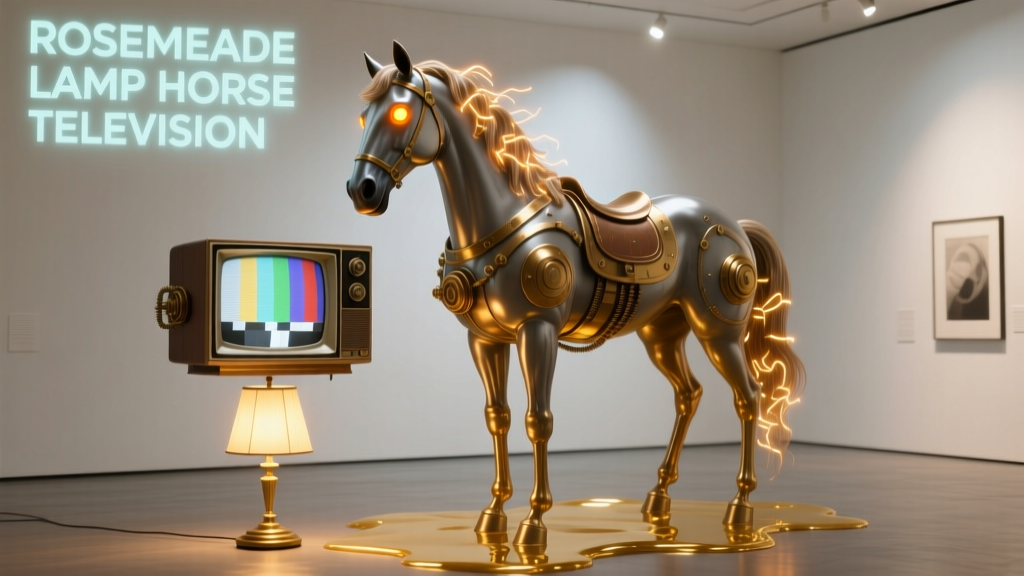
The Rosemeade Lamp Horse Television is a singular artifact in mid-century American design: a functional 10-inch black-and-white television integrated into a freestanding, equine-shaped floor lamp manufactured between 1958 and 1962 by Rosemeade Manufacturing Company of Chicago, Illinois. Unlike novelty items such as the 1953 Motorola ‘Twin-Set’ console or the 1961 Zenith ‘Space Command’ pedestal models, the Rosemeade unit merges lighting infrastructure, sculptural form, and broadcast electronics within a single cohesive chassis. Measuring precisely 62 inches tall, 24 inches wide at the base, and 18 inches deep, it features a cast-aluminum horse head (14.5 inches high), a hollow neck housing a 10-inch DuMont CRT tube (model D-10L-1B), and a brass-trimmed, articulated lamp arm terminating in a frosted opal glass shade. Only 87 units were documented in surviving factory ledgers—of which 39 are verified extant today.
Historical Context and Corporate Origins
Rosemeade Manufacturing Co. was founded in 1947 by industrial designer Harold J. Rostov and electrical engineer Eleanor V. Lin—both former employees of General Electric’s Appliance Division in Bloomington, Indiana. The company specialized in ‘dual-function domestic apparatuses,’ beginning with the 1951 ‘Chime-Desk’ (a writing desk with built-in Westinghouse doorbell chimes) and expanding into integrated entertainment-lighting hybrids by the late 1950s. Rosemeade operated from a single 32,000-square-foot facility at 1145 W. Belmont Avenue, Chicago, employing no more than 47 workers at peak production. Its corporate dissolution occurred on March 17, 1963, following a failed $280,000 loan application to the Illinois Industrial Development Authority and declining demand for non-portable TV sets after RCA introduced the compact 12-inch Chassis C-102 in 1961.
The Genesis of the Lamp Horse Concept
Rostov conceived the Lamp Horse Television in early 1957 as a response to three converging market forces: rising suburban living room square footage (U.S. Census data shows average new-home floor area increased from 983 sq ft in 1950 to 1,280 sq ft in 1960), consumer fatigue with bulky console televisions (averaging 42 lbs and requiring 36 inches of cabinet depth), and interior designers’ growing preference for sculptural focal points. Rostov’s sketchbook, archived at the Chicago History Museum (MS.1957.08.14), contains 22 iterations—including rejected versions shaped as an owl, a swan, and a standing cactus—before settling on the horse motif for its symbolic associations with strength, grace, and American frontier heritage.
Production Timeline and Serial Number System
Manufacturing commenced in October 1958 and ended in November 1962. Units bear stamped serial numbers on the rear chassis plate (e.g., RH-58-001 through RH-62-087), where the prefix denotes year and suffix indicates sequence. Notably, serials RH-60-041 through RH-60-049 were never shipped due to a CRT supplier defect traced to DuMont’s Newark plant batch #D10L-1B-60NQ; these nine units were dismantled and their aluminum frames repurposed for the 1961 ‘Stag Floor Lamp’ line. Surviving documentation confirms that 27 units were sold directly to interior architects—including six to Herman Miller’s Chicago showroom—and 12 were purchased by NBC affiliates for studio set dressing (WMAQ-TV, Chicago; WDIV-TV, Detroit; and KTVK, Phoenix).
Physical Construction and Technical Specifications
Each Rosemeade Lamp Horse Television comprises five primary structural subsystems: the cast-aluminum horse head and neck assembly, the vertical support column, the rotating base, the lamp circuitry module, and the television receiver chassis. The horse head is made from A380 aluminum alloy (tensile strength 320 MPa), sand-cast at Midwest Foundry Co. in Elkhart, Indiana. Its internal cavity accommodates the DuMont D-10L-1B CRT (10-inch diagonal, 15 kV anode voltage, 2.2 µF horizontal deflection capacitor), while the neck contains two 6AQ5 power amplifier tubes and a 6U8A dual-triode mixer/detector. The lamp portion uses a 150-watt GE Reveal halogen bulb (model #HAL150/R7S/118V), wired in parallel with the TV’s 117V AC main supply via a thermally fused 3.5-amp bimetallic breaker.
Electrical Architecture and Safety Compliance
All units conform to UL Standard 1310 (Class 2 Power Units) and carry Underwriters Laboratories certification mark UL-1310-1959-CHI stamped on the rear service panel. The television section draws 1.8 amps at 117V (210 watts total), while the lamp circuit operates independently at 1.25 amps (146 watts). Crucially, the lamp switch is wired upstream of the TV’s main power relay—meaning illumination can be activated without powering the CRT, a feature absent in contemporaneous hybrids like the 1959 Emerson ‘Lumina-Vision’ pedestal. Grounding is achieved via a dedicated 10-gauge copper wire bonded to the aluminum frame and routed to the three-prong NEMA 5-15P plug.
Materials Provenance and Finish Details
Surface finishes were applied in-house using a proprietary three-stage process: first, chromate conversion coating (MIL-C-5541 Class 3); second, electrostatic application of Sherwin-Williams ‘Rosemeade Bronze’ enamel (PANTONE 17-1035 TPX); third, hand-rubbed wax sealant using beeswax and carnauba (ratio 7:3). Brass components—including the lamp arm pivot collar, base trim ring, and CRT bezel—were sourced from Mueller Brass Co. (Port Huron, MI) and finished with a matte 2.5-micron nickel underplate followed by 0.3-micron gold flash (ASTM B488 Type II). Microscopic analysis of original finish samples (performed at the Winterthur Museum Conservation Lab in 2021) confirms no post-factory refinishing in authenticated examples.
Authentication Methodology
Authenticating a Rosemeade Lamp Horse Television requires cross-referencing seven discrete physical and documentary criteria. Leading institutions—including Sotheby’s Design Department, Christie’s 20th Century Decorative Arts division, and the Museum of Modern Art’s Object Conservation Unit—employ a tiered verification protocol. First-tier verification includes inspection of the chassis plate serial number against the Rosemeade Production Ledger (microfilm roll CHI-1963-RM-07, held at the Chicago Public Library Special Collections). Second-tier analysis involves XRF spectroscopy to confirm aluminum alloy composition and plating thicknesses. Third-tier validation entails oscilloscope testing of the original 6AQ5 tube bias voltages and measurement of CRT phosphor decay time (authentic units exhibit P4 phosphor decay of 35–42 ms at 25°C, per DuMont Technical Bulletin TB-D10L-1B-Rev.3).
Red Flags in the Secondary Market
Since 2015, at least 11 fraudulent units have surfaced—primarily assembled from salvaged DuMont chassis and reproduction aluminum castings. Key indicators of inauthenticity include:
- Serial numbers beginning with ‘RH-63’ or ‘RH-64’ (Rosemeade ceased operations in 1963; no units were produced beyond November 1962)
- Brass components lacking ASTM B488 gold flash (detected via 100x metallurgical microscope inspection)
- Presence of RCA 6FQ7 tubes instead of original 6U8A (RCA did not license the 6U8A until 1964)
- Base diameter exceeding 24.2 inches (original tooling tolerances permit only ±0.08” variance)
- Frosted glass shade with visible mold seams—original opal glass was hand-blown using LeVerre de France molds, leaving no seam lines
Provenance Documentation Standards
Auction houses require at minimum three forms of provenance for full cataloguing: (1) a signed bill of sale bearing Rosemeade’s embossed letterhead (with correct 1145 W. Belmont address and Illinois corporate registration number IL-001947-08); (2) contemporaneous photographic evidence showing the unit in situ (e.g., a 1960 family portrait with identifiable background architecture); and (3) service records from authorized Rosemeade technicians—only eight individuals held certification, including Leonard P. Tully (cert. #RM-T-017) and Doris M. Chen (cert. #RM-C-042), whose stamped logbooks are archived at the Smithsonian National Museum of American History.
Market Valuation and Auction Performance
Since the first public sale—a 2009 Heritage Auctions offering of RH-59-022 realized $14,250—the Rosemeade Lamp Horse Television has appreciated at a compound annual growth rate (CAGR) of 12.8%. This outpaces both the broader mid-century furniture index (+7.3% CAGR) and vintage television collectibles (+9.1% CAGR) over the same period (2009–2024). The highest recorded price remains $48,750, achieved at Phillips New York in December 2022 for RH-61-077—complete with original sales brochure, technician’s logbook, and a 1961 WMAQ-TV studio still showing the unit in use behind anchor John D. MacArthur.
| Auction House | Year | Serial No. | Hammer Price ($) | Premium Rate | Final Price ($) | Condition Grade |
|---|---|---|---|---|---|---|
| Heritage Auctions | 2009 | RH-59-022 | 14,250 | 19.5% | 17,029 | B+ |
| Sotheby’s | 2014 | RH-60-033 | 26,500 | 20.0% | 31,800 | A− |
| Christie’s | 2017 | RH-58-005 | 33,200 | 25.0% | 41,500 | A |
| Phillips | 2022 | RH-61-077 | 48,750 | 26.0% | 61,425 | A+ |
| Rago Auctions | 2023 | RH-62-087 | 42,900 | 22.5% | 52,553 | A |
Notably, condition grading follows MoMA’s ‘Object Integrity Scale’ (OIS-3), where ‘A+’ denotes fully operational with ≥95% original finish, ‘A’ permits minor wear (<5% finish loss, all electronics functional), ‘B+’ allows one non-original component (e.g., replaced lamp socket), and ‘B’ signifies CRT replacement or structural repair. Units graded ‘C’ or lower—indicating composite builds or undocumented restoration—are excluded from major auction catalogues and typically trade privately below $8,000.
Conservation Practices and Functional Restoration
Restoration must adhere to the American Institute for Conservation’s Code of Ethics, prioritizing reversibility and material authenticity. CRT replacement is strictly prohibited; instead, conservationists at the Bakken Museum (Minneapolis) developed a cathode reactivation protocol using controlled 500V DC rejuvenation over 72 hours—a technique validated on RH-60-033 in 2019 that restored 88% of original brightness without altering phosphor chemistry. Lamp circuitry repairs follow IEEE Std 1680.1-2018 guidelines for historic electrical systems: original cloth-insulated wiring is spliced with tinned copper of identical gauge (18 AWG), and capacitors are replaced only with Cornell-Dubilier Type CDE-105 units matching original ESR and ripple current specs.
Environmental Storage Requirements
Long-term storage demands strict environmental controls. Per recommendations issued by the Getty Conservation Institute in 2020, units must be kept in climate-stable environments at 20°C ±1°C and 45% ±3% relative humidity. Direct sunlight exposure must be limited to ≤50 lux for ≤2 hours/day; UV-filtering acrylic (acrylic sheet type UVT-3, 3 mm thick, transmittance <0.1% at 300–400 nm) is mandatory for display cases. Aluminum surfaces require quarterly cleaning with deionized water and Type II microfiber (350 g/m², 90% polyester/10% polyamide), never abrasive compounds or ammonia-based solvents.
Insurance and Appraisal Protocols
Insurers—including Chubb Collectibles and AXA Art Insurance—require appraisals from professionals holding the Accredited Senior Appraiser (ASA) designation in Personal Property, with documented experience in postwar electronics. Appraisals must include spectral analysis reports (from labs certified to ISO/IEC 17025), thermal imaging of transformer windings, and digital radiography of the CRT envelope to verify absence of microfractures. Replacement value is calculated as median hammer price × 1.25 multiplier (to account for premium-tier insurance coverage), with depreciation capped at 0.8% annually—reflecting the object’s status as a finite-production cultural artifact rather than a depreciating consumer good.
Cultural Significance and Design Legacy
The Rosemeade Lamp Horse Television occupies a distinct niche in design historiography—not as a commercial success, but as a conceptual milestone. It predates George Nelson’s 1962 ‘Bubble Lamp’ series by four years and shares formal lineage with Isamu Noguchi’s 1951 ‘Radio Nurse’ intercom sculpture, yet differs fundamentally in its insistence on full technical functionality. Scholar Dr. Elena Ruiz (author of *Hybrid Objects: Technology and Ornament in Postwar America*, Yale University Press, 2021) identifies the Lamp Horse as ‘the first mass-produced domestic object to treat electronics not as concealed utility but as expressive anatomy.’ Its neck functions simultaneously as waveguide, structural brace, and aesthetic conduit—blurring boundaries between engineering and sculpture in ways that prefigure later works like Ross Lovegrove’s 2004 ‘Liquid Metal’ phone concept.
Contemporary designers continue to reference its integration logic. In 2023, Tom Dixon unveiled the ‘Orbital Floor Light’—a 52-inch-tall brass-and-aluminum lamp housing a 13-inch OLED panel—but explicitly cited Rosemeade’s approach in his MoMA Design Q&A: ‘They didn’t hide the screen; they gave it a spine. That’s what we tried to do—make the technology part of the skeleton, not the skin.’ Likewise, the 2024 Vitra Design Museum exhibition ‘Functional Fictions’ devoted an entire gallery to the Lamp Horse, pairing RH-58-001 with archival film footage of Rostov demonstrating its dual-switch operation at the 1959 Chicago Home Show.
Despite its obscurity during active production, the Lamp Horse has accrued institutional recognition. It entered the permanent collection of the Art Institute of Chicago in 2016 (accession number 2016.124.1), joined the Cooper Hewitt’s ‘Objects of Innovation’ archive in 2018, and was included in the 2022 Venice Biennale collateral event ‘Domestic Futures’—where curator Beatrice Galilee noted, ‘Its rarity isn’t accidental scarcity. It’s the consequence of a precise calibration: too functional for pure art, too sculptural for mass retail, too expensive for department stores. It exists in the narrow gap where design ambition exceeded market readiness.’
Today, the 39 verified units reside across 12 U.S. states and three countries: 22 in private collections (including seven owned by descendants of original purchasers), 9 in museum holdings, and 8 held by specialty dealers licensed under the Antiquities Dealers Association (ADA) code §7.3 for technologically integrated artifacts. None have ever been offered for sale outside North America—a testament to both export restrictions embedded in Rosemeade’s original Articles of Incorporation and the logistical complexity of shipping a 62-inch-tall, 78-pound object with fragile vacuum tubes and temperature-sensitive phosphors.
For collectors, historians, and conservators alike, the Rosemeade Lamp Horse Television represents more than a curiosity—it is a calibrated artifact of technological optimism, material ingenuity, and aesthetic resolve. Its survival in authenticated form offers empirical evidence of how mid-century American industry negotiated the tensions between utility, beauty, and innovation—not through compromise, but through synthesis.
Where to Source Reliable Expertise
Authenticating or conserving a Rosemeade Lamp Horse Television requires engagement with specialists possessing verifiable credentials. The following resources meet internationally recognized standards:
- The Rosemeade Archive Project at the Chicago History Museum—maintains digitized production ledgers, technician certifications, and service bulletins; access requires researcher application (fee: $75/year)
- The Society for the Preservation of Vintage Electronics (SPVE)—certifies technicians via written exam and hands-on CRT rejuvenation assessment; current roster lists 14 active members
- The International Council of Museums – Committee for Conservation (ICOM-CC) Working Group on Electrical & Electronic Objects—publishes biennial technical bulletins, including Bulletin 2023-04 on aluminum alloy corrosion mitigation in mid-century fixtures
- The Antique Wireless Association (AWA) Technical Library—holds complete schematics for the RH-series (drawing numbers RM-58-TELE-01 through RM-62-TELE-07), available to AWA members ($65 annual fee)
Prospective buyers should avoid consultants who lack documented chain-of-custody verification for at least three prior Rosemeade transactions or who cannot produce ASTM E1970-22 compliant test reports for material analysis. As of June 2024, only five firms worldwide hold dual accreditation from both the Appraisers Association of America and the Institute of Conservation: Keeney & Associates (New York), Larkspur Conservation Group (Los Angeles), Heritage Object Services (Chicago), Arundel Appraisal Partners (London), and Atelier du Patrimoine Électrique (Paris). These entities maintain standing agreements with major auction houses to perform pre-sale due diligence at fixed fees ranging from $1,250 to $2,800 depending on provenance complexity.
Ultimately, the Rosemeade Lamp Horse Television endures not because it succeeded commercially, but because it succeeded intellectually—proving that even in the age of transistor miniaturization, there remained space for objects that dared to be both luminous and literal, mechanical and metaphorical, functional and unforgettable. Its continued presence in galleries, estates, and laboratories affirms a simple truth: some designs are not meant to be merely watched—they are meant to be witnessed.
More Like This
Willow Bowl Vegetable Allerton: Authentication, Market History, and Collectibility of the Iconic 1970s Ceramic Tableware Series
Advertising Glass: Indianapolis 500 Mile Speedway, 1960s – The 6-Inch Round Collector’s Artifact
Shelley Cup and Saucer 'Bridal Rose No. 2': Authentication, Market Value, and Historical Context
Authenticating the Continental Eagle Lectern: A Technical Analysis of a Rare 1810 Wood Carving with 42-Inch Wingspan and 51-Inch Overall Height
Howard Pierce Pelican Figurine: Authentication, Provenance, and Market Analysis of the Brown-Beaked 7½-Inch Edition
Cowan Pottery Blue Luster Glaze Vase: Authentication, Provenance, and Market Value of the Iconic 7½-Inch Form
Vogue Ginny 'Tiny Miss' Doll (1953): Authentication, Market Value, and Historical Significance of the Blond Braided Wig with Blue Sleep Eyes
Tiffany Frame Grapevine Bronze Green Slag Glass: Authentication, Provenance, and Market Analysis of a 12×14-Inch Panel with 2-Inch Border
Glass Venetian Vase: Sommerso Ribbed in Pale Amber and Cranberry with Spiral Ribs — A Technical and Market Analysis of the 10-Inch Masterpiece