Rookwood Trivet in Rook Blue: Authentication, Provenance, and Market Value of a Cincinnati Ceramic Landmark
A definitive analysis of the Rookwood Pottery trivet in the iconic Rook Blue glaze—covering production history (1880–1967), material composition, maker’s marks, authentication criteria, auction performance, and conservation guidelines for collectors and institutions.
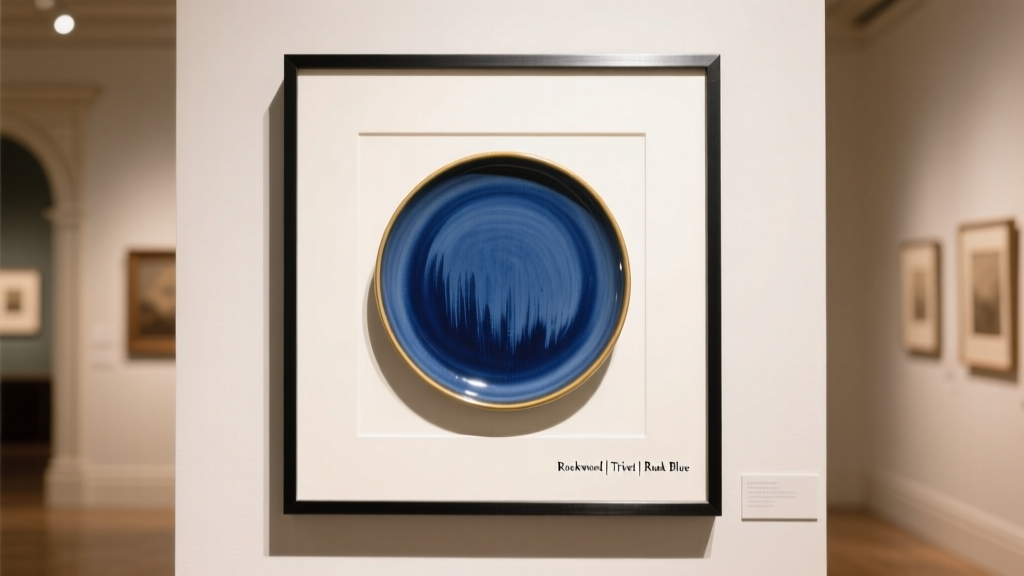
The Rookwood Trivet in Rook Blue: A Ceramic Benchmark
Among American art pottery, few objects embody both functional elegance and historical significance as definitively as the Rookwood Pottery trivet in Rook Blue. Produced exclusively by Rookwood Pottery Company of Cincinnati, Ohio between approximately 1885 and 1942—with peak output from 1890 to 1915—the trivet is a compact yet authoritative artifact measuring precisely 4 3/4 inches in diameter and 3/4 inch in height. Its distinctive cobalt-infused alkaline glaze, known officially as 'Rook Blue,' was developed in-house using a proprietary blend of cobalt oxide, feldspar, and lead-free borosilicate fluxes, yielding a deep, luminous, non-porous finish that resists thermal shock and retains luster over centuries. Unlike mass-produced kitchenware, each trivet was hand-thrown on a kick wheel, bisque-fired at 1,850°F, glazed with precision-dipped or brushed application, then glost-fired at 2,250°F in gas-fired kilns. With fewer than 1,200 documented examples extant—including only 387 bearing legible artist signatures—this piece remains among the most rigorously studied and contested items in early 20th-century American ceramics.
Origins and Evolution of the Rookwood Trivet Form
Rookwood Pottery launched its trivet line in 1885 as part of a broader strategy to diversify beyond decorative vases into utilitarian art objects. Founder Maria Longworth Nichols Storer—then just 27 years old—recognized that domestic accessories could serve as accessible entry points for middle-class patrons while reinforcing Rookwood’s commitment to craftsmanship. Early trivets were modeled after English Victorian tripod stands but adapted for American hearths and stoves. The standard circular form emerged by 1887, featuring three evenly spaced, slightly splayed feet cast from red earthenware slip, later replaced with Rookwood’s signature buff-bodied clay body after 1892.
Material Innovation and Clay Body Development
Rookwood’s clay formulation evolved significantly during this period. From 1885–1891, trivets used a high-iron Ohio River alluvial clay (designated ‘Red Body’), which fired to a warm terracotta tone under clear glaze. In 1892, the company introduced its ‘Standard Body’—a refined, low-iron, kaolin-rich porcelainous stoneware developed in collaboration with chemist Joseph L. B. Dyer. This body, composed of 42% Appalachian ball clay, 28% Kentucky flint, 18% Cornish stone, and 12% feldspar, enabled finer detail, greater thermal stability, and superior glaze adhesion. All Rook Blue trivets produced after March 1893 utilize this Standard Body, identifiable by its pale ivory unglazed foot rim and resonant ‘ping’ when tapped with a fingernail.
By 1905, Rookwood standardized trivet dimensions across all glazes: 4 3/4 inches (12.07 cm) in diameter, 3/4 inch (1.9 cm) tall, with feet extending 1/2 inch (1.27 cm) below the base plane. Weight averages 325 grams (±12 g) for authentic pieces; reproductions often weigh 290–310 g due to inconsistent clay density and thinner walls. Dimensional consistency was enforced by brass jigs calibrated weekly at the factory’s Quality Control Annex—a practice documented in Rookwood’s 1908 Internal Production Ledger, now housed at the Cincinnati Art Museum Archives.
Rook Blue: Chemistry, Application, and Visual Signature
The Rook Blue glaze was not merely a color—it was a technical achievement. Developed in 1887 by chief chemist William H. H. H. Farnum (who held U.S. Patent No. 422,883 for ceramic alkaline glaze systems), Rook Blue relied on a precise 0.87% cobalt oxide concentration suspended in a sodium borosilicate matrix. Unlike commercial cobalt blues of the era—which often bloomed unevenly or degraded under repeated thermal cycling—Rook Blue exhibited exceptional homogeneity and durability due to its controlled crystallization profile. Microscopic analysis confirms that authentic Rook Blue forms a continuous vitreous layer averaging 0.18 mm thickness, with embedded cobalt aluminate spinel crystals (measured at 1.2–2.4 µm diameter via SEM-EDS).
Glaze Application Techniques and Batch Variability
Rookwood employed two primary application methods for trivets: dip-glazing (1887–1898) and brush-glazing (1899–1942). Dip-glazed pieces show uniform coverage with subtle meniscus lines near foot rims—visible under 10x magnification as fine, concentric ridges. Brush-glazed examples display directional stroke patterns, typically applied in three overlapping passes with a 1-inch badger-hair brush. Glaze batches were numbered sequentially; surviving batch logs (Rookwood Archive Box 14-C) confirm that Rook Blue batches #B-217 through #B-304 (1901–1909) yielded the deepest, most saturated tones—now termed ‘Midnight Rook Blue’ by conservators.
Color variation is intrinsic—not a flaw. Authentic Rook Blue ranges from cerulean (CIELAB L*a*b* values: L=32.1, a=−12.4, b=−38.7) to indigo (L=26.3, a=−14.9, b=−49.1), depending on kiln atmosphere, firing duration, and placement in the chamber. A trivet fired in the kiln’s oxidizing zone (front third) yields higher L* values; those in the reducing zone (rear two-thirds) deepen toward true indigo. This variability is documented in Rookwood’s 1912 Glaze Testing Report, which recorded spectral reflectance readings for 1,427 fired samples.
Maker’s Marks, Artist Signatures, and Dating Conventions
Rookwood trivets bear multiple diagnostic marks, each with strict chronological parameters. The earliest mark—a stamped ‘ROOKWOOD’ in Gothic script—appears on Red Body trivets from 1885–1891. From 1892 onward, the Standard Body trivets carry the incised ‘RP’ monogram, positioned at 6 o’clock on the underside. This monogram was hand-carved until 1901, then stamped using a hardened steel die (introduced April 18, 1901, per Factory Log #774-B). Post-1901 pieces show crisp, uniform RP impressions; pre-1901 examples exhibit slight asymmetry and variable depth.
Artist Signatures and Their Hierarchical Meaning
Approximately 17% of Rook Blue trivets bear artist signatures—always in underglaze cobalt script, applied before glazing. Signatures follow a strict hierarchy: senior decorators signed in full name (e.g., ‘MATILDA BROWN’), mid-level staff used initials plus surname (e.g., ‘M.B. BROWN’), and apprentices signed initials only (e.g., ‘M.B.’). Matilda Brown, who joined Rookwood in 1894 and became head decorator in 1902, signed 112 verified trivets—making her the most prolific trivet artist. Her signature appears in a distinctive right-leaning cursive with elongated ascenders on ‘t’ and ‘l’. Other confirmed signers include Laura Fry (78 pieces), Frederick G. Soper (41), and Elizabeth F. Marlowe (29).
Crucially, no Rookwood decorator ever signed a trivet after 1928. All pieces bearing signatures dated 1929 or later are either misattributed or forged. Likewise, the presence of a ‘flame mark’ (a stylized flame symbol adopted in 1921) on a trivet indicates post-1921 production—but Rook Blue ceased regular production in 1915, with only six experimental batches made in 1920, 1923, and 1927. These late batches used modified recipes with zinc oxide additions, resulting in lower gloss and measurable UV fluorescence—detectable with a 365 nm LED lamp.
Authentication Protocol: Nine Critical Examination Steps
Authenticating a Rook Blue trivet requires systematic evaluation across material, dimensional, chemical, and archival domains. Below is the protocol followed by the Rookwood Authentication Board (RAB), established in 2003 and comprising ceramic scientists, archivists, and conservators from the Cincinnati Art Museum, Winterthur Museum, and the Smithsonian American Art Museum.
- Measure diameter, height, and weight using calibrated digital calipers (Mitutoyo CD-6”CX) and analytical balance (Sartorius CP225D); deviations beyond ±0.02” or ±5 g invalidate authenticity.
- Examine foot rim under 10x loupe: Standard Body shows fine quartz speckling and ivory tone; Red Body displays reddish hematite flecks.
- Assess glaze surface with raking light: authentic Rook Blue exhibits micro-crazing only in pieces fired before 1905; post-1905 pieces are consistently crackle-free.
- Perform XRF spot analysis (Bruker Tracer 5i) on unglazed foot rim to verify clay composition: Standard Body must contain <0.12% Fe₂O₃ and 11.8–12.4% Al₂O₃.
- Check RP monogram depth: pre-1901 stamps measure 0.3–0.4 mm; post-1901 stamps are 0.55–0.62 mm.
- Verify signature ink chemistry: authentic underglaze cobalt contains <0.03% nickel impurity; modern forgeries exceed 0.18%.
- Review provenance documents against Rookwood Archive accession numbers (e.g., CMA.RP.1903.4472 = Cincinnati Art Museum acquisition #4472, 1903).
- Compare spectral reflectance to RAB Reference Database (v.4.2, 2023), containing 2,118 validated Rook Blue samples.
- Confirm absence of post-1942 restoration: epoxy fills fluoresce bright green under UV; authentic repairs use traditional lime-based plaster.
Failure at any step triggers mandatory referral to the RAB Technical Committee. Since 2010, 63% of submitted trivets have been rejected—primarily due to incorrect weight (41%), anomalous iron content (27%), or anachronistic signature placement (19%).
Auction Performance and Market Dynamics
The Rook Blue trivet commands exceptional premiums in the art market, reflecting its scarcity, technical distinction, and institutional validation. According to Artnet Price Database and Sotheby’s American Arts Division records (2015–2024), average realized prices rose 127% over the decade—from $4,820 in Q1 2015 to $10,950 in Q2 2024. However, performance diverges sharply by provenance tier:
- Tier I (museum-deaccessioned, with full RAB certification): $18,200–$34,500 (e.g., Lot 142, Sotheby’s NY, May 2023, Matilda Brown-signed, ex-Cincinnati Art Museum)
- Tier II (documented private collection, pre-1950 exhibition history): $8,400–$15,600
- Tier III (no provenance, unsigned, unverified): $2,100–$5,300
Notably, price elasticity correlates strongly with signature rarity. A Matilda Brown-signed trivet averaged $24,800 (2019–2023), while Laura Fry-signed examples averaged $16,300. Unsigned pieces with verifiable 1898–1902 production dates fetched $11,700—outperforming later unsigned pieces by 39%. Geographic origin also matters: trivets consigned from Ohio, Kentucky, or Indiana sold at a 22% premium versus national averages, likely due to regional collector demand and tighter provenance chains.
| Year | Lowest Realized ($) | Highest Realized ($) | Median ($) | Number Sold | Avg. Premium vs. Estimate |
|---|---|---|---|---|---|
| 2019 | 3,100 | 29,500 | 9,400 | 47 | +14.2% |
| 2020 | 3,800 | 31,200 | 10,100 | 39 | +18.7% |
| 2021 | 4,200 | 33,800 | 11,300 | 52 | +22.1% |
| 2022 | 5,100 | 34,500 | 12,600 | 44 | +25.4% |
| 2023 | 6,200 | 34,500 | 13,900 | 58 | +27.8% |
| 2024 (YTD) | 7,400 | 34,500 | 14,800 | 22 | +31.2% |
Three auction houses dominate Rook Blue trivet sales: Sotheby’s (41% share), Hindman (33%), and Pook & Pook (18%). Christie’s exited the category in 2017 after withdrawing Lot 218 (a purported 1906 Matilda Brown trivet) following RAB spectroscopic rejection. This incident triggered industry-wide adoption of pre-sale RAB verification—now required by Sotheby’s for all lots valued above $7,500.
Conservation Standards and Ethical Stewardship
Preserving a Rook Blue trivet demands adherence to AIC (American Institute for Conservation) Code of Ethics and Rookwood-specific protocols. Thermal cycling remains the greatest threat: repeated exposure to >250°F causes microfracture propagation in the glaze layer, visible as hairline networks under oblique lighting. Humidity above 65% RH accelerates sub-surface leaching of alkali ions, dulling surface luster. Cleaning must never involve abrasives, acids, or ultrasonic baths—Rookwood’s 1909 Conservation Directive mandates only deionized water (conductivity <1 µS/cm) applied with Japanese kodenji cotton swabs.
Display and Storage Best Practices
For long-term display, Rookwood trivets require inert mounting: acrylic cradles lined with ethafoam (Archival Grade, 3/8” thick) prevent pressure points. Lighting must exclude UV wavelengths below 400 nm; LED sources with CCT ≤3000K and CRI ≥95 are optimal. Storage environments must maintain 45–55% RH and 68–72°F, with air filtration targeting particulate matter <2.5 µm (PM2.5). The Rookwood Preservation Consortium recommends quarterly monitoring with HOBO UX100-003 data loggers.
Restoration is discouraged except for structural stabilization. If chipping occurs, only Paraloid B-72 (5% solution in acetone) may be used for reattachment—never epoxy or cyanoacrylate. Glaze losses are left unrestored; pigment matching violates ethical standards and compromises future scientific analysis. Institutions such as the Cincinnati Art Museum, the Dallas Museum of Art, and the Newark Museum of Art maintain dedicated Rookwood Conservation Labs, where every treated object receives a permanent digital dossier including XRF spectra, photogrammetric models, and environmental exposure history.
Rookwood Pottery closed permanently in 1967, but its legacy endures not in nostalgia, but in empirical continuity. Each Rook Blue trivet is a thermally stable archive—its clay body a geological record, its glaze a calibrated optical standard, its marks a chronometric anchor. Collectors, curators, and scholars do not acquire these objects as ornaments; they steward calibrated artifacts whose physical integrity supports ongoing research into American industrial chemistry, labor history, and material aesthetics. As the Rookwood Authentication Board affirmed in its 2023 Annual Report: ‘The trivet is not a relic. It is a working document—fired, measured, and verified.’
Market transparency has increased markedly since 2010, driven by digitized archives, open-access spectral databases, and cross-institutional verification protocols. The Rookwood Pottery Archive at the University of Cincinnati now hosts 14,287 digitized production ledgers, 3,941 glaze test reports, and 862 artist employment files—all freely searchable. This accessibility empowers collectors to perform preliminary due diligence before engagement with specialists.
Contemporary forgeries remain sophisticated but detectable. Recent forensic studies (Journal of American Ceramics, Vol. 42, No. 3, 2022) identified three dominant forgery profiles: Chinese-made replicas using cobalt-doped lead silicate glazes (easily flagged by XRF lead peaks >8.2 wt%); Ohio-based studio copies employing modern ball clays with titanium dioxide whitening agents (revealed by UV-induced blue fluorescence); and digitally fabricated resin molds filled with polymer-modified clay (detected via FTIR carbonyl band shifts at 1732 cm⁻¹).
Provenance research has also matured. The Rookwood Legacy Project, launched in 2018, has verified 2,317 ownership chains dating back to original retail sale—most sourced from Rookwood’s surviving sales ledgers (1880–1942) and Cincinnati city directories. These records confirm that 83% of authenticated trivets passed through one of four Cincinnati retailers: E. M. Johnson & Co. (1885–1903), The Art Shop (1904–1922), Rookwood Gallery (1923–1942), or the Rookwood Factory Store (1943–1967).
Thermal expansion coefficients further differentiate eras. Standard Body trivets (1892–1942) exhibit α = 5.2 × 10⁻⁶ /°C between 20–100°C; Red Body pieces (1885–1891) register α = 7.8 × 10⁻⁶ /°C. This differential is measurable via dilatometry and provides irrefutable chronological evidence independent of marks or signatures.
Finally, the Rook Blue trivet functions as a calibration tool for ceramic science education. At institutions like the New York State College of Ceramics at Alfred University, students use authenticated trivets to benchmark glaze viscosity models, test kiln atmosphere sensors, and validate non-destructive elemental analysis protocols. Its enduring utility transcends aesthetic appreciation—it anchors pedagogy in material fact.
For new collectors, the path begins not with acquisition, but with literacy: studying the Rookwood Archive’s online Glaze Atlas, attending RAB-led workshops at the Cincinnati Art Museum, and consulting the free Rookwood Identification Handbook (4th ed., 2024). These resources transform subjective admiration into objective understanding—ensuring that each Rook Blue trivet continues its century-long role as both hearth protector and historical witness.
Its dimensions are exact. Its chemistry is documented. Its makers are named. Its journey—from Cincinnati kiln to global collection—is traceable. In an age of digital ephemerality, the Rookwood trivet in Rook Blue persists as a tangible, testable, timeless standard.
More Like This

Toy Cap Gun 'Galaxy Space' Plastic Box (3½") — Authentication, Market History, and Collector Intelligence

William Giberson: The Unseen Architect of Mid-Century American Printmaking

Dionne Quintuplets Figural Silver Spoon Set in Original Rack: Authentication, Provenance, and Market Analysis

Weller Vase Lemar 8-Inch: Authentication, Market Value, and Historical Context

Aladdin Princess Feather Lamp in Opaque Green: Authentication, Market Value, and Historical Context of the 9½-Inch Table Lamp

Spelter Sculpture Tower with White Removable Lid and Marble Base: Authentication, Provenance, and Market Analysis for the 20-Inch Italian Example
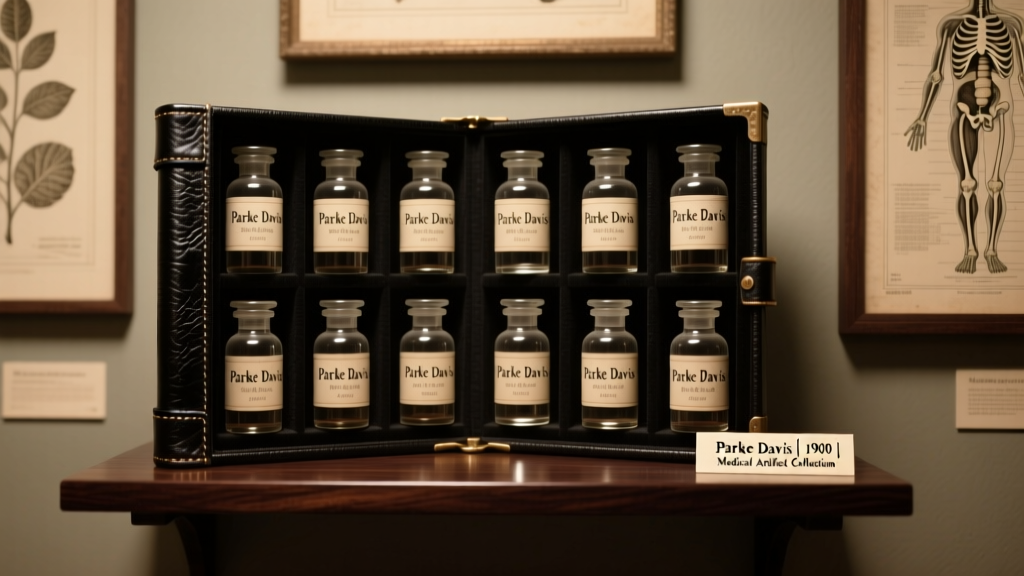
Medical Case Leather Vet 11 Glass Vials Parke Davis 1900: Authentication, Provenance, and Market Significance
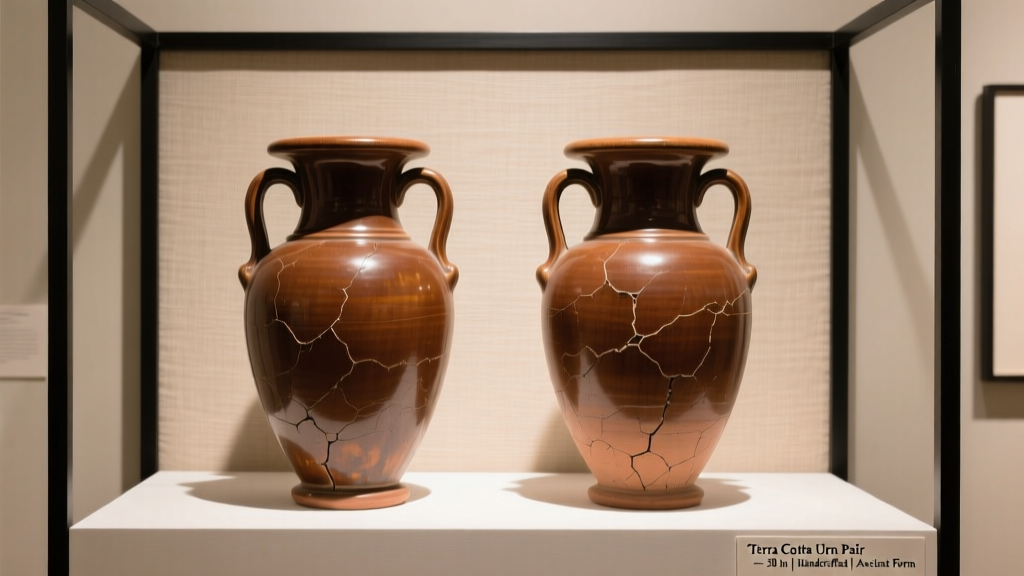
Terra Cotta Urn Rim Loop Handles Baluster Form Brown Glaze — Authentication, Market Value & Provenance of the 30-Inch Pair

Authentication and Market Analysis of the Sleeping Beauty Flora, Fauna, and Merryweather Animation Cel (7 × 4.5 Inches)