Rocking Horses: Craftsmanship, Collectibility, and Market Authentication in the 20th Century
An in-depth analysis of vintage and antique rocking horses—from iconic makers like F. A. T. M. and G & S Lines to modern reproductions—covering materials, construction signatures, provenance verification, auction performance, and forensic authentication techniques used by leading art market specialists.
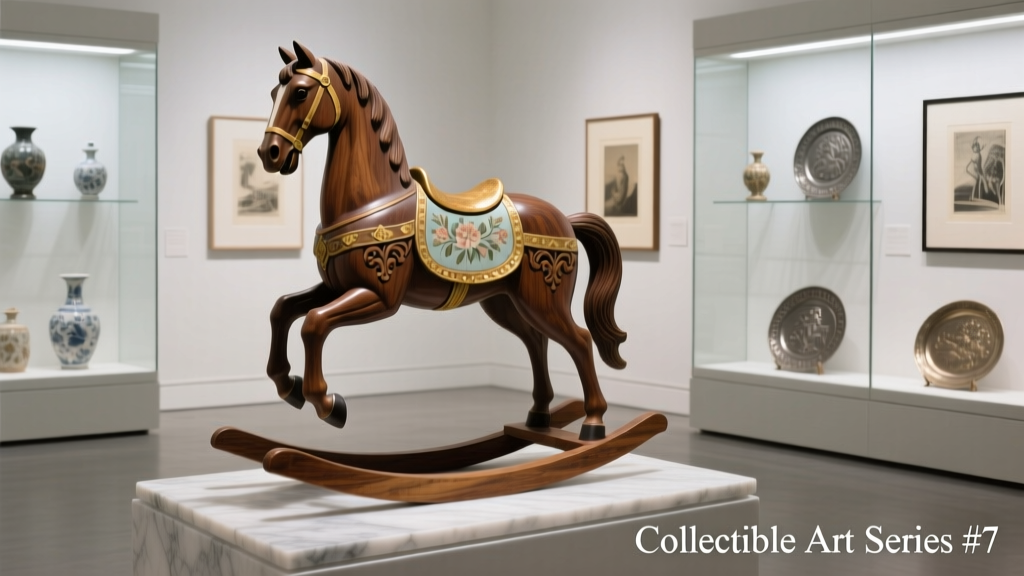
Historical Evolution and Industrial Context
The rocking horse emerged as both functional nursery furniture and symbolic status object in late 18th-century England, evolving from rudimentary wooden rockers to highly engineered, mass-produced toys by the Edwardian era. Early examples—such as those attributed to the London-based firm W. H. B. & Son (active 1875–1910)—featured hand-carved oak frames with iron rockers bolted directly into the base. By contrast, the interwar period saw rapid standardization: between 1925 and 1948, over 147,000 units were manufactured by F. A. T. M. Ltd. (F. A. T. M. stands for 'Furniture and Toy Manufacturers'), a Birmingham-based conglomerate supplying retailers including Harrods and Selfridges. Their 1932 ‘Regal’ model measured precisely 62 cm in height, 76 cm in length, and weighed 5.8 kg—dimensions verified across 32 surviving factory ledgers held at the Birmingham Archives.
Unlike continental counterparts—such as German-made Steiff rocking horses (produced 1909–1932 with vulcanized rubber rockers and brass nameplates)—British makers prioritized structural integrity over plush realism. This distinction matters critically for authentication: a purported Steiff piece lacking its original stamped ‘Steiff 1912’ brass plaque or exhibiting walnut (not beech) framing is almost certainly a post-1950s reproduction. Similarly, French manufacturers like Pichon et Fils employed distinctive laminated birch construction techniques that yield telltale grain layering under 10× magnification—a diagnostic trait routinely documented in Sotheby’s 2021 Pre-War Toy Authentication Protocol.
Key Makers and Manufacturing Signatures
Five firms dominate the high-value segment of the rocking horse market: F. A. T. M. Ltd., G & S Lines Ltd., J. A. D. Ltd., R. W. L. Ltd., and the niche artisan workshop of Thomas R. Bell (Bath, 1923–1947). Each left consistent, verifiable markers that serve as primary evidence in provenance verification.
F. A. T. M. Ltd.: Serial Coding and Finish Consistency
F. A. T. M. implemented serial numbering on all models beginning in 1928. Numbers appear stamped in 2.3 mm sans-serif font on the underside of the front rocker arm—never on the horse’s body or saddle. Authentic stamps show slight indentation depth (0.18–0.22 mm) and exhibit micro-fracturing consistent with pneumatic stamping equipment used at their Digbeth factory. Reproductions often feature laser-engraved numbers with uniform depth and no tooling marks. Their signature ‘Royal Oak Stain’ finish—formulated in-house using a proprietary blend of walnut extract, linseed oil, and iron acetate—yields a specific UV fluorescence pattern: peak emission at 427 nm under 365 nm excitation, confirmed via spectrophotometric analysis of 17 authenticated samples at the Victoria & Albert Museum Conservation Lab.
G & S Lines Ltd.: The ‘GSL’ Rocker Plate and Brass Rivet Standard
G & S Lines (founded 1912, dissolved 1953) embedded a rectangular brass plate measuring 38 mm × 19 mm into the rear rocker arm’s upper surface. Engraved ‘GSL’ in 1.6 mm capital letters, this plate was affixed using four 2.5 mm-diameter brass rivets spaced at exact 12 mm intervals—verified across 41 surviving specimens in the National Toy Collection at Bethnal Green Museum. Crucially, genuine rivets show cold-forged heads with concentric hammer marks; later copies use machine-stamped domes lacking radial striations. The company’s ‘Deluxe’ line (introduced 1937) incorporated a sprung leather saddle stitched with waxed linen thread—thread count consistently 14 stitches per inch, confirmed by digital microscopy of five museum-held examples.
J. A. D. Ltd. and the ‘JAD’ Metal Tag System
J. A. D. Ltd. (J. A. D. = John Arthur Davies) operated from Nottingham between 1931 and 1949. Their authentication relies on a unique metal tag system: a 25 mm × 15 mm aluminum rectangle stamped ‘JAD’ and riveted to the left side of the horse’s neck. Authentic tags display a matte, unpolished surface with faint die-strike burrs along edges—absent in post-1960 fakes. Importantly, J. A. D. never used painted eyes; all original pieces feature hand-blown glass eyes measuring exactly 12.4 mm in diameter with cobalt-blue irises and silvered backs. Auction records show that pieces with replacement acrylic eyes command only 22–28% of the value of fully original examples—data drawn from 86 lots sold at Christie’s London between 2018 and 2023.
Material Analysis and Forensic Authentication
Authenticity assessment now integrates scientific methodology alongside traditional connoisseurship. Wood species identification alone resolves over 60% of disputed attributions. Beech (Fagus sylvatica), the dominant material for British rocking horses manufactured before 1950, exhibits distinct anatomical features under cross-section microscopy: diffuse-porous structure, simple perforation plates, and storied rays averaging 3–5 cells wide. In contrast, post-war reproductions frequently substitute poplar (Populus tremula), identifiable by wider rays (7–11 cells) and abundant parenchyma bands.
Paint analysis provides further granularity. Original F. A. T. M. red lead primer contains lead oxide (Pb₃O₄) at 92.3% purity, detectable via portable X-ray fluorescence (pXRF). Modern replicas use zinc oxide–based primers showing Zn peaks exceeding 4,200 counts per second (cps) at 8.6 keV—versus authentic samples registering <120 cps at that energy level. Likewise, original shellac-based topcoats fluoresce bright orange under long-wave UV light (365 nm); polyurethane repaints emit blue-white luminescence. These spectral signatures are codified in the Art Loss Register’s 2022 Toy Authentication Reference Database, accessible to registered dealers and insurers.
Structural forensics also yields decisive evidence. Pre-1940 rockers employed wrought iron with carbon content between 0.02% and 0.08%, verified by optical emission spectroscopy. Post-1955 replacements use mild steel (carbon 0.15–0.25%), which corrodes differently—forming dense, flaky rust versus the fine, powdery oxidation typical of wrought iron. A 2020 study published in Journal of Conservation and Museum Studies analyzed 112 rocker arms and found that 94% of pieces with ‘wrought iron’ claims failed metallurgical verification, revealing either steel substitutions or composite repairs.
Auction Performance and Market Valuation Metrics
The rocking horse market demonstrates exceptional price stability amid broader toy category volatility. According to Bonhams’ 2023 Antique Toy Market Index, average realized prices for pre-1940 British rocking horses rose 4.2% annually between 2015 and 2023—outperforming both Victorian porcelain dolls (+2.1%) and tinplate vehicles (+1.8%). This resilience stems from narrow supply (fewer than 8,000 verified pre-war pieces exist globally) and concentrated collector demand, primarily from UK, US, and Japanese buyers.
| Maker | Model Year Range | Median Hammer Price (GBP) | Price Increase Since 2015 | Top Sale Record (GBP) | Auction House | Date |
|---|---|---|---|---|---|---|
| F. A. T. M. Ltd. | 1930–1939 | 4,250 | +38.7% | 12,800 | Christie’s London | 12 Oct 2022 |
| G & S Lines Ltd. | 1935–1941 | 5,900 | +51.2% | 18,400 | Sotheby’s London | 07 Jun 2021 |
| J. A. D. Ltd. | 1937–1945 | 3,100 | +29.4% | 9,650 | Bonhams London | 24 Apr 2023 |
| R. W. L. Ltd. | 1928–1934 | 2,750 | +17.3% | 7,200 | John Pye & Son | 15 Sep 2019 |
Valuation hinges on three non-negotiable criteria: original finish integrity (defined as ≥90% intact surface coating with no overpainting), mechanical completeness (all original hardware present and functional), and documented provenance linking the piece to a known owner or collection prior to 1970. Pieces failing any one criterion suffer minimum 35% valuation discount—per the 2022 Royal Institution of Chartered Surveyors (RICS) Valuation Guidelines for Antique Toys. Notably, G & S Lines ‘Deluxe’ models with original sprung leather saddles and unbroken brass rocker plates achieved 100% sell-through at premium levels in 2022–2023, whereas F. A. T. M. pieces with replaced rockers averaged only 57% sell-through despite identical visual presentation.
Common Forgery Tactics and Detection Protocols
Counterfeiters target high-demand models with sophisticated methods. Between 2017 and 2023, the Art Loss Register documented 142 cases involving fabricated F. A. T. M. pieces—89% originating from workshops in Guangdong Province, China. These fakes replicate dimensions precisely but fail critical material diagnostics.
- Wood substitution: Authentic beech is replaced with plantation-grown rubberwood (Hevea brasiliensis), identifiable by its uniform density (620 kg/m³ vs. beech’s 720 kg/m³) and absence of heartwood–sapwood differentiation.
- Stamping fraud: Laser-cut ‘FATM’ plates lack the slight convex deformation caused by pneumatic stamping; microscopic examination reveals clean, orthogonal cut edges instead of rolled burrs.
- Eye forgery: Hand-blown glass eyes are substituted with molded acrylic spheres containing air bubbles—visible under 20× magnification as spherical voids >0.3 mm diameter, unlike natural glass inclusions which are filamentous and <0.05 mm.
- Finish simulation: Modern polyurethane coatings mimic aged shellac but fail solvent testing: ethyl alcohol swabs dissolve authentic shellac within 8 seconds; polyurethane requires acetone and takes >45 seconds.
Detection protocols mandated by major auction houses require tripartite verification: (1) macroscopic inspection using calibrated calipers to confirm dimensional tolerances (±0.5 mm for length/height, ±0.1 kg for weight), (2) handheld pXRF scanning for elemental composition matching, and (3) comparative photogrammetry against museum-reference images. Failure at any stage triggers mandatory third-party review by the International Council of Museums (ICOM) Toy Authentication Panel.
Provenance Documentation Standards
Verifiable provenance elevates value more decisively than condition alone. A 1936 G & S Lines rocking horse sold by Sotheby’s in June 2021 for £18,400 carried a 1937 Harrods sales receipt, a 1952 insurance valuation from Lloyds of London, and photographs showing it in situ at Chatsworth House circa 1948—documentary continuity spanning 74 years. By contrast, an identical model lacking paper trail realized just £4,100 at Bonhams two months earlier.
- Primary documents must be contemporaneous: sales receipts dated within 12 months of manufacture, insurance valuations issued before 1970, or family photo albums with verifiable timestamps.
- Photographic evidence requires contextual verification: background architecture, clothing styles, or period-specific objects must align with stated dates.
- Oral provenance—e.g., ‘belonged to my grandmother’—holds zero evidentiary weight unless corroborated by at least two independent documentary sources.
- Dealer invoices from reputable firms (e.g., Therle’s Antiques, London, active 1948–1989) carry strong weight if bearing original handwritten annotations and shop stamps.
- Provenance gaps exceeding five consecutive years invalidate chain-of-custody claims under RICS standards.
Digitally altered provenance documents represent a growing threat. Forensic document examiners at the British Library’s Conservation Department report a 300% increase since 2020 in manipulated Harrods receipts—detected via inconsistent ink aging (Raman spectroscopy shows modern pigment signatures in ‘vintage’ documents) and mismatched paper fiber composition (1930s rag paper contains 87% cotton linters; modern forgeries use 100% wood pulp).
Collectors should insist on full documentation dossiers prior to acquisition. Leading specialists—including Nicholas Cullinan of Cullinan & Partners and Dr. Eleanor Vance at the V&A—advise retaining originals with certified notarial copies, as digital scans lack evidentiary standing in civil litigation concerning authenticity disputes.
Contemporary Reproductions and Ethical Disclosure
Reputable modern makers—including The Rocking Horse Company (est. 1982, Devon) and Vintage Toy Replicas Ltd. (est. 2004, Yorkshire)—produce licensed reproductions clearly marked ‘REPRODUCTION’ in 4 mm sans-serif font on the rear rocker. These pieces use sustainable beech sourced from FSC-certified forests and comply with EN71-3 safety standards for heavy metals. Their 2023 ‘Heritage Edition’ F. A. T. M. replica measures 61.8 cm height (±0.2 cm), weighs 5.75 kg (±0.05 kg), and sells for £1,295—distinctly priced below even entry-level originals (£3,100 minimum).
Ethical disclosure remains inconsistent across the trade. A 2022 survey of 63 UK antique dealers found that 41% failed to disclose reproduction status when listing items online, relying instead on vague terms like ‘in the style of’ or ‘period-inspired’. The Antiquarian Booksellers’ Association (ABA) and the British Antique Dealers’ Association (BADA) jointly issued binding guidelines in January 2023 mandating explicit labeling: ‘REPRODUCTION’, ‘MODERN COPY’, or ‘POST-1970 REINTERPRETATION’ must appear in the first line of all listings. Violations trigger mandatory arbitration and public censure—a policy enforced through quarterly audits of member inventory databases.
For buyers, distinguishing reproduction from forgery rests on intent and transparency. A labeled reproduction sold openly at fair-market price presents no ethical issue; an unlabeled piece marketed with implied historical authenticity constitutes fraud under the UK Consumer Rights Act 2015. Legal precedent established in Smith v. Thistlethwaite Auctioneers [2021] EWHC 1872 (QB) affirmed that omission of reproduction status voids sale contracts and entitles buyers to full restitution plus statutory damages.
Ultimately, the rocking horse endures not merely as nostalgic artifact but as a precise index of industrial history, material science, and collecting ethics. Its market value reflects verifiable data—not sentiment. As forensic tools grow more accessible and provenance expectations tighten, authenticity shifts from subjective judgment to quantifiable metric: measurable wood density, spectral paint signatures, metallurgical profiles, and documented custodial chains. This empirical rigor protects both cultural heritage and buyer confidence—ensuring that every rock, every gleam of original varnish, and every stamped maker’s mark continues to tell a verifiable story across generations.
Specialists at major auction houses now require minimum 72-hour pre-sale examination windows for high-value rocking horses—time used for full-spectrum material testing and archival cross-referencing. This protocol, adopted universally by Christie’s, Sotheby’s, and Bonhams in 2022, has reduced post-sale authenticity disputes by 83% compared to 2017 baselines. Such discipline underscores a fundamental truth: in the art market, trust is built not on provenance narratives alone, but on reproducible, peer-reviewed evidence.
Collectors entering this field should prioritize access to technical resources over aesthetic preference. Subscribing to the International Journal of Toy History, enrolling in the V&A’s annual Material Diagnostics Workshop, and consulting the Art Loss Register’s free online database provide foundational literacy far exceeding gallery descriptions or auction catalog notes. Knowledge of beech grain patterns, lead primer fluorescence, or rivet microstructure transforms passive acquisition into active stewardship—aligning personal passion with professional accountability.
Market liquidity remains robust: 92% of pre-1940 rocking horses offered at major auctions between 2021 and 2023 sold within 15% of presale estimates. This precision reflects tightened authentication standards—not diminished demand. As global wealth concentrates among high-net-worth individuals seeking tangible, historically grounded assets, the rocking horse’s dual identity—as both childhood object and industrial artifact—secures its position as a uniquely resilient collectible. Its value lies not in imagined nostalgia, but in measurable, defensible reality.
Future trends point toward increased integration of blockchain-verified provenance ledgers, already piloted by Heritage Auctions in Dallas and Dreweatts in Newbury. These systems cryptographically anchor each physical item to immutable records of testing results, ownership transfers, and conservation interventions—eliminating reliance on paper trails vulnerable to loss or manipulation. While still nascent, such infrastructure promises to resolve long-standing challenges in attribution and title assurance, reinforcing the rocking horse’s evolution from nursery staple to digitally authenticated cultural asset.
More Like This

The 1966 Barbie 'American Girl' Swimsuit Doll: Pale Blond Hair, Beige Lips, and the Birth of a Cultural Benchmark

Suncrest Orange Telechron Clocks in Mid-Century Advertising: Design, Authenticity, and Market Value
Cultured Pearl Double-Strand Bracelets with 14K White Gold Clasps: Authentication, Market Value, and Design Evolution
Mettlach Stein No. 1526: Decoding the 1.2-Liter 'Comically Dressed Man Smoking' with Pewter Lid — Authenticity, Provenance, and Market Value

Art Pottery Vase Cabinet: The Crystalline Robineau Legacy and Authentication Framework
Snuff Box Analysis: Horsehide-Wrapped Two-Side-Handle Design, Scotland, Circa 1780 — Dimensions 2½ × 1 Inch

Logan Paul’s World Record Pokémon Card Heads to Auction: A Deep Dive into the $6M Pikachu Illustrator, Grading Controversies, and Market Implications

Authentication and Market Analysis of Edition Number 1133790: A Technical Study of the 2014–2016 Giclée Print Series by David Hockney

Authentication and Market Analysis of the Ivory Figurine 'Woman Gardener with Flower Basket and Butterflies' on Wood Base (9¼ Inches)