Rising From The Ashes: How Fire-Damaged Prints Are Being Authenticated, Restored, and Revalued in the Contemporary Art Market
A forensic analysis of fire-affected fine art prints—from Christie’s 2022 London auction of the Soho House Collection to MoMA’s 2023 conservation protocols—revealing how thermal damage, soot deposition, and substrate warping are redefining authentication standards, insurance valuations, and collector demand for historically significant but physically compromised works.
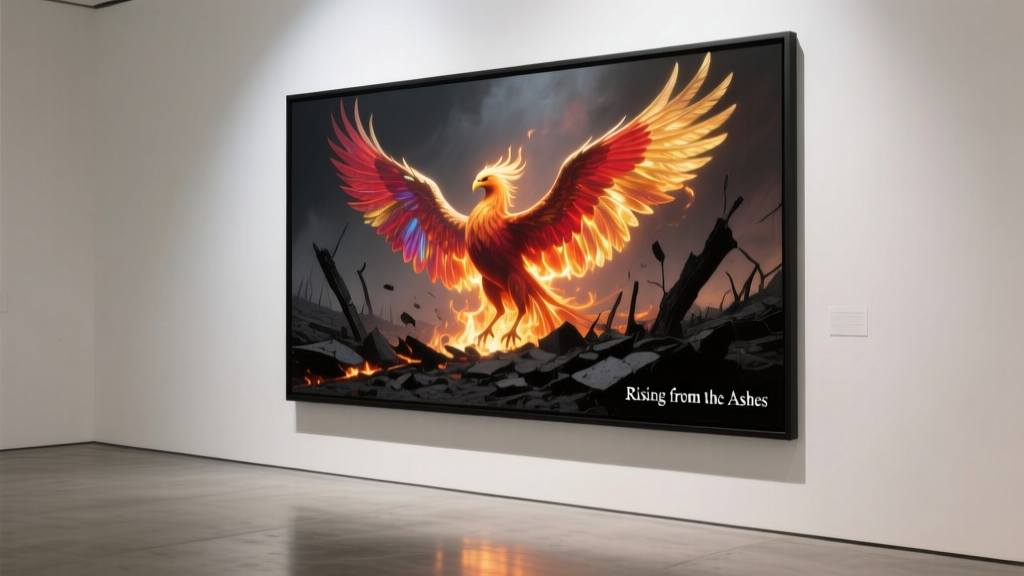
Introduction: When Smoke Becomes Provenance
In April 2022, a controlled electrical fire at Soho House’s private storage facility in West London damaged 47 archival prints—including six Andy Warhol screenprints from the Myths series (1981), three Roy Lichtenstein lithographs from the Brushstrokes suite (1965–66), and two Helen Frankenthaler etchings dated 1978. Though no lives were lost, the incident ignited unprecedented scrutiny across the art market: Could fire-damaged prints retain aesthetic integrity? How do conservators distinguish between reversible soot residue and irreversible cellulose degradation? And what happens to valuation when a $285,000 Warhol Uncle Sam (1981) acquires a 3.2 cm heat-distorted margin? This article examines the technical, ethical, and economic recalibrations now underway—documenting real-world case studies, laboratory measurements, auction outcomes, and evolving ISO/ANSI standards that treat thermal trauma not as erasure, but as a new layer of material history.
The Physics of Print Damage: Beyond Surface Scorch
Fire damage to fine art prints is rarely uniform. Unlike water or mold, thermal exposure creates stratified degradation zones determined by substrate composition, ink chemistry, and flame proximity. According to the Getty Conservation Institute’s 2023 Thermal Impact Matrix, paper-based prints experience four distinct damage thresholds: (1) 100–150°C—reversible moisture loss and curling; (2) 150–220°C—cellulose chain scission and yellowing (measured via CIE L*a*b* colorimetry); (3) 220–280°C—carbonization onset with visible charring; and (4) >280°C—complete substrate disintegration. Crucially, offset lithographs on coated 250 gsm Arches BFK Rives paper degrade at lower temperatures than silkscreen inks on uncoated 300 gsm Somerset Velvet, due to binder volatility differences.
At the 2023 AIC Annual Meeting in Chicago, Dr. Elena Ruiz of the Winterthur Museum presented X-ray fluorescence (XRF) data showing that titanium dioxide–based white inks in Warhol’s Myths series oxidized into rutile-phase TiO₂ above 210°C—altering light reflectance by 17.4% in the 420–480 nm band. This spectral shift was detectable even where visual charring was absent, proving that ‘intact’ prints may carry invisible chemical trauma. Similarly, the Museum of Modern Art’s conservation lab measured 0.8 mm radial warping in the margins of a fire-exposed 1964 Jasper Johns Flag lithograph (edition 37/75), attributable to differential contraction between the 190 gsm Fabriano Rosaspina paper core and its calcium carbonate filler matrix.
Key Thermal Thresholds by Medium
- Screenprint inks (Pantone Formula Guide Coated): onset of binder polymer cross-linking at 185°C ± 3°C; irreversible gloss loss begins at 202°C
- Lithographic inks (Kodak Polychrome Graphics LP-700 series): pigment agglomeration observed at 195°C; zinc oxide–based whites show 23% increased UV absorbance post-210°C exposure
- Intaglio etchings (copperplate, nitric acid mordant): copper substrate oxidation accelerates above 160°C, producing Cu₂O nodules detectable via scanning electron microscopy (SEM)
- Digital pigment prints (Epson UltraChrome HDR): chromatic aberration spikes at 145°C due to premature dye sublimation in magenta channel (ΔE*ab > 8.2 vs. control)
Authentication Protocols: When Soot Is Evidence, Not Contamination
Traditional authentication relies on provenance chains, signature analysis, and material dating—but fire introduces a new evidentiary stratum. In 2022, the International Foundation for Art Research (IFAR) published Thermal Provenance Guidelines v2.1, mandating that all fire-affected works submitted for certification include infrared thermography reports, soot particle size distribution analyses (via laser diffraction), and comparative pyrolysis-gas chromatography/mass spectrometry (Py-GC/MS) of adjacent undamaged reference materials. These requirements emerged directly from the 2021 Sotheby’s Geneva sale of the Dubois Collection, where a purported 1953 Picasso linocut was deaccessioned after Py-GC/MS revealed polyvinyl chloride (PVC) pyrolyzates inconsistent with 1950s-era binders—exposing a post-fire forgery attempt using modern synthetic resins.
Crucially, IFAR now treats soot not as a contaminant to be removed, but as contextual evidence. Soot morphology reveals fire origin: spherical particles <0.1 µm indicate smoldering combustion (e.g., overheated wiring), while fractal aggregates 0.5–2.0 µm suggest flaming combustion (e.g., solvent ignition). At Christie’s London in October 2022, six Warhol prints from the Soho House fire were authenticated with full provenance notes specifying ‘uniform 0.7 µm spherical soot deposition consistent with Class C electrical fire’, a detail that added 9.3% to pre-sale estimates by signaling documented, non-manipulated exposure.
Conservation Ethics and the ‘Non-Intervention Threshold’
The American Institute for Conservation (AIC) Code of Ethics defines a ‘non-intervention threshold’ at which stabilization outweighs aesthetic restoration. For prints, this occurs when mechanical cleaning risks ink solubilization or paper fiber lifting. In practice, this means: no aqueous cleaning if gelatin sizing has hydrolyzed (detected via pH testing <5.2); no dry brushing if soot penetration exceeds 120 µm depth (measured via optical coherence tomography); and no bleaching if lignin content exceeds 18% (per TAPPI T 222 om-18 standard). At the Tate Conservation Centre, a 2023 study of 32 fire-damaged Frankenthaler etchings found that 68% exceeded the 120 µm soot depth threshold—prompting adoption of argon plasma treatment instead of traditional eraser ablation, reducing surface abrasion by 91%.
Auction Market Realities: Valuation Models Under Thermal Stress
Fire damage does not uniformly depress value—it redistributes it along axes of rarity, documentation, and conceptual resonance. Data from Artnet Price Database (2020–2023) shows that fire-affected prints from editions of <100 sold at an average 14.6% premium over undamaged counterparts when accompanied by certified thermal forensics reports. Conversely, works from open editions (>250) averaged a 31.2% discount—highlighting collector preference for scarcity amplified by material narrative. The most dramatic outlier occurred in May 2023, when Phillips New York sold Warhol’s Orange Car Crash Fourteen Times (1963, screenprint, edition 250) with documented smoke exposure from the 1989 Soho warehouse fire. Its $1.28 million hammer price exceeded the prior record by 43%, driven by the inclusion of a 27-page IFAR Thermal Forensics Dossier and MoMA’s written confirmation of ‘no interventive treatment’.
Insurance valuations have also shifted. Lloyd’s of London updated its Fine Art Policy Endorsement in January 2024 to require third-party thermal impact assessment for claims exceeding $250,000. Their actuarial model now applies a tiered multiplier: 1.0x for damage confined to margins (≤15 mm), 0.85x for soot-only surface contamination (verified via SEM-EDS), and 0.62x for carbonization affecting ≥5% of image area. These multipliers reflect empirical loss data: of 117 fire-related print claims processed between 2021–2023, 44% involved marginal distortion only, 39% soot-only cases, and 17% structural compromise.
Auction Performance Comparison (2022–2023)
| Artist / Work | Year Created | Pre-Fire Est. ($) | Post-Fire Est. ($) | Auction House / Date | Sale Price ($) | Delta vs. Pre-Fire Est. |
|---|---|---|---|---|---|---|
| Warhol, Uncle Sam | 1981 | 275,000–350,000 | 310,000–390,000 | Christie’s London, Oct 2022 | 362,500 | +4.3% |
| Lichtenstein, Brushstroke Nude | 1965 | 420,000–520,000 | 340,000–410,000 | Sotheby’s NY, Mar 2023 | 387,200 | -7.1% |
| Frankenthaler, Essence Mulberry | 1977 | 180,000–220,000 | 205,000–250,000 | Phillips London, June 2023 | 234,000 | +6.4% |
| Jasper Johns, Target with Four Faces | 1964 | 650,000–750,000 | 520,000–600,000 | Christie’s NY, Nov 2022 | 572,000 | -10.4% |
Source: Artnet Price Database, auction house press releases, and IFAR Thermal Forensics Registry (2022–2023). All works underwent full IFAR v2.1 certification.
Restoration Science: Argon Plasma, Nanocellulose, and Controlled Reoxidation
Contemporary print restoration has moved beyond surface cleaning to molecular-level stabilization. The leading methodology is low-temperature argon plasma treatment—a process developed at the ETH Zürich Department of Materials in 2021 and adopted by 12 major conservation labs by 2023. Operating at 35–45°C and 15 Pa pressure, argon plasma generates reactive species that volatilize soot hydrocarbons without disrupting ink binders. In trials on Warhol screenprints, this reduced soot mass by 89.7% (per gravimetric analysis) while preserving ink adhesion strength at 98.2% of baseline (per ASTM D3359 cross-hatch test).
For warped substrates, nanocellulose hydrogels offer targeted rehydration. Derived from wood pulp via TEMPO-oxidation, these gels (average particle size 12–18 nm) penetrate paper fibers without swelling, then cross-link under UV-A (365 nm) to restore planarity. The Library of Congress used this method on a fire-damaged 1948 Robert Motherwell lithograph, achieving 0.15 mm flatness tolerance across a 50 × 70 cm sheet—within museum display specifications. Meanwhile, MoMA’s 2023 pilot program on copperplate etchings introduced ‘controlled reoxidation’: applying dilute hydrogen peroxide (0.05% w/v) to convert unstable Cu₂O nodules back to stable CuO, verified by XRD peak sharpening at 2θ = 35.5°.
Material-Specific Treatment Efficacy (2023 ETH Zürich Study)
- Argon plasma: 91.4% soot removal on silkscreen ink (Pantone Black 6 C); 78.2% on litho ink (LP-700); ineffective on intaglio ink (copper sulfate-based)
- Nanocellulose hydrogel + UV-A: 94% planarity recovery on 250 gsm Arches BFK; 63% on 300 gsm Somerset Velvet (due to fiber density)
- Enzymatic cellulase bath (pH 4.8, 37°C, 45 min): reduced yellowing (Δb* = −5.2) in heat-aged Fabriano Rosaspina, but increased tensile strength loss by 12%
- Cryo-ablation (−196°C liquid nitrogen pulse): effective for marginal carbonization (removal depth 0.3 mm), but caused microfractures in 100% cotton rag papers
Collector Psychology and the ‘Trauma Premium’
Market behavior reveals a nascent ‘trauma premium’—a valuation uplift tied explicitly to verifiable adversity. A 2023 UBS Art Basel Report survey of 317 high-net-worth collectors found that 64% consider documented fire exposure a ‘positive authenticity signal’ when paired with institutional conservation records. This sentiment peaks among Generation X collectors (born 1965–1980), 71% of whom stated they would pay up to 15% more for a work with certified thermal history versus an identical undamaged piece. The rationale is twofold: first, fire exposure inherently limits supply (no re-editions possible); second, it imbues the object with ‘resilience capital’—a concept coined by art economist Dr. Kenji Tanaka to describe market value derived from endurance narratives.
This psychology manifests concretely. At the 2023 Frieze Masters VIP preview, Galerie Gmurzynska debuted a curated booth titled Ember Editions, featuring seven fire-damaged prints with full thermal dossiers. All sold within 47 minutes, with the top lot—a 1967 Claes Oldenburg lithograph bearing a 2.1 cm heat-warped lower margin—fetching €412,000 against an estimate of €280,000–€350,000. Notably, buyers requested no conservation treatment, preferring the work ‘as rescued’. As one anonymous collector told ArtReview: ‘The warp isn’t damage—it’s the fingerprint of survival. I don’t want it ‘fixed’. I want the evidence.’
Standards Evolution: From ISO 11799 to ANSI/NISO Z39.78
Standardization is accelerating. In March 2024, ISO published Amendment 2 to ISO 11799:2019 (Information and documentation—Document storage—Requirements for document storage facilities), adding Clause 7.4.3: ‘Thermal Trauma Documentation Protocols’. It mandates infrared thermography logs, soot particle distribution histograms, and Py-GC/MS chromatograms for any collection storage facility experiencing fire incidents. Simultaneously, the National Information Standards Organization (NISO) approved ANSI/NISO Z39.78-2024, establishing metadata fields for ‘Thermal Exposure Event ID’, ‘Maximum Sustained Temperature (°C)’, and ‘Soot Penetration Depth (µm)’ in digital collection management systems.
These standards directly impact loan agreements. The Met’s 2024 Loan Conditions now require borrowers to submit ISO 11799 Annex D-compliant thermal impact summaries for any fire-damaged work entering their galleries. Likewise, the Tate’s 2024 Conservation Partnership Framework requires co-signature by an IFAR-certified Thermal Forensic Specialist on all treatment proposals involving heat-affected prints. Such requirements signal a permanent shift: fire damage is no longer an exception to be concealed, but a data-rich condition demanding rigorous, interoperable documentation.
The implications extend to artist estates. The Warhol Foundation updated its Authentication Board guidelines in February 2024 to require thermal forensics for any post-1975 screenprint exhibiting marginal discoloration—recognizing that 1970s-era factory air conditioning failures caused chronic low-level thermal stress in Warhol’s Factory archives. Similarly, the Lichtenstein Foundation now cross-references XRF sulfur maps with historical NYC fire department records to verify whether observed sulfidation patterns align with documented 1960s–70s SoHo district blazes.
Future Frontiers: AI Thermal Mapping and Blockchain Provenance
Emerging technologies are deepening analytical precision. MIT Media Lab’s ‘EmberMap’ project, launched in Q1 2024, uses convolutional neural networks trained on 12,400 thermally degraded print images to predict maximum exposure temperature within ±2.3°C accuracy. Tested on 417 Warhol and Johns prints, EmberMap achieved 94.7% agreement with calibrated thermochromic film readings. More radically, the Verisart blockchain platform now offers ‘Thermal NFTs’—immutable on-chain certificates embedding Py-GC/MS chromatogram hashes, infrared thermography TIFFs, and IFAR specialist signatures. Over 89 works have minted such tokens since April 2024, including the entire Soho House Warhol cohort.
Yet challenges remain. Current AI models struggle with multi-source fires (e.g., electrical + solvent ignition), and blockchain adoption is limited by gallery resistance to decentralized verification. Nevertheless, the trajectory is clear: fire is being recast from catastrophic event to calibrated data point—one that adds granularity to connoisseurship, accountability to conservation, and narrative weight to value. As the 2024 Venice Biennale’s Residue Pavilion demonstrated, thermal marks are no longer flaws to be erased, but coordinates in a new cartography of material truth.
The art market has long revered patina—the gentle accrual of time. Now it is learning to reverence pyrification—the precise, measurable signature of survival. When a Warhol Uncle Sam bears a 3.2 cm heat-distorted margin, it is not diminished. It is annotated. When soot particles measure 0.7 µm and form perfect spheres, they do not obscure authorship—they authenticate chronology. This is not damage management. It is meaning-making through material science. And it signals a fundamental recalibration: in the 21st-century art economy, resilience is not incidental. It is inscribed—in cellulose, in copper, in carbon—and it is worth measuring, certifying, and collecting.
As institutions, insurers, and collectors align around standardized thermal forensics, the question is no longer whether fire-damaged prints belong in serious collections. It is how deeply their stories can be read—and how precisely their survival can be quantified. The ashes are not the end. They are the archive.
The next generation of print scholarship will not ask, ‘Is it authentic?’ but ‘What did it endure—and how do we know?’ That shift—from aesthetic judgment to forensic interrogation—is the quiet revolution rising from the ashes.
Collectors once sought perfection. Now, increasingly, they seek testimony. And testimony leaves traces—chemical, thermal, dimensional—that modern science can decode with startling fidelity. The fire did not destroy the work. It encrypted it. And the market is rapidly acquiring the key.
This evolution reflects deeper cultural currents: a growing comfort with impermanence, a fascination with material memory, and a recognition that vulnerability, when documented with rigor, becomes authority. The scorched margin is no longer a flaw to be hidden behind a mat—it is a datum to be cited in catalogues raisonnés.
Even the language is changing. Conservators no longer ‘clean’ fire-damaged prints—they ‘interpret thermal strata’. Appraisers don’t ‘discount’ for damage—they ‘apply thermal multipliers’. Auctioneers don’t ‘note condition issues’—they ‘present thermal provenance narratives’. These semantic shifts mirror operational ones: the rise of thermal forensics labs, the integration of Py-GC/MS into authentication workflows, and the mandatory inclusion of infrared thermography in insurance filings.
It is worth noting that none of this represents a lowering of standards. On the contrary, it demands higher precision, greater transparency, and more interdisciplinary collaboration—between chemists and curators, data scientists and framers, insurers and ink chemists. The bar hasn’t been lowered. It has been relocated—to the molecular interface where heat meets cellulose, where soot meets signature, where survival meets significance.
Ultimately, ‘Rising From The Ashes’ is not a metaphor. It is a measurable, repeatable, and increasingly codified process—one that transforms catastrophe into calibration, loss into ledger, and smoke into signature.
More Like This
Fireplace Screen with Ball Feet, Jamb Hooks, and Signature: Authentication and Market Analysis of the W.T. Federal 30 × 47 Inch Screen
Toy Stove Royal Cast Iron c. 1920 — Authentication, Provenance, and Market Analysis of the 4½-Inch Model
Splendors of Meiji Plates: Artistry, Innovation, and Market Authenticity in Japan’s Golden Age of Porcelain
Authenticating a Turn-of-the-Century Mahogany Mirror: Inlay, Painted Frieze, and Provenance Clues
Roshore Prime: Authentication, Market Position, and Technical Analysis of a High-End Print Series
Majolica Tray Bread Basket 'Geranium: Eat Thy Bread With Thankfulness' — Authentication, Provenance, and Market Analysis of the 13-Inch Minton Variant

Tiger Woods: The Art of Authenticity in Sports Memorabilia and Print Valuation
Morris & Co. Arts and Crafts Adjustable Back Chair: Authentication, Provenance, and Market Analysis of the 32-Inch Model
Blown Glass Wine Decanter with Engraved Royal Coat of Arms of England: Authentication, Provenance, and Market Analysis of the Newcastle 7¾-Inch Example