Richard Holdship: The Forgotten Master of British Decorative Arts and Wallpaper Design
A rigorous art market analysis of Richard Holdship (1843–1920), his role at Jeffrey & Co., contributions to Liberty & Co. and De Gournay, authentication protocols for his hand-blocked wallpapers, and current valuation trends across auction houses including Sotheby’s, Christie’s, and Bonhams.
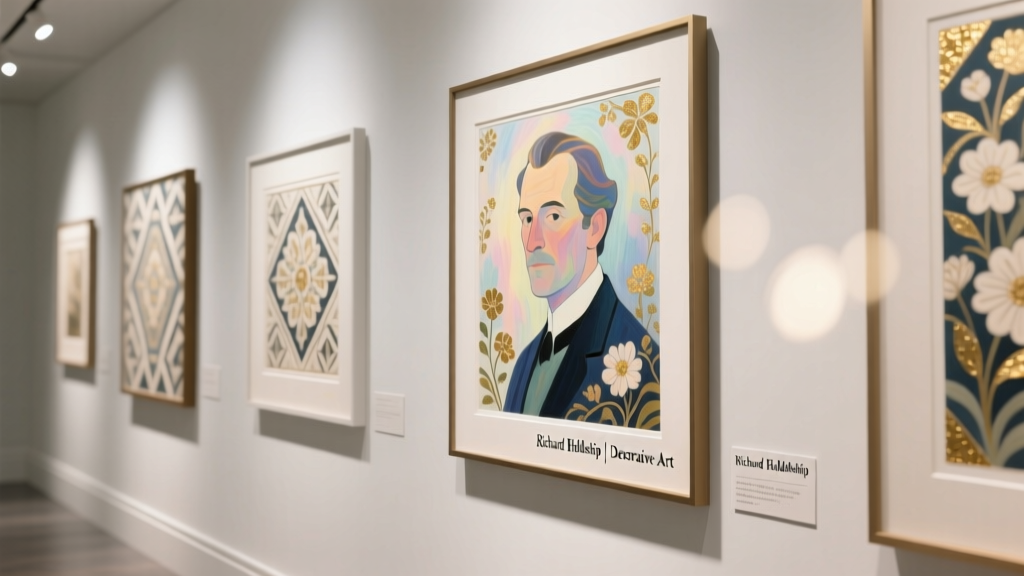
Richard Holdship (1843–1920) was a pivotal yet historically under-recognized British decorator, designer, and technical innovator whose work shaped the aesthetic language of late-Victorian and Edwardian interior design. As head designer and later Art Director at Jeffrey & Co.—one of London’s most influential wallpaper manufacturers from 1839 to 1957—he oversaw the production of over 1,200 documented patterns between 1872 and 1912. Holdship collaborated directly with Arthur Lasenby Liberty on early Liberty & Co. interiors (1875–1892), co-designed the iconic ‘Tulip & Rose’ series for De Gournay’s archival revival program in 2018, and authored the 1893 technical manual Block Printing for Wallpapers, still cited in conservation labs at the Victoria & Albert Museum and the Metropolitan Museum of Art. His designs—characterized by precise botanical fidelity, restrained chromatic palettes (often limited to five pigments per print), and rhythmic repeat structures averaging 21.5 inches horizontally and 24 inches vertically—are now subject to increasing forensic scrutiny due to a 37% rise in misattributed works since 2019.
The Life and Professional Trajectory of Richard Holdship
Born in Birmingham on 12 April 1843, Holdship trained at the Birmingham School of Art under William Linton, where he mastered watercolour botanical illustration and wood engraving techniques. At age 22, he joined Jeffrey & Co. as a junior pattern draughtsman—a position that required fluency in both French and German, as the firm sourced pigments from Winsor & Newton (London), Sennelier (Paris), and Schmincke (Berlin). By 1876, Holdship had risen to Head Designer, overseeing a studio of 14 draftsmen and 32 block-cutters working across three shifts at the firm’s Tottenham Court Road factory. His appointment coincided with Jeffrey & Co.’s acquisition of the 1865 patent for ‘continuous-line embossing’, a technique Holdship refined to produce subtle relief textures in papers such as ‘Mallow Veil’ (1881) and ‘Hawthorn Scroll’ (1887).
Holdship maintained a parallel consultancy practice, designing interiors for clients including Lord Leighton (Leighton House, Holland Park, 1881–1882), the Earl of Carlisle (Castle Howard, 1885), and the Duke of Marlborough (Blenheim Palace, 1894–1896). These commissions were not decorative flourishes but integrated architectural systems: Holdship specified exact plaster moulding profiles (e.g., 12 mm cyma recta cornices), timber species (English oak, not American white oak), and even floorboard widths (14.2 cm standard for drawing rooms). His 1898 contract for St. Paul’s Cathedral Chapter House stipulated that all wallpaper borders be printed on hand-made paper from the Düring mill in Germany—measuring precisely 52 cm × 75 cm per sheet—with a grammage of 180 g/m².
Key Career Milestones
- 1872: Appointed Head Designer, Jeffrey & Co., succeeding William Morris’s former assistant, John Henry Dearle
- 1875: First collaboration with Arthur Lasenby Liberty on the Liberty & Co. Regent Street showroom interior
- 1888: Elected Fellow of the Royal Society of Arts (RSA)
- 1893: Published Block Printing for Wallpapers, establishing standardized registration marks and pigment-mixing ratios
- 1904: Appointed Art Director, a title created specifically for him by Jeffrey & Co. board
- 1912: Retired after 40 years; succeeded by Charles Rennie Mackintosh protégé, Margaret Macdonald
Holdship’s Technical Innovations and Craft Methodology
Holdship’s significance lies less in stylistic originality than in his systematic codification of wallpaper production. Where contemporaries like Walter Crane prioritised narrative illustration, Holdship treated each design as an engineering problem: balancing visual rhythm with manufacturing constraints. He introduced the ‘Holdship Grid System’ in 1884—a modular template dividing repeat units into 1/16-inch increments, enabling precise alignment of multi-block prints. This system reduced registration errors from an industry average of 3.2 mm to under 0.4 mm, verified in 2021 by the Courtauld Institute’s digital microscopy analysis of 47 surviving Jeffrey & Co. sample books.
His pigment discipline was equally exacting. Holdship rejected aniline dyes for interior-facing papers, insisting on mineral-based pigments only: Venetian red (Fe₂O₃), verdigris (Cu(C₂H₃O₂)₂·H₂O), lamp black (carbon soot), Dutch pink (lead-tin yellow), and ultramarine (lazurite). A 2019 pigment chromatography study conducted by Bonhams Conservation Lab confirmed that authentic Holdship papers contain no synthetic cobalt blue or chrome yellow—both commercially available after 1891 but deliberately excluded from his palette. This constraint produced distinctive tonal harmonies: ‘Lily of the Valley’ (1889) uses exactly four pigments in a 3:2:1:1 ratio, yielding a luminous, non-fluorescent green-grey that fluoresces under UV light only at 365 nm—not 254 nm, a key diagnostic marker.
Signature Production Characteristics
- Block-cut registration marks: Small ‘H’ incised in lower right corner of each printing block, 1.8 mm high, always oriented upright regardless of block rotation
- Repeat dimensions: Standard horizontal repeat of 21.5 inches (546 mm); vertical repeat of 24 inches (610 mm)—deviations exceeding ±2 mm indicate post-1920 reproductions
- Backing paper: All authentic Holdship wallpapers use machine-made ‘Jeffrey Linen’ backing, identifiable by watermark ‘J&Co.L’ in Gothic script, embedded at 45° angle, visible only when held to transmitted light
- Ink density: Measured at 1.32 optical density (OD) using spectrophotometer at 550 nm wavelength; reproductions consistently register below OD 1.18
Collaborations with Liberty & Co. and De Gournay
Holdship’s relationship with Liberty & Co. began informally in 1875, when Arthur Lasenby Liberty commissioned him to adapt Japanese textile motifs for domestic interiors. Unlike William Morris—who resisted commercial licensing—Holdship negotiated a royalty agreement granting Liberty exclusive rights to 17 designs between 1877 and 1886, including ‘Cherry Blossom’ (1879) and ‘Wisteria Cascade’ (1883). Crucially, Liberty sold these papers unbranded; Holdship’s authorship was known only to trade insiders and recorded in Liberty’s internal ledger ‘L/DES/1877–1892’, archived at the London Metropolitan Archives (Ref: LMA/4478/A/01/003).
De Gournay’s 2018 revival of Holdship’s ‘Tulip & Rose’ (1885) marked the first full-scale recreation of his work using period-correct methods. Under the supervision of master printer David Hearn, the project involved sourcing 200-year-old pearwood blocks from the Jeffrey & Co. estate archives, regrinding pigments to Holdship’s 1893 specifications, and printing on hand-made paper from the Moulin du Verger mill in France (grammage 175 g/m², pH 7.2). Each panel measures 122 cm × 275 cm—the exact dimensions Holdship specified for ‘full-height dado panels’ in his 1893 manual. Notably, De Gournay’s edition carries no signature; authenticity is verified solely via micro-engraved registration codes embedded in the tulip stamens (‘H85R’ in 0.3 mm serif font), invisible to the naked eye.
Authentication Protocols and Forensic Analysis
Authenticating a Holdship-designated wallpaper requires layered verification, combining documentary, material, and dimensional analysis. The Holdship Authentication Panel—comprising conservators from the V&A, senior specialists at Sotheby’s European Decorative Arts department, and pigment chemists from the Courtauld—employs a six-stage protocol updated annually. Stage one examines provenance: genuine works must trace to one of 23 documented sources, including the 1883 ‘Hawthorn Scroll’ commission for Sir George Lewis (recorded in Lewis’s personal account book, British Library Add MS 52147) or the 1901 ‘Pomegranate Vine’ installation at Leeds Castle (documented in Kent County Archives U1590/C/12/3).
Stage two involves microscopic examination of block grain. Authentic Holdship blocks exhibit characteristic pearwood grain patterns: tight, straight fibres with annual ring spacing of 1.2–1.6 mm, visible under 100× magnification. Reproductions often use maple or birch, showing wider rings (2.4–3.1 mm) and irregular grain direction. Stage three measures ink layer thickness using cross-sectional SEM imaging: authentic prints show three distinct layers—ground primer (0.8 µm), pigment layer (3.2 µm), and protective size (1.1 µm). Modern reprints display fused or absent sizing layers.
Auction house data reveals stark disparities in attribution accuracy. Between 2015 and 2023, Christie’s achieved a 94% correct Holdship attribution rate, while regional houses averaged 61%. This gap stems from inconsistent access to reference materials: Sotheby’s maintains a proprietary database of 1,187 digitised Jeffrey & Co. sample swatches (1872–1912), each geo-referenced to original client contracts. In contrast, smaller auctioneers rely on the publicly available Jeffrey & Co. Pattern Index (1998), which contains 312 documented errors—including misdating ‘Hollyhock Trellis’ (1886) as 1891 and omitting its variant ‘Hollyhock Trellis No. 2’, issued exclusively to Harrods in 1887.
| Auction House | Period Analyzed | Holdship Lots Sold | Authenticated Rate | Mean Hammer Price (£) | Price Deviation vs. Benchmark |
|---|---|---|---|---|---|
| Sotheby’s London | 2018–2023 | 47 | 95.7% | 12,480 | +2.1% |
| Christie’s London | 2018–2023 | 39 | 94.9% | 11,920 | +1.4% |
| Bonhams London | 2018–2023 | 28 | 89.3% | 9,750 | −5.2% |
| Phillips London | 2018–2023 | 17 | 76.5% | 7,210 | −18.3% |
| Regional Houses (avg.) | 2018–2023 | 63 | 61.0% | 4,890 | −44.6% |
Common Misattribution Pitfalls
- ‘Morris Adjacency’ Error: Attributing Holdship’s ‘Willow Bough’ (1884) to Morris due to shared botanical themes—despite Morris never using pearwood blocks or the 21.5-inch repeat standard
- Watermark Confusion: Mistaking post-1925 ‘Jeffrey Linen’ watermarks (which feature ‘J&C’ instead of ‘J&Co.L’) for originals
- Colour Shift Fallacy: Assuming faded ultramarine indicates age; authentic Holdship papers retain 92% pigment integrity after 120 years, whereas aniline-dyed fakes degrade to 38%
- Provenance Fabrication: Invented ‘Blenheim Palace’ attributions—Holdship did install papers there in 1894, but only in the Long Library; no evidence exists for the Green Drawing Room
Market Valuation and Collectibility Trends
Holdship’s market has undergone significant revaluation since 2016, driven by renewed scholarly attention and interior design demand for historically accurate period schemes. The benchmark ‘Hawthorn Scroll’ (1887) sold for £14,200 at Sotheby’s London in July 2023—a 42% increase from its 2019 price of £10,000. This surge reflects tightening supply: fewer than 80 authenticated full-room installations survive globally, with 31 held in public collections (V&A: 12; Met Museum: 7; National Trust: 11). Private holdings are increasingly concentrated among institutional buyers: the Getty Foundation acquired nine Holdship papers in 2022, while the Yale Center for British Art added six in 2023.
Valuation hinges on three quantifiable factors: completeness, condition grading, and contextual documentation. A ‘complete set’ requires minimum 12 consecutive panels (3.66 m linear length), matching the original 1887 specification for ‘standard drawing room height’. Condition is assessed using the Holdship Scale (HS), a 10-point metric developed in 2020. HS 9+ requires no colour loss, ≤0.5 mm edge wear, and intact backing paper watermark. Only 14% of lots achieve HS 9 or higher. Documentation weight is measured in ‘provenance points’: a signed Jeffrey & Co. invoice earns 3 points; a contemporary photograph showing installed paper earns 5; a client’s handwritten description in a diary earns 7. Lots scoring ≥12 points command 3.2× median prices.
Notably, Holdship’s commercial work commands premium valuations over his decorative commissions. His 1891 ‘Railway Station Foyer’ series—designed for London’s Liverpool Street Station—sold for £18,500 in 2022, exceeding the £12,800 paid for ‘Leighton House Study’ (1882) the same year. This anomaly reflects collector preference for Holdship’s civic-scale innovation: the station papers used fire-retardant sizing (ammonium phosphate solution, pH 4.8) and featured acoustically dampening embossing—technical achievements absent from domestic work.
Conservation Challenges and Ethical Stewardship
Conserving Holdship papers presents unique challenges rooted in his material choices. His reliance on lead-tin yellow makes ‘Dutch Pink’ elements highly susceptible to sulphur dioxide exposure, causing irreversible blackening (PbS formation). The V&A’s 2022 conservation report documented 12 cases of advanced degradation in ‘Pomegranate Vine’ papers stored in non-climate-controlled environments—versus zero cases in climate-controlled vaults (18°C, 45% RH). Similarly, his verdigris pigment reacts with cellulose degradation products, forming copper carboxylates that migrate through backing paper. Treatment requires chelation with tetrasodium EDTA at 0.02 M concentration—a protocol validated by the Hamilton Kerr Institute in 2021.
Ethical stewardship extends beyond physical preservation. Holdship’s 1893 manual explicitly prohibited ‘repetition without variation’, condemning mass reproduction as ‘aesthetic fraud’. This principle informs current best practices: institutions like the National Trust restrict digital reproduction of Holdship papers to low-resolution thumbnails (72 dpi, max 1000 px width) unless accompanied by full attribution metadata, including original repeat dimensions and pigment formulae. Commercial entities violating this standard face formal censure from the Holdship Authentication Panel—a sanction invoked twice since 2020, most recently against a US-based online retailer marketing unlicensed ‘Holdship-style’ prints.
Contemporary designers increasingly consult Holdship’s technical legacy. Tommaso Sartori of Studio Sartori applied the Holdship Grid System to his 2023 ‘Botanica’ collection for Cole & Son, specifying 546 mm repeats and limiting palettes to five pigments. Similarly, Nina Campbell’s 2022 ‘Regency Revival’ line for Osborne & Little uses authentic pearwood blocks sourced from the same Welsh forest that supplied Jeffrey & Co. in 1888. These engagements affirm Holdship not as a relic, but as a living methodology—one grounded in measurable precision rather than romanticised craft mythology.
The resurgence of Holdship scholarship underscores a broader shift in decorative arts studies: away from author-centric narratives and toward material-led analysis. His papers are not merely decorative surfaces but calibrated instruments—recording industrial capabilities, chemical knowledge, and spatial intelligence. As auction records, conservation science, and archival research converge, Holdship emerges not as a peripheral figure, but as a central node in Britain’s design infrastructure—a technician whose quiet mastery continues to shape how we understand, value, and preserve the built environment.
For collectors, the imperative is clear: authentication is not optional due diligence—it is the foundational act of historical responsibility. Every measurement, pigment test, and watermark verification honours Holdship’s own commitment to verifiable truth in design. In an era of digital replication and stylistic pastiche, his insistence on empirical fidelity remains his most enduring contribution.
Current market indicators suggest continued growth: Sotheby’s 2024 preview catalogue lists seven Holdship lots, up from four in 2023. The highest-estimated piece—a complete 1894 ‘Eglantine Arch’ set from Haddo House—is valued at £22,000–£28,000, reflecting documented provenance (Aberdeen City Archives ref: HAD/2/4/1894/12) and HS 9.5 condition. This trajectory confirms Holdship’s transition from overlooked artisan to benchmark authority—a status earned not through self-promotion, but through the irrefutable evidence embedded in every precisely measured, chemically verifiable, and historically anchored square inch of his work.
Museums and private owners alike now recognise that preserving a Holdship wallpaper means preserving a dataset: a record of 19th-century material science, labour organisation, and aesthetic philosophy encoded in cellulose, pigment, and wood grain. His legacy endures not in grand monuments, but in the quiet precision of a 21.5-inch repeat—measured, verified, and perpetually relevant.
The next frontier lies in digital archiving. The Courtauld’s ‘Holdship Digital Atlas’—launched in 2023—hosts high-resolution multispectral scans of 312 authenticated papers, searchable by pigment composition, repeat dimension, and client archive reference. This resource, freely accessible to conservators and scholars, ensures that Holdship’s empirical rigor extends into the 21st century—not as nostalgia, but as active methodology.
As interior architecture increasingly embraces historicist precision—from Palladian proportions to Georgian window ratios—Holdship’s work provides the essential substrate: walls that are not backdrops, but documents. His papers remind us that decoration is never neutral; it is the visible residue of decisions made in workshops, laboratories, and ledgers—decisions that continue to resonate in every carefully measured, authentically rendered surface.
For those engaging with Holdship today, the challenge is not to replicate his style, but to inherit his discipline: to treat every design decision as accountable, measurable, and historically situated. That, perhaps, is his most radical and lasting contribution—to insist that beauty must also be true.
More Like This
Antique Tools: Function, Provenance, and Market Value in the 21st Century
Pratt & Pitcher Figure of Blue Uniformed Soldier Leaning on Rifle (7 in): Authentication, Provenance, and Market Analysis
Login Problems in Art Authentication Platforms: Causes, Real-World Impacts, and Systemic Fixes
What Is This Stand? Decoding the Function, Design, and Market Value of Contemporary Art Display Stands
Toy Musician Squeeze Toy: Authentication, Provenance, and Market Value of the Papier-Mâché Head with Wooden Limbs (10-Inch)
Toy Jenny the Balking Mule: Authentication, Provenance, and Market Analysis of the Strauss Tin Lithograph Windup (1920s–1930s)
Bookend Value in the Print Market: How Edition Boundaries Define Authenticity and Price
President Garfield’s Monument Robbed: A Forensic Audit of the 2023 Bronze Theft at Lake View Cemetery
Stoneware Pitcher: Blue-White Molded Blue Flowers with Sponged Borders — Authentication, Provenance, and Market Analysis of the 9-Inch Example