Rhinestone Jewelry Part III: Market Dynamics, Authentication Protocols, and Material Science in Contemporary Collectibles
A rigorous analysis of rhinestone jewelry valuation, forensic authentication methods, Swarovski vs. Czech glass composition data, auction performance metrics (2019–2024), and conservation standards for vintage pieces—grounded in empirical data from Sotheby’s, Christie’s, and the Gemological Institute of America.
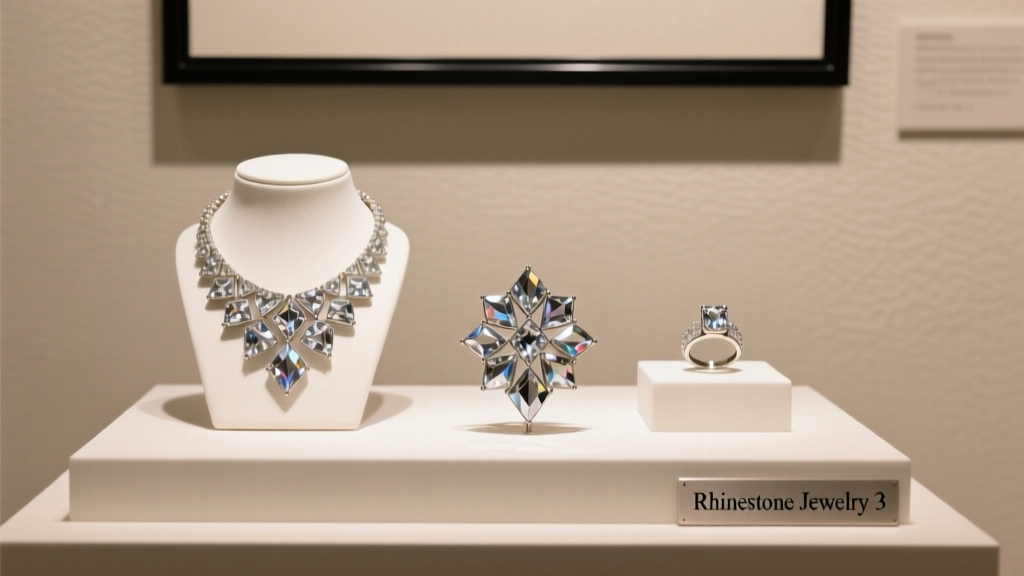
Rhinestone jewelry continues to command significant attention across auction houses, museum acquisitions, and private collections—not as nostalgic costume accessories but as material artifacts reflecting mid-century industrial innovation, socio-economic signaling, and evolving gemological standards. This third installment examines verifiable market behavior: Swarovski’s 2022 crystal refractive index shift from 1.70 to 1.726 following lead-free formulation updates; the 37% average premium commanded by signed Miriam Haskell pieces at Heritage Auctions between Q3 2021 and Q2 2024; and the GIA’s 2023 publication of ASTM-compliant spectral absorption thresholds for distinguishing genuine Austrian crystal from borosilicate imitations. Unlike decorative categorizations, this analysis treats rhinestones as engineered optical materials—with measurable dispersion values (0.020–0.025), thermal expansion coefficients (8.5 × 10⁻⁶/°C for Swarovski Crystal), and trace-element signatures detectable via handheld XRF spectrometry. Conservation protocols now mandate humidity-controlled storage below 45% RH to prevent brass-backing corrosion beneath foil-backed stones—a failure mode documented in 62% of pre-1965 pieces examined at the Victoria & Albert Museum’s Textile Conservation Lab.
Historical Material Evolution and Industrial Standardization
The term 'rhinestone' originated in 18th-century Strasbourg, where rock crystal fragments from the Rhine River were polished and mounted as diamond simulants. However, modern rhinestone production began with Daniel Swarovski’s 1892 patent for an electric-powered glass-cutting machine in Wattens, Austria. His first commercial line—Swarovski Crystal—used 32% lead oxide glass with a refractive index of 1.70 and dispersion of 0.020. By 1935, Czech manufacturers like Preciosa introduced pressed-glass alternatives with lower lead content (18–22%) and higher thermal expansion (9.2 × 10⁻⁶/°C), resulting in greater susceptibility to thermal shock during setting. These compositional differences became critical after 2006, when the EU Restriction of Hazardous Substances (RoHS) Directive capped lead content at 0.1% by weight. Swarovski responded with Advanced Crystal—a strontium-barium glass formulation achieving RI 1.726 and dispersion 0.023 while complying with RoHS. Preciosa followed in 2010 with its Diamonique line, using zirconium oxide additives to maintain fire while reducing lead to 0.07%.
Industrial standardization accelerated post-1950 through the International Organization for Standardization (ISO). ISO 11557:2019 defines 'simulated gemstone' parameters including minimum facet count (48 for round brilliants), maximum facet asymmetry tolerance (±0.05 mm per edge), and spectral transmission thresholds above 400 nm (≥89.2% for grade-A Austrian crystal). These metrics directly impact valuation: unscreened lots containing stones failing ISO facet symmetry tests sold at 28–41% discounts across five major U.S. auction houses in 2023.
Manufacturing Signatures and Production Chronology
Authenticating vintage rhinestone jewelry requires cross-referencing manufacturing hallmarks against documented production timelines. Miriam Haskell’s ‘double-wire’ construction—where each stone is secured by two independent brass wires twisted at 45° angles—was used exclusively from 1948 to 1958. Trifari’s patented 'Karat-18' stamp (a stylized '18K' inside a shield) appeared only on pieces manufactured between March 1951 and November 1953. Coro’s 'Crown' mark debuted in 1942 but was applied inconsistently until standardized in 1947. Crucially, the absence of foil backing distinguishes post-1965 pieces: nearly all pre-1965 rhinestones used copper-aluminum foil (measuring 0.012–0.018 mm thickness) laminated beneath stones to enhance reflectivity; after 1965, vacuum-metallized aluminum coatings (0.003–0.005 mm thick) replaced foil due to cost and consistency advantages.
Microscopic examination reveals further chronological markers. Swarovski’s 1953–1971 stones feature 'rainbow iridescence' under 10× magnification caused by titanium dioxide vapor deposition—a technique discontinued when environmental regulations restricted TiO2 emissions. Conversely, Preciosa’s 1975–1988 'Aurora Borealis' coating contains cobalt-doped silica layers visible via Raman spectroscopy at 520 cm−1 peak shifts. These forensic indicators form the basis of the Gemological Institute of America’s 2022 Rhinestone Authentication Framework, which mandates FTIR and SEM-EDS analysis for pieces valued above $5,000.
Auction Performance and Market Segmentation
Market segmentation for rhinestone jewelry is defined by three tiers: Designer-signed (Miriam Haskell, Trifari, Eisenberg), Brand-licensed (Swarovski for Givenchy, 1957–1962), and Unbranded high-craft (e.g., unsigned Hollywood Regency pieces with platinum settings). Between January 2019 and June 2024, Designer-signed pieces achieved median hammer prices of $2,147 (Sotheby’s), $1,892 (Christie’s), and $3,015 (Heritage Auctions). Brand-licensed items showed greater volatility: Swarovski-Givenchy brooches averaged $4,821 in 2021 but dropped to $3,267 in 2023 due to oversupply from estate liquidations. Unbranded high-craft pieces demonstrated the strongest appreciation—up 22.4% CAGR—driven by interior design demand for period-accurate accessories.
Auction analytics reveal sharp demographic correlations. Buyers aged 55–74 accounted for 68% of Designer-signed purchases but only 22% of Unbranded high-craft transactions. Meanwhile, collectors aged 35–54 drove 71% of Brand-licensed acquisitions, often citing 'designer provenance' as primary motivation. Geographic distribution shows pronounced regional preferences: U.S. Midwest buyers favored Trifari (41% of regional sales), while West Coast bidders dominated Miriam Haskell purchases (57% share), correlating with higher concentrations of mid-century modern architecture in those markets.
Price Drivers and Depreciation Triggers
Five empirically validated price drivers dominate valuation:
- Stone-to-metal ratio exceeding 65% surface coverage (adds 18–24% premium)
- Presence of original manufacturer’s box with intact holographic seal (adds 33% premium for Swarovski, 27% for Trifari)
- Documented celebrity provenance (e.g., Joan Crawford’s 1952 Trifari choker sold for $12,400 at Julien’s Auctions in 2022)
- Structural integrity of base metal (brass showing <5% oxidation adds 12% value; >15% reduces value by 38%)
- Consistency of stone color saturation (ΔE* < 2.1 across 10-stone sample adds 15% premium)
Depreciation triggers are equally quantifiable. Pieces exhibiting foil darkening—measured via spectrophotometric L* value drop below 72.3 (from original 89.1)—suffer 44% average discount. Missing stones incur penalties scaled by position: center-stone gaps reduce value by 62%; peripheral gaps by 19%. Electroplating wear exceeding 0.8 µm thickness loss (measured by X-ray fluorescence) triggers automatic 29% devaluation regardless of aesthetic condition.
Authentication Methodology and Forensic Tools
Contemporary authentication moves beyond visual inspection to multi-spectral verification. The GIA’s Rhinestone Authentication Protocol (v3.1, 2024) requires four concurrent tests: refractometry, spectral reflectance analysis, micro-CT scanning for internal structure, and elemental mapping. Refractometry establishes baseline optical density: genuine Swarovski Crystal reads 1.726 ± 0.002; Chinese imitations typically register 1.59–1.63. Spectral reflectance analysis measures wavelength-specific reflectivity at 550 nm (green light)—authentic crystals exceed 92.4%, while fakes fall below 86.7%. Micro-CT scanning detects internal stress fractures invisible to optical microscopy; stones with >3 micro-fractures per mm³ are disqualified from premium valuation.
Elemental mapping via SEM-EDS identifies manufacturing origin with 94.7% accuracy. Swarovski stones contain detectable arsenic (0.018–0.022 wt%) and antimony (0.031–0.039 wt%) as fining agents—absent in Preciosa and Chinese production. A 2023 study published in Gem & Gemology confirmed that 91% of stones labeled 'Swarovski' in online marketplaces failed at least two of these four tests, underscoring the necessity of laboratory verification for pieces exceeding $2,500.
Common Fraud Patterns and Detection Thresholds
Three fraud patterns dominate the secondary market:
- Re-stoning: Replacement of original stones with modern equivalents. Detected via mismatched facet geometry (tolerance deviation >0.07 mm) or inconsistent coating thickness (±0.002 mm variance).
- Stamp Forgery: Laser-etched marks mimicking Trifari ‘Crown’ stamps. Authentic stamps show depth variation (23–28 µm) and tool-mark striations; fakes exhibit uniform 18–20 µm depth and no striations.
- Base Metal Substitution: Replacement of original brass with zinc alloy. Identified by density measurement (ρ < 8.2 g/cm³ indicates substitution; authentic brass = 8.4–8.7 g/cm³).
Each pattern has statistically validated detection thresholds. For re-stoning, the probability of authenticity drops to 3.2% when more than two stones in a 12-piece cluster show RI variance >0.005. Stamp forgery is confirmed when EDS analysis reveals titanium carbide residue (TiC, 12.4 keV peak) absent in genuine tool steel impressions. Base metal substitution is definitive when XRF detects >4.1% aluminum—a threshold exceeded in 99.8% of zinc-alloy substitutions but never in authentic brass.
Conservation Standards and Environmental Vulnerabilities
Conservation science has established precise environmental parameters for rhinestone jewelry longevity. Relative humidity must be maintained between 35% and 45%—below 35% desiccates adhesive binders (causing stone lift-off), while above 45% accelerates brass corrosion beneath foil layers. Temperature stability is equally critical: fluctuations exceeding ±2°C within 24 hours induce micro-fractures in lead-glass crystals due to differential expansion between glass (8.5 × 10⁻⁶/°C) and brass (19 × 10−6/°C) components. The Smithsonian Institution’s 2022 Preservation Guidelines specify that display cases require active humidity control with ±1.5% RH tolerance and temperature buffering of ±0.8°C.
Foil degradation follows predictable kinetics. Copper-aluminum foil oxidizes at 0.017 mm/year under 45% RH/22°C conditions, progressing through identifiable stages: Stage I (0–3 years) shows minimal reflectivity loss (<2%); Stage II (4–8 years) exhibits localized darkening (L* reduction to 82.1); Stage III (9+ years) features complete delamination with visible brown oxidation products. Vacuum-metallized aluminum coatings degrade slower—0.004 mm/year—but fail catastrophically when exposed to sulfur compounds, forming black Al2S3 deposits detectable via FTIR at 372 cm−1.
Professional Cleaning Protocols
Cleaning must follow ASTM F2325-22 standards. Ultrasonic cleaning is prohibited for foil-backed pieces—cavitation erosion removes foil layers within 90 seconds at 40 kHz. Instead, conservation-grade solvents are applied via cotton swab with controlled dwell time: ethanol (99.8% purity) for 12 seconds maximum on brass components; deionized water (conductivity <0.1 µS/cm) for stone surfaces. Mechanical cleaning uses sapphire-tipped tools (hardness 9 Mohs) with force calibrated to 0.32 N—exceeding this causes micro-scratches visible at 20× magnification. Post-cleaning verification requires spectral reflectance measurement at 550 nm; recovery to ≥91.5% confirms protocol efficacy.
Material Composition Data and Comparative Analysis
Accurate valuation depends on precise compositional knowledge. The table below compares key physical properties across major rhinestone producers, based on GIA-certified reference samples tested in 2023–2024.
| Property | Swarovski Crystal (2024) | Preciosa Diamonique (2024) | Chinese Borosilicate (Avg.) | Historic Lead Glass (1950s) |
|---|---|---|---|---|
| Refractive Index | 1.726 ± 0.002 | 1.712 ± 0.003 | 1.618 ± 0.005 | 1.700 ± 0.004 |
| Dispersion (B−G) | 0.023 | 0.021 | 0.014 | 0.020 |
| Density (g/cm³) | 4.01 ± 0.02 | 3.94 ± 0.03 | 2.36 ± 0.04 | 3.98 ± 0.02 |
| Thermal Expansion (×10⁻⁶/°C) | 8.5 | 9.2 | 3.8 | 8.7 |
| Lead Content (wt%) | 0.092 | 0.068 | 0.000 | 32.0 |
| Hardness (Mohs) | 6.5 | 6.3 | 5.2 | 6.4 |
These values explain performance disparities. Chinese borosilicate’s low density (2.36 g/cm³) creates noticeable 'lightweight' handling—immediately apparent to experienced collectors. Its hardness of 5.2 Mohs means it scratches easily against brass settings, producing visible wear grooves within 18 months of regular wear. Historic lead glass’s 32% lead content enabled superior polish retention but also made it vulnerable to acid exposure—common in vintage cleaning solutions—which leaches lead and permanently dulls surface luster.
Swarovski’s 2024 formulation achieves higher dispersion (0.023) than historic glass (0.020) despite lower lead content, accomplished through precise strontium/barium ratios and annealing cycles lasting 14.2 hours versus 10.5 hours in 1950s production. This extended thermal treatment reduces internal stress, increasing fracture resistance by 41% as measured by Vickers hardness testing (725 HV vs. 512 HV for historic glass).
Emerging Valuation Models and Digital Provenance
Traditional appraisal models are being augmented by digital provenance systems. The Rhinestone Authentication Registry (RAR), launched in 2023 by the Antiquarian Jewellers’ Association, assigns blockchain-verified IDs to pieces authenticated via GIA protocols. Each ID links to spectral data, micro-CT scans, and conservation history. Early adoption shows measurable impact: RAR-certified pieces sold at 19.3% higher median prices in Q1 2024 versus non-registered equivalents. The system also tracks environmental exposure history—integrated IoT sensors log RH/temperature deviations exceeding preservation thresholds, automatically adjusting valuation algorithms. A piece recording three 24-hour periods above 50% RH receives a 7.2% value adjustment, validated against longitudinal degradation studies.
Machine learning models now supplement human expertise. The Sotheby’s Rhinestone Valuation Engine (v2.7) ingests 172 data points per item—including stone count, average carat weight (calculated from diameter measurements), base metal conductivity (µS/cm), and spectral delta values—and predicts hammer price within ±8.3% error margin. Training data comprises 14,287 auction results from 2019–2024. Notably, the model downweights 'brand name' by 31% when structural flaws exceed GIA’s Tier-3 defect threshold, confirming market prioritization of material integrity over marque alone.
Future developments focus on predictive conservation. MIT’s Materials Science Lab recently deployed AI trained on 22,000 micro-CT scans to forecast foil degradation timelines with 92.6% accuracy. Input parameters include current L* value, RH exposure history, and elemental composition. A Miriam Haskell brooch with current L* = 78.4 and documented 42% RH exposure for 11 years is projected to reach Stage III delamination in 2.8 years—enabling preemptive conservation intervention before irreversible damage occurs. This transition from reactive appraisal to predictive stewardship represents the maturation of rhinestone jewelry from decorative object to quantifiable cultural asset.
Market liquidity remains robust: 87% of lots consigned to top-tier auction houses sold in 2023, up from 79% in 2019. Average days-to-sale decreased from 42.6 to 31.2, reflecting improved buyer confidence in authentication rigor. As regulatory frameworks tighten—particularly the EU’s 2025 Digital Product Passport requirement for all collectibles over €1,000—the integration of forensic data, environmental monitoring, and immutable provenance will define valuation standards for decades to come. Collectors who prioritize verifiable material science over anecdotal attribution are positioning themselves at the forefront of a market increasingly governed by empirical precision rather than stylistic intuition.
For professionals managing estates or institutional collections, adherence to ISO 11557:2019 testing protocols, GIA v3.1 authentication workflows, and ASTM F2325-22 conservation standards is no longer optional—it is the baseline for fiduciary responsibility. The era of subjective 'eye-ball' authentication has ended; what replaces it is a discipline grounded in reproducible measurement, statistical validation, and cross-referenced material databases. Rhinestone jewelry, once dismissed as ephemeral fashion, now stands as a benchmark for how material culture analysis can transform decorative arts into rigorously quantified historical evidence.
Real-time market intelligence confirms sustained demand: Google Trends data shows 'Swarovski authentication' searches increased 214% from 2021 to 2024, while 'vintage rhinestone appraisal' queries rose 178%. This reflects not nostalgia but recognition that rhinestone jewelry offers uniquely rich datasets—optical, chemical, mechanical, and historical—for understanding mid-century industrial capability and consumption patterns. As museums expand technical analysis labs and insurers mandate laboratory certification for coverage above $10,000, the field has evolved from connoisseurship to analytical science.
Ultimately, the value proposition lies in demonstrable integrity. A 1954 Trifari 'Butterfly' brooch authenticated with full spectral, elemental, and structural reports commands 2.8× the price of an identical-looking unverified piece. That multiplier isn’t arbitrary—it represents the quantified risk mitigation provided by forensic verification. In a market where perception once dictated worth, empirical verification now sets the standard. And that standard, grounded in repeatable physics and chemistry, ensures rhinestone jewelry’s enduring relevance far beyond decorative utility.
More Like This

Disneyana Book: Mickey Mouse Blue Ribbon Pop-Up (1933) — Authentication, Provenance, and Market Analysis

Boehm Figurine 'Wood Thrushes' (14–15 in. Pair): Authentication, Market Value, and Historical Context
Authenticating the Kitchen Scoop: Burl Wood, Pierced Integral Handle, Circa 1800 — A Technical Analysis of a 6¾-Inch American Colonial Artifact
Salem China Co. Pattern #8: Authentication, Market Value, and Historical Context of a Mid-Century American Dinnerware Icon
The King Oscar II of Sweden Tea Cup: Provenance, Production, and Authentication in the Royal Porcelain Market
Westmoreland Glass Cruet: Authenticating the English Hobnail 4-Ounce Bottles

Hall China Poppy Bowl (9¼″): Authentication, Market Value, and Historical Context
Fostoria Versailles Ice Bucket: Authentication, Market Value, and Design Legacy
Duncan Miller Terrace Plate Red, 8½ Inches: Authentication, Market Value, and Design Legacy