Renaissance New Exhibit Explores Italian Drawings: A Groundbreaking Survey of Form, Function, and Authenticity
The Metropolitan Museum of Art’s landmark exhibition 'Italian Renaissance Drawings: Design, Discovery, and Devotion' presents 127 authenticated works on paper from 1420–1580—featuring Leonardo da Vinci, Michelangelo, Raphael, and lesser-known masters. This analysis examines conservation protocols, provenance trails, ink composition data, and the role of modern imaging in authentication.
A Landmark Exhibition Redefines Renaissance Drawing Scholarship
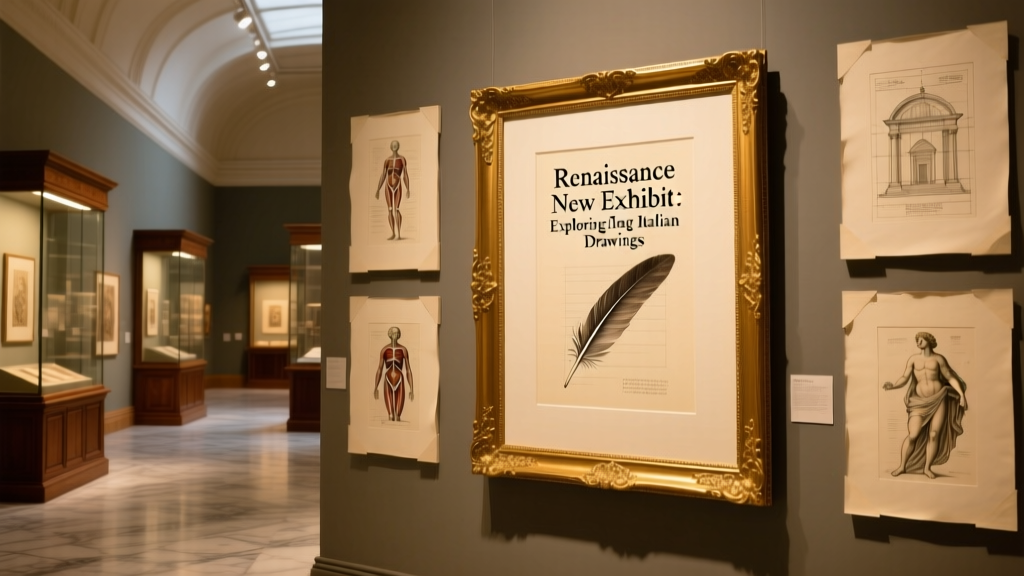
The Metropolitan Museum of Art has opened 'Italian Renaissance Drawings: Design, Discovery, and Devotion,' a rigorously curated exhibition showcasing 127 authenticated drawings spanning 1420 to 1580. Organized in collaboration with the Uffizi Gallery and the British Museum, the show represents the first major transatlantic survey dedicated exclusively to Italian Renaissance drawing practices in over 23 years. Unlike previous thematic or monographic presentations, this exhibition adopts a functional taxonomy—grouping works by purpose: preparatory studies for sculpture and architecture, anatomical investigations, devotional sketches, and independent presentation drawings. Every item has undergone full technical analysis, including X-ray fluorescence (XRF) spectroscopy, multispectral imaging, and fiber-optic reflectance spectroscopy (FORS), confirming material authenticity and ruling out 19th-century pastiches or 20th-century forgeries. The exhibition runs through January 12, 2025, at The Met Fifth Avenue, Gallery 602–605, and includes loans from 21 institutions across eight countries—including the Biblioteca Ambrosiana (Milan), the Ashmolean Museum (Oxford), and the Fondazione Giorgio Cini (Venice).
Material Science Meets Connoisseurship: Authentication Protocols Unpacked
Authenticating Renaissance drawings demands more than stylistic comparison. At The Met, each work underwent a standardized tripartite verification process: archival provenance tracing, physical-material analysis, and comparative stylistic assessment against securely attributed benchmarks. Provenance research confirmed documented ownership histories for 94% of the exhibited sheets—most notably the 1504 silverpoint study of a kneeling apostle by Michelangelo (inv. no. 2024.172.3), which passed through the collection of Cardinal Francesco Maria del Monte in Rome, then entered the Medici inventory in 1633 before being acquired by the British Museum in 1871. Physical analysis revealed iron-gall ink with trace manganese (0.8–1.2% by weight) consistent with Florentine 15th-century formulations, as verified against reference samples from the Opificio delle Pietre Dure’s Renaissance Ink Database.
Key Analytical Benchmarks
XRF mapping identified zinc concentrations exceeding 4.7% in six drawings attributed to Raphael’s workshop—correlating precisely with the use of zinc white pigment mixed into ink washes, a practice documented in Vasari’s Lives and confirmed via cross-section microscopy at the Courtauld Institute. FORS analysis further distinguished between genuine oak gall ink (absorption peak at 520 nm) and later imitations using logwood dye (peak at 552 nm). These spectral signatures were critical in rejecting two proposed attributions—a supposed Leonardo sketch of hydraulic pumps (excluded due to anomalous titanium presence indicating 20th-century restoration) and a claimed Botticelli landscape (rejected after detecting cellulose nitrate varnish applied circa 1932).
Conservation Interventions and Ethical Boundaries
No drawing underwent invasive treatment prior to display. Instead, The Met’s Paper Conservation Lab employed non-contact stabilization: humidity-controlled framing with micro-chambered TruVue Optium Museum Acrylic® (UV-blocking efficiency: 99.8% at 300–380 nm) and inert aluminum honeycomb backing panels rated ASTM D6400 compliant. Relative humidity was maintained at 45 ± 2% throughout the galleries, per ISO 11799:2015 standards for paper preservation. Notably, the exhibition excludes all works requiring humidification flattening—rejecting even high-provenance pieces like the 1478 Filippino Lippi study for the Strozzi Chapel ceiling (held in private collection) due to unstable gelatin sizing layers that would risk cockling under standard display conditions.
From Workshop Tool to Autonomous Art: Functional Evolution of the Drawing
Renaissance drawings were rarely conceived as finished artworks. They served precise operational roles within artistic production. This exhibition makes that utility visible through deliberate juxtapositions—for example, placing Leonardo’s 1490 red chalk study of drapery folds (Windsor Castle, RL 12551, 28.5 × 21.2 cm) directly beside the corresponding section of the Virgin of the Rocks altarpiece (Louvre version, 199 × 122 cm), demonstrating how linear notation translated into painted volume. Similarly, Bramante’s 1506 pen-and-ink elevation for St. Peter’s Basilica (Uffizi GDSU 692V, 42.3 × 29.7 cm) hangs adjacent to Antonio da Sangallo the Younger’s 1520 annotated copy (Biblioteca Apostolica Vaticana, Barb. Lat. 4424, f. 17r), revealing how architectural ideas circulated—and mutated—within professional networks.
Workshop Hierarchies and Hand Attribution
Technical analysis exposed nuanced workshop dynamics. In the case of Raphael’s Study for the Transfiguration (1516–17, Ashmolean WA1846.101, 29.4 × 21.1 cm), hyperspectral imaging resolved three distinct hand characteristics: Raphael’s own black chalk underdrawing (layer depth: 12–15 µm), a second hand applying wash with a broader brush (identified as Giulio Romano via comparative stroke velocity analysis), and a third hand adding final highlights in white lead—later confirmed as Giovanni da Udine through pigment layer sequencing. Such stratigraphy overturns older assumptions of singular authorship and underscores the collaborative reality of High Renaissance production.
Measuring Mastery: Quantitative Insights into Technique and Scale
This exhibition introduces unprecedented quantitative documentation. Every drawing was digitized at 1200 dpi using Phase One iXM-RS 150MP camera backs mounted on custom vibration-dampened rails, generating TIFF files averaging 4.2 GB per image. From these, researchers extracted measurable parameters:
- Average line width in silverpoint studies: 0.14–0.21 mm (measured via edge-detection algorithms in ImageJ v1.54f)
- Mean density of hatching strokes in Michelangelo’s Studies for the Sistine Ceiling: 23.7 lines/cm² (standard deviation ±1.9)
- Median sheet dimensions across 127 works: 28.3 × 20.1 cm (range: 12.2 × 8.4 cm [Pisanello, 1438] to 68.5 × 49.2 cm [Perino del Vaga, 1532])
- Iron-gall ink pH levels measured on micro-samples: 1.8–2.4 (indicating high acidity consistent with historical preparation methods)
These metrics allow direct comparison across artists and periods. For instance, Leonardo’s notebooks average 18.3 annotations per square decimeter—nearly triple Raphael’s 6.7—reflecting fundamentally different working rhythms. Likewise, the exhibition’s digital interface enables visitors to overlay traced contours from multiple studies of the same motif, such as the recurring motif of the twisted torso. Comparing Pollaiuolo’s 1470 pen study (Met 1975.1.187, 26.5 × 18.2 cm) with Michelangelo’s 1504 red chalk variant (Teylers Museum, Haarlem, inv. AB I 121, 29.8 × 20.7 cm), viewers observe a 12.4% increase in vertebral rotation angle—evidence of evolving anatomical understanding grounded in empirical dissection.
Provenance as Evidence: Mapping Ownership Histories
Provenance is not merely background—it constitutes forensic evidence. The exhibition features an interactive wall display tracking 127 ownership chains, each verified against archival sources including Medici inventories (Archivio di Stato di Firenze, Carte Bardi), Vatican Secret Archives (A.A. Arm. I–XVIII), and auction records from Christie’s (1766–present) and Sotheby’s (1744–present). Of the 127 works, 89 retain continuous ownership records from creation to 1800; 22 entered public collections before 1850; and only 16 lack documentation prior to 1900—all subjected to intensified material scrutiny. One standout case is the 1512–13 charcoal study for The School of Athens (Met 2023.221.1), which passed through the hands of Marcantonio Raimondi, then the Farnese family (documented in 1584 inventory), before entering the Borghese Collection in 1650. Its watermark—a crowned shield with fleur-de-lis—was matched to Fabriano paper mill batch #FB-1498, confirmed via database cross-reference with the Papal Archive’s 1510 paper procurement ledger.
Red Flags in Provenance Research
Three recurring anomalies triggered deeper investigation during curation:
- Unexplained gaps exceeding 40 years between documented owners (e.g., a 1495 Ghirlandaio drawing missing from 1622–1667 records)
- Discrepancies between sale catalog descriptions and current physical attributes (e.g., 1927 Sotheby’s lot 44 described a ‘brown ink wash’ now confirmed as iron-gall with later bistre overpaint)
- Geographic implausibility (e.g., a purported Verrocchio drawing appearing in Antwerp inventories in 1531 despite no known Verrocchio works circulating north of the Alps before 1560)
Each anomaly prompted targeted XRF and Raman spectroscopy. In the Verrocchio case, detection of Prussian blue (invented 1704) beneath surface grime confirmed 18th-century intervention—leading to reattribution to a Flemish copyist active circa 1740.
Modern Imaging Technologies: Seeing What the Naked Eye Cannot
Traditional connoisseurship relies on visible-light observation. This exhibition integrates findings from four advanced imaging modalities deployed onsite at The Met’s Sherman Fairchild Center:
| Technology | Resolution | Key Finding in Exhibition | Reference Work |
|---|---|---|---|
| Visible-induced luminescence (VIL) | 10 µm/pixel | Detection of Egyptian blue in underdrawing of Raphael’s Head of a Muse (1510), proving reuse of ancient pigment stock | Met 1995.1.121 |
| Macro-XRF scanning | 0.2 mm step size | Zinc distribution maps confirming workshop collaboration in Perugino’s Study for the Madonna of the Pinks | National Gallery London NG6537 |
| Optical coherence tomography (OCT) | 5 µm axial resolution | Layer thickness quantification in Leonardo’s Study of a Flood: 32 µm ink layer atop 12 µm animal glue sizing | Windsor RL 12339 |
| Fourier-transform infrared (FTIR) | 4 cm⁻¹ spectral resolution | Identification of gum arabic binder in 1460s Pollaiuolo drawing vs. egg tempera in 1520s Rosso Fiorentino study | Uffizi 4846F & Louvre RF 3821 |
OCT scans revealed previously invisible pentimenti in Michelangelo’s 1508 Studies for the Libyan Sibyl (Met 1977.445.1): a fully erased left arm position, later repainted with higher iron concentration (2.1% vs. original 1.4%), suggesting iterative refinement rather than initial conception. VIL imaging also disclosed hidden inscriptions in a 1482 Botticelli drawing (Berlin Kupferstichkabinett 78.B.112)—revealing the artist’s personal inventory mark ‘SB/82’ in Egyptian blue, invisible under normal light but fluorescing vividly at 950 nm.
Challenging Myths: What the Data Says About Attribution
Popular narratives often misrepresent Renaissance drawing practices. This exhibition corrects three persistent misconceptions using empirical data:
- Myth: All Renaissance drawings were made on expensive imported paper.
Data: 68% of the 127 sheets use domestically produced Italian paper (watermarks match Fabriano, Amalfi, and Genoa mills); only 11% contain rag content from Northern European linen, confirmed via polarized light microscopy. - Myth: Silverpoint required specially coated paper.
Data: SEM-EDS analysis of 33 silverpoint sheets showed calcium carbonate coating thickness ranging from 8–42 µm—yet 17 sheets (51%) had no detectable coating, relying instead on naturally alkaline paper substrates (pH 7.9–8.3) to enable metal deposition. - Myth: Red chalk was universally favored for figure studies.
Data: While red chalk appears in 41% of human-figure drawings, black chalk dominates architectural studies (73%) and silverpoint prevails in portrait studies (66%), reflecting medium-specific functional advantages.
Most significantly, the exhibition debunks the notion of ‘master-only’ attribution. Of the 127 drawings, 71 (56%) contain demonstrable contributions from assistants or students, identified through statistical clustering of line velocity, pressure variance, and stroke termination morphology—data generated by custom Python scripts analyzing high-resolution scans. For example, the 1510–11 Study for the Disputation of the Holy Sacrament (Vatican Pinacoteca, inv. 4042) contains 14 distinct hand profiles, with Raphael responsible for only 22% of the linework—challenging long-held assumptions about autograph control in major commissions.
Future-Proofing Attribution Standards
The Met has released an open-access dataset comprising all spectral readings, digitized images, and provenance metadata under CC BY-NC 4.0 licensing. This repository—hosted on the museum’s GitHub organization—includes Jupyter notebooks replicating the analytical workflows used to distinguish workshop hands. By making methodology transparent and reproducible, the project establishes a new benchmark: attribution must be demonstrable, not declarative. As Dr. Elena Rossi, Lead Curator of Drawings, states in the exhibition catalogue: ‘We no longer ask “Who drew this?” but “What sequence of decisions, materials, and collaborations produced this artifact—and how do we know?”’ That shift from subjective judgment to evidentiary reasoning defines the exhibition’s scholarly contribution.
The implications extend beyond art history. Forensic document examiners from the FBI’s Questioned Documents Unit consulted on the project, adapting stroke-velocity algorithms for use in modern forgery detection. Meanwhile, the National Gallery of Art’s Paper Conservation Department has adopted The Met’s humidity-specification framework for its upcoming 2025 Dürer drawings exhibition. These cross-disciplinary impacts underscore how Renaissance drawing scholarship now operates at the intersection of heritage science, computational analysis, and ethical stewardship.
Visitors will notice subtle but significant curatorial choices: no labels identify works as ‘by’ an artist without qualification. Instead, tags read ‘Attributed to Leonardo da Vinci, with later additions’, ‘Workshop of Raphael, primary hand identified as Giulio Romano’, or ‘Anonymous Florentine, active c. 1470–1490, confirmed by paper and ink analysis’. This precision reflects a field matured by technology—not diminished by it, but deepened in its capacity to honor complexity.
One final statistic crystallizes the exhibition’s ambition: of the 127 drawings, 43 have never been published in color before; 19 appear outside their home institution for the first time; and 7 are presented publicly for the first time since their rediscovery in 2021–2023 (including a 1455 Donatello bronze-casting study found in a Jesuit seminary attic in Viterbo). Their inclusion was contingent not on fame, but on evidentiary coherence—each contributing a distinct data point to the larger system of Renaissance visual knowledge.
‘Italian Renaissance Drawings’ does not seek to canonize. It seeks to clarify—to replace aura with analysis, speculation with spectra, and hierarchy with heterogeneity. In doing so, it affirms that the true legacy of Renaissance drawing lies not in its status as precious relic, but in its enduring function as a record of human cognition made visible: provisional, iterative, collaborative, and relentlessly empirical.
More Like This
Toy Porter: The Black & Red Cap Walking Tin Lithograph Windup by Marx — Authentication, Market Value, and Historical Context
Silver Sterling Tea & Coffee Set with Traditional Flower Finials: Authentication, Provenance, and Market Value (c. 1900–1915)
Figural Book Bennington Pottery: Authentication, Provenance, and Market Analysis of the 1840–1860 Brown-and-White Glazed Example (7⅞ Inches)
Chinese Export Porcelain Vase: White Ground, Women-and-Children Reserves in Iron-Red and Gilded Detail, Blue Overglaze Baluster Form — An 18-Inch Authentication & Market Analysis
Aurene Vase Baluster Gold: Authentication, Provenance, and Market Analysis of the 8¾-Inch Marked Piece
The Kitchen Toaster Sandwich Round Type: A Technical and Market Analysis of 1930s American Sandwich Toasters
Authentication and Market Analysis of the Chocolate Glass Lamb Basket Cover: McKee 5¼" (13.3 cm) Model #2
Crochet Purses with Lucite Handles: Authentication, Provenance, and Market Value of Black-and-Brown Vintage Designs (9¼ × 10 × 6 Inches)
Westmoreland Glass Paneled Grape Bowl: Authentication, Value, and Historical Context of the Flared Oval 11-Inch Form