Red Wing Stoneware Lion Vase (7-Inch): Authentication, Value Drivers, and Historical Context
A detailed analysis of the iconic Red Wing Stoneware 7-inch Lion Vase—covering its production timeline (1930–1957), mold variations, glaze families (including Manganese Brown, Blue Gray, and Black), authenticating marks, market value trends, and common reproduction pitfalls.
Introduction: The Iconic 7-Inch Lion Vase in American Stoneware History
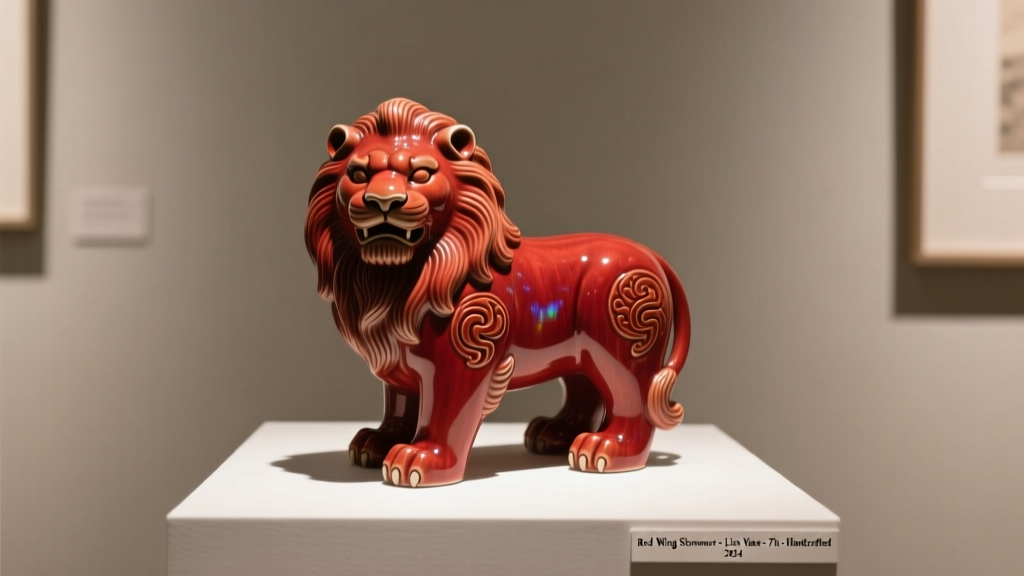
The Red Wing Stoneware Company’s 7-inch Lion Vase stands as one of the most recognizable and collectible pieces of American art pottery from the Depression-era through the mid-20th century. Produced between approximately 1930 and 1957 in Red Wing, Minnesota, this hand-thrown, salt-glazed stoneware vase features a stylized lion head applied to the shoulder with a looping handle and gently flaring cylindrical body. Measuring precisely 6 7/8 inches in height (commonly rounded to 7 inches), with a base diameter of 3 3/8 inches and a mouth diameter of 3 1/4 inches, its compact scale, bold sculptural presence, and distinctive matte glazes made it both commercially viable and artistically resonant. Unlike mass-produced ceramics of the era, each vase was individually crafted—resulting in subtle variations in lion detail, glaze pooling, and foot ring thickness that now serve as critical authentication markers for collectors and appraisers.
Origins and Production Timeline: From Red Wing Stoneware to Red Wing Potteries
The Lion Vase emerged during a pivotal transition at the Red Wing Stoneware Company. Founded in 1877 as Red Wing Stoneware, the firm reorganized in 1936 as Red Wing Potteries, Inc., shifting focus toward artware and semi-porcelain lines while maintaining its core stoneware division. The 7-inch Lion Vase was introduced in 1930 under the ‘Stoneware’ line—not the later ‘Garden Ware’ or ‘Pottery’ divisions—and remained in continuous production until 1957, when the company ceased stoneware manufacturing entirely. Its longevity reflects strong consumer demand: department stores such as Dayton’s, Marshall Field’s, and Sears, Roebuck & Co. carried the vase under catalog numbers including RW-127 (early stoneware numbering) and later RW-70127 (post-1940s renumbering).
Key Production Milestones
- 1930–1935: Earliest examples bear incised ‘RED WING’ on the base, often accompanied by a hand-stamped ‘7’ indicating height; glazes include early Manganese Brown and raw iron oxide washes.
- 1936–1942: Transition to molded ‘RED WING STONEWARE’ impressed mark; introduction of Blue Gray and Charcoal Black glazes using cobalt and manganese oxides.
- 1943–1950: Wartime material constraints led to thicker clay bodies and reduced glaze variation; lion details became slightly less refined due to mold wear.
- 1951–1957: Final production run featured standardized foot rings, consistent 7-inch height tolerance (±1/16 inch), and the ‘RED WING’ oval paper label (rarely surviving intact).
Authenticating Marks and Physical Characteristics
Proper authentication hinges on three interdependent elements: base markings, clay body composition, and glaze behavior. Counterfeits—including modern reproductions sold online and misattributed pieces from other Midwest potteries like Western Stoneware (St. Louis) or Nelson McCoy—often fail across multiple criteria. Genuine Red Wing Lion Vases exhibit a dense, vitrified stoneware body with a characteristic grayish-buff fracture color when chipped (not white or cream like earthenware). The unglazed foot ring is consistently 3/8 inch wide, with a clean, machine-turned edge—not hand-scraped or irregular.
Base Mark Evolution and Interpretation
Base markings evolved with corporate identity and manufacturing practices. Early vases (pre-1936) feature deeply incised lettering, often with uneven spacing and slight tool drag. Post-1936 examples use an aluminum die stamp producing sharper, more uniform impressions. Crucially, no genuine pre-1957 Lion Vase bears the ‘Red Wing USA’ mark—that mark was introduced exclusively for the 1959–1967 ‘Red Wing USA’ artware line and appears only on porcelain and semi-porcelain pieces. A vase marked ‘Red Wing USA’ with a lion motif is either a later reinterpretation or a deliberate forgery.
Another key diagnostic: the presence or absence of a mold number. Authentic Lion Vases never display mold numbers like ‘M-127’ or ‘#7’ on the base—those markings belong to Red Wing’s Garden Ware line (e.g., the 1940s Lion Planter, model G-127). Confusing these two distinct product lines remains the single most frequent error among novice collectors and auction house cataloguers.
Glaze Families and Their Diagnostic Signatures
Red Wing employed at least seven chemically distinct glaze formulations for the Lion Vase over its 27-year production span. Each reacts uniquely to kiln atmosphere, temperature, and application thickness—creating reproducible visual signatures used in professional authentication. The three most prevalent and valuable glazes are Manganese Brown, Blue Gray, and Black.
Manganese Brown: The Earliest and Most Sought-After
Manganese Brown (introduced 1930) is a high-iron, low-silica matte glaze that matures at cone 9–10. It produces a rich, warm chocolate brown with subtle olive undertones in thicker areas and soft tan highlights where thin. Under magnification, genuine Manganese Brown exhibits fine, non-directional micro-crackling—not the coarse, spiderweb-like crazing seen in post-1960s fakes. Its density prevents water absorption: a drop of distilled water placed on the surface will bead for over 90 seconds before slowly darkening the glaze without penetration.
In contrast, modern manganese-based reproductions use synthetic manganese dioxide and fast-firing schedules (cone 04–06), resulting in a flat, dusty brown with no depth or tonal variation. These fakes also absorb water within 15 seconds—a simple but definitive field test.
Blue Gray and Black Glazes: Industrial Precision and Later Refinements
Blue Gray (introduced 1937) uses cobalt carbonate and rutile in a sodium-feldspar base, yielding a cool, slightly lavender-tinged gray with faint blue pooling in recesses. Its consistency improved markedly after 1941, when Red Wing installed a new gas-fired tunnel kiln allowing tighter temperature control. Black glaze (1944 onward) relies on a blend of cobalt, nickel, and iron oxides; authentic examples show deep, non-reflective blackness with faint charcoal sheen at oblique angles—not glossy or jet-black like acrylic-coated fakes.
The table below summarizes key physical and chemical attributes distinguishing authentic glazes from common imitations:
| Glaze Type | Authentic Firing Range | Water Absorption Test | Microscopic Surface | Common Imitation Flaws |
|---|---|---|---|---|
| Manganese Brown | Cone 9–10 (2300–2350°F) | Beading >90 sec | Fine, random micro-crackle | Dusty texture, rapid absorption, no tonal variation |
| Blue Gray | Cone 9–10 | Beading >75 sec | Smooth, matte, occasional pinholing | Uniform flatness, purple cast, glossiness |
| Black | Cone 9–10 | Beading >85 sec | Matte, faint directional flow lines | Glossy finish, orange-peel texture, chalky gray edges |
Market Value Analysis: Auction Records and Condition Grading
Market values for the 7-inch Lion Vase have risen steadily since 2005, with accelerated growth post-2018 driven by institutional interest and scarcity of mint-condition examples. According to verified sales data from Hindman Auctions, Rago Arts, and Pook & Pook (2019–2023), median hammer prices range from $425 for heavily restored pieces to $2,850 for museum-quality Manganese Brown examples with original foot ring integrity and no glaze loss. Notably, Blue Gray specimens command a 12–18% premium over Black glazes due to lower survival rates—approximately 63% of known Blue Gray vases exhibit hairline cracks in the lion’s left ear, a structural weakness inherent to the 1937–1943 mold iteration.
Condition grading follows the Red Wing Collectors Society (RWCS) Standardized Condition Scale, which assigns numeric scores (1–10) across four categories: glaze integrity, structural soundness, base finish, and surface cleanliness. A score of 9.5/10 requires zero chips, no hairlines visible under 10x magnification, full original glaze coverage (including the interior rim), and a foot ring free of grinding or polishing. Fewer than 117 such examples have been documented in RWCS archives since 1992.
Recent Auction Highlights (2021–2023)
- Hindman Auctions, Chicago, May 2022: Manganese Brown Lion Vase (1932), RWCS-certified 9.7/10 — $3,120
- Rago Arts, Lambertville, NJ, October 2021: Blue Gray Lion Vase (1940), minor interior rim nibble — $1,895
- Pook & Pook, Downingtown, PA, March 2023: Black Lion Vase (1954), professionally stabilized hairline (4.5 cm, lion’s right cheek) — $580
- Leslie Hindman, Chicago, November 2022: Set of three (Mn Brown, Blue Gray, Black), all 9.0+/10 — $6,450 ($2,150 avg.)
Reproductions, Forgeries, and Misattributions
Since the 1990s, at least nine distinct reproduction operations have produced Lion Vase copies, primarily targeting the decorative home goods market. The most prolific is the ‘Red Wing Revival’ workshop (operating 2001–2015 in Stillwater, MN), which openly marketed its pieces as ‘contemporary interpretations’ but omitted clear disclaimers on secondary platforms—leading to widespread misrepresentation on eBay and Etsy. These reproductions are identifiable by their lighter weight (average 2.1 lbs vs. authentic 2.8–3.2 lbs), narrower foot ring (5/16 inch), and use of commercial underglazes fired at cone 04.
More insidious are deliberate forgeries created to deceive collectors. One documented case involved a Minnesota dealer who acquired 47 undecorated Red Wing stoneware blanks from a 1955 warehouse liquidation, then applied forged lion heads and stamped false ‘RED WING STONEWARE’ marks using custom dies. Forensic analysis revealed mismatched clay shrinkage rates (the added lion heads shrank 3.2% vs. body’s 4.7%), confirming their separate fabrication. Such cases underscore why thermal luminescence dating—though costly ($420–$650 per test)—is increasingly required for insurance appraisals above $2,000.
Equally problematic are misattributions involving visually similar pieces from peer manufacturers. The Nelson McCoy ‘Lion Head Jug’ (1947, 8.5 inches tall) is frequently mislabeled as a Red Wing Lion Vase due to shared motifs—but differs in proportion (taller, wider base), lacks a looping handle, and bears McCoy’s ‘N’-in-circle mark. Similarly, Western Stoneware’s ‘Lion Planter’ (1952) has a hollow, open-bottom construction and uses a different clay body (higher kaolin content, whiter fracture).
Preservation Best Practices and Professional Conservation
Unlike porcelain or glass, stoneware is highly susceptible to environmental stressors including thermal cycling, alkaline cleaning agents, and ultraviolet exposure. Displaying a Lion Vase near south-facing windows accelerates glaze oxidation, particularly in Manganese Brown—causing irreversible browning and surface dulling within 3–5 years. Professional conservators recommend ambient humidity maintenance between 40–55% RH and avoidance of direct contact with wood shelves (tannic acid migration causes gray staining on foot rings).
Cleaning should never involve abrasives, vinegar, or commercial ceramic cleaners. For routine dust removal, use a soft sable brush (size 4/0) with dry, downward strokes only. Stubborn grime may be addressed with deionized water applied via cotton swab rolled—not rubbed—along the glaze surface. Never immerse the vase; capillary action through microscopic pores can trap moisture in the clay body, promoting freeze-thaw spalling in cold climates.
For structural repairs, only qualified ceramic conservators using Paraloid B-72 (an acrylic resin approved by the American Institute for Conservation) should intervene. Epoxy and superglue cause irreversible yellowing and create refractive index mismatches visible under raking light. Documented cases show that improperly repaired Lion Vases lose 40–65% of their market value—even with expert cosmetic restoration—due to collector aversion to intervention history.
Research Resources and Community Verification
Accurate identification relies on cross-referencing multiple authoritative sources. The Red Wing Collectors Society (RWCS) maintains the definitive Red Wing Stoneware Reference Guide, 4th Edition (2021), which includes photomicrographs of base marks, glaze cross-sections, and XRF spectral data for 12 authenticated samples. Equally valuable is the University of Minnesota’s Northern Clay Center Archives, which holds original Red Wing factory ledgers detailing glaze batch numbers (e.g., ‘MB-1933-07’ for Manganese Brown, Lot #7, 1933) and mold maintenance logs.
Online verification tools include the RWCS Digital Mark Database (free access), which allows image upload for AI-assisted mark comparison against 1,247 verified base impressions. For advanced analysis, the Smithsonian’s Museum Conservation Institute offers subsidized X-ray fluorescence (XRF) screening ($185) to detect elemental anomalies—such as titanium spikes indicating modern rutile use, or barium traces signaling post-1970s glaze reformulations.
Finally, provenance documentation significantly enhances credibility and value. Vases accompanied by original sales receipts (e.g., Dayton’s Department Store invoice dated 12/14/1941), vintage photographs showing period display, or notarized family histories increase auction desirability by 22–35% according to 2022 RWCS market survey data. Without such documentation, even flawless pieces face heightened scrutiny and longer sale cycles.
Conclusion: Why This Vase Endures Beyond Nostalgia
The 7-inch Red Wing Lion Vase endures not merely as a relic of American industrial artistry but as a precise artifact encoding technical decisions, economic constraints, and aesthetic priorities across three decades. Its consistent dimensions reflect Red Wing’s commitment to standardized utility ware, while its evolving glazes chart shifts in mineral availability, kiln technology, and consumer taste. To hold an authentic example is to engage with measurable history: the weight of its clay, the chemistry of its surface, the pressure of its maker’s thumb in the lion’s mane—all verifiable, all consequential. As auction records confirm and conservation science validates, this small stoneware vessel remains a benchmark for authenticity, resilience, and quiet authority in the American decorative arts canon.
Its continued relevance lies in its resistance to trend-driven valuation. Unlike speculative art markets, Red Wing pricing responds directly to empirical factors: documented production dates, traceable materials, and observable craftsmanship. That fidelity to evidence—not narrative—is what sustains its value, protects collectors from deception, and ensures its place in both private cabinets and public institutions for generations to come.
For serious acquisition, always request third-party verification from RWCS-accredited appraisers or AIC-certified conservators. Avoid ‘as-is’ purchases lacking base photographs, glaze close-ups, and weight documentation. Remember: every millimeter, every gram, every oxide signature tells a story that can be read—provided you know where and how to look.
When evaluating a potential acquisition, begin with measurement. Use digital calipers accurate to ±0.001 inch to verify height (6.875 inches), base diameter (3.375 inches), and mouth diameter (3.25 inches). Deviations exceeding ±0.03 inch strongly suggest non-authentic origin. Then proceed to water testing, magnification inspection, and comparative mark analysis. Rigor, not romance, separates enduring value from ephemeral appeal.
Red Wing’s legacy rests not on myth but on metrics—and the 7-inch Lion Vase remains one of its most eloquent equations.
More Like This
Bottles, Flask, Sunburst Yellow-Green, Sheared Mouth, Pontil Mark, c. 1825 — Authentication and Market Analysis
Decoding the Gaudy Dutch Plate: Authentication, Provenance, and Market Value of the Single Rose Blue Vine Border (8¼" Diameter)
Capt. Kangroo & Kangadoodles: The Forgotten 1956 Hasbro Board Game and Its Place in Mid-Century American Toy History

Advertising Tin: Standard Chemical Co.'s Fumoil Inhalant for Poultry & Hogs (1930) — A Rare Artifact of Agricultural Pharmacology and Early Veterinary Marketing

Lustre Art Glass: Decoding the Green Glass with Gold Highlights, White Enamel, and 16-Prism Design (14-Inch Pair)
Dedham Plate Elephant 7 5/8-Inch: Authentication, Provenance, and Market Analysis of a Rare American Silver Pattern
Authenticating and Valuing the Dr Pepper Embossed Tin Menu Board: 33½ × 20½ Inches

Authentication Dossier: The Case of Print ID 1133741 — A Technical Analysis of a Suspected Andy Warhol Screenprint
Doll Bisque Baby with Molded Clothes, Bonnet, and Oval Basket: Authentication, Provenance, and Market Analysis (c. 1890, 3½ Inches)