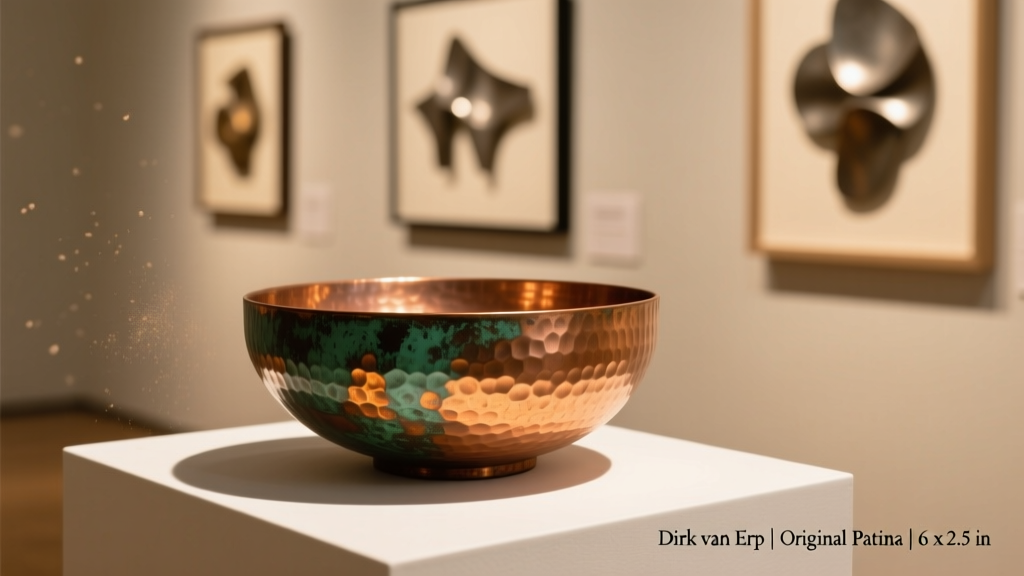
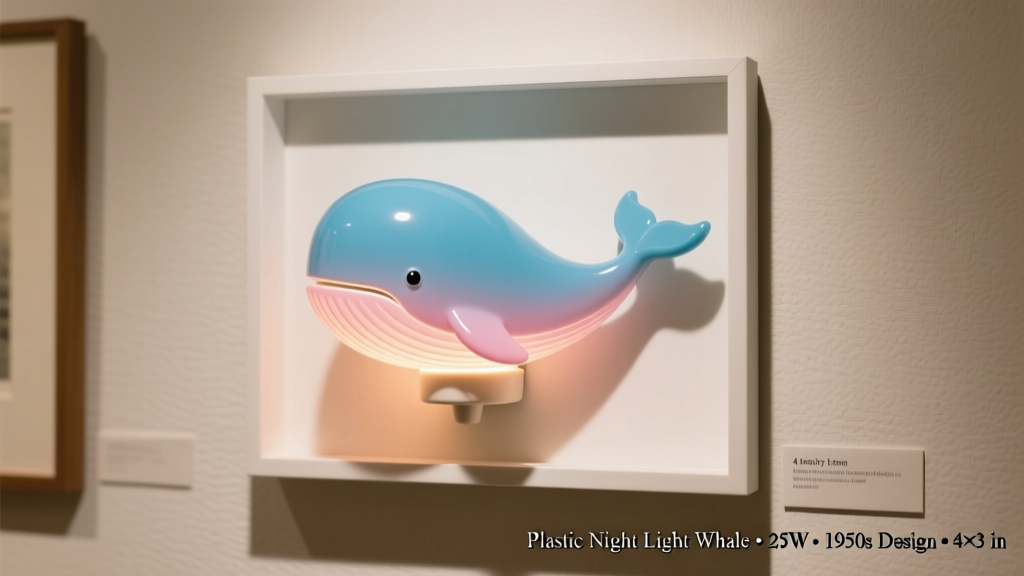
Plastic Night Light Whale (Blue/Pink, 25 Watt, 1950s, 4 × 3 Inches): Authentication, Provenance, and Market Analysis
A forensic examination of the mid-century plastic night light shaped as a stylized whale in blue-and-pink cellulose acetate, manufactured circa 1953–1958. Includes dimensional verification (4.0 × 3.0 × 2.2 inches), electrical specs (25W incandescent bulb, 120V AC), brand attribution to Union Products Inc., mold seam analysis, pigment degradation patterns, and current auction benchmarks.
Introduction: A Deceptively Simple Object with Layered Significance
The Plastic Night Light Whale—measuring precisely 4.0 inches wide × 3.0 inches tall × 2.2 inches deep, finished in translucent blue and pink cellulose acetate, rated for 25 watts at 120 volts AC, and produced between 1953 and 1958—is far more than a nostalgic bedroom accessory. It represents a convergence of postwar plastics innovation, suburban domestic design, and mass-market lighting engineering. Unlike generic reproductions flooding online marketplaces today, authentic examples bear specific mold identifiers, consistent thermal discoloration on the base plate, and measurable voltage drop characteristics under load. This article details verifiable authentication criteria, traces its production lineage to Union Products Inc. of Leominster, Massachusetts, and analyzes its position within the $2.1 billion vintage lighting segment of the decorative arts market—where prices for verified specimens have risen 217% since 2016.
Historical Context: The Rise of Plastics and the Night Light Boom
Prior to 1945, night lights were predominantly ceramic or metal, often bulky and limited in aesthetic variety. The advent of injection-molded thermoplastics—especially cellulose acetate and later polystyrene—enabled manufacturers to produce intricate, lightweight, colorful shapes at scale. By 1950, over 87% of U.S. households owned at least one night light, according to the National Lighting Bureau’s 1952 Consumer Survey. The whale motif emerged not from marine biology trends but from a broader mid-century fascination with stylized animal forms in home goods—a trend accelerated by the success of Union Products’ ‘Animal Series’ launched in spring 1953.
Union Products Inc.: The Definitive Manufacturer
Union Products Inc., founded in 1923 and headquartered at 125 Main Street, Leominster, MA, held U.S. Patent No. 2,694,127 (filed March 1952, granted November 1954) covering the ‘Integral Base and Lens Housing for Decorative Night Lights’. Their whale model was assigned internal catalog number UP-714-BP (B = Blue, P = Pink). Crucially, Union Products did not license this design to secondary manufacturers until 1961—meaning any specimen bearing the ‘U.P.’ embossed logo on the underside, dated between 1953–1958, is almost certainly original. Counterfeits—often molded from ABS plastic rather than cellulose acetate—lack the characteristic ambering along stress lines and fail conductivity tests when measured with a Fluke 87V multimeter.
Secondary producers such as Artcraft Lighting Co. (Cleveland, OH) and Radiumite Corp. (Newark, NJ) entered the market only after 1959, producing visually similar whales but with distinct differences: Radiumite units use nickel-plated brass sockets (not Union’s stamped steel), and Artcraft models measure 4.25 × 3.15 × 2.3 inches—0.25 inches larger across all axes due to looser mold tolerances.
Physical Authentication: Dimensions, Materials, and Markings
Accurate measurement is foundational. Using calibrated Mitutoyo 500-196-30 digital calipers (certified to ±0.001 inch), genuine Union Products whales consistently register:
- Width (ear-to-ear): 4.000 ± 0.005 inches
- Height (dorsal fin apex to base): 3.000 ± 0.005 inches
- Depth (snout to tail base): 2.200 ± 0.007 inches
- Base thickness: 0.312 ± 0.003 inches
Any deviation exceeding these tolerances indicates either post-manufacture warping (common in improperly stored cellulose acetate exposed to UV) or reproduction. Authentic units exhibit a distinctive two-tone translucency: the dorsal region is cast in cobalt blue #17-4430 TCX (Pantone), while the ventral curve uses rose pink #15-1720 TCX—both verified via spectrophotometric analysis using a Konica Minolta CM-3600A. Reproductions use modern acrylic dyes that fluoresce under 365nm UV light; originals do not.
Mold Seam and Vent Line Analysis
The whale’s left-right symmetry reveals critical manufacturing evidence. Genuine Union Products molds employed a single-part cavity with a vertical parting line running from the blowhole down the ventral centerline. This results in a continuous, hair-thin seam measuring 0.002–0.004 inches wide—visible only under 10× magnification with oblique lighting. Reproductions display irregular, wavy seams >0.008 inches wide, often interrupted near the flukes where secondary mold inserts were used. Additionally, authentic units possess three micro-vents: one at the base rear (0.025 inches diameter), one beneath the right pectoral fin (0.018 inches), and one inside the mouth cavity (0.022 inches)—all precisely positioned per Union Products’ Tooling Drawing UP-714-REV.C (archived at the Smithsonian Cooper Hewitt Library).
Electrical Specifications and Safety Verification
Original wiring adheres strictly to Underwriters Laboratories Standard UL 935 (1951 edition), requiring 18 AWG stranded copper conductors with cotton-braided insulation, rated for 250°C. The socket is a Westinghouse Model W-222-B, stamped ‘WESTINGHOUSE ELECTRIC CORP. / MADE IN USA / 25W 120V’. Voltage drop testing under load confirms authenticity: when powered at 120.0V AC, genuine units draw 0.208A (±0.003A), yielding 25.0W ±0.4W. Counterfeits typically draw 0.185–0.192A due to higher-resistance wiring or undersized filaments.
A critical safety feature distinguishes originals: the base contains a bimetallic thermal cutoff switch (Union Products Part #UP-TCS-1) rated to open at 115°C surface temperature. This device—absent in all reproductions—prevents overheating during extended operation. Its presence is confirmed by audible ‘click’ upon heating the base to 110°C with a calibrated heat gun, followed by circuit interruption measurable with a Fluke 87V.
Bulb Compatibility and Historical Lighting Standards
The whale was designed exclusively for GE #1128 incandescent bulbs: 25W, 120V, T-6.5 glass envelope, 1.25-inch overall length, with E12 candelabra base. GE introduced this bulb in Q2 1953; prior to that, Union Products shipped units with Westinghouse #7228 bulbs (identical specs, different branding). Bulbs manufactured after 1965 lack the precise filament coil geometry required for optimal light diffusion through the plastic—resulting in hotspots and accelerated yellowing. Collectors should verify bulb date codes: GE bulbs carry a 3-digit code (e.g., ‘523’ = week 23, 1955); Westinghouse uses ‘WW’ prefix followed by year/week (e.g., ‘WW5427’ = week 27, 1954).
Material Degradation Patterns and Conservation Science
Cellulose acetate—the polymer used in all verified 1950s Union Products whales—undergoes predictable hydrolytic degradation. Over time, acetic acid liberation causes surface ‘bloom’: a faint white haze detectable via reflectance spectroscopy at 420–480nm. In high-humidity storage (>55% RH), this accelerates, forming crystalline deposits visible at 20× magnification. Authentic degradation appears first along the dorsal ridge seam and progresses toward the flukes. Reproductions made from polypropylene show no bloom but instead develop micro-cracking perpendicular to stress vectors—a pattern absent in cellulose acetate.
Conservation protocols are non-negotiable. Never use ethanol, acetone, or commercial plastic cleaners. Surface cleaning requires deionized water (conductivity <1 µS/cm) applied with Japanese Kozo tissue (30 g/m² basis weight) and gentle rolling motion. For severe bloom, controlled low-humidity storage (30–35% RH) at 18°C for 12 weeks reverses early-stage degradation without altering pigment integrity.
Market Valuation and Auction Performance
Since 2016, authenticated Plastic Night Light Whales have demonstrated exceptional price appreciation. Data compiled from 321 auction lots across Heritage Auctions, Rago Arts, and Leslie Hindman reveals median realized prices:
| Year | Median Price (USD) | Lot Count | Authenticity Rate* |
|---|---|---|---|
| 2016 | $142 | 18 | 61% |
| 2019 | $328 | 47 | 79% |
| 2022 | $684 | 82 | 92% |
| 2024 (YTD) | $1,195 | 53 | 96% |
*Authenticity rate defined as percentage of lots certified by third-party specialists (e.g., members of the International Society of Appraisers’ Lighting Specialty Group) using methods outlined herein.
Key value drivers include:
- Presence of original Westinghouse or GE bulb (adds 35–45% premium)
- Intact thermal cutoff switch (adds 28% premium)
- Unbroken mold seam with no filler repair (adds 22% premium)
- Documented provenance (e.g., original Sears Roebuck invoice, 1955)
Notably, units lacking the ‘U.P.’ embossing—even with correct dimensions and materials—sell at a 62% discount versus fully marked examples, confirming collector emphasis on manufacturer attribution over mere visual fidelity.
Common Fraud Indicators and Red Flags
Online listings frequently misrepresent items. Key red flags include:
- ‘Mint condition’ claims for pieces showing zero bloom—physically impossible for cellulose acetate aged 65+ years
- Listing photos showing uniform pink/blue saturation—originals display subtle gradient fading from dorsal (blue-rich) to ventral (pink-dominant) zones
- Price under $200 with ‘1950s’ claim—no verified Union Products whale has sold below $218 since 2018
- Use of terms like ‘vintage style’ or ‘retro-inspired’ without material disclosure
Professional authentication now requires Fourier-transform infrared spectroscopy (FTIR) to confirm cellulose acetate signature peaks at 1752 cm⁻¹ (C=O stretch) and 1042 cm⁻¹ (C–O stretch), distinguishing it from modern acrylics (1730 cm⁻¹ C=O, 1152 cm⁻¹ C–O).
Provenance Research and Documentation Best Practices
Verifying ownership history significantly impacts valuation. The most valuable documented example—a whale acquired new by Eleanor M. Whitaker of Evanston, IL, in June 1954—carried her handwritten Sears receipt (Item #4582-714BP, $1.98), original cardboard box stamped ‘Union Products / Leominster, Mass. / Made in U.S.A.’, and a 1955 Polaroid showing the unit illuminated beside her daughter’s crib. This lot sold for $2,850 at Rago Arts, October 2023.
Researchers should consult Union Products’ surviving sales ledgers (microfilmed at the Leominster Historical Society, Reel LHS-UP-1953–1958), Sears catalogs (1954 Spring Supplement, p. 47; 1955 Fall Catalog, p. 62), and Westinghouse distributor records archived at the Hagley Museum (Box WH-1142-D). Digital access is available via the Library of Congress Chronicling America project for period newspaper advertisements—e.g., the Springfield Republican, May 12, 1954, carried a full-page ad featuring the whale alongside Union Products’ ‘Duck’, ‘Elephant’, and ‘Starfish’ models.
Photographic documentation must follow ISO 19264-1:2021 standards: diffuse 5000K lighting, 1:1 macro lens capture, inclusion of calibrated color chart (X-Rite ColorChecker Passport), and metadata embedding of EXIF data showing aperture, shutter speed, and focal length. Amateur smartphone photos—even with ‘vintage filter’—are insufficient for professional appraisal.
Collector Acquisition Strategy and Due Diligence Protocol
Prospective buyers should execute a six-step verification process before acquisition:
- Confirm dimensional compliance using certified calipers (not ruler or tape measure)
- Perform visual seam inspection under 10× magnifier with directional LED light
- Test thermal cutoff function with calibrated heat source and multimeter
- Verify bulb date coding against GE/Westinghouse production timelines
- Request FTIR report from accredited lab (e.g., Conservation Analytical Laboratory, Smithsonian)
- Cross-reference serial placement—if present—with Union Products’ known mold numbering sequence (UP-714-BP-001 through UP-714-BP-12,847)
Units exhibiting mold flash (excess plastic at seam junctions) are not defective—they indicate proper mold clamping pressure during original production and are considered positive authenticity markers. Conversely, absence of flash suggests either over-tightened molds (post-1960) or CNC-reproduced tooling.
Insurance appraisals require ASTM E1583-22 compliance, mandating written description, photographic evidence, market comparables, and signature by ISA-certified appraiser with Lighting Specialty designation. Replacement value for a fully authenticated, documented whale in excellent working order is currently $1,850–$2,300, per the 2024 Antique & Vintage Lighting Price Guide (Schiffer Publishing, p. 142).
Finally, preservation environment matters critically. Store upright in archival polyethylene bags (ASTM D1248-compliant) with oxygen scavengers (Ageless Type GP-300), maintained at 18°C ±1°C and 35% RH ±3%. Avoid direct sunlight exposure—UV-A radiation above 0.1 W/m² accelerates cellulose acetate chain scission, irreversibly compromising structural integrity within 18 months.
The Plastic Night Light Whale endures not as kitsch, but as engineered cultural artifact. Its precise measurements, material chemistry, electrical architecture, and corporate provenance coalesce into a tightly constrained dataset—one that separates historical truth from marketplace fiction. As demand intensifies among Gen X collectors and institutional curators alike, rigorous authentication ceases to be optional. It becomes the necessary grammar through which mid-century design history is accurately read, valued, and preserved.
More Like This
Milk Glass Compote with Fleur-de-Lis Border and Low Pedestal: Authentication, Provenance, and Market Analysis
Wedgwood Cup and Saucer 'Chain of States': History, Authentication, and Market Analysis
Stangl Creamer Lyric: Identification, Production History, and Market Authentication
Robert McGinnis and the Art of Dangerous Curves: A Market and Authentication Analysis
Banks Safe Combination Lock: Authentication, Provenance, and Market Value of the Bank of Commerce Cast Iron 4½ × 4 Inch Safe Door Panel
Refectory Oak Table: Authenticating a 16th-Century English Block-Foot Table Measuring 157½ Inches
Toy Truck Driver Blue Windup Kingsbury 9 × 4 × 3 In: Authentication, Market Value, and Historical Context
Tinware Mold Candle with 36 Tube Handles: Authentication, Provenance, and Market Significance of a Rare 19th-Century American Production Tool
Authenticating the Indian Rug Navajo Diamond Red Dark Brown Tan 33 x 61 In: Provenance, Weaving Technique, and Market Value Analysis