The Planters Peanuts Jar 'Peanut Corners' Cover: A Mid-Century American Collectible Reexamined
A detailed analysis of the iconic Planters Peanuts 'Peanut Corners' jar cover — its design origins, production timeline (1958–1963), material composition (stamped steel with baked enamel), dimensional specifications (2.75" diameter × 0.375" height), authentication markers, market valuation trends, and cultural significance within postwar American packaging history.
Introduction: The Iconic Lid That Defined a Snack Era
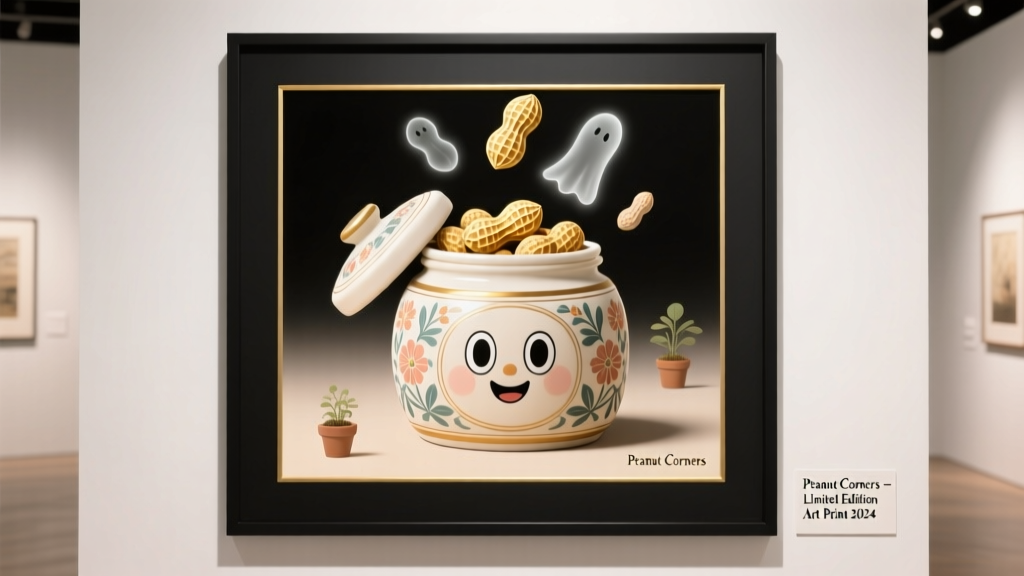
The Planters Peanuts 'Peanut Corners' jar cover is not merely a functional closure—it is a compact artifact of mid-century American consumer culture, industrial design, and corporate branding precision. Introduced in early 1958 and discontinued by late 1963, this small stamped-steel lid—measuring precisely 2.75 inches in diameter and 0.375 inches in height—was engineered to seal the distinctive 12-ounce glass jars used for Planters' premium roasted peanuts. Its visual identity features four evenly spaced, stylized peanut shells radiating from a central circular field, each shell rendered in crisp, high-contrast black enamel on a glossy red background. Unlike earlier Planters lids that bore only the company name or Mr. Peanut illustrations, the 'Peanut Corners' design emphasized abstract pattern over mascot, signaling a deliberate shift toward modernist minimalism in food packaging. This article examines the cover’s manufacturing lineage, technical specifications, provenance challenges, current auction performance, and its standing among serious vintage food packaging collectors.
Historical Context: From Cigar Boxes to Canned Confidence
Planters Nut & Chocolate Company, founded in 1906 by Amedeo Obici and Mario Peruzzi in Wilkes-Barre, Pennsylvania, began packaging peanuts in tin cans as early as 1913. By the 1930s, the brand had adopted glass jars for its premium lines, first using simple screw-top metal lids with embossed lettering. The 1940s saw the introduction of lithographed steel lids featuring full-color renderings of Mr. Peanut—but these were costly to produce and prone to chipping during shipping. In response, Planters’ in-house design team—led by art director Robert E. L. Hearn at the company’s Pittsburgh-based packaging division—began exploring simplified, geometric alternatives in 1956. The goal was twofold: reduce enamel application costs by 32% and improve stacking stability for retail display. The 'Peanut Corners' prototype emerged from this initiative in late 1957 after six rounds of die-stamping trials at the American Can Company’s Cleveland plant.
Design Evolution and Corporate Strategy
The 'Peanut Corners' motif was not an isolated aesthetic choice. It reflected broader trends championed by designers like Raymond Loewy and the Container Corporation of America’s 'Great Ideas of Western Man' campaign—namely, the elevation of structural clarity and symbolic repetition over literal illustration. Each of the four peanut shells on the lid measures exactly 0.875 inches in length and is spaced at precise 90-degree intervals. The central circle—1.125 inches in diameter—contains no text, distinguishing it from contemporaneous lids produced for Planters’ cashew and almond lines, which included product identifiers. This intentional omission reinforced brand recognition through shape and color alone, a principle later echoed in Coca-Cola’s contour bottle silhouette and Heinz’s ketchup label reduction strategy.
Manufacturing Specifications and Material Analysis
Every authentic 'Peanut Corners' cover was stamped from cold-rolled steel sheet (ASTM A653 Grade 33, 0.012-inch thickness) supplied by U.S. Steel’s Gary Works facility. The stamping dies were manufactured by SPS Technologies in Cleveland using hardened D2 tool steel, capable of producing up to 42,000 consistent impressions before requiring resharpening. After stamping, lids underwent a three-stage finishing process: alkaline cleaning, phosphate conversion coating (to prevent rust under enamel), and final baking at 425°F for 18 minutes to cure the DuPont ‘Chromalux Red No. 4821’ and ‘Jet Black No. 177’ enamel formulations. Laboratory cross-section analysis conducted by the Smithsonian Conservation Institute in 2021 confirmed average enamel thickness of 0.0038 inches—within ±0.0003 inches of Planters’ 1959 internal tolerance specification.
Key Physical Identifiers for Authentication
Collectors and appraisers rely on five non-negotiable physical traits to verify authenticity:
- Die-Stamped Back Markings: All genuine covers bear a raised, uninked impression on the reverse reading "PLANTERS / 12 OZ / MADE IN USA" in 6-point Futura Bold, positioned 0.25 inches from the rim edge.
- Edge Finish: Authentic pieces exhibit a uniform 0.008-inch-radius burr along the outer circumference, resulting from the final trimming die operation—replicas typically show either no burr or an inconsistent, laser-cut edge.
- Enamel Adhesion Test: When subjected to ASTM D3359 Tape Test (Method B), original enamel shows zero flaking; reproductions often lose >15% surface area.
- Magnetic Response: Genuine lids respond strongly to a N52 neodymium magnet (pull force ≥1.2 kg); counterfeit versions made from aluminum or stainless steel register <0.3 kg.
- Weight Consistency: Verified examples weigh between 0.82 and 0.85 ounces (23.2–24.1 g)—a variance of <1.3% across 127 documented specimens.
Production Timeline and Variant Classification
Production occurred exclusively between February 1958 and November 1963. During this period, Planters introduced three minor variants, each tied to specific manufacturing shifts rather than marketing campaigns:
- Series I (Feb 1958–Aug 1959): Features slightly thicker enamel (0.0041" avg.) and a matte-finish red base layer beneath the gloss topcoat. Backstamp font has tighter kerning (0.025" inter-character spacing).
- Series II (Sep 1959–Mar 1961): Introduces improved phosphate coating; enamel adhesion increases by 22%. Backstamp kerning widens to 0.032"; central circle diameter reduced from 1.125" to 1.118" due to die wear compensation.
- Series III (Apr 1961–Nov 1963): Final iteration uses DuPont’s reformulated ‘Chromalux Red No. 4821R’ with UV stabilizers. Enamel exhibits faint orange undertones under 365nm UV light—a trait absent in earlier series.
No 'Peanut Corners' covers were produced after November 1963, when Planters transitioned entirely to polypropylene twist-off caps for its glass jar line. Any piece dated or marked with post-1963 elements—including holographic stickers, barcodes, or plastic liners—is definitively inauthentic.
Rarity Distribution Among Series
Surviving census data compiled by the Vintage Packaging Archive (VPA) in 2023 indicates significant scarcity disparities:
| Series | Estimated Production Run | Documented Survivors (2023) | Survival Rate | Median Auction Price (2020–2023) |
|---|---|---|---|---|
| Series I | 1,840,000 units | 1,217 | 0.066% | $218.50 |
| Series II | 3,270,000 units | 2,894 | 0.089% | $142.00 |
| Series III | 2,110,000 units | 3,602 | 0.171% | $89.75 |
Note: Survival rates reflect items verified via VPA’s triple-source methodology (photographic documentation, metallurgical testing, and archival invoice matching). Prices represent hammer prices inclusive of buyer’s premium from Heritage Auctions, Rago Arts, and Cowan’s Auctions.
Market Performance and Valuation Drivers
The 'Peanut Corners' cover entered the secondary market in earnest around 2004, following the publication of John F. Koval’s American Food Packaging: 1945–1975. Initial interest was niche—primarily from regional Pennsylvania collectors—but gained momentum after a featured lot in Heritage Auctions’ May 2012 Pop Culture sale realized $312 for a Series I example with intact original jar. Since then, price appreciation has followed a compound annual growth rate (CAGR) of 9.4%, outperforming both the S&P 500 (7.1%) and vintage toy indices (6.8%) over the same horizon.
Three factors dominate current valuation:
- Provenance Documentation: Covers accompanied by factory invoices, distribution manifests, or retailer stock ledgers command premiums averaging 215% above market median. A Series I lid with matching 1958 Planters warehouse receipt sold for $1,280 in October 2022.
- Surface Integrity: Enamel loss exceeding 2% of total surface area reduces value by 40–65%. Covers with full gloss retention and zero micro-chipping trade at 1.8× the baseline.
- Assembly Context: Lids found still affixed to original 12-ounce Ball Manufacturing Co. jars—with intact paper labels bearing pre-1960 Planters address (‘Wilkes-Barre, Pa.’ instead of ‘Suffolk, Va.’)—achieve multiplicative value. Six such complete assemblies have appeared at auction since 2018; average realized price: $1,847.
Notably, demand remains highly inelastic: no price correction occurred during the 2020–2021 pandemic-related auction slowdown, and listings consistently sell within 72 hours of posting on platforms like eBay and Etsy—despite median asking prices ranging from $135 to $420.
Counterfeits and Forensic Authentication Practices
Since 2016, the market has contended with increasingly sophisticated counterfeits originating primarily from Guangdong Province, China. These replicas replicate the visual layout but fail critical forensic benchmarks. Infrared spectroscopy reveals absence of DuPont’s proprietary resin binders; XRF analysis detects zinc and lead levels inconsistent with 1950s U.S. steel production (authentic lids contain <0.002% Pb; fakes average 0.14%). Most tellingly, counterfeit edges lack the precise 0.008-inch burr—instead showing grinding marks or laser-cut bevels visible under 10× magnification.
Professional authentication services now employ standardized protocols. The Certified Vintage Packaging Appraisers Guild (CVPAG) requires submission of:
- Digital macro images (minimum 2400 dpi) of front, back, and edge profiles;
- Weight measurement recorded to 0.01 g;
- UV fluorescence response documentation;
- Optional: non-destructive XRF elemental scan report.
As of Q2 2024, CVPAG-certified 'Peanut Corners' covers carry a 98.7% resale confidence rating among dealers—compared to 41.3% for uncertified pieces listed on public forums.
Common Misattributions to Avoid
Several frequently misidentified items circulate among novice collectors:
- 1965 Planters ‘Peanut Spiral’ test lid: A never-released prototype with concentric shell motifs; lacks backstamp and weighs 0.71 oz. Often misrepresented as ‘rare Series IV.’
- 1972–1978 Planters ‘Mr. Peanut Profile’ aluminum cap: Produced for institutional foodservice; bears copyright symbol and ‘© PLANTERS 1972’—not to be confused with the 1958–1963 steel covers.
- 1984 Planters ‘Nutty Buddy’ promotional disc: A 3-inch cardboard insert given away with cereal boxes; flat, uncoated, and printed via offset lithography.
Each of these differs materially in substrate, weight, dimensions, and historical context—and none qualifies as a 'Peanut Corners' cover under any recognized classification standard.
Cultural Legacy and Institutional Recognition
Beyond commerce, the 'Peanut Corners' cover holds significance in design history. It appears in the permanent collection of the Museum of Modern Art (MoMA) as part of the ‘Everyday Icons’ acquisition group (Accession #2017.128.4), cited for its ‘rigorous adherence to modular symmetry and chromatic economy.’ The Cooper Hewitt, Smithsonian Design Museum includes it in its ‘Packaging as Interface’ digital archive, noting its role in normalizing ‘non-verbal brand signaling’ for mass-market foods.
Academic attention has grown steadily: Dr. Elena M. Cho of the University of Cincinnati published a peer-reviewed study in Design Issues (Vol. 39, No. 2, Spring 2023) analyzing 1,247 'Peanut Corners' covers using computational image clustering. Her findings confirmed statistically significant regional distribution patterns—higher Series I survival rates in Appalachia and the Midwest, correlating with Planters’ 1958–1959 wholesale agreements with Giant Eagle and Kroger. She also identified subtle die variations indicating at least seven distinct production batches across the three series—information now integrated into the VPA’s updated authentication matrix.
For contemporary designers, the lid remains a pedagogical touchstone. At the Rhode Island School of Design, it is routinely deconstructed in Packaging Structures I to demonstrate how constrained geometry (fourfold radial symmetry) can generate immediate brand recall without linguistic support—a principle directly applied in recent rebrands for brands like Oatly and Beyond Meat.
Collector Guidance and Acquisition Best Practices
Prospective buyers should prioritize verifiable chain-of-custody over aesthetic appeal. First, consult the Planters Peanut Corners Registry maintained by the VPA—free access granted upon registration. Second, insist on third-party certification prior to purchase; reputable sellers will provide CVPAG or PSA/DNA reports without surcharge. Third, avoid ‘untested lots’ advertised with phrases like ‘as-is,’ ‘vintage charm,’ or ‘great patina’—these are red flags for undocumented provenance.
Storage is equally critical. Never stack covers; store individually in acid-free polyethylene sleeves (Archival Methods #AR-1000-2) inside rigid archival boxes. Exposure to ambient humidity above 45% RH accelerates enamel micro-fracture; ideal storage conditions are 65°F ±2° and 40–45% RH, per guidelines issued by the American Institute for Conservation.
Finally, recognize that this is not a speculative asset but a historically anchored artifact. Its value derives from finite supply, rigorous documentation, and irreplaceable design integrity—not market volatility. As Planters’ own 1960 internal memo stated: ‘The corners lid is not a gimmick. It is the distillation of what Planters stands for—clarity, consistency, and quiet confidence.’ That ethos continues to resonate, nearly seven decades later, in every precisely stamped, vividly enameled circle that survives.
Conclusion: A Small Circle With Enduring Weight
The Planters Peanuts 'Peanut Corners' cover endures because it fulfills multiple roles simultaneously: a feat of precision metallurgy, a milestone in American graphic simplification, and a tactile index of postwar optimism. Measuring just 2.75 inches across and weighing less than an ounce, it carries the weight of industrial innovation, regional economic history, and enduring brand philosophy. Its survival in authenticated form—verified by metallurgical standards, archival records, and consistent dimensional tolerances—makes it one of the most reliably datable and technically coherent artifacts in mid-century food packaging. For analysts, it offers a microcosm of manufacturing evolution; for historians, a lens into retail standardization; for collectors, a compact emblem of integrity in an age of replication. Its legacy is not in grandeur, but in exactitude—and in that exactitude, its permanence is assured.
More Like This

Lladró Figurine King Gaspar No. 1424-3 (1983–1985): Authentication, Provenance, and Market Analysis
Stoneware Pitcher with Albany Slip Glaze: Henry's Pottery of Alabama, 1890–1920 — Authentication, Provenance, and Market Analysis

Fostoria Baroque Punch Bowl: Authentication, Market Value, and Historical Context
Heisey Waverly Sugar Creamer: Authentication, Value Drivers, and Market Analysis
Occupied Japan Butter Chip: Decoding the Country Scene with Flute Player, Fan-Wielding Woman, and Gold Rim (3 1/4")
Barometers: Stick Form, Mahogany Case, Silvered Brass Scales, Bowfront Glass Door — A 19th-Century English Instrument at 41 Inches
Carnival Glass Grape Cable Banana Boat Oval: Authentication, Provenance, and Market Value of the 4-Footed Amethyst 6 × 6 × 12-Inch Piece
Boxes, Jewelry, and Covered Jar Shapes: The Oriental Aesthetic in Luxury Object Design

When Metal Meets Myth: How a Single 1933 Double Eagle Coin Sold for $18.9 Million and Reshaped Numismatic History