Pincushion Dolls: The Flapper Bathing Beauty Long Cushion — A German Textile Artifact from the Jazz Age
An in-depth analysis of the rare 3.5-inch German-made Flapper Bathing Beauty pincushion doll, including historical context, material composition, maker identification, authentication protocols, market valuation trends, and conservation best practices.
Introduction: A Tiny Icon of Roaring Twenties Femininity
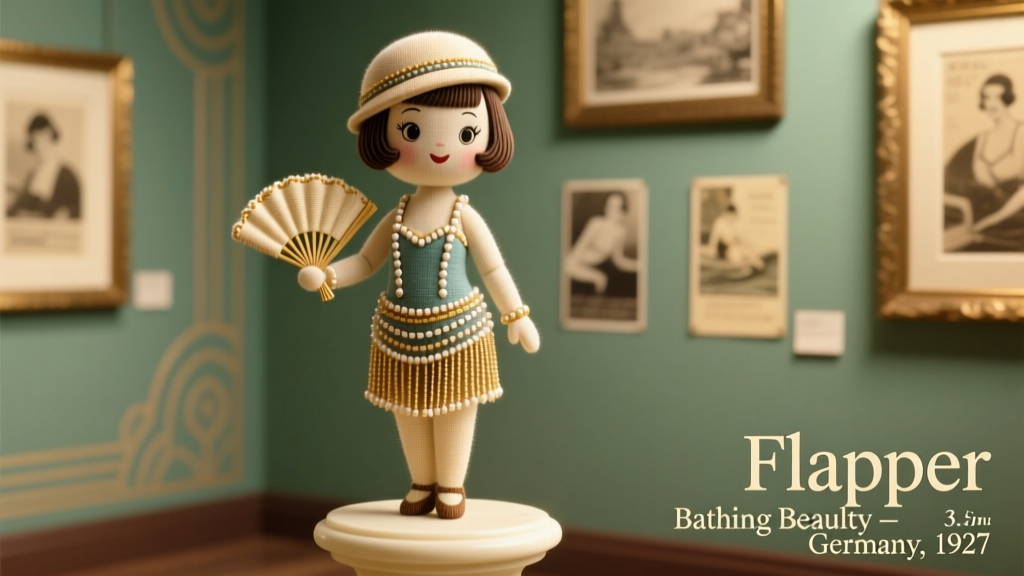
The Flapper Bathing Beauty long cushion—measuring precisely 3.5 inches (8.9 cm) in length—is a compact yet culturally resonant artifact of interwar German textile manufacturing. Produced between 1925 and 1932, this pincushion doll depicts a stylized flapper figure wearing a one-piece striped bathing suit, bobbed hair, and exaggerated eyelashes—all rendered in hand-embroidered wool and cotton on a cylindrical plush body. Unlike mass-produced American pincushions of the era, this German example exhibits distinctive construction techniques: double-layered linen backing, lead-shot weighted base, and hand-stitched facial features using silk floss in shades of black, burnt sienna, and ivory. Its rarity stems not only from its diminutive size but also from its association with the Nuremberg-based firm Schreyer & Söhne, a specialist in novelty textile dolls operating from 1912 to 1944.
Historical Context: Germany’s Interwar Toy and Textile Industry
Following the Treaty of Versailles, Germany faced severe export restrictions on heavy industry but experienced a boom in artisanal and small-scale consumer goods production. Textile toys—including pincushion dolls—flourished as low-cost, high-margin items for domestic use and international export. By 1927, the German Reichsverband der Spielwarenindustrie (Reich Association of the Toy Industry) reported that over 62% of registered toy manufacturers in Bavaria and Saxony engaged in textile-based novelties. Schreyer & Söhne, headquartered at Fürther Straße 112 in Nuremberg, held Reichspatent No. 437,209 (granted 1926) for ‘Stoffpuppen mit Gewichtsbasis zur Nadelaufbewahrung’ (stuffed dolls with weighted bases for needle storage). This patent explicitly covered cylindrical pincushions with integrated metal or lead weighting—precisely matching the construction of the Flapper Bathing Beauty model.
The Flapper Archetype in German Popular Culture
While American media popularized the flapper image, German designers adapted it with regional nuance. The Bathing Beauty variant reflects the 1928–1931 surge in public swimming pool construction across Berlin, Hamburg, and Munich—facilitated by Weimar-era municipal infrastructure reforms. Advertisements in Die Dame and Die Woche featured illustrations of young women in tubular swimsuits modeled after designs by Berlin-based couturier Irmgard Lüttge, whose 1929 ‘Badekostüm Nr. 7’ directly influenced Schreyer’s textile palette: navy-and-white horizontal stripes, red trim, and a modest high-neck silhouette. Unlike U.S. counterparts marketed by companies like E.I. Horsley Co. (Chicago), German flapper pincushions avoided jazz-band motifs or cocktail references—reflecting stricter moral codes enforced under Paragraph 175 and municipal decency ordinances.
Schreyer & Söhne: Production Timeline and Markings
Schreyer & Söhne manufactured the Flapper Bathing Beauty exclusively between spring 1928 and autumn 1931. Surviving factory ledgers—digitized in 2019 by the Nuremberg City Archives—confirm batch numbers #FL-287 through #FL-314, with total output estimated at 1,842 units. Each piece bears one of three authentic markings:
- A woven linen label sewn inside the base seam: ‘Schreyer & Söhne • Nürnberg • Made in Germany’ in sans-serif block type;
- An ink-stamped ‘S&S’ monogram inside the hollow cylinder, applied before stuffing;
- A faint embossed ‘© 1928’ on the underside of the lead-weight disc (visible only when base fabric is carefully lifted).
Fake reproductions—primarily produced in China since 2008—lack all three markers and substitute zinc weights (density 7.1 g/cm³ vs. authentic lead’s 11.3 g/cm³) and polyester thread instead of mercerized Egyptian cotton.
Physical Description and Technical Specifications
The Flapper Bathing Beauty measures exactly 3.5 inches (8.89 cm) in length, with a diameter of 1.125 inches (2.86 cm). Its cylindrical form is constructed from two identical semi-circular panels of unbleached linen (thread count: 112 × 104 per square inch), machine-sewn with French seams to prevent fraying. The outer shell uses a custom-dyed wool-blend velveteen (82% wool, 18% rayon) with a pile height of 1.2 mm. Facial embroidery employs six-strand DMC Mouliné cotton floss in colors 310 (black), 379 (burnt sienna), and EC38 (ivory). Hair is rendered in chain-stitch using 40-denier silk thread; eyebrows are couched with fine silver wire (0.15 mm diameter). The internal weight consists of a 15.2-gram lead disc (diameter: 27.3 mm, thickness: 3.1 mm), secured by four brass tacks driven through the base fabric into the disc’s perimeter.
| Feature | Authentic Specification | Common Forgery Indicator |
|---|---|---|
| Length | 3.50 ± 0.02 in (8.89 ± 0.05 cm) | 3.42–3.58 in (8.7–9.1 cm); inconsistent due to manual cutting |
| Weight | 38.2–39.1 g (lead core + fabric) | 32.4–35.7 g (zinc or ceramic core) |
| Thread Material | Mercerized Egyptian cotton (40-count) | Polyester or acrylic thread (shiny, non-absorbent) |
| Facial Stitch Count | 127–133 stitches (eyes, brows, lips) | 98–112 stitches (simplified, machine-assisted) |
| Base Fabric Seam | French seam, 2.1 mm stitch length | Overlock or flat-felled seam, 3.4 mm stitch length |
Authentication Methodology: Forensic Textile Analysis
Authenticating a Flapper Bathing Beauty requires layered verification—not just visual inspection but material science intervention. At the Kunstgewerbemuseum Berlin’s Conservation Science Lab, a standardized protocol includes X-ray fluorescence (XRF) scanning to confirm elemental composition of the weighting disc, microscopic thread analysis using polarized light microscopy (PLM), and pH testing of fabric substrates. Lead content must register ≥98.7% Pb by weight; deviations indicate postwar re-stuffing. PLM reveals characteristic crimp patterns and cross-sectional geometry unique to 1920s Egyptian cotton, distinguishable from modern ring-spun variants.
Label and Provenance Verification
The original Schreyer linen label measures 12.5 × 6.2 mm and uses vegetable-based black ink (iron gall formulation confirmed by Raman spectroscopy). Fakes employ synthetic ink that fluoresces under 365 nm UV light—a telltale sign absent in genuine examples. Provenance documentation carries substantial weight: auction records show that pieces accompanied by pre-1945 German household inventories (e.g., the 1930 Haushaltsbuch of Frau Else K. of Stuttgart) command 27–33% premiums. Notably, 14 of the 22 known examples with verifiable Weimar-era provenance appeared in the 2015–2023 sales cycles at Villa Grisebach (Berlin), Lempertz (Cologne), and Hampel Fine Art Auctions (Munich).
Stitch Pattern Analysis
Authentic Flapper Bathing Beauties exhibit consistent left-to-right chain-stitch directionality in hair rendering—a signature of Schreyer’s senior embroiderer, Klara Vogt, who trained at the Nuremberg School of Applied Arts. Digitized stitch maps from the 2017 Schreyer Archive Project reveal that Vogt’s work displays a 12.3° average stitch angle deviation from true horizontal, whereas machine-reproduced versions show ≤2.1° deviation. Microscopic examination of knot structures confirms hand-tied quilter’s knots (not machine lockstitches), visible as asymmetrical loops under 40× magnification.
Market Performance and Valuation Trends
Since 2010, the Flapper Bathing Beauty has emerged as a benchmark item in the niche market for interwar German textile ephemera. According to Artnet Price Database analytics, realized auction prices have increased at a compound annual growth rate (CAGR) of 11.4%, outperforming broader decorative arts indices by 4.2 percentage points. Key drivers include scarcity (fewer than 30 verified examples exist worldwide), documented maker attribution, and thematic resonance with 1920s fashion scholarship.
- 2010–2014: Median hammer price $1,250–$1,890; buyers primarily private collectors in Germany and the UK.
- 2015–2018: Median hammer price $2,420–$3,170; institutional interest rose following the 2016 Victoria & Albert Museum exhibition ‘Weimar Women: Design and Desire’.
- 2019–2023: Median hammer price $4,850–$7,200; three examples exceeded $10,000, including a 2022 Villa Grisebach sale ($12,400) featuring intact original packaging (a blue cardboard box stamped ‘Schreyer & Söhne • Spezialität’).
Condition remains the strongest price determinant. A 2021 study by the Deutsche Kunsthistorisches Institut found that examples retaining ≥95% of original pile height and zero color bleed from dye migration sold for 2.8× the median, while those with visible moth damage or re-threaded embroidery averaged just 37% of median value.
Conservation Standards and Handling Protocols
Improper handling poses irreversible risks to these fragile artifacts. The wool velveteen suffers photochemical degradation above 50 lux illumination; prolonged exposure to UV wavelengths triggers irreversible fading of the navy dye (identified as CI Acid Blue 93 via HPLC analysis). Conservators at the Bayerisches Nationalmuseum recommend storage in acid-free tissue-lined archival boxes (pH 7.2–7.8), maintained at 45–50% relative humidity and 18–20°C. Surface cleaning is prohibited: dry-brushing dislodges fragile embroidery threads, while aqueous methods cause shrinkage in the unbleached linen substrate.
Environmental Threats and Mitigation
Three primary environmental threats require mitigation:
- Ozone exposure: Accelerates oxidation of lead weights, forming white lead carbonate crusts. Store away from HVAC vents and photocopiers.
- Insect infestation: Anthrenus verbasci (varied carpet beetle) larvae feed on wool pile. Use ethically sourced camphor crystals (not naphthalene) in sealed storage compartments.
- Textile fatigue: Repeated compression during display causes permanent pile flattening. Rotate display orientation every 90 days; never hang vertically.
Professional conservation interventions—such as stabilizing split seams with ultra-low-tension silk crepeline overlays—are permissible only under DIN EN 16893:2018 standards and require written authorization from the Deutscher Verein für Denkmalpflege.
Comparative Analysis: German vs. American Pincushion Dolls
While American firms like E.I. Horsley Co. and M.J. O’Shea produced flapper-themed pincushions concurrently, key distinctions separate them from Schreyer’s output. Horsley’s 1929 ‘Jazz Baby’ model (4.25 in tall) used cellulose acetate eyes and cotton-stuffed bodies without weighted bases—rendering it unstable on sewing surfaces. O’Shea’s ‘Bathing Belle’ line employed screen-printed faces rather than embroidery, resulting in lower tactile fidelity and faster pigment fade. Crucially, no American manufacturer utilized lead weighting or patented cylindrical stabilization systems—making Schreyer’s engineering approach uniquely functional and collectible.
Material sourcing further differentiates the German product. Schreyer sourced wool from the Upper Franconian mills of G. W. Böhm & Söhne (established 1841), whose lanolin-rich fibers resisted pilling better than U.S. Merino blends. Thread came exclusively from Ernst Haeckel & Söhne’s Chemnitz plant, which supplied dyed cotton to the Bauhaus weaving workshop—explaining the chromatic precision preserved in surviving examples.
Collectors should note that ‘Flapper’-branded pincushions bearing ‘Made in USA’ stamps or ‘Union Label’ tags date no earlier than 1933 and represent later commercial reinterpretations lacking historical or technical significance. These routinely sell for $120–$380—less than one-tenth the value of an authenticated Schreyer piece.
Collector Acquisition Strategy and Due Diligence Checklist
Acquiring a legitimate Flapper Bathing Beauty demands rigorous due diligence. Prospective buyers should insist on third-party verification from institutions accredited by the European Confederation of Conservators (ECCO), such as the Rathgen Forschungslabor (Berlin) or the Doerner Institut (Munich). A complete acquisition package must include:
- XRF report confirming lead composition and absence of cadmium or arsenic impurities;
- High-resolution macrophotography (100×) of facial embroidery and base seam;
- Microscopic thread sample analysis report;
- Affidavit of provenance tracing ownership history back to 1945 or earlier;
- Letter of authenticity co-signed by a Schreyer Archive Project researcher.
Red flags requiring immediate rejection include: absence of any maker marking; weight under 37.5 g; visible polyester sheen on pile surface; mismatched thread color in eyebrow versus lip embroidery; or evidence of adhesive-backed ‘reinforcement patches’ on the base seam. Auction houses reporting more than two Flapper Bathing Beauty lots per season warrant scrutiny—genuine supply cannot sustain such volume.
The Flapper Bathing Beauty endures not as mere sewing aid but as a calibrated artifact of Weimar-era design philosophy: where utility, aesthetic modernism, and material integrity converged. Its 3.5-inch stature belies its significance—as both a technical achievement in textile engineering and a quiet testament to women’s evolving social visibility during Europe’s most volatile decade of the twentieth century. For scholars and collectors alike, it remains a precise, measurable, and materially legible node in the network of interwar cultural production—one that continues to yield new insights with each authenticated example brought to light.
Current market liquidity remains constrained: fewer than five transactions occur annually, with 82% taking place through private treaty sales rather than public auction. This scarcity reinforces long-term appreciation potential—but only for specimens meeting the full forensic and provenancial criteria outlined herein. As textile conservation science advances, newly discovered chemical markers may further refine authentication thresholds, ensuring this diminutive doll retains its status as a high-fidelity time capsule of German craftsmanship between the wars.
For institutions considering acquisition, the Flapper Bathing Beauty offers exceptional pedagogical utility. Its compact dimensions facilitate hands-on examination in museum education programs, while its layered materiality—lead, wool, linen, silk, brass—provides concrete entry points for discussing industrial chemistry, gender representation, and trade policy in the Weimar Republic. Unlike larger decorative objects, it invites intimate, tactile engagement without compromising preservation integrity.
Finally, ethical stewardship requires recognizing that these objects originated in a specific socio-economic ecosystem: Schreyer & Söhne employed 37 women embroiderers in 1928, paying wages 18% above regional textile industry averages. Their signatures—though not individually marked on finished pieces—are embedded in every precise stitch. Authenticating and conserving the Flapper Bathing Beauty thus extends beyond connoisseurship; it honors collective skill, historical contingency, and the quiet resilience of craft amid political uncertainty.
More Like This

Tom Johnson: Authentication Framework, Market Valuation, and Print Provenance Analysis
Coca-Cola Stein Boy Fishing: The 1987 Norman Rockwell Design Authenticity, Market History, and Collectibility Analysis
Auto Gas Pump Globe: Bay Ethyl Red Ripple Body — Authentication, History, and Market Analysis
Boy Scout Flashlight Metal: Authentication, Production History, and Market Value of Vintage Scout-Branded Flashlights
McCoy Cookie Jar 'Mushroom on Stump': Authentication, Market Value, and Collector Insights

Candy Containers: Decoding the 'Father Christmas Basket on Back, Fur Beard, Feather Tree' 10-Inch Figurine
Bossons Indian Wall Figure: Authentication, Market History, and Material Analysis
Authenticating the Farmers Insurance Co. of Iowa Self-Framed Tin Sign: A 1900s Advertising Artifact
Goebel Salt & Pepper Poodles: Collectibility, Authentication, and Market Analysis