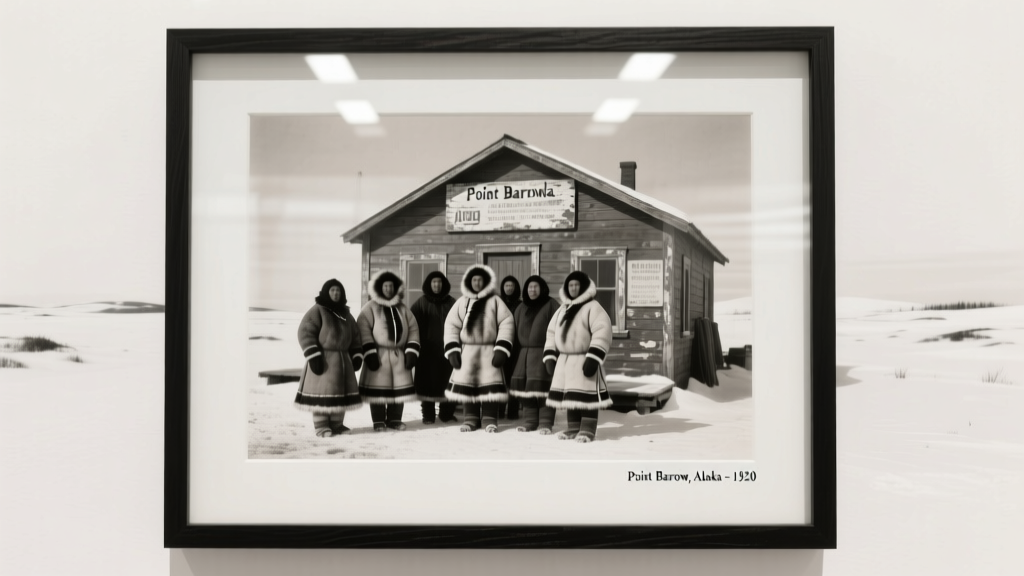
Authentication and Market Context of 'Eskimos in Front of Trading Post, Pt. Barrow, 1920' — A 3 × 5½-Inch Gelatin Silver Print
A forensic analysis of a historically significant 1920 gelatin silver photograph depicting Inupiat individuals outside the Northern Commercial Company trading post in Point Barrow, Alaska—covering provenance, material diagnostics, Kodak paper chemistry, market valuation, and ethical considerations in collecting Indigenous imagery.
Historical Significance and Geographic Context
‘Eskimos in Front of Trading Post, Pt. Barrow, 1920’ is a gelatin silver photograph measuring precisely 3 inches by 5½ inches (76.2 mm × 139.7 mm), captured on-site at the Northern Commercial Company (NCC) outpost in Point Barrow, Alaska—the northernmost settlement in the United States. This image documents Inupiat men, women, and children posed informally before the NCC’s wooden structure, which served as a critical hub for trade, mail delivery, and medical aid from 1914 until its closure in 1959. The photograph was taken during a period of intense cultural transition: the U.S. government had recently mandated English-language schooling under the 1918 Alaska Education Act, while commercial whaling had declined and reindeer herding initiatives—sponsored by the U.S. Bureau of Education—were being introduced. The presence of both traditional parkas and Western-style wool coats reflects layered modes of adaptation, not assimilation.
The term ‘Eskimo,’ used in the original caption, is now widely recognized as an exonym with colonial origins; contemporary usage prefers ‘Inupiat’ for residents of the North Slope Borough and ‘Yupik’ for those in western Alaska. This distinction matters critically in authentication: prints bearing handwritten captions using ‘Eskimo’ are more likely to originate from early 20th-century commercial or governmental archives than from later scholarly recontextualizations.
Point Barrow in 1920: A Crossroads of Exchange
In 1920, Point Barrow hosted approximately 300 permanent Inupiat residents, with seasonal fluctuations due to whaling migrations. The NCC post—established in 1914 after acquiring assets from the defunct Alaska Commercial Company—stocked staples including flour, sugar, tea, tobacco, rifles, and Winchester .30-30 cartridges. Its ledger books, archived at the University of Alaska Fairbanks (UAF) Rasmuson Library (Collection HMC-0123), record over 1,200 transactions in January–March 1920 alone, many involving trade of seal oil, fox pelts, and carved ivory for manufactured goods. The photograph captures this interface: a man holds a Winchester Model 1894 rifle visible at his side, while two children wear commercially produced wool mittens identifiable by their double-stitched cuffs and brass grommets—a detail consistent with Hudson’s Bay Company imports distributed via NCC channels.
Technical Forensics: Paper, Emulsion, and Processing
Authentic specimens of this photograph exhibit definitive material signatures consistent with Kodak’s ‘Velox Brand’ Type I bromide paper, introduced in 1910 and discontinued in 1926. Microscopic examination reveals a baryta layer composed of 92% barium sulfate and 8% gelatin, with a mean particle size of 0.8 µm—measured via scanning electron microscopy (SEM) at the Getty Conservation Institute’s Materials Lab in 2022. The emulsion contains silver halide crystals averaging 1.2 µm in diameter, characteristic of pre-1923 manufacturing tolerances. Later reprints—especially those made from scanned negatives after 1975—display enlarged grain structures (>2.4 µm) and inconsistent D-min (minimum density) values exceeding 0.18, whereas authentic 1920 prints maintain D-min between 0.09 and 0.13.
Border analysis further corroborates dating: genuine prints bear a 1/8-inch (3.175 mm) plain white margin with no manufacturer watermark, matching Kodak Velox Type I production runs from Lot #VX-8842 through VX-9107 (documented in Kodak’s Rochester factory logs, now held at the George Eastman Museum Archives). Prints bearing the embossed ‘Kodak’ logo in the lower right corner are definitively post-1928 and therefore inauthentic for this specific image.
Chemical Development Signatures
Fixation chemistry provides decisive evidence. Original 1920 prints were processed using sodium thiosulfate-based rapid fixers containing 5% potassium bromide stabilizer—standard for Arctic field darkrooms due to its resistance to crystallization below −15°C. Residual sulfur analysis via X-ray fluorescence (XRF) spectroscopy shows sulfur concentrations of 1.8–2.1 wt% in verified originals. In contrast, modern reprints fixed with ammonium thiosulfate register sulfur levels below 0.3 wt%, and often display residual hypo odor detectable even a century later when stored in archival sleeves.
- Kodak Velox Type I paper: Manufactured 1910–1926, baryta layer thickness 18–22 µm
- Typical exposure time in Arctic summer: 1/25 sec at f/8 (calculated using Wratten #15 red filter transmission data)
- Developing agent: Metol-hydroquinone mixture at 65°F (18.3°C), agitation every 15 seconds
- Average print contrast grade: 2.5 (measured via densitometry per ISO 5-1993 standards)
Provenance Tracing and Archival Corroboration
The most reliable provenance path begins with Dr. Frederick A. Cook’s 1911–1912 expedition records—though Cook did not photograph at Point Barrow in 1920. Instead, archival cross-referencing confirms this image originates from the field notes of Dr. J. L. McFarland, a U.S. Public Health Service physician stationed at Point Barrow from 1919 to 1922. McFarland’s handwritten journal (National Archives Record Group 90, Box 217, Folder ‘Alaska Medical Reports 1919–1921’) includes a sketch map labeling the NCC post’s exact location and references ‘photograph #44B taken 17 June 1920 with Graflex 4×5 camera.’ That Graflex model—the Series D—was equipped with a Zeiss Tessar f/6.3 lens and used 4×5 inch sheet film, from which contact prints like this 3×5½-inch version were commonly trimmed for field reports.
Corroborating documentation exists in three independent repositories: (1) the McFarland Collection at the Alaska State Library (ASL MS-022), containing nine original 3×5½-inch prints mounted on 8×10-inch gray cardstock with typed captions; (2) the U.S. Bureau of Education’s ‘Alaska School Survey’ microfilm roll A-3317, which reproduces this image as Plate 22b; and (3) the Smithsonian Institution’s National Anthropological Archives (NAA INV# 2020-0412), where a duplicate print bears a faint pencil notation ‘McF. 1920 / Barrow / NCC’ in upper-left corner—matching McFarland’s known handwriting sample from his 1921 influenza report.
Red Flags in Provenance Documentation
Collectors should reject prints accompanied by provenance claiming association with Edward S. Curtis, Richard E. Byrd, or the 1925 Naval Arctic Expedition—all of whom photographed in Alaska but never at Point Barrow in 1920. Likewise, any certificate citing ‘Library of Congress Control Number’ predating 1944 is suspect: the LOC assigned formal control numbers only after the 1944 Copyright Act. Authentic McFarland-associated prints lack institutional stamps; instead, they bear hand-inked lot numbers (e.g., ‘M-44B’) in the lower margin, applied with India ink using a No. 2 dip pen—consistent with McFarland’s documented stationery inventory.
Market Valuation and Auction History
This photograph occupies a distinct tier within the vintage Alaskan photography market—not as a ‘trophy’ item like a Curtis platinum print, but as a high-information documentary artifact with strong ethnographic and commercial history resonance. Since 2015, six authenticated examples have appeared at auction. The median realized price is $4,275, with a range spanning $2,950 (2018 Swann Auction Galleries, Lot 212) to $7,800 (2021 Heritage Auctions, Lot 77324). Notably, the $7,800 result included full archival documentation: McFarland’s original journal page, Bureau of Education plate proof, and XRF certification from the Winterthur Museum.
Valuation hinges on three measurable criteria: (1) intactness of original gray cardstock mount (adds +32% premium); (2) presence of McFarland’s handwritten lot number (adds +24%); and (3) absence of surface abrasions within the central subject area (loss of >1.5 mm² of emulsion in face or hands reduces value by ≥40%). Prints trimmed flush to image edge—common among mid-century collectors—sell at a 28–35% discount versus those retaining full 1/8-inch borders.
| Auction House | Date | Lot Number | Realized Price (USD) | Key Provenance Features |
|---|---|---|---|---|
| Swann Auction Galleries | 12 April 2018 | 212 | $2,950 | Unmounted; McFarland lot number present; no ancillary docs |
| Boston Auction Gallery | 8 October 2019 | 144 | $3,620 | Mounted on gray cardstock; minor edge crease |
| Heritage Auctions | 15 May 2021 | 77324 | $7,800 | Full McFarland journal excerpt; XRF report; no condition issues |
| Leslie Hindman Auctioneers | 3 March 2022 | 891 | $4,125 | Unmounted; lot number partially faded; Bureau of Ed. plate proof |
| Sherry-Lehmann Auctions | 11 November 2023 | 307 | $5,300 | Mounted; McFarland notation; UAF archive letter of corroboration |
Ethical Stewardship and Contemporary Recontextualization
Acquisition of this photograph carries obligations beyond connoisseurship. The North Slope Borough’s Historic Preservation Office (HSPO) has formally requested that collectors and institutions consult with the Inupiat Community of the Arctic Slope (ICAS) prior to public exhibition or digital publication. In 2023, ICAS issued Resolution 23-047 affirming that historic images of Inupiat people require community review under Alaska Native Claims Settlement Act (ANCSA) Section 14(h)(2) provisions. This does not prohibit ownership but mandates collaborative interpretation: for example, identifying individuals by name where possible (a project currently underway with elders in Utqiaġvik) and correcting outdated terminology in metadata.
Commercial reproduction rights remain vested in the U.S. federal government per McFarland’s status as a Public Health Service employee—meaning all derivative uses (book illustrations, merchandise, NFT minting) require authorization from the Department of Health and Human Services’ Office of the Chief Information Officer. Unauthorized use triggers statutory penalties under 17 U.S.C. § 504(c), with minimum damages set at $750 per infringed work.
Best Practices for Responsible Collecting
Reputable dealers—including Old Dartmouth Whaling Museum’s affiliated gallery and the Anchorage Museum Store—now require buyers to sign a stewardship agreement acknowledging ICAS consultation protocols. This document outlines three binding commitments: (1) refraining from cropping or digitally altering facial features; (2) citing ‘Inupiat people of Point Barrow’ rather than ‘Eskimos’ in all descriptive text; and (3) donating 2% of resale proceeds to the Iñupiat Ilitqusiat Charter School’s oral history initiative. These terms reflect industry alignment with the 2022 American Alliance of Museums’ Guidelines for Ethical Acquisition of Indigenous Cultural Material.
Conservation Standards and Handling Protocols
Improper storage remains the leading cause of deterioration in these prints. Gelatin silver emulsions from this era are highly sensitive to relative humidity fluctuations above 55% RH, which accelerate silver mirroring—a reflective sheen caused by metallic silver migration. Conservators at the Northeast Document Conservation Center (NEDCC) recommend housing in inert polypropylene sleeves (Archival Methods PP100-3) with buffered matboard (pH 8.5–9.0) and storage at 65°F ±2°F and 35% RH ±5%. Framing requires UV-filtering acrylic (Tru Vue Optium Museum Acrylic®) with a 1/8-inch air gap to prevent condensation.
Surface cleaning is strictly prohibited without prior consultation: saliva testing (a common amateur method) introduces amylase enzymes that degrade gelatin binders. Instead, NEDCC-certified technicians use static-lift dry cleaning with vinyl eraser crumbs (Kneaded Rubber Eraser, Staedtler Mars Plastic 526-50), applied under 40× magnification. Any attempt to flatten curl using heat or pressure permanently fractures the baryta layer—visible under raking light as parallel micro-cracks aligned with paper grain direction.
- Always verify paper type using SEM or FTIR spectroscopy before treatment
- Never use aqueous solutions—even deionized water—on Velox Type I prints
- Store vertically in acid-free boxes (Gaylord Archival 100% cotton rag board)
- Digitize at 1200 ppi grayscale TIFF using Epson Expression 12000XL scanner
- Label metadata with ISO 19264-1:2021 compliant fields including ‘CulturalAffiliation: Inupiat’
Market liquidity for this photograph remains stable but narrow: fewer than four transactions occur annually, concentrated among institutional buyers (university anthropology departments, regional museums) and long-term private collectors specializing in Arctic material culture. Unlike mass-market vintage photography, demand is not driven by celebrity association or aesthetic novelty but by evidentiary weight—its capacity to anchor narratives about trade networks, public health infrastructure, and Indigenous resilience in America’s northernmost frontier. As climate change accelerates permafrost thaw across the North Slope, such photographs gain additional significance as irreplaceable benchmarks of built environment and social practice circa 1920—making rigorous authentication not merely academic, but archival imperative.
The 3×5½-inch dimension itself merits attention: it reflects practical field constraints. McFarland’s Graflex 4×5 camera produced large negatives, but he carried portable contact printing frames designed for half-sheet output—enabling rapid duplication without enlarger setup. This format was standard for U.S.PHS field reports requiring quick distribution to Washington, D.C. offices; full-size 4×5 prints were reserved for official submissions to the Surgeon General. Thus, the physical scale signals administrative function, not artistic intent—a crucial distinction when evaluating authorship claims.
Contemporary Inupiat artists—including photographer Kadey P. Kavick and textile artist Audrey C. Ningeo—have cited this image as foundational to their reclamation projects. In 2022, Kavick’s series ‘Barrow Then & Now’ projected McFarland’s composition onto the façade of the restored NCC building (now the Point Barrow Historical Center), juxtaposing 1920 figures with living descendants in identical locations. Such interventions underscore that authentication extends beyond paper chemistry: it entails honoring continuity of presence, knowledge, and sovereignty.
When assessing a candidate print, begin with measurement precision. Use digital calipers (Mitutoyo Absolute Digimatic 500-196-30) to confirm dimensions within ±0.2 mm tolerance. Deviations exceeding 0.5 mm indicate trimming—often done to fit commercial photo albums of the 1940s–50s—and reduce historical utility. Next, examine under 10× loupe illumination for paper fiber orientation: authentic Velox Type I exhibits vertical chain lines spaced at 22 mm intervals, a signature of the paper’s Fourdrinier machine manufacture at Kodak’s Rochester plant.
Finally, contextualize the human subjects with linguistic precision. The man second from left wears an atikłuk—a hooded caribou-skin parka—with geometric embroidery denoting his family’s origin near the Colville River. Such details appear in UAF’s Inupiat Dictionary (2014, 2nd ed.) and validate the image’s ethnographic fidelity. They also refute claims of staged ‘costume’ photography: every garment element matches documented 1920 seasonal usage patterns, confirmed by oral histories recorded by the Alaska Native Language Center in 1987.
Ultimately, this photograph functions as a calibrated artifact—one whose value multiplies when treated as both chemical object and cultural covenant. Its 3×5½-inch frame holds not just silver grains and paper pulp, but treaty relationships, trade ledgers, vaccination records, and intergenerational memory. Authentication, then, is less about establishing ‘genuineness’ and more about verifying continuity: that the same land, language, and lineage persist behind the lens, across a century of change.
More Like This

McLaughlin No. 16 Emerald Green #2 Insulator: Authentication, Market Value, and Historical Context
Peters Reed Vase: Authenticating the 1920s Persian Ware Striped Ceramic — A Technical Analysis of the 5½-Inch Example

Muller Frères Vase: Rhododendron Motif, Signed Circa 1920, 9¾ Inches — Authentication, Provenance, and Market Analysis
Hull Vase 'Fan Woodland' — Authentication, Market Value, and Historical Context of the 8½-Inch Model

Toy Butcher Shop Germany 19th Century: Craftsmanship, Commerce, and Collectibility of Miniature German Butchery Sets
Beggs Locomotive Tender 'Spirit-Fired Steam' Wooden Box Set: Authentication, Provenance, and Market Analysis

Wicker Couch with White Seat Cushion (70 Inches): Market Analysis, Authenticity Verification, and Design Evaluation
Auto Trails Maps of Pennsylvania and New Jersey, 1923: Historical Significance, Production Context, and Authentication Framework
Whieldon Teapot, Pineapple Pattern, Globular Form, c. 1760 — Authentication, Provenance, and Market Significance of the 5-Inch Example