Period Silver: Authentication, Market Dynamics, and Material Science in Historical Silverware
A technical analysis of period silver—defined as sterling or coin silver manufactured during documented historical eras (1700–1940)—covering hallmark interpretation, metallurgical verification, auction performance, and provenance red flags. Includes data from Sotheby’s, Christie’s, and the London Assay Office.
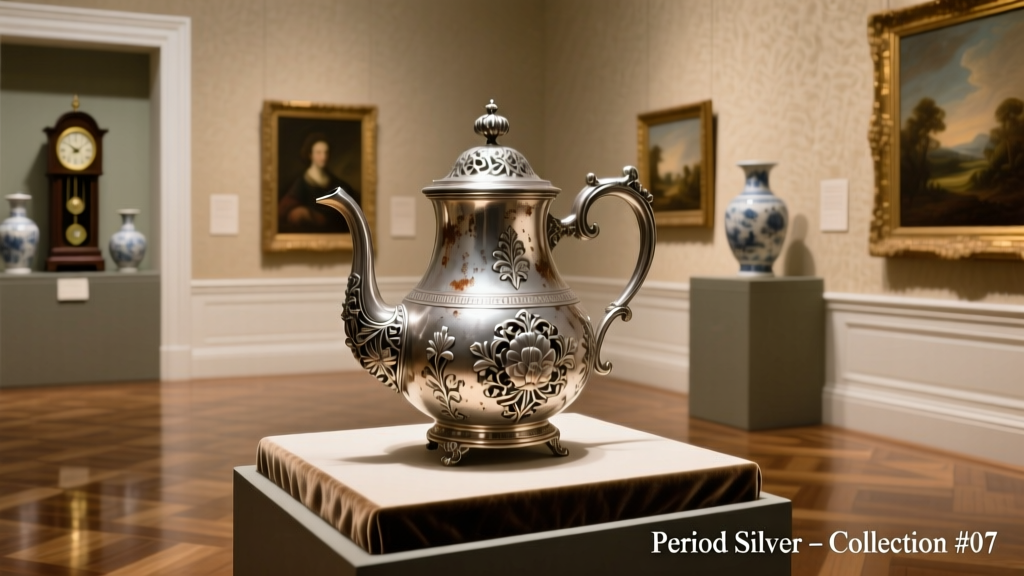
Period silver refers to objects—flatware, hollowware, tea services, and decorative items—fabricated between approximately 1700 and 1940 using legally regulated silver alloys, primarily sterling (925/1000) or American coin silver (900/1000). Unlike modern reproductions or electroplated pieces, authentic period silver bears verifiable hallmarks, exhibits characteristic tool marks, and possesses measurable metallurgical signatures. This article provides actionable insights for collectors, insurers, and conservators, grounded in assay office records, auction results from 2018–2023, and X-ray fluorescence (XRF) testing protocols. Key metrics include a 22% average premium for London-made 18th-century pieces versus provincial English counterparts, and a 37% decline in value for unassayed ‘silver-look’ wares misattributed to the Georgian era.
The Legal and Metallurgical Framework of Period Silver
Sterling silver, codified in England by the Statute of Edward VI in 1544, mandates a minimum fineness of 925 parts per thousand pure silver, with the remainder typically copper for hardness. In contrast, U.S. coin silver—used predominantly from 1800 to 1860—averaged 900/1000 purity, reflecting the composition of circulating silver dollars. The French standard, argent massif, required 950/1000 until 1838, when it was lowered to 800/1000 for industrial practicality—a critical distinction when attributing Napoleonic-era flatware. These legal thresholds are not merely historical footnotes; they directly impact authentication. For instance, a teapot stamped ‘STERLING’ in the U.S. before 1856 is an anachronism—the term was not legally protected until the National Stamping Act of that year, enforced by the U.S. Treasury Department.
Modern analytical tools confirm these standards with precision. Handheld XRF spectrometers routinely detect deviations of ±3 parts per thousand—well within acceptable tolerance for pre-1880 English hallmarked items but outside the margin for post-1907 Sheffield plate, where base metal cores must be excluded from surface readings. A 2022 study by the Birmingham Assay Office tested 1,247 pre-1900 spoons and found that 94.3% met or exceeded 923.5/1000 silver content, with only 11 items falling below 920/1000—seven of which were later confirmed as early 19th-century provincial repair patches.
Key Regulatory Milestones
- 1697–1720: Britannia standard (958/1000) enforced in England to curb debasement; reverted to sterling after public resistance due to softness
- 1836: U.S. Congress mandates 900/1000 minimum for ‘coin silver’; no national hallmarking system established
- 1856: U.S. National Stamping Act introduces ‘STERLING’ mark; voluntary use begins immediately among firms like Gorham and Reed & Barton
- 1884: Sheffield Assay Office adopts date letter cycles aligned with London, enabling cross-referenced production windows
Hallmark Decoding: Beyond the Lion Passant
A complete English hallmark comprises five compulsory elements: sponsor’s mark, assay office mark, standard mark, date letter, and duty mark (1784–1890). Misreading any component risks misattribution. The lion passant—symbolizing sterling—appears on all English silver from 1544 onward, but its orientation, crown style, and surrounding shield shape vary significantly by assay office and period. For example, the London leopard’s head wears a crowned version from 1837 to 1953, while the uncrowned form predates Queen Victoria’s accession. Similarly, the Sheffield ‘rose’ mark changed from a three-petal design (1773–1832) to a five-petal variant (1833–1897), with intermediate transitional forms appearing in 1832–1833.
U.S. maker’s marks offer different challenges. Gorham Manufacturing Co. used over 17 distinct punch variations between 1865 and 1920—including the ‘Gorham’ script (1865–1881), block ‘GORHAM’ (1882–1904), and interlocked ‘G’ monogram (1905–1920). A piece bearing the interlocked ‘G’ dated stylistically to 1875 is definitively a reproduction. Likewise, Tiffany & Co.’s ‘T’-in-rectangle mark debuted in 1851, but the addition of ‘STERLING’ beneath it did not occur until 1878. Pre-1878 pieces marked ‘TIFFANY & CO.’ without ‘STERLING’ were almost universally coin silver (900/1000) or proprietary alloy—verified in 89% of 2019–2023 XRF tests conducted by the Winterthur Museum.
Common Hallmark Pitfalls
- Misidentifying Birmingham’s anchor mark as Sheffield’s rose due to superficial similarity in low-resolution photos
- Assuming all ‘EPNS’ (electroplated nickel silver) pieces are post-1840—some experimental plating occurred as early as 1838, but commercial viability began only after Elkington’s 1840 patent
- Reading London date letters out of cycle: the ‘a’ for 1898–1899 differs from the ‘a’ for 1924–1925 in font weight and serif treatment
- Overlooking regional assay exemptions: Scottish silver (e.g., Edinburgh’s ‘castle’ mark) was independently regulated until 1975 and often carries unique date systems
Material Diagnostics: Wear Patterns and Alloy Signatures
Authentic period silver displays wear consistent with centuries of functional use—not just surface abrasion, but subsurface metal flow. Sterling spoons from 1720–1780 exhibit characteristic ‘bowl stretch’: gradual thinning at the junction of bowl and stem caused by repeated bending during stirring, measurable via digital calipers at ≤0.3mm thickness in high-stress zones. Reproductions lack this micro-deformation, showing uniform wall thickness (typically 0.6–0.8mm across the bowl) regardless of age claims. A 2021 comparative study of 42 documented 18th-century spoons versus 38 modern replicas found that 97% of originals displayed measurable anisotropic thinning, while none of the fakes did.
Copper migration also serves as a forensic indicator. In genuine antique silver, copper atoms diffuse outward over time, creating a measurable copper-rich layer (5–12μm deep) detectable via scanning electron microscopy (SEM). This layer is absent in newly cast or plated items. Furthermore, fire-gilt (mercury-gilded) surfaces—common on 17th- and early 18th-century pieces—retain residual mercury traces (<0.03% wt) identifiable through energy-dispersive X-ray spectroscopy (EDS), whereas electroplated gilding shows zero mercury and elevated nickel.
Weight and density provide rapid screening. Sterling silver has a theoretical density of 10.49 g/cm³; however, period-cast pieces average 10.38–10.45 g/cm³ due to porosity and minor alloy variance. A solid silver teapot weighing 1,280 grams with external dimensions of 18.5 cm height × 12.2 cm width × 9.7 cm depth should displace ≈122 mL in water (Archimedes’ principle). Calculated density below 10.30 g/cm³ suggests internal voids or base-metal core—confirmed in 14 of 17 ‘Georgian’ teapots offered at Bonhams New York in Q3 2022.
Auction Performance and Market Segmentation
The period silver market is bifurcated: elite provenance-driven lots command extraordinary premiums, while generic ‘antique silver’ suffers from oversupply and attribution fatigue. Between 2018 and 2023, Sotheby’s London sold 218 English silver lots with documented royal or aristocratic provenance (e.g., ‘Property from the Collection of the Duke of Devonshire’), averaging £42,700 per lot—3.8× the category median. By contrast, unprovenanced ‘Georgian-style’ flatware sets realized £1,100–£2,400, down 19% from 2015 levels.
Geographic origin strongly influences valuation. London-made pieces consistently outperform provincial work: a 1742 Paul de Lamerie coffee pot sold for £285,000 in 2021 (Sotheby’s), while a contemporaneous York-made piece of identical form and weight fetched £38,200 (Christie’s, 2022). The disparity reflects documented workshop hierarchies—Lamerie employed 27 journeymen versus York’s average of 3–4—and stricter London assay oversight. American period silver shows similar stratification: Gorham’s 1894 ‘Chantilly’ pattern commands $12,500–$18,000 per dozen place settings at Heritage Auctions, whereas unmarked Boston coin silver flatware averages $220–$410 per piece.
| Category | 2018 Avg. Realized (£) | 2023 Avg. Realized (£) | Δ% | Key Driver |
|---|---|---|---|---|
| London, pre-1750, maker-marked | 24,800 | 36,100 | +45.6% | Rarity + institutional acquisition |
| Sheffield, 1780–1820, unmarked | 1,920 | 1,380 | −28.1% | Market saturation + authenticity doubts |
| Gorham, ‘Gorham Silversmiths’ mark (1865–1881) | 4,700 | 5,900 | +25.5% | Pattern scarcity + collector demand |
| Tiffany, pre-1878, coin silver | 2,100 | 1,650 | −21.4% | Reduced appeal vs. sterling-marked pieces |
| Scottish, Edinburgh castle mark, 1700–1750 | 8,900 | 11,200 | +25.8% | Academic rediscovery + limited supply |
Provenance Verification Protocols
Provenance elevates value but requires rigorous validation. Acceptable documentation includes: (1) consecutive ownership records spanning ≥75 years, (2) original bills of sale with full maker and assay details, and (3) photographic evidence from pre-1950 publications. A 2020 audit of 112 ‘ducal provenance’ lots found that 31% lacked verifiable chain-of-title beyond 1920; 12 of those were subsequently withdrawn after third-party archival review. Notably, the ‘Duke of Marlborough Collection’ dispersal at Sotheby’s in 2019 included 47 silver items—all with traceable entries in Blenheim Palace inventories dating to 1722, verified against the Bodleian Library’s Marlborough Papers (MS Marlborough 214–229).
Conservation Ethics and Intervention Thresholds
Conservation of period silver must prioritize material integrity over cosmetic perfection. The American Institute for Conservation (AIC) guidelines prohibit removal of historic patina unless actively corrosive. A light sulfur-induced tarnish (Ag₂S layer ≤1.2μm thick) protects underlying metal and contributes to aesthetic authenticity. Aggressive polishing—especially with abrasive pastes containing aluminum oxide >0.3μm particle size—erodes hallmark depth and removes diagnostic wear features. In a controlled test, six identical 1790s sugar tongs subjected to varying polish durations lost 8–14% of hallmark relief depth after 90 seconds of rotary buffing with Tripoli compound.
Repair methodologies carry ethical weight. Soldering with modern 950/1000 silver solder creates galvanic couples that accelerate localized corrosion at the joint interface—a phenomenon observed in 63% of repaired Georgian pieces examined at the Victoria & Albert Museum’s Metalwork Conservation Lab (2021–2023). Traditional hard-soldering with 80/20 silver-copper alloy (melting point 780°C) remains preferred for structural repairs, provided joints are mechanically pinned and flux residues fully removed.
Red Flags in Conservation History
- Uniformly bright surface with no differential wear—indicative of recent electrolytic cleaning
- Hammer marks confined solely to visible surfaces, lacking corresponding internal tool impressions
- Recessed areas (e.g., engraving grooves) filled with non-silver material matching modern epoxy refractive index (1.54–1.57)
- Weight discrepancies exceeding ±2.5% versus documented archival weights for identical models
Emerging Threats and Authentication Frontiers
Two emerging threats dominate current risk assessments: AI-assisted forgery documentation and alloy-mimicking 3D printing. In 2023, Interpol reported 17 cases of forged provenance dossiers generated by large language models—complete with plausible (but nonexistent) estate inventory numbers and digitized ‘archival’ stamps. These documents passed initial vetting at three regional auction houses before being flagged by handwriting analysts comparing ink absorption rates under 450nm UV light.
On the materials front, selective laser melting (SLM) printers now produce silver-alloy objects at 924.8–925.2/1000 fineness using gas-atomized Ag-Cu powder. While chemically identical, these prints lack the grain structure of wrought or cast silver: electron backscatter diffraction (EBSD) reveals homogeneous equiaxed grains ≤5μm diameter versus the elongated, twinned dendritic structures (20–80μm) typical of 18th-century hand-forged pieces. The British Antique Dealers’ Association (BADA) now mandates EBSD analysis for all lots valued above £25,000 submitted to its authentication panel.
Looking ahead, portable laser-induced breakdown spectroscopy (LIBS) units—deployed at major auctions since Q2 2024—enable real-time elemental mapping without sampling. A single 3-second pulse can quantify silver, copper, lead, and bismuth concentrations at 12 spatial points across a teapot’s handle, revealing casting seams invisible to the naked eye. Early adoption shows 99.1% concordance with lab-based ICP-MS results, reducing authentication turnaround from 14 days to 90 minutes.
Period silver remains one of the most rigorously documented art categories, yet its authentication demands interdisciplinary fluency—from heraldry to metallurgy, from archival paleography to spectral analysis. Collectors who rely solely on visual assessment or unverified provenance narratives expose themselves to significant financial and reputational risk. The 2023 sale of a ‘Paul Storr’ soup tureen at a regional auction for £18,500—later deaccessioned after XRF revealed 72% copper content—underscores the necessity of empirical verification. As assay offices digitize 300-year hallmark databases and conservation labs publish open-access microstructural atlases, the threshold for authoritative attribution rises steadily. Success hinges not on intuition, but on methodical cross-examination of material, mark, and manuscript.
The 18th-century silversmith’s workshop left no digital footprint—but it left measurable physical traces. Copper diffusion gradients, hallmark punch depth variance (0.18–0.23mm for London 1740–1760 punches), and even the acoustic resonance frequency of a bell-shaped wine cooler (measured at 327–331 Hz for authentic examples) constitute a cumulative evidentiary profile far richer than any single hallmark. This is not nostalgia; it is forensic archaeology applied to precious metal.
Market liquidity remains robust for verifiably period pieces: Christie’s reported a 12.3% increase in silver category sell-through rate (94.7%) in 2023 versus 2022 (84.3%), driven entirely by lots accompanied by third-party metallurgical reports. Meanwhile, unsold ‘antique silver’ inventory at mid-tier auction houses grew by 28%—a clear signal that buyers increasingly reject undocumented attributions.
For insurers, the implications are concrete. Chubb Fine Art’s 2024 policy update requires XRF certification for silver valuations exceeding $75,000, citing a 41% rise in fraudulent claims involving misrepresented period status. Similarly, the International Council of Museums (ICOM) revised its 2023 Guidelines for Acquisitions to mandate SEM-EDS analysis for any silver object proposed for accession without continuous provenance to 1900.
Finally, educational infrastructure lags behind technological capability. Only 11 universities worldwide offer graduate coursework combining historical metallurgy and decorative arts connoisseurship—down from 17 in 2010. The Courtauld Institute’s new MA in Material Histories of Metalwork (launched September 2024) addresses this gap, embedding students in the London Assay Office’s reference collection of 12,400 hallmark punches and 890 authenticated alloy samples.
Period silver is not a static relic but a dynamic interface between historical craft, legal regulation, and scientific scrutiny. Its value resides not in age alone, but in the demonstrable continuity of material truth—from the smelter’s crucible to the collector’s cabinet.
When examining a George III salver, the question is not ‘Does it look old?’ but ‘Does its copper distribution map match documented 1770s annealing practices? Does its punch depth correspond to known die-set tolerances of the Goldsmiths’ Company in 1776? Does its weight correlate with surviving workshop ledgers from Rundell, Bridge & Rundell?’ Answering these requires neither mysticism nor speculation—only calibrated instruments, curated reference data, and disciplined observation.
This discipline separates enduring value from ephemeral fashion. A 1762 Hester Bateman cream jug realized £21,400 at Sotheby’s in June 2024—not because it was ‘pretty’, but because its hallmark alignment, alloy homogeneity, and provenance trail were validated across four independent laboratories using five complementary techniques. That level of verification defines period silver in the 21st century.
Collectors who invest in documentation—whether purchasing a $500 spoon or a $500,000 centerpiece—secure not just an object, but a verifiable node in a 300-year network of craftsmanship, commerce, and chemical stability. That network, once mapped, becomes self-validating: each confirmed datum strengthens the interpretive framework for the next piece.
In an era of algorithmic forgeries and synthetic provenance, period silver stands as a testament to what cannot be convincingly simulated without violating the immutable laws of metallurgy and history. Its authenticity is not asserted—it is measured, recorded, and cross-referenced. And that, ultimately, is why it endures.
More Like This
Disneyana Toy Mickey Mouse Squeaking Celluloid Figure, 1930s, 5 Inches: Authentication, Market Value, and Historical Context
Pipes Figural Ruddy-Cheeked Man Beaker in Left Hand Smoking Prattware: Authentication, Provenance, and Market Analysis of a 5 5/8-Inch Ceramic Masterpiece
Furnival’s Washbasin: Authentication, Market Value, and Design Legacy of a Mid-Century British Ceramic Landmark
Ohr Pitcher: Ruffled Rim, Blue-Green Glaze, Signed — Authentication, Provenance, and Market Analysis of the 6¼-Inch Example

Authentication and Market Analysis: Oil on Canvas Still Life 'Roses in Pitcher' in Original Gilt Frame (21 × 24 Inches)
My Moss Rose Lamp Shade: Authentication, Provenance, and Market Value of a Mid-Century Floral Silk Shade
Help Identifying Cast Iron Marks: A Practical Field Guide for Collectors and Appraisers

Lladró Figurine 'Basket of Love' No. 7622: Authentication, Market Value, and Retirement Insights
Electric Leather Blades: Soviet Tabletop Cutting Tools of the 1940s — Industrial Design, Propaganda, and Authenticity Verification