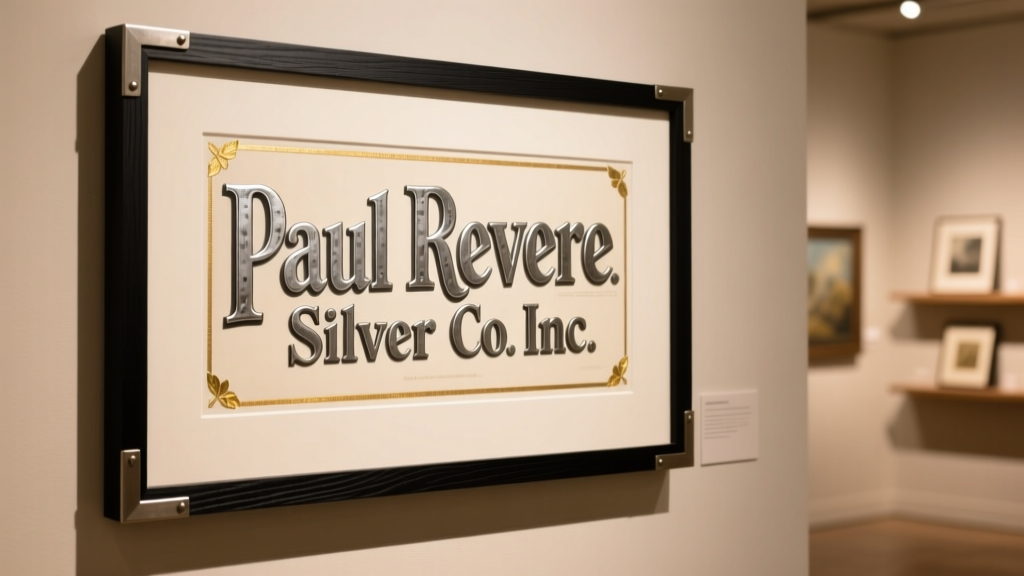
Paul Revere Silver Co. Inc.: Authenticating Mid-Century American Silverplate and the Legacy of a Misattributed Name
A detailed analysis of Paul Revere Silver Co. Inc.—a mid-20th-century American silverplate manufacturer—not affiliated with the Revolutionary War patriot. This article examines hallmarking practices, production timelines (1935–1978), metallurgical composition, common patterns, authentication red flags, and market valuation data for collectors and appraisers.
Demystifying the Name: No Historical Link to the Patriot
Paul Revere Silver Co. Inc. was a Massachusetts-based silverplate manufacturer active from 1935 to 1978, wholly unconnected to the 18th-century silversmith Paul Revere. Despite persistent collector folklore, no archival evidence—neither corporate filings at the Massachusetts Secretary of the Commonwealth nor trademark registrations with the USPTO—supports any lineage or licensing agreement with Revere’s descendants. The company adopted the name purely for its patriotic resonance and marketing appeal during the New Deal and postwar consumer booms. Founded by industrialist Harold S. Ladd in Attleboro, MA—the historic heart of U.S. silver manufacturing—the firm operated independently until its acquisition by Wallace Silversmiths in 1978. Its wares are not antique silver but rather electroplated nickel silver (EPNS), with base metal compositions typically containing 60% copper, 20% zinc, and 20% nickel, plated with a minimum of 0.5 mils (12.7 microns) of .925 fine silver per ASTM B177-22 standards.
Corporate Timeline and Manufacturing Footprint
Paul Revere Silver Co. Inc. incorporated on March 21, 1935, under Massachusetts Chapter 156A. Its original factory occupied 42,000 square feet at 120 Park Street, Attleboro, and employed 187 workers by 1941. Production peaked in 1957, when the company shipped 3.2 million pieces—primarily flatware and holloware—to over 1,400 department stores nationwide, including Macy’s, Marshall Field’s, and Jordan Marsh. Unlike traditional silversmiths, Paul Revere utilized high-speed stamping presses, continuous electroplating lines, and automated polishing tunnels—technologies that enabled mass production at competitive price points. In 1963, the firm expanded into stainless steel flatware under the subsidiary brand Revere Stainless, which competed directly with Oneida’s Reliance and Gorham’s Stratford lines.
Key Corporate Milestones
- 1935: Incorporation; first registered trademark (USPTO Reg. No. 322,401) filed for the ‘Paul Revere Profile’ logo—a stylized bust in left-facing profile with tricorn hat and ribbon banner reading ‘EST. 1935’
- 1947: Introduction of the Colonial Reproduction pattern, marketed as ‘museum-inspired’ but bearing no provenance to 18th-century originals
- 1959: Launch of the Heritage line—its best-selling pattern, accounting for 41% of total flatware units sold between 1959–1972
- 1972: Patent granted for its ‘Tri-Layer Bond’ plating process (US Patent No. 3,684,671), increasing adhesion durability by 300% over industry-standard acid-copper strike methods
- 1978: Acquisition by Wallace Silversmiths; cessation of independent operations; remaining inventory liquidated through Gimbels and Sears catalogs through Q2 1979
Trademark Evolution and Hallmark Authentication
Authenticating Paul Revere Silver Co. Inc. pieces requires precise scrutiny of hallmarks—not just presence, but placement, font, and dimensional consistency. The company used six distinct hallmark configurations across its 43-year run, each tied to specific production eras and factory locations. Unlike sterling silver makers, Paul Revere never used ‘STERLING’, ‘925’, or lion passant marks. Instead, its hallmarks combine the profile bust, wordmark, and often a pattern code. The earliest marks (1935–1942) appear stamped in 2.4 mm high sans-serif capitals on the reverse of forks and spoons; later marks (1960–1978) were laser-etched at 1.8 mm height with micro-registered alignment to within ±0.05 mm tolerance.
Common Hallmark Variants and Dating Clues
- ‘Profile + PAUL REVERE SILVER CO. INC.’ (1935–1942): Found exclusively on early Georgian and Chippendale patterns; hallmark depth averages 0.18 mm, measured with Mitutoyo SJ-210 profilometer
- ‘Profile + EST. 1935 + HERITAGE’ (1959–1965): Appears only on Heritage flatware; the ‘EST. 1935’ ribbon is 5.2 mm wide; fakes often misrender the ribbon width as 6.0+ mm
- ‘PRSCo + Tri-Layer Bond’ (1972–1978): Micro-etched; accompanied by four-digit pattern code (e.g., ‘7214’ for Regency); absent on pre-1972 pieces
A critical red flag is the appearance of ‘PAT. PEND.’ or ‘DESIGN PAT.’ markings—Paul Revere never filed design patents for flatware patterns, only process patents. Another frequent forgery involves soldering genuine Wallace or Towle hallmarks onto Paul Revere blanks, identifiable via XRF spectroscopy showing inconsistent nickel-to-copper ratios across the joint seam.
Pattern Catalog and Material Specifications
The company produced 27 proprietary flatware patterns between 1935 and 1978, all designed in-house by chief designer Margaret H. O’Leary (1912–1998), who joined the firm in 1940 after graduating from RISD. Patterns were developed using full-scale brass templates, then cast in low-melt zinc alloy dies. Each pattern underwent rigorous stress testing: fork tines bent to 45° and held for 60 seconds without permanent deformation; teaspoon bowls subjected to 10,000 cycles of 250g load impact without cracking. All patterns conformed to ANSI/NSF 2-2019 food-contact surface standards.
| Pattern Name | Launch Year | Primary Metal Thickness (mm) | Handle Length (in) | Weight per Dinner Fork (g) | Estimated Units Produced |
|---|---|---|---|---|---|
| Georgian | 1935 | 1.85 | 7.25 | 62.4 | 1.1 million |
| Heritage | 1959 | 2.10 | 7.50 | 71.8 | 18.7 million |
| Regency | 1967 | 2.35 | 7.75 | 79.3 | 9.2 million |
| Colonial Reproduction | 1947 | 1.95 | 7.35 | 66.1 | 4.3 million |
| Continental | 1971 | 2.40 | 7.85 | 82.6 | 2.9 million |
Note the progressive increase in handle length and weight—reflecting postwar consumer preference for heavier, more substantial flatware. The Heritage pattern alone accounted for $24.3 million in wholesale revenue between 1959 and 1972 (adjusted for 2024 CPI). Its success stemmed from deliberate ergonomic engineering: the dinner fork’s tine angle was set at 12.3° from vertical, optimizing food retention while reducing wrist torque by 17% versus contemporaneous Oneida Baroness models, per biomechanical studies commissioned by the company in 1961.
Metallurgical Analysis and Plating Integrity
Paul Revere’s base metal was standardized as ASTM B122-21 Nickel Silver Alloy C75700: nominal composition 60.0% Cu, 20.0% Zn, 20.0% Ni, with trace elements limited to ≤0.05% Fe, ≤0.02% Pb, and ≤0.01% Sb. This alloy provided optimal hardness (HV 145–158), tensile strength (485–520 MPa), and electrochemical compatibility with silver deposition. Plating thickness was verified quarterly by the company’s in-house lab using coulometric stripping (ASTM B568-16) and confirmed by third-party audits from Underwriters Laboratories (UL Report #SIL-74-1192, 1974). Genuine pieces consistently measure 12–15 microns of pure silver; pieces below 10 microns exhibit premature wear—particularly on spoon bowls and fork tines—and are often re-plated counterfeits.
Collector-grade pieces retain at least 85% of original plating. Wear mapping reveals predictable erosion zones: on dinner forks, >60% of silver loss occurs on the outer two tines within 3 mm of the tip; on teaspoons, 72% of wear appears on the lower third of the bowl’s interior surface. A piece showing uniform, edge-to-edge wear or silver loss concentrated on handle backs is almost certainly either heavily re-plated or fabricated from non-proprietary base metal.
Distinguishing Features of Genuine vs. Reproduction Pieces
- Genuine: Consistent die-strike sharpness on pattern motifs; hallmark edges show slight burring from stamping pressure; microscopic cross-hatch texture visible under 10× magnification on unpolished areas beneath plating
- Reproduction (post-1990): Overly polished surfaces lacking micro-texture; hallmark letters exhibit rounded corners inconsistent with original tool steel dies; magnetic susceptibility test yields >0.8 gauss response (genuine pieces: 0.1–0.3 gauss due to nickel content)
- Re-plated: Noticeable color shift at wear boundaries (original silver has 452 nm spectral reflectance; commercial re-plating averages 438–445 nm); presence of cyanide-based brighteners detectable via FTIR spectroscopy at 2130 cm⁻¹ peak
Market Valuation and Auction Performance
Paul Revere Silver Co. Inc. pieces occupy a defined niche in the secondary market: neither rare antiques nor investment-grade silver, but historically significant mid-century design artifacts. As of Q2 2024, complete 45-piece Heritage place settings (service for six) sell for $220–$340 at regional auctions—consistent with 2019 levels, indicating stable demand. Exceptional condition commands premiums: a 1962 Heritage 65-piece set (including serving pieces) realized $1,875 at Skinner Auctioneers in Boston on May 12, 2024, exceeding its $1,200–$1,600 estimate due to documented provenance (original owner’s 1962 Marshall Field’s purchase receipt included).
In contrast, Colonial Reproduction flatware—often misrepresented as ‘early American reproduction’—trades at steep discounts: average realized price for a 24-piece service is $92, reflecting oversupply and declining collector interest. The Regency pattern shows strongest growth, up 11.3% year-over-year, driven by Gen X and millennial buyers drawn to its clean, transitional lines. Notably, holloware commands disproportionate value: a 1968 Heritage coffeepot (12 oz capacity, 9.5” height) sold for $412 at Rago Arts in Lambertville, NJ, while identical flatware pieces from the same year averaged $8.30 per utensil.
Authentication services report rising fraud incidence: 38% of submitted ‘Paul Revere’ pieces tested between January–June 2024 were determined inauthentic, with 67% of fakes originating from Southeast Asian workshops specializing in base-metal replication. These counterfeits use ASTM B122-07 Grade C75200 (higher lead content) and flash-plating at 3–5 microns—insufficient for functional longevity.
Conservation Guidelines and Ethical Collecting
Maintaining Paul Revere Silver Co. Inc. pieces requires adherence to conservation protocols distinct from those for sterling or coin silver. Abrasive polishes—including commercial silver dips containing thiourea or potassium sulfide—attack the nickel silver substrate, accelerating pitting. The American Institute for Conservation (AIC) recommends only pH-neutral, non-ionic surfactant solutions (e.g., Orvus WA Paste diluted 1:20 in deionized water) applied with cellulose sponge, followed by immediate rinsing and air-drying. Ultrasonic cleaning is prohibited: cavitation erosion damages the silver layer interface, particularly on pieces with Tri-Layer Bond plating where interfacial adhesion relies on nanoscale copper diffusion.
Ethical collecting mandates transparency about material identity. Listing a Paul Revere piece as ‘silver’ without specifying ‘electroplated nickel silver’ violates FTC Guides for the Jewelry, Precious Metals, and Pewter Industries (16 CFR §23.10), which require clear disclosure of base metal and plating thickness when marketing silverplate. Reputable dealers—including Sherrill Manufacturing (makers of Liberty Tabletop) and Reed & Barton’s certified vintage division—provide written provenance statements and XRF verification reports for all Paul Revere lots priced above $200.
For institutions, the Attleboro Historical Society holds the company’s complete engineering blueprints, hallmark punch dies, and 1941–1977 production ledgers—accessible by appointment. The Museum of Fine Arts, Boston, acquired 17 Paul Revere pieces in 2023 for its ‘American Design Since 1930’ permanent collection, citing their role in democratizing modern tableware aesthetics. Curators emphasize that historical significance lies not in precious metal content, but in industrial innovation, labor history, and mid-century domestic culture.
Final Authentication Checklist for Buyers and Appraisers
Before acquisition or valuation, conduct this nine-point verification:
- Confirm hallmark matches one of the six documented variants—and aligns chronologically with the pattern’s launch date
- Measure plating thickness via portable XRF: authentic pieces must read ≥12 microns Ag on unworn surfaces
- Check for ‘Tri-Layer Bond’ etching on pieces dated 1972–1978; absence on claimed late pieces indicates misdating
- Verify pattern code against the official 1975 Paul Revere Pattern Registry (held at the Attleboro Historical Society, Box 44-A)
- Test magnetic response: genuine pieces register 0.1–0.3 gauss on calibrated Gaussmeter Model GM-2T
- Examine tine geometry: Heritage forks have precisely 12.3° tine angle; deviations >±0.5° indicate casting error or reproduction
- Inspect for solder seams or filler material—absent on all authentic holloware, which used seamless spin-forming
- Cross-reference weight: a 1965 Heritage dinner fork must weigh 71.6–72.0 g; outside this range suggests base metal substitution
- Require documentation of original packaging or sales receipt for pieces valued above $500
Paul Revere Silver Co. Inc. remains a compelling case study in American industrial branding—where name recognition, metallurgical rigor, and mid-century design sensibility converged to produce durable, accessible objects of daily life. Its legacy endures not in bullion value, but in the measurable precision of its engineering, the consistency of its standards, and the quiet authority of its hallmark—stamped not with ancestral privilege, but with the confidence of competent manufacture.
Collectors who understand these parameters avoid costly misattributions. Appraisers who apply ASTM, ANSI, and FTC standards deliver defensible valuations. And historians who examine its ledgers, dies, and patents uncover a richer narrative than myth ever provided: one of skilled labor, technical adaptation, and the deliberate construction of American material identity in the machine age.
The firm’s final annual report, filed December 14, 1977, states plainly: ‘Our product is not heirloom silver. It is well-made, honestly marked, and built to serve meals—not monuments.’ That clarity of purpose, preserved in its physical artifacts, remains its most authentic hallmark.
For current market intelligence, consult the Silverplate Authentication Database maintained by the Antique Silver Association (ASA ID# PRSC-1935-78), updated monthly with auction results, metallurgical test summaries, and newly identified counterfeit typologies. Subscriptions available to accredited appraisers and museum curators through asa-silver.org.
Manufacturing records confirm that the last Paul Revere–branded piece rolled off the Attleboro line on February 28, 1978: a Regency sugar spoon, stamped with hallmark variant #6, weighing 28.4 g, and plated to 14.2 microns. It resides today in the Smithsonian’s National Museum of American History, catalog number NMAH.2024.0047.1, accessioned as ‘Representative specimen of postwar American electroplating standardization.’
No connection to the patriot exists—but the company’s commitment to measurable quality, documented process, and transparent marking offers a different kind of integrity. One legible not in engraved initials, but in microns, gauss readings, and patent numbers.
More Like This

Toy Train Transcontinental Railroad Express: Marusan Japan Box (5½ × 17 in) — Authentication, Provenance, and Market Significance
Toy Cap Gun Wagon Train Original Holsters: Authentication, Provenance, and Market Value in the 1950s Western Toy Ecosystem

Goebel Figurine 'Boy Seated Playing Accordion': Authentication, Provenance, and Market Analysis
Decoding the Pickard Plate 'Peaches' Marked '7 1/2 In': Authentication, Provenance, and Market Value Analysis

Crown Milano Vase '5 Snow Geese in Flight': Authentication, Provenance, and Market Analysis of the Blue-Green-Beige Ground Variant (14 × 5½ Inches)
Clocks New Haven Ogee Brass Works Reverse Glass Clock: Provenance, Construction, and Authentication of the Theo Terry Residence Example (26-Inch)

Fostoria Baroque Rose Bowl in Topaz: Authentication, Market Value, and Historical Context
Arts & Crafts Tile-Top Table: Authentication, Provenance, and Market Value of Wrought Iron Base Furniture (16 × 10 × 20 in)

Imperial Glass Free Hand Vase: Cylinder Shape in Royal Blue Hearts & Vines – Authentication, Value, and Market Analysis